

Most people who have dealt with narcissists eventually say the same thing: narcissists cannot be understood logically.
That happens because their behavior often contradicts the logic of a normal relationship. Most people think, “If I explain it clearly enough, they will understand.” In practice, this almost never works.
This article gives you a lens through which narcissists can be understood logically: their motives, psychological mechanisms, biological circuits, behavioral maps, and why narcissists operate through an abuse cycle model in the first place.
Narcissistic Cycle Overview: The Abuse Cycle
This article is part of the Narcissistic Cycle series. Each part of this repeating loop has been explored in detail in separate articles, which you can access by clicking on the titles:
Idealization → Devaluation → Discard → Hoover → Repeat
The narcissistic abuse cycle repeats on a global scale, regardless of country, culture, or ethnic background. People in different settings have been discussing this phenomenon for a long time. Research on the narcissistic abuse cycle is still limited, but the cycle is beginning to receive more attention from researchers because of its repetition and the psychological harm it can create (Ameen et al., 2025).
TL;DR
- Narcissistic supply and facade as a feeding and camouflage system
- Abuse cycle as a survival strategy
- Studies on the narcissist mechanism from different angles
- Narcissism as a biopsychosocial system
- Social-parasitic survival model inside the dominance hierarchy
- Stone Age context: The “By the Fire” Function
- A framework to recognize the narcissistic abuse cycle
- “100 narcissists in one village”
- General conclusion
Goal Of This Material
Through our own abuse cycle observations, we identified repeated models and ways to understand and recognize narcissistic behavior, with the goal of reducing the damage it can cause.
Narcissists are predictable. They repeat. You just have to stop looking at them through the lens of normal human relationship logic and start looking at them as a system. That is the observer position. From that position, it becomes much easier to see how a narcissist operates and reduce damage before it escalates.
This article is a theoretical tool grounded in observation, research, and synthesis across related fields for recognition, self-protection, and understanding, not diagnosis. Narcissistic Personality Disorder (NPD) can only be diagnosed by a qualified professional.
Download the Manipulation Recognition Guide
Not sure if you are being manipulated by the narcissist? Take a test. Press a button below. Sign up for Dark Psychology Lab, and we will send it to your email.
Repeating Narcissistic Behavior Models
At their core, narcissists are unstable. Their internal processes, self-esteem, and sense of status tend to depend on the reactions of people around them. One way to recognize narcissistic patterns is to observe their reactions to social cues and the intensity of those reactions.
Much of narcissistic behavior can be understood as a recurring self-regulation pattern that seeks to stabilize itself by extracting narcissistic supply (Morf & Rhodewalt, 2001) and operates from an antagonistic core.
The narcissistic facade is what allows this system to function: it attracts attention, protects fragile self-worth, controls the social narrative, and gives the narcissist enough credibility to avoid accountability when their real behavior starts to contradict their public image. At the same time, the facade helps maintain supply rotation, a feeding cycle that operates through the abuse cycle: idealization, devaluation, discard, and hoover, if they find a suitable person for it. We explain this in more detail in the articles:
Narcissistic Supply and Narcissistic Facade

Simplified Narcissistic Algorithm
Although narcissists are different people, from different social backgrounds, with different histories, views, and tendencies, their behavior patterns tend to be fundamentally similar.
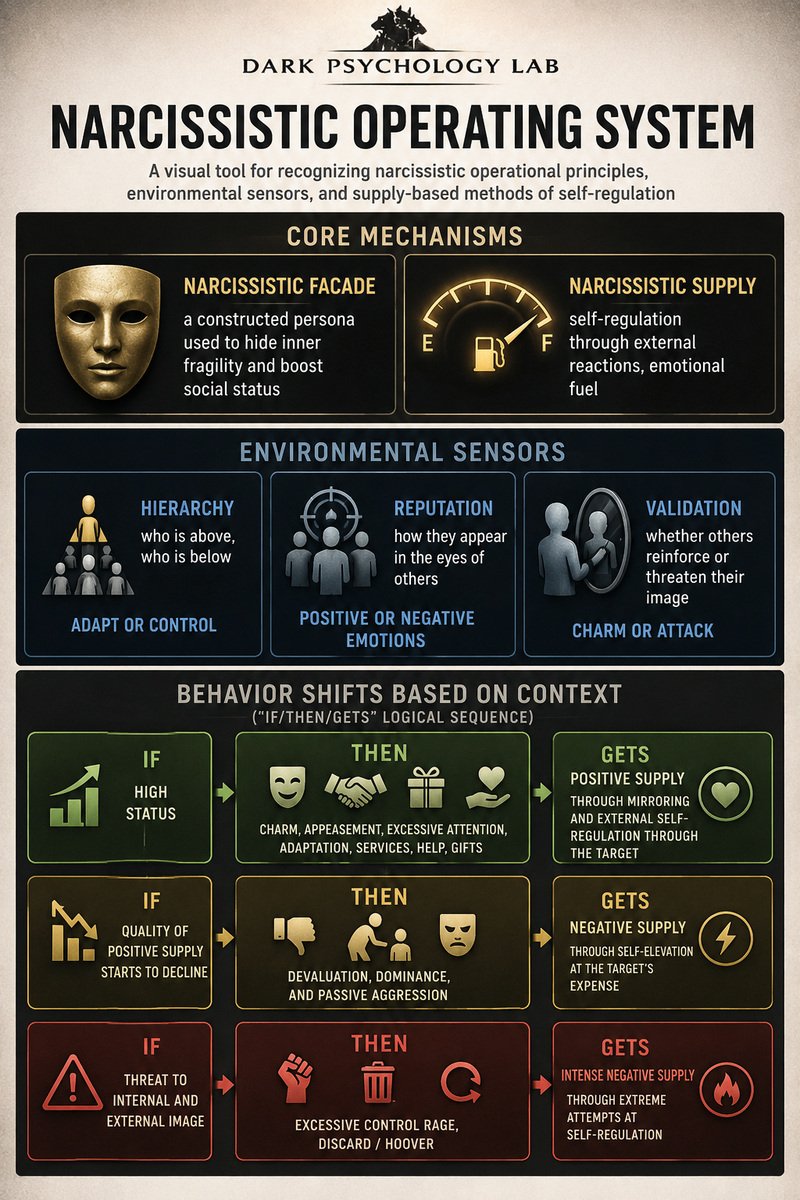
Core mechanisms:
- Narcissistic facade = a constructed persona used to hide inner fragility and boost social status
- Narcissistic supply = self-regulation through external reactions, emotional fuel
Environmental sensors:
- Hierarchy: who is above, who is below → Adapt or control
- Reputation: how they appear in the eyes of others → Positive or negative emotions
- Validation: whether others reinforce or threaten their image → Charm or attack
Behavior and supply shifts based on context (“If/Then/Gets” logical sequence):
- If high status → Then charm, appeasement, excessive attention, adaptation, services, help, gifts → Gets positive supply through mirroring and external self-regulation through the target
- If the quality of positive supply starts to decline → Then devaluation, dominance, and passive aggression → Gets negative supply through self-elevation at the target’s expense
- If threat to internal and external image → Then excessive control rage, discard / hoover → Gets intense negative supply through extreme attempts at self-regulation
The Shift From Positive to Negative Supply
Narcissists are selective. They tend to choose targets they feel they can control in one way or another. Once the narcissistic supply mechanism locks onto one person, the abuse cycle starts almost automatically.
During this cycle, positive supply and relatively stable behavior usually appear mainly in the idealization phase. But even there, devaluation has already begun beneath the surface. The narcissist is already collecting material for future attacks, testing vulnerabilities, exploiting weak points, and observing how much control they can gain over the target. Some narcissists, for example, covert/vulnerable, can stretch the idealization phase for years, often spending most of that time pretending, because deception is in their nature. Others choose a suitable partner they can control, use them as a social springboard, and never cross the line too far because it is useful for them. A lot of this behavior depends on the narcissist’s view of themselves, their motives, and the other person’s status.
After idealization, for the rest of the cycle, they mainly receive negative supply: self-elevation at another person’s expense. In some cases, this can escalate into coercive control or physical violence.
Narcissists can be very careful. They usually do not use more openly abusive techniques to extract sadistic forms of supply unless they feel safe, superior to the target, and supported by the environment. If the target can defend themselves, is difficult to control, or does not give the narcissist enough access, the abuse cycle may not escalate (Andrews et al., 2023).
Conclusion: A Feeding and Camouflage System
In a broader sense, narcissistic behavior resembles certain life forms in nature that attract, deceive, and capture their prey through similar mechanisms:
- The facade creates access. At this level, it can be compared to aggressive mimicry (Yu et al., 2021): a technique used by predators and parasites to attract prey by appearing charming or safe.
- Supply is what the narcissistic system feeds on once access is secured.
- The abuse cycle functions as a way to extract more intense forms of supply than the environment can normally provide.
The Narcissistic Mechanism: Development, Biology, and Social Environment
To understand how the abuse cycle functions as a supply extraction strategy, we first need to understand how people with narcissistic personality traits may differ from other people inherently, neurologically, and socially.
Inherited and Acquired Traits
Narcissistic traits appear to have a significant heritable component. A 2026 extended twin and family analysis suggests that genetic factors may explain about half of the differences in narcissism between people (Back et al., 2026). These traits exist on a spectrum and vary in intensity across the general population (Krizan & Herlache, 2018; Livesley et al., 1993). This means that some tendencies connected to narcissism may be inherited, while other parts may develop or strengthen through experience from childhood onward (Ross et al., 2024).
Brain Differences in Narcissism
At the neurobiological level, some studies suggest that people with high narcissistic traits may show differences in brain structure or function.
Decreased Impulse Control, Increased External Dependence:
Structural MRI studies have mentioned reduced cortical thickness or volume in prefrontal regions (Schulze et al., 2013). This may lead to more difficulty with impulse control and greater dependence on external regulation (Heatherton & Wagner, 2011).
Reduced Empathy, Heightened Reward Seeking:
Other research discusses possible differences in the insula, cingulate cortex, and reward networks. These brain structures are connected with empathy, social reward, and responses to recognition (Ash et al., 2023).
Increased Reward Sensitivity:
A 2024 neurobiological review connects narcissistic reward-seeking behavior with dopamine-related mechanisms. Narcissists may be more sensitive to dopamine-related rewards, which can create stronger positive emotions in response to rapid closeness, admiration, or status signals (Cale & Al-Saadi, 2024).
Decreased Attachment Capacity, Increased Aggressive Reactivity:
Some research has found that oxytocin levels may be lower in certain individuals with narcissistic traits (Cochran et al., 2014). Oxytocin is involved in social behavior, emotional bonding, trust, and attachment-related processes (Ito et al., 2019). Lower oxytocin activity may increase stress sensitivity and contribute to more aggressive reactions to environmental stimuli (Pfundmair et al., 2018).
Social Environment and Narcissism
Narcissism is found across cultures, suggesting it is a broader phenomenon of human social behavior (Miscikowski et al., 2025). This supports the view that narcissism is a globally widespread phenomenon.
The social and economic environment also matters. The study observed that narcissism scores were somewhat higher in countries with higher GDP (Gross Domestic Product). Higher-GDP societies are often associated with higher population density and greater movement between people, groups, and social environments. This suggests that the narcissistic model may be easier to apply and sustain in a more socially dense environment, meaning narcissism can be understood as a strategy that operates inside social cooperation systems (Jonason et al., 2020).
Narcissistic Mechanism Conclusion: The Biopsychosocial System
DPL Framework
Based on these studies and DPL synthesis, the narcissistic system, especially in more harmful forms, can be understood as adapted for exploitation, as if its internal structure and external operating factors are organized to use other people for its own needs. From this point, narcissism looks less like a simple conscious choice and more like a biologically driven operating program:
- Narcissistic traits can develop from a combination of inherited tendencies and environmental pressures. For some people, these tendencies appear early. For others, they grow stronger over time through developmental experiences and social reinforcement. This suggests that narcissism can function as one possible coping strategy embedded in the brain’s regulatory architecture.
- Reduced emotional empathy protects them from internal discomfort and guilt, while sensitive dopamine pathways push them to constantly climb the dominance hierarchy. This creates a coping strategy that can resemble social parasitism. In social insects, social parasites exploit the host’s social structure rather than building their own (Rabeling, 2020). This gives us a useful lens for understanding narcissistic exploitation: the facade creates access, the bond creates dependency, and the target gradually relaxes, lets the narcissist in, and adapts to them. After that, the narcissist can extract more and more from the target and, in many cases, hurt them to gain more social validation and strengthen their position in the dominance hierarchy.
- A competitive, status-driven environment may create more opportunities for narcissistic traits to be rewarded and reinforced. This kind of society rewards external image and status, so narcissism may become not only a dominance strategy but also a success strategy.
This fits a survival strategy that uses other people.
The Narcissistic Abuse Cycle as a Survival Strategy
Narcissistic behavior often looks unstable or contradictory, but if we separate the mechanism from moral interpretation and observe narcissistic patterns through behavioral ecology, we can see something closer to a survival algorithm operating within a social field, with the narcissistic abuse cycle acting as a way to extract the resources needed to preserve image and implement control:
- Status, hierarchy, image, validation, and idealization become inputs.
- Control, manipulation, attack, withdrawal, devaluation, and discard become outputs.
The narcissist constantly scans hierarchical structures, threats, and sources of supply (Grapsas et al., 2020). Their behavior may look chaotic from the outside, but underneath it often follows a primitive adaptation sequence: gain validation, maintain control, remove if threatened, restore position.
That is the abuse cycle.
Output Formula of the Abuse Cycle
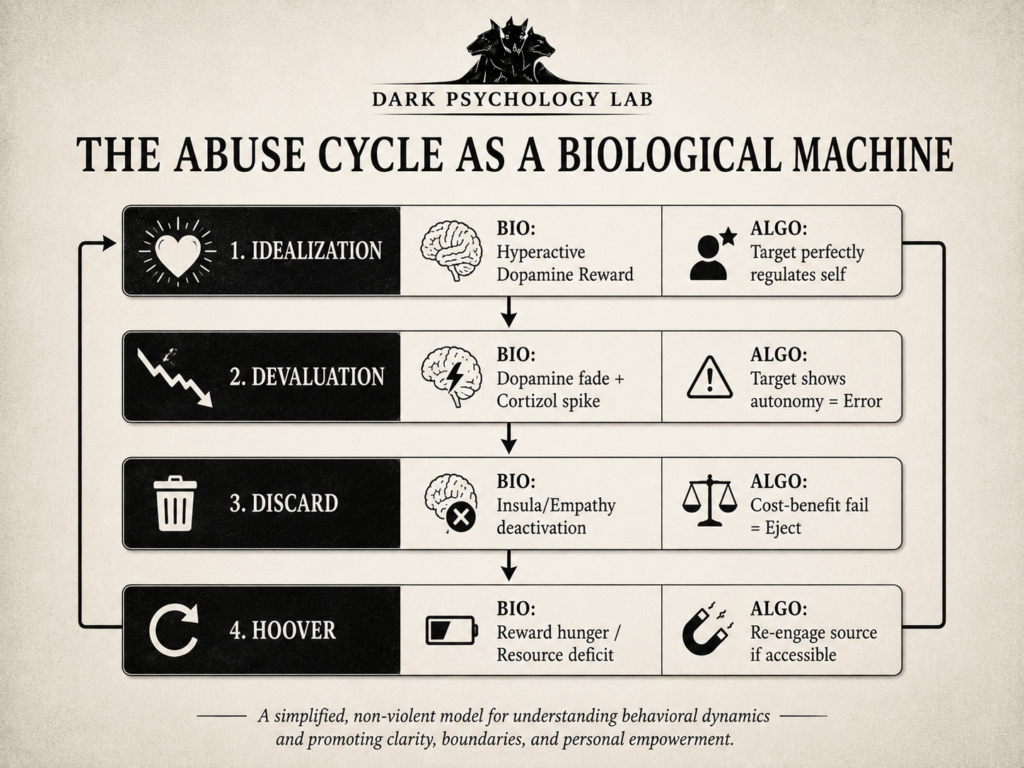
Idealization
- Biology: A reward-sensitive dopamine mechanism locks onto a new valuable resource. Less conscious narcissists may confuse this attachment-and-supply process with love.
- Algorithm: Intense attachment begins. The target regulates the narcissist’s False Self almost perfectly.
Devaluation
- Biology: The dopamine effect starts to fade. Stress and dominance pathways become more active, including cortisol and aggression-related mechanisms.
- Algorithm: The target becomes “defective” when it shows autonomy, human limitations, or vulnerabilities. This threatens the narcissist’s image. Control begins and escalates.
Discard
- Biology: The antagonistic defense mechanism kicks in. Empathy-related deficits may protect the narcissistic system from guilt.
- Algorithm: The narcissist senses a threat, perceives a loss of control, or no longer receives the right kind of supply. They can no longer tolerate the target. The cost of self-regulation becomes too high, so the target is removed in order to preserve the False Self.
Hoover
- Biology: A lack of supply can create an inner hunger. After the discard, the narcissist often feels positioned above the target, which can make it easier to extract the needed resource from someone they already know.
- Algorithm: If the target becomes accessible again, the process returns to the starting position for another extraction cycle, but usually faster and more intense.
Conclusion: Abuse Cycle as Feeding Process
This suggests that, in some sense, the cycle resembles a feeding process. Once the narcissist gains access to the target, they begin draining them and extracting increasingly valuable resources, while constantly assessing risk and the level of group support around them. When they detect a threat, their response depends on the power balance: they either withdraw or escalate the pressure.
Evolutionary Theory: Social Parasitism Model
If we remove moral judgment, narcissism looks very similar to a social-parasitic survival model inside the dominance hierarchy. The fact that narcissists often do not consciously know they are narcissists, yet still repeat the same behaviors, supports the idea that narcissism may be embedded in older layers of our brain architecture.
Through an evolutionary lens, narcissistic behavior can be seen as a status and resource strategy within social environments (Manson, 2020).
- Resource Transfer (Parasitism): If the narcissistic structure cannot effectively generate internal stability and self-worth on its own, it may depend on extracting these resources from the environment. This resembles biological parasitism as a conceptual lens: an organism that lacks certain functions survives by exploiting the host’s functions.
- Short-Term Evolutionary Advantage: The shift from charm into control, influenced by reward, stress, and dominance-related systems, can be viewed as an adaptive mechanism. In nature, predatory organisms may use mimicry and deceptive signals to gain access to a host or prey source before extracting resources.
In some parasitic structures, the host remains functional for some time because it continues to provide resources. In the context of the narcissistic cycle, we can see a similar behavioral logic: idealization creates the bond, which is then used to extract supply. Devaluation and discard serve as status-repositioning tools: the narcissist lowers the target to elevate themselves in the social field, while also defending their image when the person becomes more dependent, less useful, or threatens the narcissist’s facade.
Narcissism as a Survival Strategy
DPL Framework — Stone Age Context: The “By the Fire” Function

Thousands of years ago, human tribes lived in small groups where survival required a great deal of energy. In this environment, narcissism may have developed as an exploitative social strategy: a way of using charm, social status positioning, and other people’s resources to gain social prominence inside the group (Semenyna, 2021).
- Social chameleonism: If the environment or the tribal leaders are stronger and cannot be controlled, the narcissistic system adapts. It imitates loyalty, friendship, and closeness (love-bombing, mirroring) to higher-ranking members, securing safe shelter and resources by the fire.
- Evolutionary anesthetic: If the narcissistic operating model detects vulnerability within its own group, it instinctively targets the vulnerable member to use their resources. It is possible that, through evolution, reduced emotional empathy may function like an evolutionary anesthetic, a way to take from others without being stopped by guilt. If the narcissist felt regret, exploiting vulnerable tribe members would become much harder. Lower emotional empathy may weaken certain internal moral brakes, allowing the system to extract resources from the tribe’s vulnerable members with maximum efficiency.
In evolutionary psychology, this resembles an exploitative adaptation: a psychological mechanism or behavioral strategy shaped by evolution to manipulate other members of the social group, exploit their resources, and increase one’s own evolutionary fitness (Hagen, 2008).
The Narcissistic Abuse Cycle Role in Evolutionary Ecology
The narcissistic abuse cycle as a survival and resource-extraction mechanism works roughly like this:
Target selection → idealization → attachment → supply extraction → weakening of resistance → devaluation → discard → search for a new source or hoover
At the beginning, the narcissistic survival mechanism connects to the target. Then it creates an emotional bond. After that, it begins to reduce the value it gives and increase the value it extracts, gradually weakening the target as it feeds itself. The bond is usually formed so intensely that the target later tries to preserve it themselves.
When the target weakens or begins to see, feel, or resist the intent of this behavior, devaluation, reputation pressure, or discard activates. The goal is to preserve the narcissist and control or destroy the target inside the social environment.
Next, we will break down the sequence of the narcissistic survival model based on abuse cycle observations. This is a recognition and understanding tool that may help identify the cycle as it happens and interrupt it before it continues.
1. Binding the Host and Saving Energy: Idealization
In nature, parasitism is economic efficiency. Instead of risking its own life in hunting or protecting the camp, the “narcissistic ancestor” uses manipulation.
- Mechanism: The narcissist charms a specific person, the host, by convincing them of their specialness. In the beginning phase, the narcissist invests their own resources: attention, charm, social influence, and material benefit, in order to condition the target to them.
- Exploitation: After securing trust, the narcissist tries to remain above at all times. By doing so, they get more pieces of meat and a safer place by the fire. They are not alone. They have a follower. They use another person’s resources for their own survival while still giving enough to maintain control.
A general observation from narcissistic dynamics is that the narcissist can give a lot in the beginning.
This strategy is inherently deceptive, and at first, its true intentions are often not even suspected. It looks useful. It adapts, matches the person’s needs, gives what the person is missing at that moment, and becomes a trusted insider.
When the host is conditioned and made dependent, deeper extraction begins.
2. Intermittent Reinforcement and Resource Extraction: Devaluation
- Mechanism: The narcissist gradually starts reducing the resources they give, through intermittent reinforcement, and watches the host’s reaction. If the narcissist sees that the person is already charmed and attached, they begin to lower the quality of their behavior with the intent to establish dominance. When they cross the line too far, they temporarily normalize the relationship again to maintain their supply. The target usually begins trying to bring back the original, good version of the narcissist.
- Exploitation: The host, already conditioned to the narcissist, begins voluntarily giving even more energy and resources while receiving only rare crumbs of attention. This creates one of the strongest neurobiological bonds in abusive relationships: a trauma bond. This loop drains the supplier while feeding the narcissist more and more.
To better understand how this technique works, read:
How Intermittent Reinforcement Creates Obsession
3. Preventive Smearing and Expulsion: Discard
In the past, under Stone Age-like conditions, being expelled from the group could mean almost certain death, because an individual could not survive alone in the wild. At that time, humans lived in groups not simply because they preferred it, but because group life was a condition for survival (Spoor & Williams, 2006).
- Mechanism: When the host becomes too weak, lacks resources, support, or begins to threaten the narcissist’s image, the antagonistic defense system activates. This can happen when the person starts understanding that they are being exploited, resisting oppression, or damaging the narcissist’s image, which would be extremely dangerous for survival by the fire.
- Exploitation: Because this model’s survival depended on reputation, the narcissist, upon sensing danger, smears the target first in the tribe’s eyes. This is the smear campaign. The once valuable source of supply is then socially isolated, exploited, or expelled, while the narcissist preserves their flawless status by the fire and remains ready to search for a new host.
We have analyzed how group pressure and exclusion from the group affect the nervous system. Today, this often appears in workplace environments. To go deeper, read:
The Psychology of Group Pressure Escalation
Is This a Scientifically Successful Survival Strategy
Biologically, it may be successful in some contexts. From a moral perspective, it is destructive, but evolutionary pressure rewards survival and reproduction, not morality.
Historically, charisma, confidence, and the ability to manipulate impression management may have enabled narcissists to reach higher status in the hierarchy more easily, attract partners, and successfully pass on their genetic traits to future generations (Holtzman & Donnellan, 2015).
This theory explains why narcissism did not disappear but often thrives in social environments. It works as a specialized social strategy (Hunt & Jaeggi, 2022). As long as society contains empathic, cooperative people, there will also be a niche for those who use these good qualities to get more, sometimes as a resource. Cooperation and exploitation can exist as two sides of the same coin.
Recognition Formula: Abuse Cycle Identification
Even though narcissists often operate through repeating modules of facade, supply as the main motive, and the abuse cycle, they can still be difficult to recognize.
Sometimes people only start studying narcissists after being harmed several times. Only then do they begin to notice the subtle details that separate narcissists from other people. But even then, most people have some narcissistic traits or toxic behavior habits. That is why it is impossible to identify this behavioral model through only a few formula points (Miller et al., 2017).
Formula sequence to help identify parasitic strategy:
Connects → gives more → charms → conditions → takes more → gives less → weakens → rewrites status → removes → checks if return is still possible.
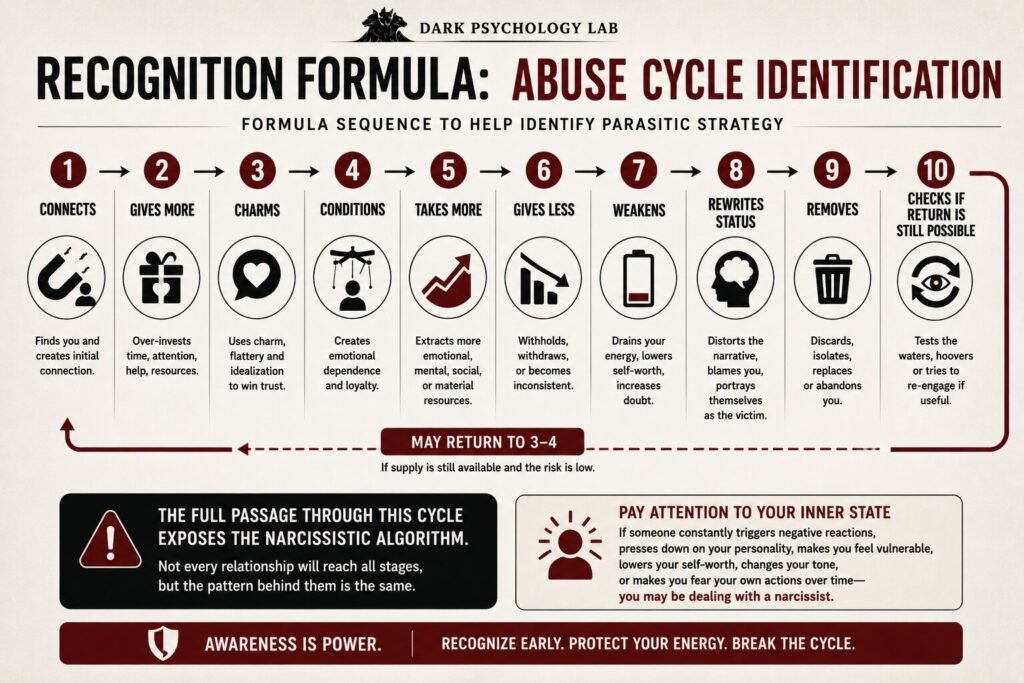
The full passage through this cycle exposes the narcissistic algorithm.
It is also useful to pay attention to your internal state and notice your own inner processes. If, during the relationship, the person constantly elicits negative reactions from you, seems to press down on your personality, makes you feel more vulnerable, and, over time, your tone of voice changes, your self-worth lowers, or you begin to fear your own actions, you may be dealing with a narcissist.
Recognition Through Reaction to Rejection
Because this parasitic structure depends on a host and the surrounding social environment, it reacts very sensitively to rejection (Poggi et al., 2019). Within this structure, rejection can be experienced as a threat to survival.
In a 2026 study, researchers used artificial intelligence to analyze the relationships among narcissistic traits, social rejection, and hostile interpretation bias (Li & Liu, 2026). Participants were divided by narcissism type: grandiose, implicit/vulnerable (covert), and a control group. Then they were placed into a social acceptance or rejection situation using the Cyberball game. In one condition, the participant was included in the game. In the other, the participant was almost ignored.
The results showed that narcissistic traits, especially vulnerable/implicit narcissism, were strongly connected with the tendency to interpret ambiguous social situations as hostile. In other words, when this kind of person experiences or imagines rejection, their internal algorithm is more likely to read the environment as threatening: “they are ignoring me,” “they do not respect me,” “they are against me,” “my status is falling.” This is narcissistic injury mechanics.
Formula:
ambiguous social signal → threat to self-worth → hostile interpretation → narcissistic injury → rage
The study also suggests that narcissistic sensitivity to rejection can show a consistent pattern, similar to the globally observed abuse cycle that we systematized into the Social Dominance Hierarchy Parasitism Model. This supports our theory about the predictability of narcissists.
If this pattern is predictable, then target selection may also follow recognizable patterns. This means that people who become a narcissist’s resource and are pulled into the abuse cycle may also share common traits such as sensitivity, vulnerability, and openness.
To recognize and defend yourself from narcissistic abuse, it also helps to examine your own vulnerabilities, reactions, and attachment hooks.
A Thought Experiment: 100 Narcissists in One Village

Imagine an experiment where 100 unsuspecting people with strong narcissistic traits are placed in an isolated village environment where only they exist.
This model would likely collapse, or weaker narcissists would be forced to reshape themselves and submit. As a result, their internal processes could become completely dysregulated, leading to strong retaliation, revenge, and similar forms of aggression.
Because a parasitic strategy depends on a host to survive, an environment in which everyone tries only to extract resources may eventually destroy itself (Buckingham & Ashby, 2022). Narcissism can be evolutionarily successful only as long as it remains a social minority.
Risk Gate: Use This Model for Recognition
The parasitism model is a conceptual lens that serves as a means for recognition and self-protection, not for diagnosing people or confronting them. It helps explain repeated extraction, control, devaluation, and discard. It should not be used to dehumanize people or reduce every difficult person to a “narcissist.”
If there is a power imbalance, financial dependency, threats, stalking, retaliation, or physical danger, do not use this model to provoke confrontation. First, assess safety, document what is happening, reduce emotional exposure, and seek external support when needed.
The goal is clarity, not escalation.
Defense Guides – Practical Self-Protection
Dark Psychology Lab focuses on clarity and self-protection in situations involving manipulation, power imbalance, and covert psychological pressure.
The following defense guides expand on practical tools to reduce psychological damage and regain control:
Psychological Manipulation
Psychological Manipulation Defense: Safe Strategies and Dangerous Tactics Explained
Narcissistic Dynamics
How to Deal With a Narcissist and What to Do When You Can’t Leave
Toxic Workplace
Workplace Mobbing Defense Playbook: 17-Step Guide
General Conclusion
The narcissistic abuse cycle becomes clearer when we see it not as one relationship, but as a resource extraction system. This strategy may be rooted in deeper regulatory brain structures of the narcissist. It helps explain why clinical narcissism is very difficult to change, even though conscious effort can sometimes create improvement. It is not a simple “thinking error.” It is linked to the brain’s architecture (Nenadić et al., 2021). This also explains why narcissism can form in some people as a defensive reaction to a hostile environment: a neurobiological adaptation that functions to protect the person from psychological destruction.
When a person understands the mechanism, they blame themselves less. They see where the hook was, where the pressure started, where their reactions became supply, and where they need to reduce damage.
Clarity does not erase what happened. It reduces the monster to its real size.
Disclaimer
This article is for educational, informational, and self-protection purposes only. It is not medical advice, psychological diagnosis, legal advice, or a replacement for professional support.
The DPL system model uses research, observation, and conceptual interpretation to explain repeated narcissistic abuse cycle patterns. It should not be used to diagnose a person, label every difficult relationship as narcissistic abuse, or justify confrontation in unsafe situations. Narcissistic Personality Disorder can only be diagnosed by a qualified professional. For the full legal and content disclaimer, read our Disclaimer Page.
If you are dealing with physical danger, stalking, coercive control, workplace retaliation, financial dependency, severe emotional distress, or threats, prioritize safety first. Contact qualified professionals, legal support, workplace authorities, emergency services, or local crisis resources when needed.
Use this model to recognize mechanisms, reduce self-blame, and make safer decisions.
Dark Psychology Lab
Original content based on lived experience and independent psychological analysis.