

This case study deconstructs how a senior manager displaying malignant narcissism, leaning more toward the covert/vulnerable subtype, and Machiavellian traits appears to have deliberately selected and systematically broken down an employee through manipulation.
Over time, this pressure escalated into a synergy of manipulation tactics known as Death by a Thousand Cuts (DBATC). It consists of repeated acts of micro-abuse: covert wearing-down techniques that are difficult to identify. Their cumulative effect slowly and methodically destabilizes the target’s nervous system.
DPL Anonymized Case Study: Manipulative Discard Analysis
This article belongs to the Dark Psychology Lab case study category. Because of the sensitive information it discusses, all identifying details have been anonymized.
This is an analysis of a manipulative discard carried out by a Machiavellian malignant narcissist. Here, we will deconstruct the manipulation techniques used to socially and psychologically destroy a person and remove them from the environment. The value of this material lies in showing how a high-caliber manipulator operates.
The terms narcissist and Machiavellian used in this case study are not clinical diagnoses but behavioral classifications based on recurring, observable actions. Conditions such as NPD can only be diagnosed by a qualified mental health professional. Dark Triad terminology here is applied strictly as an analytical framework.
TL;DR
- The subject’s personality traits, behavioral model, and the cause of the narcissistic injury
- An overview of covert manipulations and how they preserve plausible deniability
- The Manipulative Hit technique as a primary pressure tactic
- Covert Coercive Control: Death by a Thousand Cuts, a technique that creates personality erosion
- Risk gating and defense against manipulators
Download the Manipulation Recognition Guide
Not sure if you are being manipulated? Take a test. Press a button below. Sign up for Dark Psychology Lab, and we will send it to your email.
Research Subject: Machiavellian Malignant Narcissistic Senior Manager
The subject’s behavior indicates a highly unusual and complex psychological profile.

Narcissistic Traits
The individual exhibits sensitivity to criticism, episodes of envy, disproportionately strong reactions to perceived threats involving his status, and retaliatory devaluation or aggression when his grandiosity is injured. His family and social image may also be used as part of a facade (Kernberg, 2009).
As the pressure escalates, group dynamics are drawn into the process. The manipulation is spread and carried out through so-called flying monkeys. This human-based leverage system is common in narcissistic dynamics.
Malignant and Covert/Vulnerable Traits
The subject shows both the sensitivity typical of covert/vulnerable narcissism and the grandiosity associated with overt/grandiose narcissism. Grandiose and vulnerable features can coexist and fluctuate within pathological narcissism (Pincus & Lukowitsky, 2010). His sensitivity is disproportionately high compared with a typical overt narcissist, which places his narcissistic traits closer to the covert/vulnerable type. Over time, he also relies more heavily on emotional manipulation, which again resembles the covert subtype (Casale et al., 2019). However, this may simply be a proven and effective way to apply pressure while preserving his image as a competent manager.
Combined with his apparent use of public humiliation as a source of sadistic narcissistic supply, these features support our categorization of the subject within the malignant framework (Goldner-Vukov & Moore, 2010). It appears that he uses his position in the hierarchy to obtain this specific form of supply (Gauglitz et al., 2022).
Machiavellian Traits
Strong interpersonal manipulation and an ability to monitor and use people within the surrounding social circle for his own benefit highlight the subject’s Machiavellianism (Bereczkei, 2015). He is also highly cautious. It seems that he avoids escalating the conflict until he feels secure and has sufficiently tested the chosen target. This selectivity is consistent with Machiavellian behavior.
Cause of the Manipulative Pressure: Narcissistic Injury
Why did the narcissist choose this person?
The target did not always comply with the manager’s demands, especially when they conflicted with his values, boundaries, or professional judgment. He maintained his position and was not easily drawn into a relationship built on submission to authority. As a result, their work relationship gradually deteriorated. Narcissistic tests, control attempts, and manipulative episodes from the manager became more frequent. Over time, our subject experienced a narcissistic injury: possibly the target’s independence began to feel like a threat to his authority and grandiose self-perception.
As the target spent more time in the manipulative environment, he became exhausted and began showing more vulnerability. The malignant narcissist then intensified the pressure. This appears to have shown the manipulator that his techniques were working and that the attack could be escalated. Narcissists tend to exploit vulnerable targets (Black et al., 2014).
Overall, the employee may have been selected as a target because of his independence, interpersonal boundaries, and resistance to imposed authority.
For a broader explanation of this type of managerial behavior and how to respond:
How to Deal With a Toxic Boss Without Confrontation
Analysis of Manipulation Techniques
Here, we will deconstruct some of the manipulation techniques our subject, a toxic manager, uses against his target. Despite their differences, all of these techniques contribute to devaluation and discard. They humiliate and destabilize the person, provoke negative reactions, increase the manipulator’s control, and raise his status at the target’s expense.
A central feature of these pressure tactics is the preservation of plausible deniability. The manipulator keeps distance and, when confronted, can always throw the ball back into the target’s court, creating even more confusion through gaslighting or DARVO: “That is only how you see it,” “You misunderstood,” or something similar. Regardless of the effect, he always has an excuse and a way to deflect responsibility (Popat & Pandey, 2026).
The manipulator operates through a fog of deception. Deception tends to be part of his nature. By constantly lying and distorting the facts, he creates permanent uncertainty around himself. Facts no longer match reality, and misleading explanations fill the gaps.
Trying to clarify the situation with him only gives him more leverage and may expose more vulnerabilities. Everything you say can later be used against you.
1. The Truth-Lie-Truth Sandwich: Form of Covert Gaslighting
DPL Conceptual Framework
What is it?
Technically, this is gaslighting inserted between truths. It is an information-distortion technique.
See our full guide to gaslighting:
The Hidden Process of Psychological Manipulation
How does it work?
The tactic relies on a truth-lie-truth sequence. An obvious lie, a misleading detail, or a harmful action is placed between truths or logical facts.
Most people do not expect someone to lie for no apparent reason. That is why this technique works. Some manipulators, however, gain a sense of dominance and satisfaction from misleading someone.
If the target later notices the inconsistency and confronts the manipulator, he can escape responsibility by claiming it was an “accidental misunderstanding” through plausible deniability. Over time, the target may begin to struggle to distinguish truth from lies and to confront the manipulator more often, with only a small chance of proving what happened. This technique, as well as other covert manipulations, can also provoke reactive abuse, a state in which the target responds more aggressively or emotionally after being provoked through manipulation.
Case Overview: A Truth-Lie-Truth Sandwich Episode
- While an employee was trying to resolve a problem with broken transport, the senior manager sent the exact repair location through the company communication channel. This was true.
- At the same time, he wrote down a contact phone number on paper. The number was incorrect and unusable. This was the lie.
- When the employee returned to clarify the information, the manager calmly corrected one digit and said, “The number was simply written unclearly.” He presented the false information as a mistake, which functioned as gaslighting.
- When the target called the “corrected number,” there was still no signal. This was another lie.
- However, through the location link posted in the company communication channel, the employee could find the repair shop online, where the correct phone number was listed. The location was true.
The result was a small psychological hit. The target may begin to overthink:
“Why did he write that number?”
“Maybe he mixed something up.”
“Maybe his contact details were simply different.”
People rarely pay much attention to details this small. During Death by a Thousand Cuts, however, these incidents keep accumulating and gradually begin carrying more psychological weight.
2. The Manipulative Hit Technique
DPL Conceptual Framework
What is it?
A technique in which many manipulations are used within a short period of time, following the Truth-Lie-Truth Sandwich principle.
How does it work?
The target is confronted with many different forms of manipulation at once, both emotional and psychological, while some of them are embedded in truth. This immediately creates strong cognitive dissonance (Harmon-Jones & Mills, 2019), while processing several interacting elements at once increases cognitive load (Sweller, 2024).
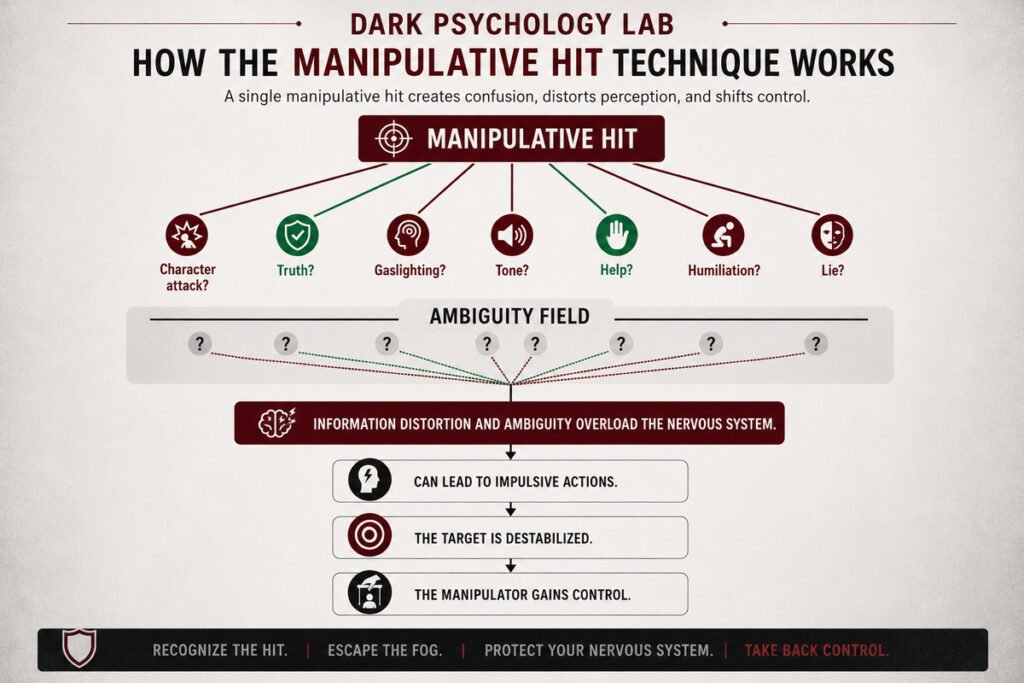
The brain tries to assemble puzzle pieces from several different puzzles at the same time.
The Primary Manipulation Used for Pressure
It appears that the Machiavellian malignant narcissist uses the Manipulative Hit technique as his main pressure and information-extraction tool.
A single act of gaslighting or DARVO may have a limited effect, while using several methods at once can create emotional and cognitive flooding. The nervous system reacts to multiple threats simultaneously. The target may become confused or disoriented, especially if he has never encountered anything similar before. Logical thinking may weaken, making it easier for the manipulator to extract information, provoke the desired reaction, or push the target toward a decision that goes against his own interests.
Case Overview: Manipulative Hit Example, 1–2 Minute Call Breakdown
A phone call from the Machiavellian manager lasts only one or two minutes, yet during that time, he manages to use as many as nine manipulation tactics.
The first group of techniques is used to destabilize communication, create confusion, take control, and locate the vulnerabilities he needs:
- Word salad: digging into specific words, tone, or phrasing while ignoring the main issue.
- Bad-faith communication: communication with no intention of understanding. The main goal is to throw you off balance and elevate himself.
- Hierarchical fog: decisions without explanation and demands that give him complete power, with no realistic option to refuse, creating a hierarchical imbalance.
- Shame induction: activating shame through tone, pauses, or implication.
- Triangulation at the micro level: bringing in a third person as a tool for probing reactions and destabilization.
- Romantic or sexualized shaming: referring to someone the target is interested in while searching for vulnerable points.
The second group of techniques is used after vulnerability has been identified and control has been established. Their purpose is to preserve it without open aggression. These are taming techniques applied after micro-pressure:
- Affective emotional mirroring: once anxiety is detected, the tone softens to normalize communication.
- Instrumental empathy: an imitation of empathy used as a control mechanism.
- Paternalistic control: a protective tone carrying the implication, “This is too difficult for you to handle on your own.” It humiliates the target while emphasizing the manipulator’s control.
Understanding the Manipulation Model
What happened during this call, which lasted around two minutes? It was one complete cycle executed at high speed:
Pressure → Hierarchy → Confusion → Shame → Calming → “Help”
- First, he disrupts normal communication.
- Second, he uses different approaches to identify vulnerability.
- Third, he adapts to the target.
- Fourth, once the target shows vulnerability through confusion or a change in tone, he subtly takes the role of protector.
This was a compressed control cycle designed to first destabilize and then reestablish dominance through instrumental care.
It is a compressed form of Death by a Thousand Cuts (DBATC). One conversation like this does not break a person by itself. It may only leave behind a vague sense of confusion: “What just happened?” Ten or twenty similar micro-episodes, however, can create lasting cognitive and emotional disruption.
3. Dog-Whistling Manipulation: Manipulative Signals
What is it?
A technique in which specific phrases, behavioral elements, or copied words previously used by the target are inserted into communication. To everyone else, they sound completely neutral. To the target, they carry a relevant subtext that may potentially have a destabilizing effect. It is a covert wearing-down technique that, depending on context, may include elements of gaslighting.
How does it work?
The manipulator, or the people around him, deliberately recreates past events, inside jokes, or speech patterns previously used by or to the target. The target may begin replaying details and checking the context.
Because of the covert nature of dog-whistling, each incident appears too small to confront directly, yet it tends to leave behind a lingering sense of uncertainty that functions as a psychological hit. If the target asks for clarification or reacts, the manipulator can easily retreat behind plausible deniability:
“I did not mean anything by it.”
“It is just a word.”
“You are imagining things.”
Case Overview: Subtle Hints Everywhere
Within the organization, phrases, speech patterns, or specific behavioral elements previously used by the target begin to “randomly” appear in other employees’ communication. Signals that were previously used against him are also recreated: particular pauses, manipulations, changes in tone, or ambiguous wording. Each incident is too small to be easily identified as an attack on its own.
The manipulation becomes distributed. Several people begin repeating similar communication elements, making it difficult for the target to determine whether he is seeing coordinated pressure, social imitation, or coincidence.
Part of the Machiavellian malignant narcissist’s surrounding group appears to support him fully and also participates in wearing the target down. This may have developed through a smear campaign or as a consequence of a narcissistic authority hierarchy: a structure in which the leader’s status, supportive followers, and the surrounding environment reinforce his behavior (Padilla et al., 2007).
4. Proxy Manipulation: Involving the Group
What is it?
A distributed pressure technique in which the manipulator uses other people to monitor, destabilize, and apply pressure to the target while preserving distance.
Case Overview: Proxy Manipulations
The toxic manager gradually brings other people into the process through distributed manipulation. The pressure is intentionally spread across a network:
- Triangulation, expanded or networked: an extended form of triangulation involving several people.
- Flying Monkeys: third parties who consciously or unconsciously apply pressure to the target. Read more: Narcissist Flying Monkeys
- Delegation of Authority: The application of pressure is delegated to subordinates.
This allows pressure to be applied through other people. Responsibility becomes fragmented, while the attacks appear to come from an unclear source.
Applied Group Pressure
As a result, the target no longer knows where the hits are coming from. They seem to come from everywhere. Covert techniques spread through the social circle, creating something similar to a spiderweb. Whenever the target touches one part of it, the manipulator receives signals and additional information about the target’s condition through his reactions and behavior.

The nervous system remains in constant anticipation. The enemy is invisible and appears to be everywhere. The mind stays under continuous strain, trying to connect the dots inside this manipulation chaos.
Meanwhile, proxy or distributed manipulation continues through intermediaries:
- Gaslighting by Proxy: gaslighting carried out through other people.
- Social Monitoring: observation through social networks, groups, following behavior, reactions, and attention.
- Swarm Pressure: micro-pressure operating through a swarm-like structure.
Systemic pressure and micro-attacks work together, while the group amplifies their cumulative effect. At this stage, the target’s nervous system may feel as if it is emotionally on fire, showing heightened emotional sensitivity, fear of his own reactions, constant overthinking, unusual fatigue, reactivity, and impulsivity.
5. Dehumanization
What is it?
The subtle imposition of a position in which one person is treated as being far beneath another. Their status is reduced, their right to speak is taken away, and they are systematically stripped of their humanity within the relationship.
How does it work?
Through repeated actions, the manipulator tries to make the target believe that he, his insights, and his communication are completely insignificant. The target loses influence over shared decisions and actions.
This manipulation can create learned helplessness or prompt the target into a defensive reaction, which the manipulator later uses against the target, making him appear guilty.
Dehumanization also has a psychological function. It helps the manipulator switch off empathy because harming someone perceived as “less than human” becomes psychologically easier (Rai et al., 2017). Manipulators such as covert narcissists may use this as a defense mechanism. By reducing the target’s status, they protect themselves from internal guilt, silence negative inner dialogue, and preserve the illusion of innocence and superiority.
In covert dynamics, dehumanization is also often carried out behind the target’s back through smear campaigns. This encourages others in the surrounding environment to begin to see the target as “problematic” or “unstable.”
Case Overview: Who Are You?
When the target contacts the manager, he responds as though he does not recognize or remember the employee. In context, this appears to function as a dehumanizing lie. The action may appear small, yet within the broader context, it communicates a clear status message:
“You are not important enough for me to remember.”
Decisions directly affecting the target are made without his involvement. He is informed only after the outcome has already been decided, while attempts to understand the circumstances are ignored or redirected elsewhere.
When the target tries to resolve the problem directly, the manager shifts into a patronizing and contemptuous tone. He emphasizes how busy he is, his higher status, or the greater importance of other work-related matters.
The target’s problem is presented as insignificant, while the person himself is gradually pushed out of an equal professional relationship.
Other Manipulation Techniques Used, Briefly
Information Gathering (Infiltration Technique, the Enemy Among Allies):
The senior manager pretends to be an ally. When the employee tries to defend himself or to understand what is happening while feeling the pressure of proxy manipulation, he asks questions to gauge how much he has recognized. This allows him to assess the risk of escalating the pressure.
Informational Fog (Engineered Ambiguity):
The deliberate creation of technical, physical, or environmental disruptions in communication to produce confusion and uncertainty. The manipulator makes communication more difficult. He inserts ambiguity or double meanings into otherwise simple situations, forcing the target to communicate with him more often or repeatedly clarify the circumstances.
This gives the manipulator more material. As the target becomes increasingly destabilized by accumulated pressure, he may reveal more emotional reactions, vulnerabilities, and points that can later be used to apply further pressure.
Digital and Social Monitoring (Enemy With Many Eyes):
As the number of conflicts and manipulative incidents increased, the target noticed a rise in views and activity around his social media profiles. Based on this, we cannot exclude the possibility that the manipulator was using social media to gather information about the target’s condition and social activity. This type of monitoring occurs among some manipulators. Covert/vulnerable narcissists, in particular, tend to monitor their “chosen ones” on social media (March et al., 2020).
Physical Distancing (Choosing the Battlefield):
The manipulator creates a battlefield that gives him the greatest advantage. In this case, he appeared more comfortable using indirect covert pressure from a distance.
Once the manipulative pressure began, the manager repeatedly avoided confronting the target face-to-face. Instead, he used workplace communication channels to apply pressure and manipulate, which may have been recorded and potentially shared within his social circle.
Death by a Thousand Cuts: Covert Coercive Control
This is the manipulative control system our subject uses.
These covert manipulations form a cumulative psychological harm technique known as Death by a Thousand Cuts (DBATC). From the outside, they may look like unclear words, comments, misleading information, glances, or changes in tone. Small details, small hooks. Each episode appears too minor to qualify as a serious attack, yet the effects accumulate and may gradually break the person down from within.
The synergy of these cumulative techniques creates covert coercive control, a systematic form of domination built through subtle signals, isolation, intimidation, emotional pressure, and constant uncertainty rather than open threats (Myhill & Hohl, 2019).
This form of control can function as one of the main techniques through which a covert/vulnerable narcissist exhausts and weakens a person over time (Day et al., 2025).
When dealing with narcissists or other manipulators, people usually identify the most visible manipulation: “He constantly lied and used gaslighting, so over time I began feeling worse, making mistakes, and reacting emotionally.” Gaslighting, however, is only one ingredient in this system. It operates as one of many small psychological hits used for attack, defense, and destabilization. DBATC can include any manipulation that indirectly targets a person’s orientation, trust in their own perception, and ability to evaluate the situation calmly.
For a deeper explanation of DBATC:
Covert Coercive Control: Death by a Thousand Cuts Explained
Risk Gating
A manipulator of this caliber is highly dangerous. Through his own actions, he has already destroyed any basis for normal communication or future trust.
As long as the target keeps trying to “understand,” “prove what happened,” or extract an honest answer from someone operating in a fog of deception, he continues to feed the system. The process is meaningless because the manipulator is not communicating in good faith. He is collecting more material for further pressure.
The priority at this stage is recognizing as quickly as possible that the game is already in progress. Trying to win against the manipulator is secondary.
Every attempt at confrontation can become another hook.
Defense Strategies: Do Not Play His Game
The main strategy and rule for defending yourself against a manipulator like this is: do not play his game. Through covert dominance techniques, he breaks down normal communication and the target’s sense of self to impose his own frame. These are his rules, and following them is designed to discredit the target.
- He moves communication to remote workplace channels: switch off work devices and use your own devices if possible. Manipulators of this type may monitor or record them and often operate with extreme suspicion. Ask to keep important communication in writing. This creates more restrictions for him and leaves fewer opportunities for manipulation.
- He probes for information and asks questions: give him no additional information. Stick to the necessary facts.
- He uses the Truth-Lie-Truth Sandwich: he has already discredited himself. He is no longer a reliable source. There is no reason to keep seeking clarification or searching for truth where it is unlikely to appear.
- You notice gaslighting: ask for clarification as briefly as possible. If no clear explanation is given, which is the most likely outcome, return to professional and direct communication. Give him no emotions and no new hooks.
- He uses the Manipulative Hit technique: when you feel confused, step back and ask for clarification in writing. Documenting everything is essential when dealing with an individual like this.
- He breaks communication through hierarchical fog, imposed rules, or tone: remain professional. When the interaction becomes uncomfortable or destabilizing, step away and reduce contact as much as possible.
- Your income or quality of life depends on him: begin looking for alternatives immediately. Nothing connected to your well-being should remain fully dependent on this person.
- Group pressure has begun: stop treating each incident as isolated. Document who did what, when it happened, which communication channels were used, and whether similar behaviors are repeating across several people. Even if you cannot prove what happened, documenting it can give you greater clarity and make it easier to navigate the fog of manipulation.
To deal with a manipulator like this, you have to break his rules. Every one of these defense techniques is designed to do exactly that.

He probably navigates far better in chaos, deception, and uncertainty. That is his territory, his frame.
He lies and operates through ambiguity. You respond with facts and order.
Tool for Risk Assessment in Manipulative Emotional Fog
When exposed to manipulative pressure as intense as DBATC, the target’s nervous system may feel as if it is in an emotional swamp. Concentration becomes difficult, and cognitive overload can create a strange, persistent exhaustion. The target may react impulsively, then blame himself afterward:
“I was never like this. Why am I behaving this way?”
That self-blame is misplaced. Strong manipulation can produce exactly this response. This is not a simple manipulation tactic you find online, such as “If I stop responding, they will try harder.” It is a systematic attempt to destabilize someone psychologically through covert techniques.
We created a quick situational assessment tool to help you make better decisions when facing manipulation and choose a safer response to both isolated incidents and systematic manipulative pressure.
Manipulative Fog Risk Radar:
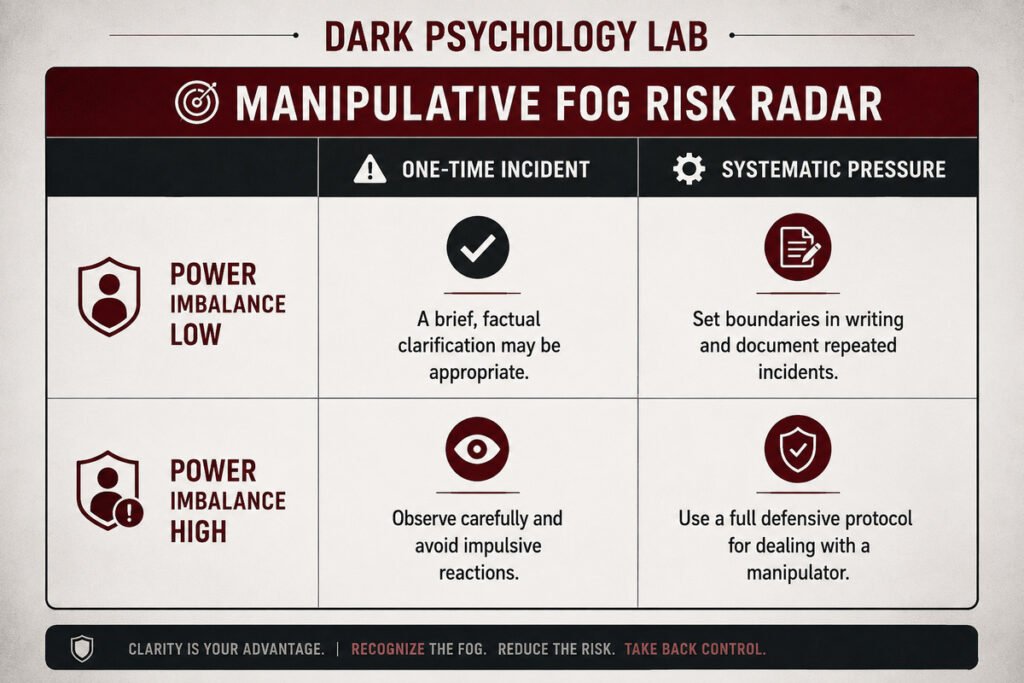
Our subject, the Machiavellian malignant narcissist, operated in the bottom-right quadrant: high power imbalance combined with systematic pressure.
Every situation is different. This tool is designed to help identify which type of situation you are dealing with before choosing a response.
When a real power imbalance exists, open confrontation can make the situation worse. In these cases, safety, documentation, and strategic withdrawal are often more important than forcing the manipulator to admit the truth.
Dark Psychology Lab Defense Guides
Dark Psychology Lab focuses on understanding covert control and defending against it. These guides explore defensive techniques in greater detail across different areas.
Psychological Manipulation
Psychological Manipulation Defense: Safe Strategies and Dangerous Tactics Explained
Narcissistic Dynamics
How to Deal With a Narcissist and What to Do When You Can’t Leave
Toxic Workplace
Workplace Mobbing Defense Playbook: 17-Step Guide
Conclusion: Manipulative Narcissistic Mobbing
What has been described here is a model of manipulative group pressure in the workplace, also known as mobbing, combined with narcissistic control inside large organizational structures.
It is extremely difficult to prove and deeply destructive to the person being targeted. At the same time, this model fits perfectly into the era of glass skyscrapers and political correctness.
It is a systematic process of driving a person toward progressive psychological breakdown while remaining hidden behind smiles, professional language, and corporations earning millions.
Disclaimer
This article presents an anonymized behavioral case study based on reported experiences, observed actions, recurring behavior, and the broader context in which the events occurred.
Terms such as narcissistic, malignant, Machiavellian, and covert are used as behavioral frameworks. They do not represent a clinical diagnosis of any individual.
Because covert manipulation rarely leaves complete evidence, some conclusions remain interpretive. The analysis focuses on repetition, escalation, cumulative impact, and how multiple actions appear to function together.
Identifying details have been removed or changed. This material is intended for educational, research, recognition, and psychological self-defense purposes. It is not medical, legal, psychological, or employment advice.
For full information about the limits and intended use of Dark Psychology Lab content, read the Disclaimer Page.
Dark Psychology Lab
Case study