

This analysis deconstructs a structural model of how a corporation can use HR pressure, corporate manipulation through ambiguity, and the illusion of legality to transform company policy into a form of administrative coercive control. The goal is to create a more profitable system that turns operational employees into an extractive, easily controlled resource.
Gradually, the worker is turned into a variable the company can easily remove if they no longer fit the new system, while the model is designed to reduce operating costs and increase operating profit.
DPL System-Model Case Study: Overview
This article belongs to the Dark Psychology Lab case study category. Because this material examines sensitive information, the case study has been fully anonymized. We will not mention company names, locations, personal names, or other identifying details.
To make this system analysis practical, we deconstruct the operating principles, pressure methods, and manipulative techniques that support it. The goal is to help the reader better understand the mechanism and choose more effective actions when facing a similar pressure. The focus remains only on the system model itself and the functions people perform inside it.
Labor laws can vary across countries, and what is described here may not apply in places with stronger labor protections and enforcement.
TL;DR
- Why can this system be profitable?
- The participants and their functions
- The system chronology is explained as a compact formula for how the Corporate Meat Grinder works.
- Manipulations observed during the process that increase pressure and reduce employee control
- Risk gating and the best defense
Corporate Meat Grinder Model
The newly appointed senior executive attempts to increase company revenue by extracting as much value as possible from the existing workforce through manipulative pressure tactics that operate effectively within legal and procedural gray areas. To optimize revenue, they begin changing company policy with a bulldozer approach, imposing change on unwilling employees through intimidation rather than participation or consent (Qureshi & Davis, 2007), creating the Corporate Meat Grinder model in the process.
The system is brutal in its intention because it uses hard, manipulative control tactics. At the same time, it is also disturbing because it is difficult to stop. If it becomes established, the company’s income can increase significantly.
The Business Logic Behind the Pressure System
Over the last few years, the organization has experienced strong revenue growth. After that spike, the numbers began to decline. If we look at the wider market, the main reason appears to be the falling prices of the services it provides.
In this company, as in similar companies, it was normal for the employer to pay social contributions for employees during their non-working period, while they waited for their next rotation and returned to work. Operational workers were socially protected. They were also not subject to strict performance quotas.
From a profit perspective, this creates a significant leak, though this model is common in the sector.
So the task of the new managers is to restrict previously valued, well-paid workers who were used to certain guarantees until they either become useful to the new system or become easy to replace.
This model does exactly that.
Implementation of the Pressure System
It starts gradually, then accelerates very quickly. Using calculated and gradual pressure within labor-law ambiguity, the model is implemented step by step:
- First, by legally restricting targeted workers.
- Then, by constraining them with control tactics.
- Then, by reducing social guarantees.
- Then, by increasing the required work.
- And later, by adding bonuses or penalties.
If we set aside morality and look from the perspective of a company that cares only about profit, this model can pay off and make the organization more attractive to investors.
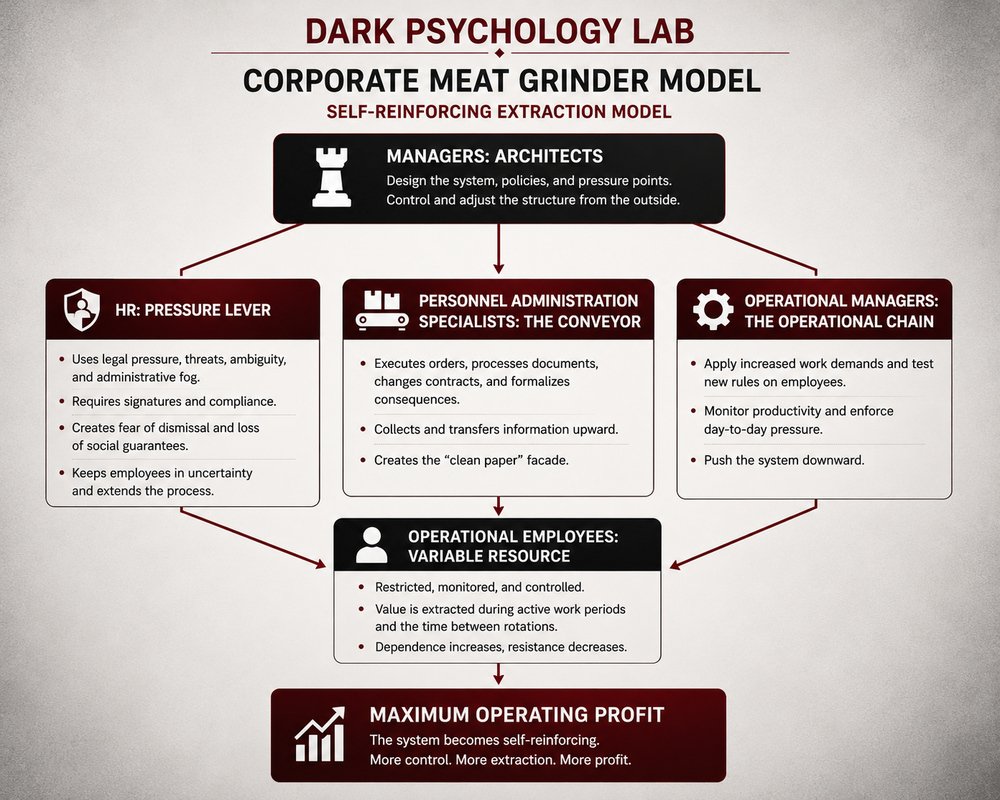
The new managers serve as architects, gradually integrating the Corporate Meat Grinder into the organization.
The Employee as a Minor Operational Cost
The company’s social reputation has already been damaged from earlier stages. There is no clean facade left to protect, and employee attempts to defend themselves are calculated into the risk costs. From a purely logical perspective, even if one or two operational workers out of a hundred successfully defend themselves, this would still be a minor cost compared to the revenue and profit the company could generate under this operating model.
For an ordinary employee to defend themselves properly, they would need legal knowledge, financial stability, and additional resources. Even then, they could be misled by employment contracts, ambiguous labor law, and legal gray areas.
In some cases, even a successful claim may result in limited compensation after a long, exhausting process. At the same time, they may become targets of a company earning millions.
The Function of Employee Castes Inside the System
The company’s employee layers are reorganized so that each level performs a specific function, while pressure and extraction are pushed downward onto those at the bottom.
There are no personal relationships inside this model. Character is not attacked directly, which is common in workplaces with narcissistic dynamics (Azazz et al., 2024). The system does not need to delve deeply into personal relationships, so it is difficult to call it classic workplace mobbing.
It is closer to cold systemic pressure: “Nothing personal, just business.”
Managers: Architects

Function: Control and adjust the system from the outside. They redesign policies, pressure points, and the company’s management structure.
The architects are mostly invisible players. They may be managers from other companies with experience in similar systems, or hired specialists responsible for risk-cost calculation and system architecture. Their function is to observe the system from the outside, implement new work practices, and calculate costs and risks.
They do not argue directly with functional employees. They try to keep a distance. However, the senior executive assumes the legal risk connected to the policy changes, while the corporation supports him. All other company organs, when the question becomes legally complex or involves work organization, refer the employee to management. Management, in turn, avoids unnecessary dialogue by using ambiguity and silence.
HR: Pressure Lever
Function: Use legal pressure, threats of dismissal without a clean reason, manipulative ambiguity-based pressure, delayed processes, and administrative fog.
In most public discussions, HR is framed as an overworked department dealing with stress, burnout, and employee conflict. Here, HR performs a different function. It is the main lever for advancing this system. That is what makes this model distinctive. HR functions like the blade of a meat grinder.
Under management direction, they require employees to sign documents that prevent the company from paying social insurance contributions during the period between work rotations. If employees refuse, HR threatens them with legal or disciplinary sanctions that could result in their immediate dismissal, without prior warning.
This creates maximum control:
- The company avoids severance.
- The employee may be socially discredited through official employment records.
- After dismissal, depending on the jurisdiction and dismissal grounds, the worker may also risk losing access to unemployment benefits.
This is hard control. It simply wears a corporate shirt and uses clean administrative language.
When Procedure Becomes a Weapon
The pressure works through unclear procedures. When confronted, HR may respond through silence, vague explanations, or corporate forms of DARVO and gaslighting. This keeps the person in a state of uncertainty and extends the process.
When confronted, HR redirects responsibility to management while still applying pressure to operational workers.
Personnel Administration Specialists: The Conveyor
Function: they control paperwork, signatures, and procedural pressure.
Their role becomes more important once this policy is introduced. Once operational workers experience this level of HR pressure and realize that resisting it is extremely difficult, mass turnover begins. Short-term performance-enhancing expectations are related to significantly higher quit and dismissal rates (Batt & Colvin, 2011).
In this system, administration specialists function as the handle of the grinder. They perform several functions:
- They present new employment contracts that restrict operational workers’ rights through legal fog, while remaining vague or silent about the practical consequences of the changes.
- Once the system activates and employee turnover increases, they keep the grinder operating by processing documents quickly, dismissing people quickly, and onboarding new people quickly.
- During dismissal, workers may be presented with documents that appear unrelated to the termination process. This resembles intimidation through corporate gaslighting. It increases uncertainty at the exact moment when the employee is already under strong administrative pressure.
They may not be fully informed about the whole system. They may simply perform their function. However, this layer also applies pressure and manipulation. It simply does it through quieter, more ambiguous administrative methods.
Operational Managers: The Operational Chain
Function: Apply direct pressure to operational workers through daily work demands, instructions, and control.
The role of operational managers is to coordinate the work of operational workers. They work directly with them, and their combined output is directly connected to the company’s income.
At the early stage, their function is to test new rules on selected or small groups of workers while avoiding a mass revolt. Pressure begins in isolated cases and can be explained as the personal style of one manager, while higher management observes productivity and income.
Once the Corporate Meat Grinder becomes stable, pressure through operational managers can become part of normal company practice. The rules are established, employee turnover becomes normalized, and heavier work demands become easier to apply.
A possible evolution is that higher management begins to pressure operational managers through bonuses, penalties, and productivity targets. Then managers become the direct tool used to overload legally trapped operational workers with work while the company activates the maximum extraction model.
Operational Employees: Variable Resource
Function: they are the system’s main resource and the company’s profit engine. At the same time, they become the most restricted and exploited part of this infrastructure.
Operational workers are mobile, isolated from the office, and legally restricted. The system is built to exploit their uncertainty, fear of losing income, and legal vulnerability.
After this kind of corporate hard control, many people leave. But some adapt and accept the policy. This is exactly the type of resource the new system needs. The model depends on these employees: fully controlled, probably frightened or unaware, legally restricted resources who can later be pressured even further through heavier work demands.
System Chronology: How the Corporate Meat Grinder Activates
The personnel caste architecture is redesigned, along with the functions assigned to each layer, to extract as much value as possible from the existing workforce through a series of step-by-step changes. The sequence of the entire process looks like this:
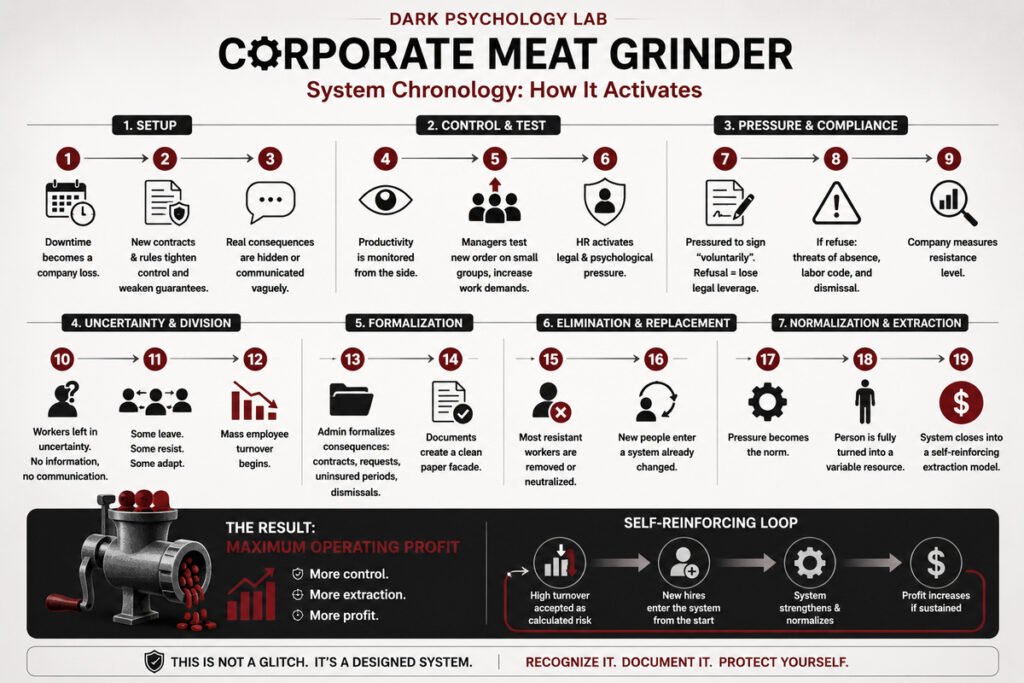
1. Setup
→ The workers’ time between work cycles begins to be treated as a company loss.
→ New employment contracts and internal rules are created, restricting the operational workers more heavily, weakening social guarantees, and tightening legal control.
→ Employees are informed about the real consequences vaguely or not informed clearly at all.
2. Control and Test
→ Employee productivity begins to be monitored from the side.
→ Operational managers begin testing the new order on small groups of operational workers by increasing work demands.
→ HR activates legal and psychological pressure.
3. Pressure and Compliance
→ The employee is pressured to sign the documents “voluntarily,” while refusal means surrendering almost all legal leverage.
→ If the employee refuses to sign, threats of absence from work, labor code articles, and dismissal are activated.
→ The company observes how much resistance appears.
4. Uncertainty and Division
→ Operational workers are left in uncertainty because they receive no information, and management refuses to communicate.
→ Some employees leave, some try to resist, some adapt.
→ Mass employee turnover begins.
5. Formalization
→ Personnel administration formalizes the consequences: contracts, requests, uninsured periods, dismissals.
→ The documents create a clean paper facade.
6. Elimination and Replacement
→ The most resistant workers are gradually removed or neutralized.
→ Newly hired people enter a system that has already been changed.
7. Normalization and Extraction
→ Pressure stops being an exception and becomes the norm.
→ The person is fully turned into a variable resource.
→ The system closes into a self-reinforcing extraction model.
This is the Corporate Meat Grinder mechanism. It is a brutal system, but it can become highly profitable if sustained.
The risk costs appear to be calculated so that even if a large number of operational workers leave, the process itself does not stop. In organizational research, employee turnover is generally associated with weaker operational performance, but some organizational cultures can buffer the negative effects of high turnover (Mohr, Young & Burgess, 2012). Newly hired people then enter this system from the beginning. So, logically, the company may be prepared to incur short-term losses and a temporary drop in profits to formalize this new company architecture.
Manipulations Observed in the Case Study
Manipulations that increased pressure and reduced the employee’s control:
- Legal fog — formal language, labor code articles, and an atmosphere of threat are used to create fear. A polite tone is used to convey that the pressure is normal, professional, and non-conflictual.
- Strategic ambiguity — the person is not clearly told what their status, rights, or obligations are. Contract clauses are changed in ways that create more uncertainty.
- Information withholding through omission — only part of the information is presented, so the employee does not understand the full effect of the documents.
- Silent treatment — refusal to answer clearly, explain, or communicate, so the operational worker remains in uncertainty and loses the sense of control.
- Corporate DARVO — the system rejects the employee’s questions, defends itself through formal language, and pushes the problem back onto them, as if the worker is the violator.
- Corporate gaslighting — procedures, documents, and vague answers are used to make targeted workers question their own understanding of the situation.
- Gaslighting through procedures — the employee is pushed to wonder whether they reacted incorrectly. Administrative and management personnel behave politely and respectfully, while the main hard pressure comes from HR.
- Refusal to provide clear written explanations — verbal or vague pressure leaves minimal evidence, allowing the system to keep room to maneuver.
- Documentary pressure — contracts, requests, and internal procedures are used as pressure tools that create fear and reduce workers’ control.
- Forced-choice frame — the operational workers are left with an illusion of choice. If they refuse to sign, the employer gains full control and a legal reason to remove them.
- Paper facade — documents later clean up the appearance of the process, making it look orderly and legal.
- Diffusion of responsibility — HR redirects responsibility to management or other departments, management avoids dialogue, and responsibility spreads through the system.
- Process delay — uncertainty, silence, and delayed responses increase the pressure on the employee.
- Complainant fatigue — the working person becomes exhausted by the fog of manipulation, waiting, and constant clarification attempts. Negative emotions increase, and the person may begin to lose the strength to defend themselves (Crockett, n.d.).
- Information extraction — different administrative employees may keep asking, “What is the reason for leaving?” This collects information and may transfer it upward. If a targeted worker openly blames management or the system, they may trigger retaliation.
Download the Manipulation Recognition Guide
Not sure if you are being manipulated? Take a test. Press a button below. Sign up for Dark Psychology Lab, and we will send it to your email.
Risk Gating: Assessment, Defense, and Awareness
When this level of pressure begins through the administrative layers, some employees leave. Possibly even most of them. Some try to solve the situation legally or emotionally. But after calculating what they can realistically gain and how much time and money the process would require, the retaliation path is usually followed only by those most emotionally invested.
It is important to note that defending yourself in this kind of situation can be difficult due to stress. In most cases, work is directly connected to survival, income, stability, and long-term goals. During the defense process, sleep, appetite, emotional state, concentration, physical energy, and decision-making may deteriorate.
Distinguishing the Force: Malice, System, or Incompetence
To defend yourself effectively, you first need to diagnose what is driving the pressure. Misidentifying the root cause may compromise your defense strategy. Look for these three distinct markers:
- Individual pathology: The Narcissistic Dynamic
Highly personalized and emotional. Driven by managerial ego, it uses direct gaslighting and character attacks to force psychological submission. In this case, distance is protection. Do not get personal or expose vulnerabilities that could later become control points. For workplace self-defense, see the full guide:
How to Work With a Narcissist - Systemic optimization: The Meat Grinder
Cold, polite, and orderly. It applies procedural pressure to entire departments strictly to extract profit and shift risk. Emotional non-engagement remains the strongest defense. It reduces the material that can be used to discredit you. Even when people execute the process, read them as system functions rather than as isolated individuals. - Operational incompetence: The Chaos Illusion
Random, disorganized management. Unlike a calculated system or narcissistic dynamic, incompetence is unpredictable. Anything can happen here, and it does not necessarily mean planned pressure. That is why it is important to assess the situation carefully.
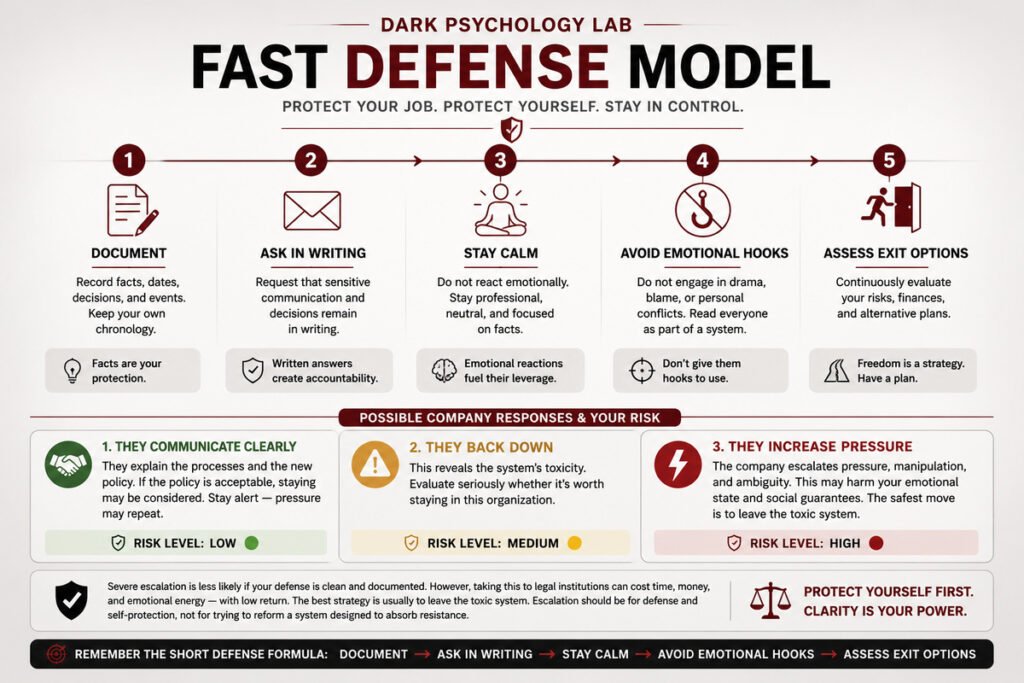
Defensive Strategy for Keeping the Job: Clean Communication
Document facts. Communicate respectfully and appropriately. Think legally and logically. Request that sensitive communication remain in writing. Read documents before signing, and do not sign anything without a clear reason or explanation.
Do not react emotionally. Stay professional. Avoid personal conflicts, emotional explanations, and attempts to treat the people inside the organization as separate individuals. Read everyone as part of one operating system. Check the law and request clear answers.
Possible responses from the company may vary, and each one carries its own risk.
- The company communicates clearly and explains the processes and the new policy.
This would partly challenge this case study. In that case, it may be worth considering staying if the new policy is acceptable. However, HR pressure without a clear basis should not be ignored, and the employee should keep in mind that it may repeat.
Risk level: LOW 🟩 - The company backs down.
This would reveal the system’s toxicity. In that case, the person should seriously evaluate whether it is worth staying in this organization.
Risk level: MEDIUM 🟨 - The company increases pressure, manipulation, and ambiguity.
During this process, the organization may damage both the person’s emotional state and social guarantees. In that case, the recommendation would be to leave the toxic system.
Risk level: HIGH 🟥
Severe escalation from the corporation is less likely because the defense strategy is well thought out, and the company has fewer hooks to use against you. But escalating this conflict into legal institutions can cost both time and money, with low return and high emotional cost.
Because of that, the best strategy is usually to leave the toxic system. Escalation should be reserved for defense and self-protection, not for trying to morally reform a system designed to absorb resistance.
Fast Defense Model
Document → Ask in writing → Stay calm → Avoid emotional hooks → Assess exit options.
Risks That Employees Face Without Awareness of a Manipulative Pressure System
This person does not fully understand the systems they are entering. They have not faced this level of pressure before and do not expect this level of restriction from the company. Legal defense, formal legal language, and the long-term consequences of signing may also be unclear. An emotional reaction is possible because income depends on the outcome. That reaction is human.
The possible employee actions, company responses, and related risks:
- They plan a calm exit and leave when the time comes.
This allows them to escape the system. The corporate castes may try to retain the employee by offering better conditions or claiming that they will adapt to him. Each ordinary worker directly generates significant profit, making the worker a necessary resource for the organization.
Risk level: LOW 🟩 - They accept the new company policy without being properly informed.
They ignore HR pressure, accept new policies, and continue doing their job. In this way, they become connected to the system and turn into an extractable resource that is easy to control or replace. At first, nothing will probably change, but over time, the company may begin to increase the pressure to extract more profit.
Risk level: MEDIUM-HIGH 🟨🟥 - They try to communicate, call managers, organize meetings, and search for fairness inside the corporate facade.
They may become labeled as a problematic employee. If the documents are already signed, the control lever remains in the corporation’s hands. If not, the system may still work as intended, keeping the operational worker easily controlled despite their attempts to resist. Indirect pressure may increase, gradually pushing them out through techniques that worsen working conditions.
Risk level: HIGH 🟥 - They contact legal institutions.
They may have evidence, or they may not. Before implementing such a system, the company may already have calculated this risk. It has resources. It can delay processes, defend itself, retaliate, apply counter-pressure, investigate employee violations, look for documentation gaps or procedural mistakes, or search for other material to use against the employee. This kind of process can drain the person mentally and financially, with very low return even if they win.
Risk level: HIGH 🟥 - They react impulsively and emotionally.
They try to defend themselves against the system through primitive methods, aggression, or unprofessional behavior. This makes them easy to discredit, and they can be removed from the system almost immediately through dismissal for misconduct.
Risk level: VERY HIGH ⬛
Dark Psychology Lab — Psychological Defense Guides
Dark Psychology Lab focuses on clarity, safety, and defense tools. Use the guides below as entry points into the main areas of psychological defense:
Manipulations
Practical Defense Guide: Psychological Manipulation Defense: Safe Strategies and Dangerous Tactics Explained
Narcissism
Practical Defense Guide: How to Deal With a Narcissist and What to Do When You Can’t Leave
Workplace Mobbing and Toxic Workplace
Practical Defense Guide: Workplace Mobbing Defense Playbook: 17-Step Guide
Conclusion
This article is meant to help readers understand mechanisms, increase awareness, and make calmer decisions under pressure. Without understanding what is happening, emotional reactions and getting pulled into human conflicts only make the situation worse.
Disclaimer
This case study is provided for educational, analytical, and defensive purposes only. It does not identify any specific company, manager, HR employee, location, or individual person. The goal is to analyze a structural mechanism that can emerge within organizations.
This article is not legal advice, financial advice, psychological treatment, or a professional investigation. Labor laws, employee rights, employer obligations, and legal procedures differ by country, contract type, industry, and specific situation. If you are facing similar pressure at work, consult a qualified labor lawyer, union representative, workplace rights organization, or relevant state institution in your jurisdiction before making decisions.
If you are currently inside a power imbalance, be careful. Emotional reactions, public accusations, impulsive confrontation, or unsigned legal assumptions can increase your risk. Document facts, keep communication in writing when possible, read documents before signing, and assess your financial and legal position realistically.
If the situation is affecting your mental health, sleep, safety, or ability to function, seek support from trusted people and qualified professionals. Leaving a toxic system may sometimes be safer than trying to reform it from the inside.
For the full website-wide legal, safety, and responsibility notice, please read our full Disclaimer Page.
Dark Psychology Lab
Independent system analysis