

The narcissistic devaluation phase is a gradual process in which a narcissist lowers a person’s perceived value to shift them into a more controllable role. Over time, this can lead to negative effects, especially when the pressure is prolonged.
Emotional closeness is not required. Both idealization and devaluation can happen between people who barely know each other, among friends, or in workplace environments. What matters is the role that the narcissist assigns to you, how many vulnerabilities were identified, and how much pressure can be applied.
In the end, if not interrupted in time, the devaluation phase may lead to the narcissist’s discard.
Narcissistic Cycle Overview: Devaluation Phase
This article is part of the Narcissistic Cycle series.
Idealization → Devaluation → Discard → Hoover → Repeat
To understand how all phases connect into one repeating abuse mechanism, read:
Narcissistic Abuse Cycle Explained
This material is not a diagnostic tool. Narcissistic Personality Disorder (NPD) can only be diagnosed by qualified professionals. It is designed as a recognition map. It outlines how narcissistic abuse may progress from early signals to escalation and an eventual breaking point that can lead to discard.
Use it as a reference to better understand your own situation and recognize where you may be in the sequence. The infographics are included to make these patterns easier to spot in real time.
TL;DR Devaluation
- Narcissistic target evaluation criteria
- Devaluation as a power struggle
- Devaluation in different narcissist profiles
- Devaluation as an escalation of tests and recognition patterns
- How the transition to the discard phase happens
- How to defend yourself
Download the Manipulation Recognition Guide
Not sure if you are being manipulated by a narcissist? Take a test. Press a button below. Sign up for Dark Psychology Lab, and we will send it to your email.
Distinguishing Normal Conflict from Devaluation
Not every conflict is narcissistic abuse. Disagreements, failed jokes, power struggles, or occasional hurtful behavior can happen in any relationship. What separates devaluation from normal conflict is a recurring pattern, harmful intent, disregard for personal boundaries, and, in many cases, escalation into a social setting. Vulnerabilities are often used as leverage, and the behavior escalates.
During devaluation, the narcissist often behaves in ways they are not fully aware of. This pattern can resemble an internal survival model in which aversion toward a vulnerable target begins to develop. Over time, this creates a vicious cycle: the narcissist’s resentment grows, pressure increases, while the target’s self-worth deteriorates.
An infographic example of this degradation cycle in narcissistic dynamics:
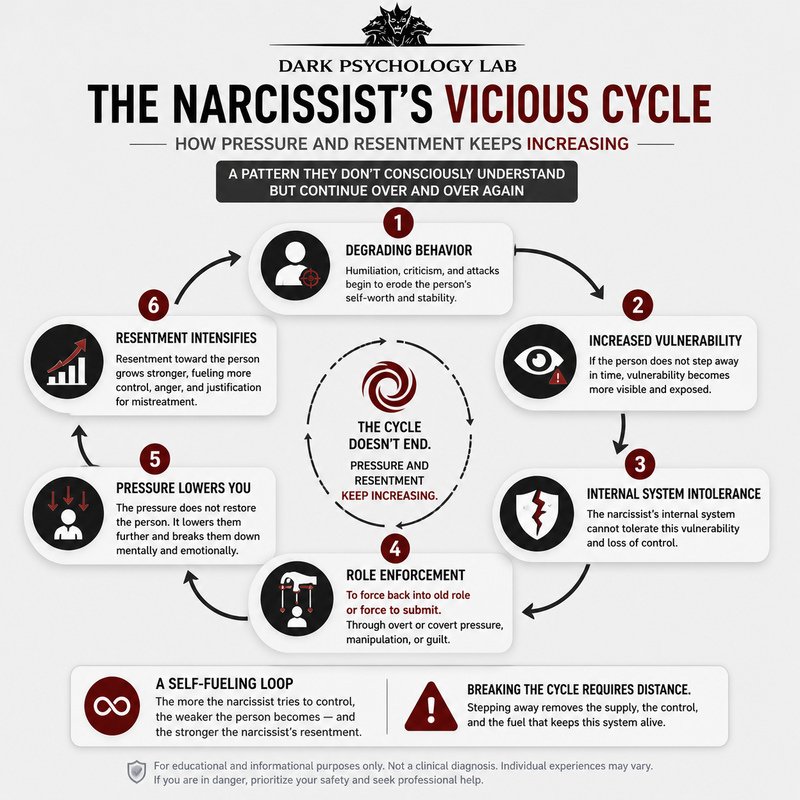
Narcissistic Devaluation Phase: Evaluation of the Target
Many people assume that a narcissist does not understand how they feel. In many cases, the opposite is true. They can read emotions, body language, insecurity, and weak points with surprising accuracy. In psychology, this is often explained through the distinction between cognitive and emotional empathy. A person may understand what you feel without experiencing it as a moral constraint (Zhu, 2021, pp. 1-10).
The devaluation phase does not begin with everyone. From the beginning, the narcissist observes you closely. They operate like a data collector, tracking your reactions, boundaries, emotional triggers, and level of attachment. Occasional low-level pressure may appear as small probing tests.
If you are a suitable target, this information begins to be used against you during the devaluation phase.
How a Narcissist Decides Whether to Move a Person Into the Devaluation Phase
First, the narcissist may begin to assess whether you are a threat. This can start during the idealization phase. Boundaries are tested, reactions are observed, and a slow conditioning process may begin. The narcissist evaluates how much you tolerate, how attached you are, whether you can be isolated, and whether you resist, and if you do, how.
In simple terms, you are being assigned a position. The question the narcissist asks is whether it is safe to move into stronger forms of control and how.
Source (related): A Process Model of Narcissistic Status Pursuit — Grapsas et al. (2020)
Criteria a Narcissist Considers When Escalating Control
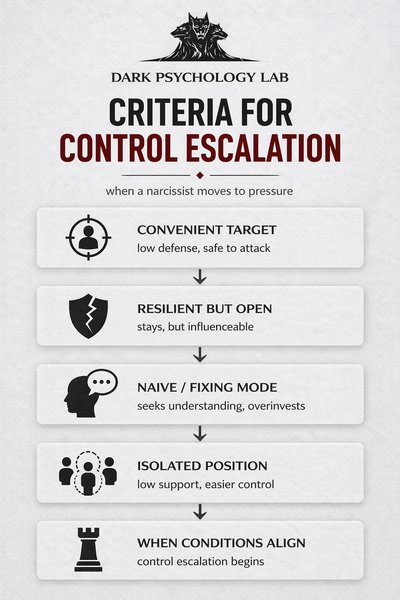
Not everyone reaches this stage. A specific combination is typically present.
- You are convenient: The narcissist will not attack someone who can immediately defend themselves. Like many toxic individuals, they wait until they feel safe and have an advantage. This can be compared to scavenger behavior. As long as you are active and stable, they hold back.
- You are both resilient and vulnerable: You do not leave immediately, but you are still open to influence. Sensitivity to negative emotions, heightened stress reactivity, or neurotic tendencies can serve as leverage points. A history of unstable relationships or past trauma increases the likelihood of deeper access.
- You are naive or try to solve everything through dialogue: If you believe in mutual understanding or goodwill, this creates additional access. You stay longer, invest more, and reveal more weak points in the process.
- You are isolated or discredited within a group: Devaluation often unfolds in social environments unless strong conditioning has already taken place, in which case, they do not need group support to feel a sense of advantage. When the group is brought in, effective defense becomes much harder. Sometimes this groundwork is prepared in advance through subtle smear tactics or a social background that supports the narcissist’s image. Isolation may not work if the narcissist lacks support from the group, is unstable, and their personality traits start to leak through the facade, making the environment naturally shift more in your favor.
Evaluation of Social Status and Utility
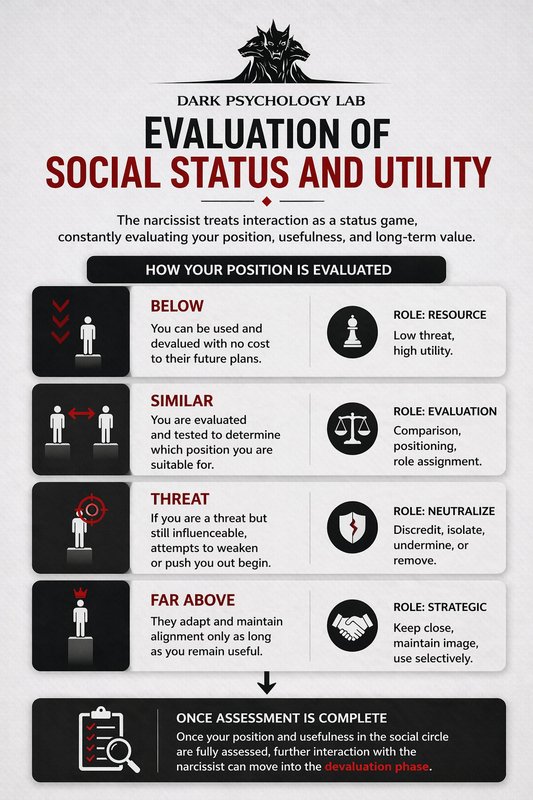
Also, the narcissist tends to treat social interaction as a status game, constantly evaluating your position, usefulness, and long-term value (Grapsas et al., 2024).
They evaluate your position:
- If you are below, you can be used and devalued with no cost to their future plans.
- If you are at a similar level, you will be evaluated and tested to determine which position you are best suited for.
- If you are perceived as a threat but still influenceable, attempts to weaken or push you out may begin.
- If you are far above, they adapt and maintain alignment only as long as you remain useful.
Once your position and usefulness in the social circle are fully assessed, further interaction with the narcissist can move into the devaluation phase.
Devaluation Mechanism: Power Struggle
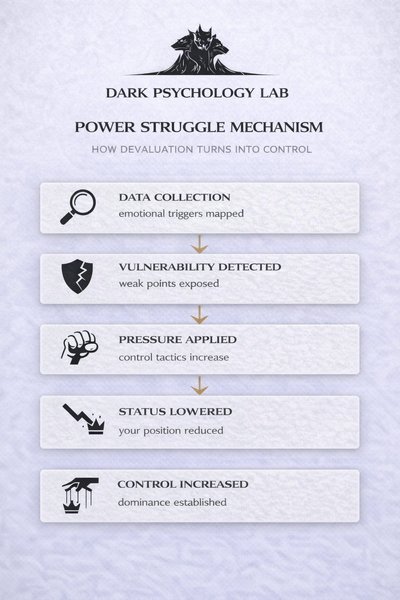
The goal of the devaluation phase is to reduce your status and reshape you into a position that serves the narcissist, increasing their influence over you.
At a certain point, the narcissist tries to take the upper hand. Once they sense vulnerability or believe they have gathered enough information, they move to the next level.
Lower empathy and higher sensitivity to reward play a role here (Jankowiak-Siuda & Zajkowski, 2013). When they feel they can win, pressure increases. The behavior often becomes more aggressive and less restrained in its disregard for your well-being.
This is where the situation turns into a high-intensity power struggle.
For more sensitive individuals, this shift can feel confusing or sudden, but if you look deeper into narcissistic psychology, it starts to resemble a predictable behavioral mechanism.
Source (related): Threatened Egotism, Narcissism, and Aggression — Bushman & Baumeister (1998)
How Different Types of Narcissists Devalue
Both grandiose (overt) and vulnerable (covert) narcissism can become highly devaluing because both share an antagonistic core. The difference often lies not in the presence of hostility, but in how it is expressed. Grandiose narcissism is more openly dominant and externally assertive, while vulnerable narcissism is more tied to hypersensitivity, defensiveness, withdrawal, and distress. At higher levels, the line between these forms becomes less clean, and the darker core becomes more visible (Jauk & Kaufman, 2018).
Overt / Grandiose Narcissist During the Devaluation Phase
The overt type is more visible during devaluation. The behavior includes direct criticism, contempt, arrogance, public pressure, and more obvious dominance.
As a result, their goal can be recognized earlier. Your value is reduced, your position is lowered, and pressure is applied to force you to submit to the overt narcissist narrative.
Covert / Vulnerable Narcissist During the Devaluation Phase
The covert type operates in ambiguity. Control is established through uncertainty rather than direct confrontation. Emotional and psychological manipulation is applied consistently, but without clear signals. Direct answers are usually avoided. Common tools include passive aggression, silence, confusion, vague dissatisfaction, role reversal, and victim positioning.
Because of the subtle nature of covert narcissistic behavior, there is no clear point of conflict. From the outside, due to the facade of the narcissist, this can look like a communication problem or a difficult, fragile, wounded personality. The target may struggle to identify what is happening, even during the devaluation phase. This prolongs exposure and increases cumulative psychological pressure.
Malignant Narcissist During the Devaluation Phase
Otto F. Kernberg, a psychiatrist and psychoanalyst, linked malignant narcissism with severe narcissistic pathology and aggression (Kernberg, 1984). Malignant narcissism is considered one of the most dangerous expressions of narcissistic behavior, sitting closest to psychopathy.
During the devaluation phase, the behavior can become more hostile and retaliatory. They are highly sensitive to criticism and resistance. Even small challenges can trigger a narcissistic injury. In response, they may quickly escalate to devaluation and use crueler methods. Unlike more passive profiles, they can switch between overt and covert tactics, using whatever is most effective to weaken or eliminate a perceived threat to their status.
Devaluation Sequence: An Escalating Series of Tests
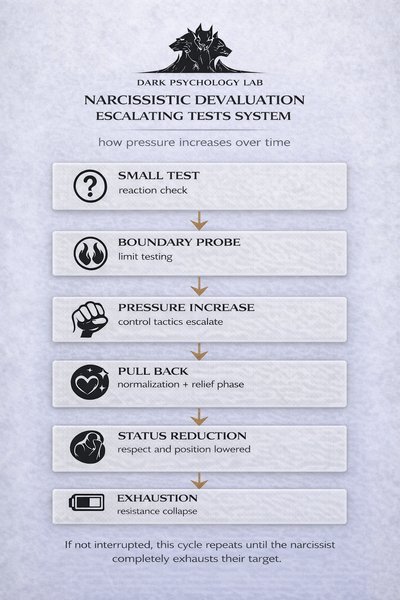
This section is based on observations and pattern analysis of overt and covert narcissists during the devaluation phase.
Devaluation resembles a progressive testing system in which pressure increases in stages.
All types of narcissists tend not to fully let go but adapt to the target, gradually increasing pressure and then pulling back. During the pullback phase, techniques such as love bombing, normalization, excessive attention, submission, and gifts may be used.
Each repetition further reduces the target’s self-worth and social standing, while simultaneously increasing the narcissist’s control.
If the cycle is not broken, it typically continues and escalates, leading to the target’s exhaustion and eventual discard.
Aggressive Escalation of Coercive Control: Overt Narcissist Tests
This pattern appears more common in overt or grandiose narcissists, although it is not exclusive. As a rough heuristic, it may resemble something like an 80/20 distribution rather than a strict rule.
At a basic level, the testing process can be reduced to questions like:
- How much will you tolerate before reacting?
- Will you accept sudden mood shifts and episodes of anger?
- Will you tolerate constant pressure?
- Will you stay after humiliation?
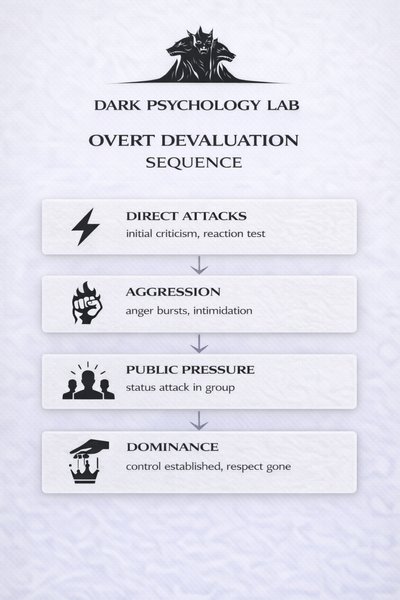
The narcissist begins to apply pressure through insults, criticism, and status reduction. This is how your boundaries are tested.
When you start defending yourself more strongly, they may pull back. Their behavior can temporarily shift toward normal or even improve, but over time, the pressure returns, in many cases stronger, and the cycle continues.
In some cases, additional signs appear. Small personal items may start disappearing. Requests for money increase. Borrowing expands to cars or other belongings. There is always some kind of problem that requires your involvement.
Over time, this pattern becomes exhausting. It works like a draining marathon. Instead of physical effort, it is continuous psychological pressure that gradually conditions you to tolerate more.
The key mechanism is the cycle itself. Each time the narcissist goes too far, they step back and return to more positive behavior. This gradually lowers resistance and reinforces the pattern until exhaustion.
Overt Escalation
In more extreme cases, this can escalate into physical aggression, public humiliation, or group involvement.
At this stage of devaluation, your status is significantly reduced. The narcissist no longer sees a reason to consider you. Debts may not be returned. Basic respect disappears.
You are no longer treated as a person. You may be used, discredited, or openly devalued.
This closely resembles discard, but in a slower form. The key difference is that you are still being kept in place because your position remains useful and under the narcissist’s control.
This is often the point where leaving becomes a safer option. Staying keeps you in a position that continues to serve the narcissist while diminishing you from the inside. Prolonged psychological pressure and a hostile environment can activate the body’s stress-response systems, leading to emotional exhaustion, reduced clarity, and increased tolerance of harmful conditions (Pereira-Figueiredo & Umeoka, 2024, pp. 1026-1043).
Subtle Escalation of Manipulative Control: Covert Narcissist Tests
This pattern appears more common in covert or vulnerable narcissists, although it is not exclusive. As a rough heuristic, it may resemble something like an 80/20 distribution rather than a strict rule.
At a basic level, the testing process can be reduced to questions like:
- Do you start seeking attention, explanations, or trying to fix the situation?
- Do you tolerate disappearances, ignoring, or ghosting?
- Do you accept sudden mood shifts?
- Are you attached enough for me to push harder? Can I threaten to leave without consequences?
- Where are you most vulnerable? How can I hurt you emotionally?
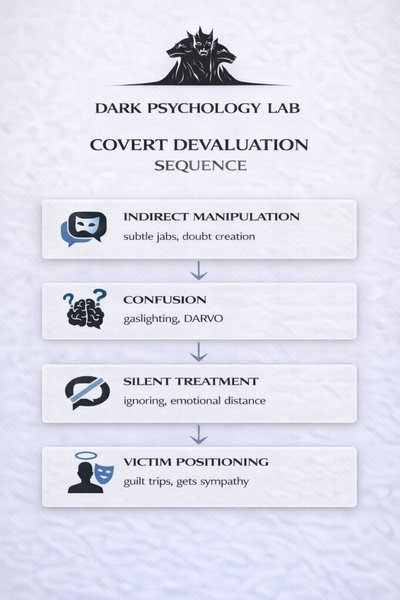
The narcissist gradually withdraws attention. They ignore and use the silent treatment without any clear reason. Calls are cut off. Messages are left on read. Communication is deliberately made difficult.
Questions go unanswered, after being indirectly raised by withholding information or introducing confusion. Gaslighting may be used to distort your perception. Confronted, a covert narcissist may escalate into emotional drama, shift blame, and use DARVO.
When you try to repair the situation, they may return to previous behavior, but with more control and confidence. The next time, the same pattern is repeated with greater precision. Over time, these conditions put you into a more controllable state.
Like overt narcissists, covert narcissists rarely fully disengage. Their high sensitivity to rejection and dependence on external validation make separation a threat to their fragile ego. Instead of direct escalation, they apply pressure gradually. Through subtle tests and increasingly difficult behavior, they generate emotional pain and confusion, which, when visible, becomes a source of narcissistic supply for them.
Manipulation techniques indirectly affect your nervous system by activating the fight-or-flight response (Dhabhar, 2018). They create negative emotional states and drain you over time. The process is gradual and difficult to notice at first.
Covert Escalation
Manipulative narcissists tend to be more sensitive and more cautious. In many cases, escalation occurs when they feel fully secure and confident in your attachment.
At later stages, respect drops further. Ignoring becomes deliberate. Third parties may be introduced through triangulation or smear tactics. Threats of leaving may appear.
Covert narcissistic devaluation functions like a slow-acting poison, slowly eroding your sense of self. If the situation is not interrupted early or if a trauma bond forms, this can develop into sustained covert coercive control. This type of progression is described as death by a thousand cuts (DBATC technique), where small, repeated actions accumulate into significant psychological damage. More on this in our article:
Covert Coercive Control Technique: Death by a Thousand Cuts Explained
Observations from Narcissistic Test Patterns
We used a rough heuristic 80/20 pattern as an indicator because both overt and covert narcissists can use aggressive and subtle forms of testing regardless of type. These differences tend to fade as the relationship moves into later stages of devaluation. At that point, both types can shift to more direct, hostile, or subtle devaluation.
What Overt and Covert Narcissists Have in Common
- They both use psychological abuse and humiliation as a form of control.
- Public humiliation. Social groups are usually involved. Lowering your status in front of others works as a form of status control and feeds the narcissist’s ego. Their regulation can depend heavily on external reactions, reputation, and perceived position.
- Intermittent reinforcement (unpredictable behavior, push-pull, hot and cold) during the devaluation phase becomes stronger and more frequent. The abuse cycle is active, but the narcissist does not leave. After intense negative behavior, they often return and try to reconnect, which keeps the cycle going. In a romantic relationship, this can cause obsessive attachment that later may turn into a trauma bond. More about this topic in our article:
How Intermittent Reinforcement Creates Obsession - Many narcissistic types use smear campaigns and rely on triangulation to increase their advantage over the target.
- Using third parties to isolate the target, as a defensive, offensive, or social leverage strategy:
Narcissist Flying Monkeys - The narcissistic supply mechanism is activated during the process. They both can derive satisfaction from your discomfort or emotional pain. More about this topic in our article:
Narcissistic Supply: What Narcissists Feed On - Provocation. The narcissist intentionally pushes for an emotional reaction. When you react, they step back and present you as unstable or overreactive.
Transition to Discard
If you do not submit or begin enforcing boundaries while still engaging with the narcissist in the mid-to-late devaluation phase, their behavior usually intensifies. In some cases, it can become openly malicious and cruel.
By this stage, your value has already been reduced in their perception. You have been drained, repositioned, and placed lower within their internal model of reality. If you continue to resist, it can trigger narcissistic rage, activate rivalry, or deepen a narcissistic injury, which may escalate the situation further. This is one of the main reasons the dynamic moves toward the discard phase.
Once a relationship reaches the devaluation phase, a stable and healthy connection may no longer be possible. It does not matter whether the process was subtle or aggressive. The narcissist has already learned how to control you. In most cases, there is no way back.
How Long Does the Devaluation Phase Last
There is no single timeline. Observations across different situations show wide variation. For some, devaluation becomes visible within weeks or months. Others only recognize it after a year, after moving in together, after marriage, or after a strong emotional attachment has already formed.
The key point is that devaluation often begins earlier than it is consciously recognized, as we noted in the article on the narcissistic idealization phase. What later feels like a sudden switch is usually built gradually through small, repeated actions.
Protection Against Narcissistic Devaluation
A narcissist tends to devalue you to prove to themselves that you are not good enough and that they are above you. In that process, they get even more confirmation when you try to fix things.
From this follows a realistic problem. Many therapists and communication coaches suggest solving everything through dialogue using “I” statements, for example: “I feel a bit confused about your behavior. I’m just letting you know how I feel.”
As a result, you reveal your vulnerability and expose yourself further while the devaluation phase is still ongoing. Continued engagement can lead to aggression, avoidance, or DARVO rather than resolution. Because the devaluation has not ended and often will not end without full disengagement, this reinforces the pattern rather than stopping it.
One of the most effective ways to defend against the devaluation phase is the ability to resist the narcissist. This means having the will to protect yourself without resorting to aggression and to refuse to engage in their games. It is about maintaining enough strength and clarity that the narcissist is forced to pull back.
They push you down to take your power. They impose a lower status on you and diminish you to raise themselves at your expense. If you really look at it, it is extremely low behavior. And what is ironic is that they see it as a form of superiority.
Once the narcissist understands that they cannot break your boundaries, they may withdraw or reduce pressure.
In those moments, you can even see how vulnerable they actually are inside. When they turn away, there is tension in their posture and an insecure movement. The control is gone.
At that point, there is no need for loud words, arguments, or trying to convince.
Vultures, when they fail to find food, pull back.

Risk Gating
Observe yourself. Pay attention to how you feel around this person. Even if you cannot clearly identify the devaluation phase, the behavior and unhealthy control should still affect your self-worth. You may have already started holding yourself back or suppressing parts of your personality.
If this is truly a narcissistic pattern and the devaluation phase is active, there is a high probability that you will be reduced in social settings. Your status may be lowered, and over time, you may be pushed to adapt while feeding the system with your own resources.
If the situation occurs in a work environment or involves a clear hierarchy and social pressure, prioritize safety and documentation. Power imbalance changes what is safe.
If there is physical danger, financial dependence, or a clear risk of escalation, protection and professional support should come first.
One of the most consistent effects of devaluation is increased self-blame. Clarity does not remove all the damage, but it can reduce it and help you recognize that the problem is not only in your reactions, but in the system itself.
Defense Guides – Practical Self-Protection
Dark Psychology Lab focuses on clarity and self-protection in situations involving manipulation, power imbalance, and covert psychological pressure.
The following defense guides expand on practical tools to reduce psychological damage and regain control:
Psychological Manipulation
Psychological Manipulation Defense: Safe Strategies and Dangerous Tactics Explained
Narcissistic Dynamics
How to Deal With a Narcissist and What to Do When You Can’t Leave
Toxic Workplace
Workplace Mobbing Defense Playbook: 17-Step Guide
Disclaimer
This content is for educational and awareness purposes only. Dark Psychology Lab does not diagnose narcissism or any mental health condition. Narcissistic Personality Disorder (NPD) and other psychological conditions can only be diagnosed by qualified mental health professionals.
DPL is not a psychologist, therapist, lawyer, or medical provider. It is an independent research-based project focused on analyzing behavioral mechanisms, not providing clinical or legal advice. For full details, visit our full Disclaimer Page.
The models and frameworks presented in this article are simplified interpretations of complex human behavior. They are designed to help you recognize patterns and reduce potential harm, not to label or clinically assess individuals. Human behavior exists on a spectrum. Not every difficult or toxic interaction means narcissism.
If you are experiencing severe psychological distress, physical danger, financial dependence, or a high risk of escalation, seek professional support. Your safety comes first.
Dark Psychology Lab
Original content based on lived experience and independent psychological analysis.