

Narcissistic hoovering and abuse cycle repetition after re-entry is a common phenomenon in narcissistic dynamics. During the hoovering phase, the narcissist attempts to pull back a person who was once a good source of supply. In plain language, this means someone who was previously easy to control, influence, or emotionally affect. Hoovering functions as a response test.
At first, it may look like the narcissistic cycle is over. They idealized you, then devalued you, acted cruelly, discarded you, and left. It looks finished. The end. But despite that, after some time, you start noticing strange signals. Strange social media activity, mutual acquaintances suggesting reconciliation, messages after a long silence, and “accidental” calls. In rare cases, they even show up in person. Rarely, because narcissists are often more afraid than their facade makes them look. If they sense resistance, strong boundaries, or a risk of exposure, they may avoid direct hoovering altogether.
Narcissist Cycle Overview: Hoovering and Repeat
This article is part of the Narcissistic Cycle series.
Idealization→ Devaluation→ Discard→ Hoover → Repeat
To understand how all phases connect into one repeating abuse mechanism, read:
Narcissistic Abuse Cycle Explained
The fourth stage of the narcissistic abuse cycle is hoover/repeat. Hoovering is a manipulation tactic that may work because the narcissist has already created attachment to themselves through intermittent reinforcement and other dependency-building, boundary-weakening methods. If the narcissist regains access to the target, the narcissistic abuse cycle usually repeats, often faster and more brutally.
To help you understand how this manipulation works and why letting a narcissist back in is not a good idea, we will break down the psychological operating principles of the narcissist, give recognition tools, and outline possible defense methods.
TL;DR
- How the narcissist’s psychological processes work
- Why narcissist hoover discarded individuals
- The DPL Narcissistic Archetypal Model, and why some narcissists do not hoover
- Why some narcissists never come back, and why that is good news for you
- Social surveillance as a technique for evaluating the target
- Hoover types: passive and active
- The difference between repair and the narcissistic abuse cycle repeat
- How to reduce harm when contact becomes a psychological or safety risk
Before We Continue
The next part goes deeper into the narcissist’s internal operating system. You do not need to agree with every model presented here. The purpose is recognition and clarity. If you only want practical defense tools, you can skip directly to:
- Hoover Types
- Reset vs Repair
- Defense Block
- Risk Gating
If you want to understand why hoovering happens mechanically, continue reading.
Why the Narcissist Hoovers: Insecure Self, Supply Rotation, and the Old Regulator
Simplified formula for recognizing the narcissist’s internal system and understanding why they hoover:
Facade → insecure self → mirror system → supply → attachment to the regulator → hoover based on persona and threat assessment
How the Narcissist’s System Works: Understanding Is the Key
If you want to understand hoovering and the narcissist’s operating principle, the first thing you need to do is forget normal human logic based on mutual understanding and empathy. This is not a situation where they “missed you,” “understood,” or “feel sorry.” This is not the return of feelings or genuine remorse. In the narcissist’s system, re-establishing contact tends to have a different function: checking whether the old regulator is still usable, whether psychological control can be re-established, and whether access to a person who once regulated their state can be restored.
Dark Psychology Lab formula of hoover mechanism:
Internal instability → old regulator → access test → reaction → control or status update
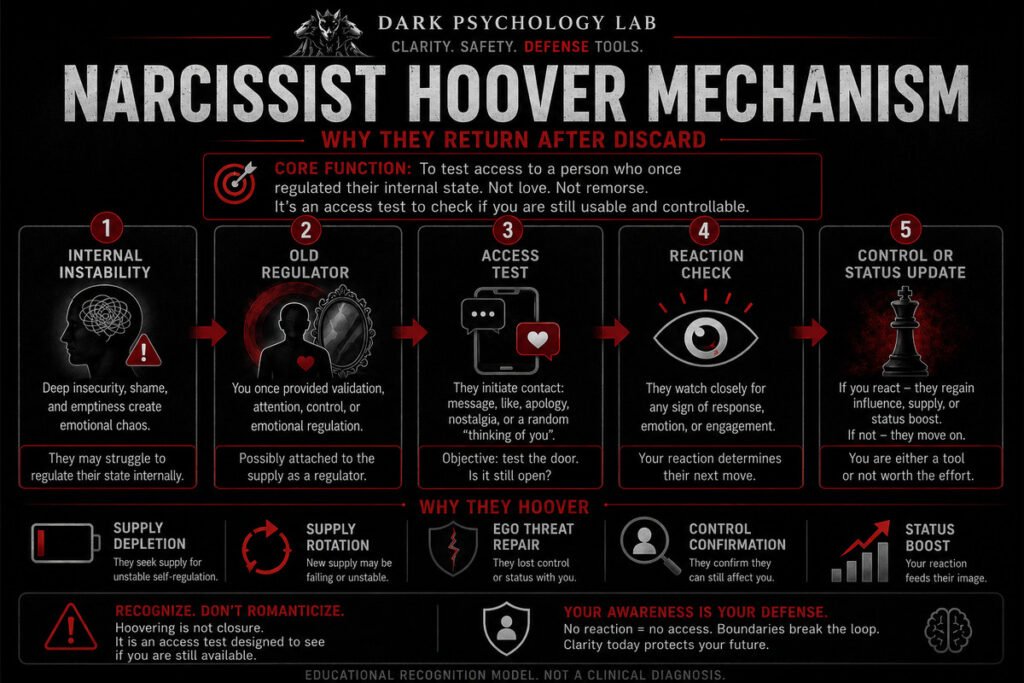
When you adopt this perspective, the narcissist’s behavior begins to look completely different. You no longer see just an angry ex-partner, a bizarre post-discard message, or a glimmer of lingering affection. Instead, you begin to see what could be described as a parasitic, predictable psychological system operating in a loop.
Let’s drop the illusions and look at the narcissist from the inside. To explain how hoovering works, why some narcissists hoover, and why some do not, we first need to explain how their system works.
You can use this model as a recognition and self-protection tool. An invisible enemy always looks bigger than it really is. When you give it a name, it stops being a demon and becomes a problem.
Grandiosity and Internal Insecurity
Narcissists usually appear much stronger than they are internally. From the outside, they may seem social, attractive, dangerous, charismatic, sexual, successful, powerful, or highly adapted to their environment. But beneath that polished facade, a deeply unstable system is operating. They often lack a stable internal self-worth engine, so they rely on others as regulators, mirrors, and tools to maintain their grandiose self (Morf & Rhodewalt, 2001).
Modern scientific models suggest that deep shame, emotional fragility, and the fear of being insignificant can hide inside the narcissist (Ritter et al., 2014). This insecure internal self struggles to calm or stabilize itself and becomes heavily dependent on external reactions and validation for regulation.
Narcissistic Facade, Mirror System, and the Archetypal Model
The narcissist uses the environment as a mirror system that confirms both their constructed social image (narcissistic facade) and their internal archetypal self-image (the inner persona through which they interpret the world). In psychology, this phenomenon is broadly associated with the concept of the False Self (Strozier & Pinteris, 2022).
These identities are built from behavioral patterns observed and adopted throughout life, as well as from personas copied from movies, magazines, social media, or the surrounding environment. Common examples include the gangster, the princess, the alpha male, or the family idealist.
These personas are then adapted to the social circles where the narcissist positions themselves. If the environment does not support the facade, they often search for another one better suited to their image and operating style.
The social facade concept is explored more deeply in our article:
The Narcissist Facade Explained
How Splitting Shapes the Narcissist’s Reality
On top of that, this invented persona is reinforced by black-and-white thinking, a psychological phenomenon known as splitting. This is the narcissist’s defense system, formed to protect them from excessive emotions (Kampe et al., 2021).
Deep inside, the narcissist may possibly understand that they are living in their own deception mode, that their external persona is only a false facade built on fantasies. This creates even more insecurity, so their black-and-white thinking can start to divide the world into roughly two camps: those who match their ideal and those who do not.
Narcissists Are Status-Oriented
Grapsas and colleagues explain narcissism as a status-pursuit process. In their SPIN model, the narcissist monitors status signals, evaluates situations, and chooses actions that can raise their status or lower another person’s status (Grapsas et al., 2019). This fits hoover mechanics very well: old supply can become a channel for status, reaction, and control.
Narcissistic Supply as the Central Node of Their Actions
Narcissistic supply, a concept used to describe external validation and ego reinforcement in narcissistic functioning, operates in the background the whole time. Psychoanalyst Otto Fenichel wrote extensively about this concept (Fenichel, 1945). In theory, narcissists do not have an internal self-worth engine. Inside, there is emptiness and deep shame (Otto F. Kernberg, 1978), possibly because they cannot reach the ideal they created in their own mind. Because of that, supply may become like oxygen to them. Without external validation, their False Self can start to fade, and this creates panic and existential anxiety. This is why their reaction to supply, or the loss of it, can become extremely sensitive.
This explains why, in some cases, the narcissist becomes attached to their supply. But they do not attach to the person as a whole human being, as an empathetic partner might imagine. It is an attachment to a regulator that confirms their grandiose self, reduces their inner emptiness, and gives them the feeling that they still have power.
In real life, this often manifests as a deeply abusive attachment because supply can also be extracted in a sadistic form. By exploiting, confusing, or humiliating other people, especially those they perceive as “weak” or “defeated,” the narcissist receives psychological fuel:
- A sense of power and control: When they see that they can affect another person, make them sad, afraid, submissive, or desperately long for the narcissist, they experience a sense of omnipotence, and their grandiose status rises.
- Confirmation of their illusion: The other person’s helplessness serves as proof for them: “See? The world really is the way I thought it was. I am the predator, and you are the victim. I was right, and you were not.” Everything becomes safely black and white again.
For a deeper breakdown of narcissistic supply and how the mechanism works, read our full article:
Narcissistic Supply
Antagonistic Core and Maliciousness in Narcissism
The reason why the narcissist acts cruelly is not only childhood trauma or high sensitivity. Modern personality research suggests that narcissism contains a self-centered, antagonistic core, while broader Dark Factor research shows how dark traits can share a tendency to pursue one’s own benefit while disregarding or even provoking harm to others (Crowe et al., 2019; Moshagen et al., 2018). Behavioral genetic research suggests that narcissism and related Dark Triad traits are partly heritable, with genetic factors explaining a substantial portion of individual differences rather than the behavior being explained only by childhood trauma or environment (Vernon et al., 2008).
Narcissists with a darker core, when they experience an ego threat or any other perceived threat, can become simply malicious. When we connect their biological and psychological mechanisms, we see that they often carry inner emptiness and envy. Their antagonistic nature turns this vulnerability into active cruelty and revengefulness. Instead of looking for healthy self-worth regulation, they may consciously choose to humiliate and exploit others, especially successful people who are still emotionally affected by them. Their malicious behavior becomes a sadistic tool that allows them to temporarily calm their inner anger, confirm that they matter, and, through the supply mechanism, artificially raise their status through another person’s suffering.
This is one part of the narcissist’s system. It helps explain the narcissistic abuse cycle and their cruel behavior. But this does not explain why different narcissists behave so differently despite similar internal processes.
Download the Manipulation Recognition Guide
Not sure if you are being manipulated by the narcissist? Take a test. Press a button below. Sign up for Dark Psychology Lab, and we will send it to your email.
Why Some Narcissists Hoover and Others Disappear
DPL framework: The Narcissistic Archetypal Model

Academic research, including Kernberg’s and the SPIN model’s accounts, explains the biological engine of narcissistic functioning and status pursuit very well. When we connect these biological and psychological points, it becomes clearer why the narcissist needs to hoover. In simple terms, they try to pull back a person who has already been written off and discarded, so they can regulate themselves once more by using a familiar source of supply.
But this does not explain why some narcissists hoover aggressively, others passively display their status, and some simply disappear.
To explain why the same narcissistic engine can look so different in real life, why one person becomes abusive inside the family while another performs the same underlying mechanism in social settings, public spaces, or company parties, we use the DPL Narcissistic Archetypal Model. In this framework, a narcissistic archetype is the internal persona through which a narcissistic system interprets reality, protects its self-image, and regulates its relationship with the outside world. This is our practical synthesis, connecting scientific research with lived, experience-based observation.
Examples of Different Narcissistic Personas and Operating Styles
Narcissists have consciousness, a mind, and the ability to learn from and adapt to their environment. They are people, and they are all different. Their facades and inner personas differ. There may be many narcissistic archetypes, because each person’s life and environment are different. The examples presented here are only a few simplified illustrations intended to support general understanding. Our framework explains these differences in real-life behavior:
The tough gangster
A young man has been convinced since childhood that this aggressive operating style is “cool.” He humiliates “different” people to confirm to himself that he is above them, that he is a gangster, and that sooner or later everyone will work for him. This type of narcissist may hoover aggressively (unless he fears consequences, because narcissists are insecure). His archetype demands that he pull an old source of supply back in so he can regulate his grandiose self again and confirm his place at the top of the hierarchy.
The princess
A girl was spoiled from a young age. She is special. From magazines and movies, she copied the princess archetype: beautiful, hard to access, high value. She hides an unstable, antagonistic inner world behind a socially attractive facade. This type of narcissist will often avoid direct hoovering because chasing someone would contradict her own archetype. She will hoover indirectly because she still craves supply. She is the princess. Everyone is supposed to chase her.
The alpha male
Since childhood, he was taught that status is everything. He trained, studied diligently, created a family (because a beautiful wife and children can also serve as status indicators), reached high positions, and adapted to the social environment. Any competitor he has access to within his environment is cruelly and publicly humiliated, while he remains supported and seen as authoritative in the same environment. This type of narcissist may not hoover partly because he fears competition, and partly because it would damage the authority image he maintains.
The family idealist
She grew up in a large family where the parents were the model, so this narcissist uses the family model as her main operating principle in the world. She creates a family, but the antagonistic core, black-and-white thinking, and supply rotation still operate in the background. Over time, she slowly wears down her partner, who becomes the source of supply she attaches to. This type of narcissist may hoover strongly and persistently by manipulating family values. Her target was easy to control. She did not need a large social arena to regulate status. One person behind closed doors was enough, a person she is pathologically attached to, as the “good man” in her internal story.
Important Difference
It is important to separate a narcissist from a simply confident person.
Everyone likes being noticed, valued, or recognized. That is normal. A beautiful girl is not automatically a narcissist. A charismatic man is not automatically a narcissist. A manager, athlete, influencer, attractive person, or a guy carrying a “gangster” image does not prove anything on its own.
The difference begins where a person starts regulating their value through the supply mechanism. While the variations and overlapping roles are endless, the fundamental rule remains the same: no matter what facade the narcissist chooses, the core often remains antagonistic, insecure, status-oriented, and dependent on external validation. Control becomes the regulator of their internal state. (Morf & Rhodewalt, 2001)
Why Some Narcissists Do Not Hoover Despite the Archetypal Model
People often blame themselves when the narcissist leaves them and does not come back. They should not. In fact, this can be a very good sign.
Personalities like this often assess risk carefully before escalating. They target vulnerable people who have a harder time defending themselves. If they cannot reach the target directly, but still have access, they may look for indirect routes.
If the target raises their status, becomes clear, documents things, stops reacting emotionally, has support, understands the mechanism, creates exposure risk, or resists the narcissist’s pressure in other ways, the situation can become too complicated for the narcissist. They may simply keep their distance. In many cases, they may disappear from the target’s field of view completely.
Regardless of the role they imagine themselves playing, narcissists tend to be vulnerable and insecure inside.
What Happens When You Let the Narcissist Back In
If the narcissist manages to restore contact, the abuse cycle repeats, only faster and more cruelly. Why?
- The narcissist already knows your weak spots: Considering how they operate, those weak spots will be used at the first opportunity when they feel they are “losing control.”
- The trauma bond may have already been formed: Intermittent abuse can create strong emotional attachments, and repetition may strengthen the bond (Dutton & Painter, 1993).
- You were already pulled into their system: The narcissist was making you dependent on them. Letting them back in confirms it.
- Their behavior often becomes less masked: They are still accepted by you, no matter what they did before. They may feel superior because: “You came back anyway, despite how I treat you. I am amazing. I am grandiose. I am on the pedestal, and I can treat you however I please.”
When hoovering succeeds, it is no longer the idealization phase. The target returns directly into the devaluation phase, only with weaker defenses, because the narcissist already knows them.
Trying to please the narcissist after returning can become a direct path to damaging your own personality. Later, it is easy to call it only “it was their fault” or “they are monsters,” but when we understand their operating principle, we see a repeating malicious system at work.
Yes, the narcissist is fully responsible for the manipulation. But for your own recovery, it is vital to recognize your own part in the dynamic: the moments you began negotiating away your boundaries, excusing unacceptable behavior, and trying to become more convenient for someone who had already shown you exactly what they do with access.
This can be hard to accept. But this is awareness.
Recognition and Defense Tools
Here, we provide ways to recognize narcissistic behavior in real time by observing both the narcissist and the social environment around them. We also provide techniques that may help reduce psychological control and improve clarity in these interactions.

Social Surveillance as Status and Access Assessment
It is important to point out that social monitoring is more common in covert narcissists. However, almost all narcissists tend to use social surveillance techniques. This means that information about the former target is constantly being collected. The narcissist monitors status signals and evaluates whether they can still influence the old supply or should stay away (Grapsas et al., 2019).
- Social media networks may be watched.
- The narcissist may keep asking mutual acquaintances how you are doing.
- In some cases, passive or active flying monkeys are used. Their function is to collect information, put pressure on you, and test your reaction. This human-based leverage system is widely present in narcissistic dynamics. We examined it in depth in our article:
Narcissist Flying Monkeys
By doing this, the narcissist evaluates access and vulnerable points.
- Status check: Did they manage to move forward without the “amazing me”? Are they better than me?
- Access reconnaissance: Are they busy? What are they doing with their life?
- Emotional state measurement: Can they defend themselves from me? Have they changed? Are they vulnerable?
Hoover Types
Hoovering can be divided into two main types.
Passive Hoover
More common in the covert type. It works through indirect signals:
- Social media status display: More open photos, attractive images, achievements, parties, or public signs of success. The goal is image projection: “Look what you lost.”
- Indirect hints: Story views, sudden likes, vague posts, old songs, inside jokes, shared references, or other small signals that make their presence visible without direct contact. The goal is a reaction test.
- Mutual people: The target is brought up from time to time. This gives the narcissist feedback and helps them reinforce a useful narrative: victimhood, nostalgia, guilt, or reconciliation pressure.
The goal is to trigger a reaction without direct risk. It may provoke the former target’s response, which can either help the narcissist move closer again or strengthen their constructed victim narrative.
Active Hoover
More common in the overt type. It works through direct contact:
- Calls: Unfinished matters suddenly reappear. They may ask for help, mention debts, offer a practical excuse, or use an unresolved issue as a reason to resume contact.
- Messages: They attempt direct contact. They may apologize, offer help, send something “useful,” or act in a supportive way to test whether the door is still open.
- Showing up in person: They show up at your home, workplace, gym, or another familiar place, expecting access and acting as if nothing serious happened.
- Orbiting: If they live nearby or know your routine, they may drive past, walk by, circle, appear in familiar places, watch your reaction, or apply pressure through their presence.
The goal is to invade your field and test whether they still have an effect. “Will the target react? Will they answer? Will they try to communicate? How will they behave? Can I still approach? Are the boundaries not fully crossed yet?”
Reset, Not Repair
The narcissist sees other people as tools. They may not consciously understand this, but their behavior reveals their inner world. Research on exploitative behavior and lack of empathy helps explain why a person can be used as a function instead of being seen as a full human being (Mitra et al., 2024).
Based on this, we can separate normal relationship repair from the narcissist’s reset after the narcissistic abuse cycle.
Repair
Repair fixes harm.
- I acknowledge the harm: I am ready to change my behavior. I made a mistake.
- I do not throw the blame back at you. I take responsibility for my actions: I was wrong. Sometimes I get nervous, sometimes I become too emotional. That is human.
- I respect your boundaries: Sometimes one reminder is not enough for me, but if this hurts you, I will try to understand your position.
- I do not pressure you. You are a separate person with your own will. There may be many things I do not know or understand.
- I change my behavior over time. I learn from my mistakes.
- I accept it if you do not want to return. My intention was never to cause you pain just for its own sake.
Reset
Reset restores the narcissist’s position.
- We will pretend nothing happened: I will come to your home after hurting or humiliating you without warning, and I will act as I did before the “accident.”
- We keep the conversation light: I cannot tolerate emotions or deeper topics. I do not have time to try to understand your position. Stronger emotions either make me reject you or give me more “hooks” to exploit.
- We skip responsibility: You understand, I acted this way because a year ago, you once said something about me that I did not like. I just wanted to remind you that my behavior is your fault.
- We return to the old role distribution: A week has passed. Looks like you calmed down. Good, now I can return to the behavior that gives me supply.
- Your boundary becomes the problem: There is always something wrong with you. I will punish you for that, or if you are stressing too much, I will pull back, watch your reactions, then return to the same behavior later.
How to Distinguish Narcissistic Hoovering from Remorse
Ask:
- Do they clearly name what they did?
- Do they pressure you to forgive quickly?
- Do they get angry when you talk about facts or emotions?
- Do they respect your “no,” or do they mostly ignore it?
- Does the conversation about their fault quickly become a conversation about your flaws?
Defense Block
If you do not want to be hoovered:
- Reduce access: Distance yourself from the social group where the narcissist operates and from shared activities.
- Reduce information: Watch the behavior of mutual acquaintances. They may be flying monkeys without realizing it and may share information with the narcissist. Avoid sharing details in open conversations until you are sure.
- Reduce reaction, No Emotions technique: Try to give the narcissist no attention at all. For example, if they drive past your home, honk, send messages, or provoke you, you do not react.
- Increase documentation: Save all messages. In some cases, it may even be useful to get a home security camera. If the narcissist crosses a legal boundary, you will already have documented evidence.
- Increase social support: If the situation is dangerous, consult professionals, such as psychologists or law enforcement officers.
- Do not explain yourself: A relationship with a narcissist cannot be solved through dialogue, apologies, or explanations.
- Do not try to win the final conversation: It does not matter if they insulted you, left you with no closure, or hurt you. One very good technique is simply to remove toxic people from your environment rather than confront them.
A dangerous target for the narcissist is the one who sees the mechanism, no longer gives reactions, and has evidence.
Mini Tool: DPL Hoover 24-hour Pause Protocol
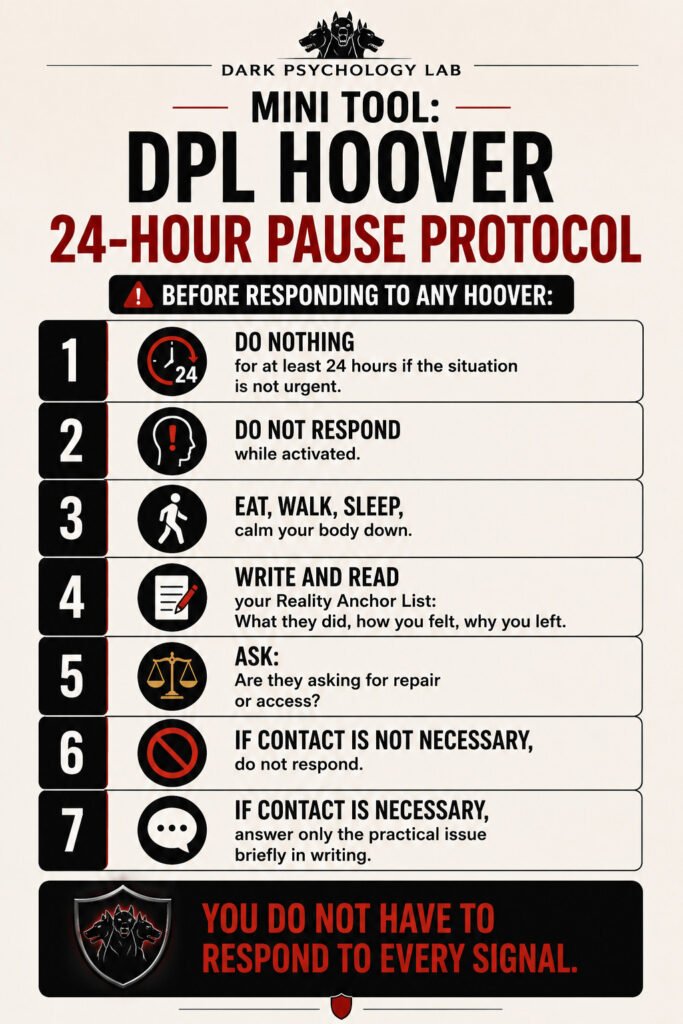
A visual tool designed to be used as a practical self-protection aid. Download and save it on your phone as a quick reminder before responding to any hoover:
- Do nothing for at least 24 hours if the situation is not urgent.
- Do not respond while activated.
- Eat, walk, sleep, calm your body down.
- Write and read your Reality Anchor List: What they did, how you felt, why you left.
- Ask: Are they asking for repair or access?
- If contact is not necessary, do not respond.
- If contact is necessary, answer only the practical issue briefly in writing.
You do not have to respond to every signal.
Risk Gating: When Hoovering Becomes a Safety Issue
Low risk:
Hoovering can look like a simple message, a like, or a nostalgic “how are you?” If it is a one-time contact, with no threats, no physical approach, no children, no property, no workplace connection, and no other power imbalance, the safest response is to slow down: do not answer from an activated state, block them, or use the 24-hour pause protocol.
Medium risk:
Risk rises when the contact repeats, comes through different numbers, emails, gifts, mutual people, accusations, or “accidental” appearances in your places. In that case, it is worth moving to low-contact: only in writing, only about practical issues, without emotional content, and if possible with clear documentation.
High risk:
If there are threats, stalking, showing up at your home or workplace, physical approach, using children for pressure, reputation attacks, legal pressure, or financial pressure, this is no longer a conversation problem. High-risk hoovering is a safety and documentation issue: a safety plan, a trusted person, evidence, professional help, legal consultation, or police, depending on the situation.
Defense Guides – Practical Self-Protection
Dark Psychology Lab focuses on clarity and self-protection in situations involving manipulation, power imbalance, and covert psychological pressure.
The following defense guides expand on practical tools to reduce psychological damage and regain control:
Psychological Manipulation
Psychological Manipulation Defense: Safe Strategies and Dangerous Tactics Explained
Narcissistic Dynamics
How to Deal With a Narcissist and What to Do When You Can’t Leave
Workplace Mobbing & Toxic Culture
Workplace Mobbing Defense Playbook: 17-Step Guide
Disclaimer
Only a qualified mental health professional can diagnose Narcissistic Personality Disorder or any other personality disorder. Dark Psychology Lab is an independent research and educational project. We are not diagnosing anyone in your life, and this article should not be used as a clinical label, medical advice, or legal advice.
This article is a recognition and self-protection tool. Its purpose is to help you understand possible manipulation mechanisms, reduce confusion, document reality, and make safer decisions. It is usually pointless to confront a narcissistic or highly manipulative person with this kind of material. In many cases, confrontation can lead to denial, blame-shifting, retaliation, escalation, or increased psychological pressure. You are responsible for your own actions and for the consequences of how you use this information.
If there is physical danger, stalking, coercive control, legal pressure, children, shared property, workplace power imbalance, or any other high-risk factor, prioritize safety and get professional help.
For the full legal and safety notice, read our full disclaimer page.
Dark Psychology Lab
Original content based on lived experience and independent psychological analysis.
If reading feels exhausting right now, audiobooks can be an easier way to absorb information.
Listen on Audible