
The narcissist discard phase is the stage in the narcissistic cycle where the narcissist removes a devalued target from their emotional and social environment, often with coldness, cruelty, or contempt.
In long-term relationships or social ties, a discard tends to follow after a gradual process of devaluation: the person is criticized, humiliated, reduced in status, and mentally reclassified until cruelty becomes easier to justify (Steiner, 2006). What was once a valued reflection becomes an object that destabilizes the narcissist’s internal world.
The discard phase is where the mask begins to fail. The face that appears during discard is the one that has been hiding under the facade from the beginning.
Narcissistic Cycle Overview: Discard Phase
This article is part of the Narcissistic Cycle series.
Idealization→ Devaluation→ Discard → Hoover → Repeat
To understand how all phases connect into one repeating abuse mechanism, read:
Narcissistic Abuse Cycle Explained
In this article, we will explain the core mechanics of the narcissist discard phase. It does not matter whether the narcissist was your friend, lover, coworker, or business partner. This model repeats on a global scale. It does not always look exactly the same, because narcissistic people are still different individuals. But once the narcissistic abuse cycle is activated, their behavior becomes more predictable.
We aim to provide clarity by deconstructing narcissism as a biological and psychological system. Once you understand the mechanism, their behavior becomes less incomprehensible. It may still be cruel, but it becomes easier to recognize. It works like an internal algorithm. When you understand how the system operates, you can identify it sooner and reduce the chance of repeating the same mistakes.
This is not a diagnostic tool. Narcissistic Personality Disorder can only be diagnosed by a qualified mental health professional.
TL;DR:
- How the discard phase begins and why it escalates.
- The antagonistic core: one of the main reasons behind the discard.
- The main trigger: narcissistic injury caused by a devalued person.
- Narcissistic self-regulation: the core discard mechanism.
- Why does discarding feel dehumanizing?
- A short overview of how different narcissistic types behave during discard.
- The consequences of the narcissistic discard phase and what to do next.
Download the Manipulation Recognition Guide
Not sure if you are being manipulated by a narcissist? Take a test. Press a button below. Sign up for Dark Psychology Lab, and we will send it to your email.
The Beginning of the Discard Phase
If you have known the narcissist for a long time or have been in a relationship with them, they may become your “enemy during hardship” instead of someone who helps you get through difficult or unexpected stages:
- When you are already hurting, they add more pain.
- When you need help, they spit in your face.
- When you try to clarify what happened, they lie.
- When they need help, they stop respecting boundaries and simply take what they want.
If the person remains exposed to the cycle, the narcissist’s degrading behavior can make their vulnerability more visible. As this vulnerability becomes harder to hide, the narcissist may fail to tolerate it and escalate the devaluation phase. Control then increases through overt or covert pressure, possibly to force the person back into their previous role or force them to submit, extracting narcissistic supply in the process.
For example, in some cases, dissonance appears when the narcissist humiliates, criticizes, and attacks while trying to “change” a person who no longer fits their image, but the pressure does not restore the person. It lowers them further and intensifies the narcissist’s resentment toward them, in the process creating a vicious cycle that the narcissist often does not consciously understand and repeats over and over again.
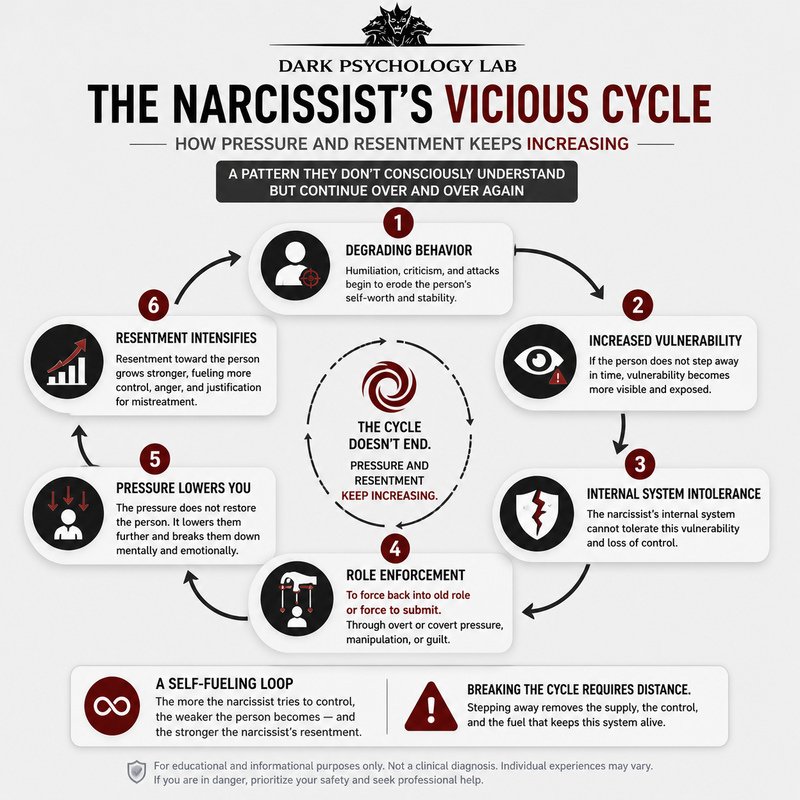
In other cases, the narcissist is not even trying to “change” the person. They simply need a narcissistic supply: visible pain, social humiliation, a reaction, submission, or confirmation of their grandiose self-image. In that state, the person is treated as an object through which the narcissist regulates their internal state.
When Devaluation Turns Into Discard
The main damage in narcissistic relationships develops over time, through repetition. When a person is constantly exposed to criticism, contempt, or subtle hostility, the harm accumulates. That is how devaluation works. It is a gradual weakening of a person’s internal state, and over time, it can erode their self-worth and stability (Ngwu et al., 2023).
As a result, more vulnerable points become visible, and the narcissist becomes even more repelled by the person. Their behavior becomes crueler, more controlling, more manipulative, and more intense. In some cases, it may escalate into abuse or violence.
Technically, this is the beginning of the discard phase. In most cases, it does not end until the person or the narcissist disengages.
Why Narcissists Discard: Antagonistic Self-Protection System
DPL framework: the antagonistic core model
According to the trifurcated model, the shared core of grandiose and vulnerable narcissism is interpersonal antagonism: hostility, manipulation, entitlement, callousness, and reactive anger. Grandiose and vulnerable narcissism are separated by other layers, but antagonism connects them both (Weiss et al., 2019). This behavioral antagonism can be understood as a hostile self-protective mode, distinct from the confident narcissistic image visible on the surface.
The nervous system of narcissists and other dark triad personalities also appears to be adapted to this kind of model. Because of neuroanatomical deficits in the prefrontal and insular regions of the brain, their capacity for affective empathy is significantly diminished, which impairs their ability to establish authentic social connections. This naturally means less empathy. As a result, the defensive status mechanism can operate cruelly, with no regard for the other person’s well-being (Nenadic et al., 2015).
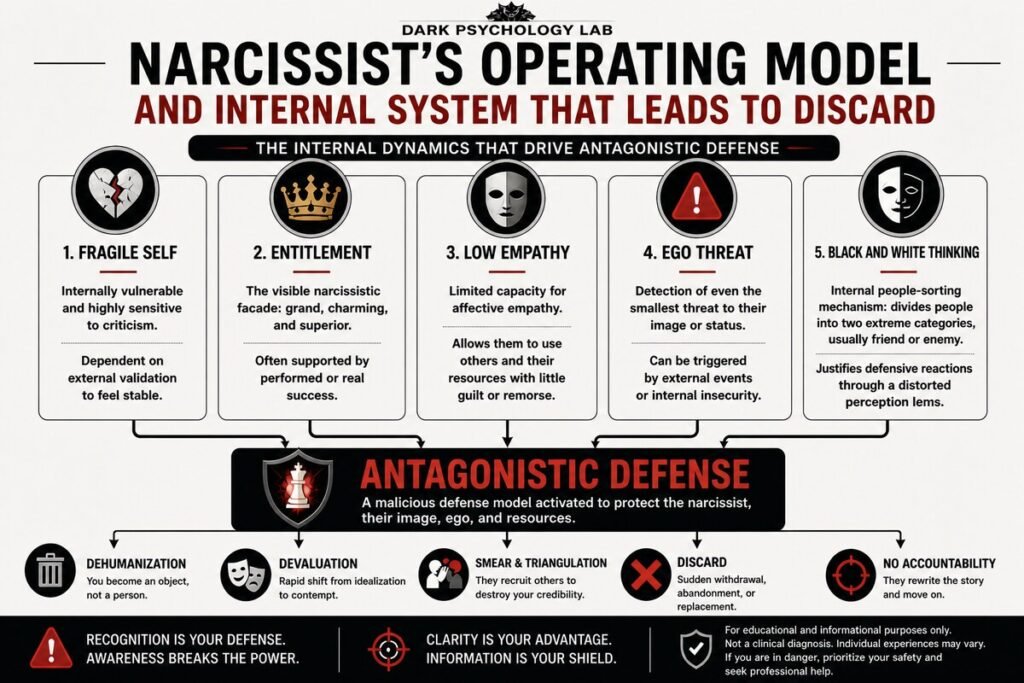
If we break down the narcissist’s operating model and internal system, their main motivation during discard looks roughly like this:
- Fragile self: internally vulnerable and sensitive to criticism, dependent on external validation.
- Entitlement: the visible narcissistic facade on the surface, the grand, charming image, sometimes supported by performed or real success.
- Low empathy: the ability to use other people and their resources without much guilt or remorse.
- Ego threat: the detection of even the smallest threat to their image, whether external or internal, which forces them to defend their fragile system.
- Black-and-white thinking: an internal simplified people-sorting mechanism that divides people into two extreme categories, usually friend or enemy.
All of this leads to an antagonistic defense, a malicious defense model designed to protect the narcissist, their image, their ego, and their resources, whether those resources actually belong to them or to others.
The Psychological Mechanism of Narcissistic Discard
Discard usually happens when several factors connect inside the narcissist’s system:
- They feel insulted, sometimes for minor things or strange reasons.
- You resist their control and enforce boundaries.
- They have already devalued you, so they feel far above you.
- They know your vulnerability.
- They see you as a threat to their status, image, or internal reality.
- A specific action you take that triggers the discard.
Formula:
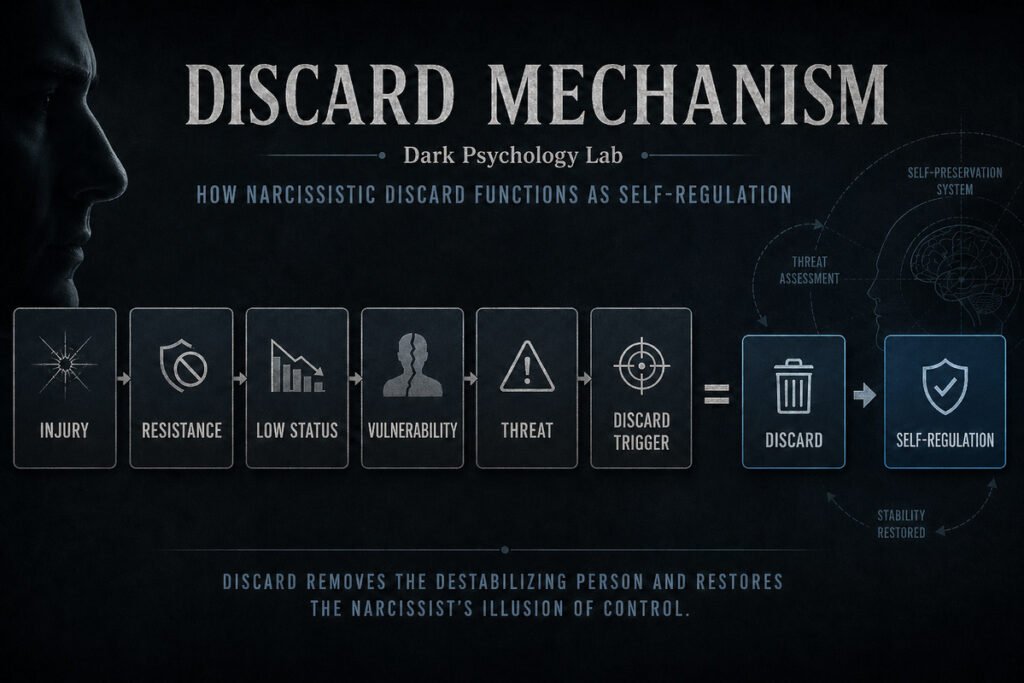
These factors are not equal or independent. They can reinforce each other, varying depending on the type of narcissist. This formula is used as an educational tool, not as a precise model.
Injury + resistance + low status + vulnerability + threat + discard trigger = discard → self-regulation
The discard is an antagonistic self-regulation response. When a person triggers an ego threat or narcissistic injury, they may be rebranded as defective through devaluation. From there, the likelihood of antagonistic defense, including discard, increases with threat intensity, social context, and personality subtype, while psychopathic traits may intensify the response. To regain the illusion of control, the narcissist removes the devalued target from their environment. This external removal helps stabilize their internal state and restore the grandiose self. The act is then justified by rewriting reality: the person becomes “the problem,” “the failure,” or “the one who caused it.” Blame is shifted outward, effectively attributing the narcissist’s chronic internal dissatisfaction to the devalued and discarded person (Miller et al., 2021).
For most people, this phase is painful. It can damage reputation, self-trust, trust in others, self-worth, and, in some cases, leave deep psychological trauma or worse. But once you understand the narcissist’s internal operating models more clearly, the discard phase becomes easier to read. It is a psychological and biological response to a threat to status.
That is why the best way to win is often to stop participating. Knowing all of this, is it really worth stepping into the narcissist’s game in the first place?
The Narcissistic Facade: How Social Image Protection Leads to Discard
The narcissist maintains the external image that is a narcissistic facade through the people around them, treating interactions like an exchange: I give you my charm, and you give me confirmation of my perfect ego.
Their perfect self-image cannot tolerate weakness or vulnerability, which often surfaces as relationships continue or when life becomes difficult. If you open up and show too much of that vulnerability, the narcissist may start feeling disappointed in you, devalue you, and eventually discard you if you do not submit to their control, which in some cases can be diminishing and brutal (Edershile et al., 2022).
If you want to learn more about the superficially constructed version designed to maintain their social image, read:
The Narcissist Facade Explained: Charm, Image, and the Hidden Emptiness
Narcissistic Shame and Status-Based Self-Regulation
Narcissistic injury usually comes from the shame the narcissist feels, because their self is dependent on external sources. This makes them hypersensitive to social evaluation. Even small actions from a devalued person, such as setting a boundary, giving criticism, stepping back, or becoming clear, can feel like a threat to their self-structure and social status (Gefen et al., 2020).
Because of their need to display achievements, appear superior, react quickly to status signals, and defend themselves against shame, narcissistic people can look more strongly tuned to the biological dominance hierarchy than most people. A deeper analysis suggests a possibility: certain narcissistic behaviors may be biologically adapted to exploit others for internal self-regulation. Campbell, Brunell, and Finkel’s agency model of narcissism supports this direction by framing narcissism through interpersonal self-regulation and agentic strategies (Campbell et al., 2006).
In simple terms, discard is often a status-defense reaction.
Narcissists are quick to detect or impose status-based meaning on any situation where such an interpretation is possible. Other people become mirrors or status tools, and relationships become more about managing their internal state. They then employ self-regulatory strategies to shield their fragile internal self, one of which is the narcissistic discard phase.
Narcissistic Rivalry: The Core of the Discard Engine
If you defend your position or fight back against the narcissist while you are already in a devalued and vulnerable phase, they may try to destroy you as a direct rival to their status. This is narcissistic rivalry. Because of low empathy, they can do this with cruelty. Because of social norms, they usually avoid physical violence.
At this stage, social humiliation appears. You may see behavior such as:
- A man humiliating another man in front of women or in social settings, functioning as an overt status reduction move between competitors.
- A woman may smear her “friend” to everyone, which is a covert smear campaign.
- Between romantic partners of different sexes, contempt and disregard appear from the narcissist’s side.
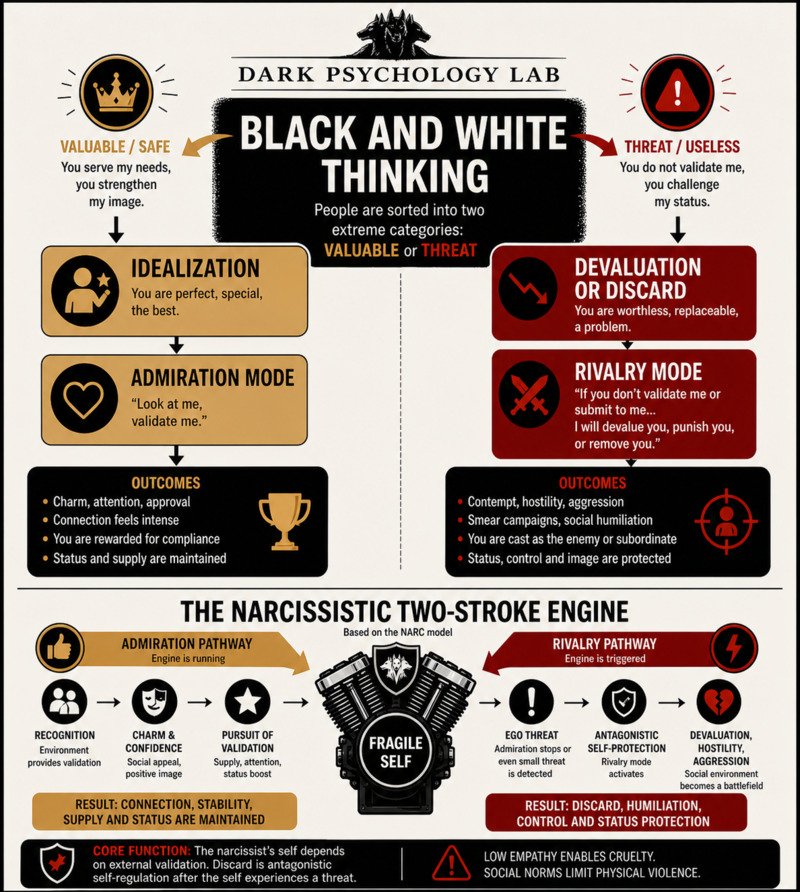
Based on the NARC model, narcissistic behavior can be understood as a two-stroke engine. Because of black-and-white thinking, it can look like this:
- During idealization, admiration mode was active: “Look at me, validate me.”
- During devaluation or discard, rivalry mode activates: “If you do not validate me, submit to me, I will devalue you, punish you, or remove you.”
As long as the environment provides recognition, the admiration pathway is active: charm, confidence, social appeal, and the pursuit of validation. But when admiration stops, or the narcissist detects even a small ego threat, the rivalry pathway can be activated. This is an antagonistic self-protection system. Its goal is to protect the fragile self through devaluation, hostility, and aggression, turning the social environment into a battlefield for superiority (Szücs et al., 2024).
This means that the devalued and humiliated person falls far below the narcissist in their dominance hierarchy. In the narcissist’s eyes, this person is fit only for the role of a subordinate or a controlled object. Because of that, any action from this person can become a direct threat to the narcissist’s social status.
When the self depends on external validation, the social environment becomes a means of sustaining itself. That is why narcissistic discard is antagonistic self-regulation after the narcissist’s self experiences a threat.
Dehumanization: Why Discard Feels Dehumanizing
During devaluation, the narcissist lowers your value to such a degree that they can later treat you with cruelty while remaining partially disconnected from guilt. In social psychology, dehumanization is one mechanism that can weaken moral self-restraint and make harmful behavior easier to justify (Bandura, 1999). Bandura’s work on moral disengagement describes how self-censure for harmful conduct can be weakened when the victim is stripped of human qualities (Bandura et al., 1996).
The Stanford Prison Experiment is a controversial but useful illustration of this principle: once participants were placed into roles of guards and prisoners, the “prisoners” were reduced to numbers, uniforms, and, at times, blindfolded during processing, reinforcing loss of identity and a lower-status category, while the “guards” escalated into cruel and dehumanizing treatment (Stanford Libraries n.d.).
At a broader level, similar patterns of exclusion and aggression toward more vulnerable individuals have been observed in animals. For example, chimpanzees sometimes attack weaker or injured group members (Shimada et al., 2023). Similar behavior has also been observed in rodents, birds, fish, and reptiles. In those systems, vulnerability can signal elimination.

These examples examine different domains, and human behavior cannot be directly equated with that of animals. However, they may point to the underlying principles of dominance hierarchies, in which those in stronger positions can benefit at the expense of those in lower positions (Tibbetts et al., 2022). In the narcissistic discard phase, something structurally similar can occur. When a person loses their function, their value can drop sharply, making removal from the system easier.
The underlying principle of the narcissistic discard phase can resemble a more primitive survival mechanism: hostile, malicious, and cruel. This is why the discard often feels dehumanizing.
Narcissistic Discard Triggers
Any defensive behavior from the wounded person may create a strong narcissistic injury, which becomes one of the main discard triggers.
Discard triggers. Main reasons that make the narcissist discard the devalued target:
- Boundary and resistance: when you do not submit to the narcissist’s control. They feel that despite everything they do to you and every manipulation attempt, you are still holding your position and fighting back.
- Exposure threat: when there is a risk that the narcissist will be exposed. This can cause sudden escalation. The narcissist may attack harder and faster, using any means necessary to discredit you and force a quick, often brutal discard.
- Need for support, or “enemy during hardship”: when you become vulnerable and ask for help, but receive contempt or coldness instead. In the narcissistic system, this may be treated as a burden, a threat, or an inconvenience. As a result, the person receives coldness exactly when they needed humanity the most.
- Rejection threat: when the narcissist senses that you may leave first and tries to discard preemptively. Covert narcissists can be especially sensitive to this. During the idealization phase, they are highly insecure about rejection and usually try to appeal to the target. Near the discard phase, they cannot tolerate the idea that someone they see as “lower status” could be the one to leave them.
- Becoming better than the narcissist: when you stabilize, become independent from the narcissist, start thinking more positively, and begin doing well while still remaining within their influence range. If you were previously devalued, your success can trigger injury and envy.
How the Narcissist Regulates Their Inner Self Through Discard
Morf and Rhodewalt describe the narcissist as a self-regulation system: a grandiose but vulnerable self constantly seeking external validation, with much of this process happening in the social world. When the environment stops providing validation or threatens the self-image, the system begins to defend itself (Morf & Rhodewalt, 2001).
The narcissist discards when another person starts destabilizing them. Through it, the narcissist not only removes a threat to their image. They may also receive a sadistic form of narcissistic supply from the other person’s suffering. This mechanism becomes especially powerful when the pain is visible, social, and clearly caused by the narcissist’s own actions. In their internal world, this can serve as proof of control, power, and superiority, temporarily stabilizing their fragile, grandiose self (Ameen et al., 2025).
Learn more about how narcissists obtain supply and the forms it takes:
Narcissistic Supply: What Narcissists Feed On.
When a person starts activating shame, exposure risk, or loss of control, the narcissistic system can switch from charm to attack. Discard is one of the exits of this attack mode that:
- Reduces internal shame and shifts blame away from the narcissist.
- Restores their sense of superiority.
- Brings back the illusion of control.
- Stops the ego threat.
- Protects their constructed image (narcissistic facade).
- Allows them to switch to a new source of supply.
- Closes the risk of exposure.
Why Discard Escalates
When the narcissist feels threatened, they often attack several times harder and increase the pressure. The more the person resists, the more the narcissist tries to regain control.
At this point, their whole arsenal can be activated: silence, passive aggression, blame-shifting, lying, triangulation, gaslighting, social pressure, coercion, financial leverage, and emotional leverage, or more.
The darker the antagonistic core, the fewer brakes there are. Malignant or strongly psychopathic traits in narcissists can mean faster discrediting, lower empathy, and greater cruelty. A covert type may look calm, sensitive, or innocent on the outside, but that does not mean their actions are less destructive. The core remains the same. Indirect cruelty is still cruelty (Amiri & Behnezhad, 2021).
How Different Types of Narcissists Discard
Different types of narcissists can look very different, but during the discard phase, they often connect through the same logic: removing a person from their social circle.
The overt narcissist lowers your status through dominance. They may leave while placing you lower in the social hierarchy. Overt discard breaks a person through force, exploitation, and social humiliation.
The covert narcissist lowers your clarity through confusion. They may leave you dependent on answers, trapped in a trauma bond, and mentally exhausted after gaslighting and other manipulations. They leave behind a kind of clarity that will never come. Covert discard breaks a person psychologically and emotionally.
The malignant narcissist attacks when your status, clarity, or nervous system is already damaged. They may try to turn your weakness into final destruction and gain sadistic satisfaction from it. Malignant discard hits an already open wound; they act with malevolence. The outcome is situation and setting-dependent.
This is the short version of the model. In real situations, these discard patterns can overlap, escalate, and take different forms depending on the narcissistic type, the target’s vulnerability, and the social environment around them. For the full recognition tool, read:
Narcissistic Discard by Type: Overt, Covert, and Malignant Narcissists.
Social Circle, Smear Campaign, and Workplace Power Imbalance
Involving the social circle is not required for the discard phase. In some cases, it happens privately. However, because the narcissist is a highly social being, they regulate themselves through their environment and protect their position within it, often intensely and sometimes aggressively. As a result, others are frequently drawn into the process. The social environment carries significant weight for the narcissist. In this sense, they may perceive public discard as a more effective way to inflict damage.
After narcissistic injury, the narcissist may try to push you out of the social circle, damage your reputation, interfere with your work, and poison communication around you.
Social tools and their goals:
- Flying monkeys: pressure, monitoring, message delivery, and information gathering (for more information, see: Narcissist Flying Monkeys).
- Victim narrative: the attempt to look abandoned, hurt, or victimized in order to receive support.
- Smear campaign: the goal is to neutralize your version, shape the social narrative, and indirectly damage your reputation.
- Triangulation: the attempt to pull more neutral people into the narcissist’s game.
- Proxy manipulations: the goal is to create the feeling of being attacked from all sides, increase confusion, and create a fog of isolation.
In the workplace, the risk is higher because power imbalance changes the rules. If the narcissistic person has higher status, access to reputation, the manager’s ear, group support, or control through work processes, discard can look like a systematic hierarchical humiliation of one person to force an exit through techniques such as mobbing, quiet exclusion, and reputation damage (Lousã et al., 2025). We have prepared a guide to help you recognize and protect your reputation during the narcissistic devaluation phase in the workplace. Read more:
How to Work With a Narcissist During the Devaluation Phase
What the Discard Does to the Target
After the discard phase, people often experience shock, obsessive thinking, insomnia, body reactions, a withdrawal-like feeling, and a collapse in self-worth. If there was manipulative pressure involved, the question often appears: “Did I imagine all of this?” (Kacel et al., 2017). Depending on the psychological shock, this can contribute to PTSD or CPTSD (Aprigio et al., 2024).
The first stage is often a nervous system crash. Later, when the person begins to see the whole sequence, discard can become a moment of retrospective clarity. The pain itself was damaging. It was harmful. But the clarity it reveals can become a defensive value in the future.

Sometimes pain does more than break a person. It can also force them to see what they could no longer deny. When the mechanism becomes visible, it can no longer operate in the dark.
Risk Gating
Not every discard situation has the same level of safety, so the first step is to realistically assess the risk.
In low-risk situations, emotional withdrawal, limiting information, and reviewing the situation with your own trusted circle are usually enough. The goal is to avoid creating additional escalation.
In medium-risk situations, more careful action is needed: reduce contact, filter the social environment, set boundaries, and if this is happening at work, calmly document facts without impulsive confrontation.
In high-risk situations, any attempt to publicly expose, retaliate, pressure, or force the narcissist to admit the truth usually increases the damage. This is especially true when there is a power imbalance or social support on the other side.
The most important rule: if there is any risk of physical violence, stalking, threats, financial control, or workplace power imbalance, safety and professional help must come before any desire to prove your truth.
What to Do During the Discard Phase
When the discard phase begins, the goal is not to win the argument. The main task is to reduce damage.
- Stop explaining: If the person already sees you as a threat or a problem, your explanations can become new material to use against you.
- Reduce exposure: Limit information, emotional reactions, and access to your weak spots.
- Document facts, especially in the workplace: Dates, messages, screenshots, incidents, and witnesses. Use real facts and avoid drama.
- Protect reputation quietly: Do not blow up the situation impulsively and emotionally. In many cases, stability is stronger than public fighting.
- Use strategic distance: No contact is not always possible. If children, work, money, or a shared business are involved, reduce access gradually.
- Do not chase closure: The person who created the wound will often not be the one to explain it honestly.
Main rule: less emotional material, less leverage.
Defense Guides – Practical Self-Protection
Dark Psychology Lab focuses on clarity and self-protection in situations involving manipulation, power imbalance, and covert psychological pressure.
The following defense guides expand on practical tools to reduce psychological damage and regain control:
Psychological Manipulation
Psychological Manipulation Defense: Safe Strategies and Dangerous Tactics Explained
Narcissistic Dynamics
How to Deal With a Narcissist and What to Do When You Can’t Leave
Toxic Workplace
Workplace Mobbing Defense Playbook: 17-Step Guide
Closing: The Pattern Becomes Visible
Discard often feels like a defeat. But in many cases, it is the moment when you stop functioning inside their system. You become harder to control, harder to deceive, and harder to pull into their chaos.
On that day, it may feel like a nervous system collapse. Freedom often comes later, when you begin to see the whole sequence: through pain, awareness appears.
The greatest value after discard is not revenge. The greatest value is clarity. Once you see the mechanism, it can no longer control you as it did before.
Disclaimer
This article is for educational and informational purposes only. It is not a diagnostic tool and should not be used to diagnose Narcissistic Personality Disorder, narcissism, PTSD, CPTSD, or any other mental health condition.
Dark Psychology Lab is an independent educational project. We are not psychologists, psychiatrists, therapists, or lawyers. The content on this website is based on behavioral analysis, research interpretation, personal observation, and independent study. For more information, read our full Disclaimer page.
If you are experiencing abuse, stalking, threats, violence, coercive control, workplace retaliation, or serious psychological distress, seek help from qualified professionals, local emergency services, legal advisors, or trusted support organizations in your area. If there is any risk of physical harm, prioritize safety.
Dark Psychology Lab
Original content based on lived experience and independent psychological analysis.