

Flying monkeys are a common feature of narcissistic dynamics. They are people through whom a narcissist or another manipulator acts, either directly or indirectly. In general, they are influenced individuals who may not even realize the role they are playing. Who would knowingly take on the role of a flying monkey?
When things are going well, and the relationship appears stable, there is no need for the narcissist to build a false narrative about you. As a result, the environment tends to stay neutral. If the narcissist has more influence, people may even respond to you positively. You might notice that others are drawn to you, that you get invited to events, or that you receive opportunities without putting in extra effort.
Nothing seems wrong. In fact, everything may feel almost too good. This layer is hard to see from the inside.
The social dynamics behind flying monkeys become more visible when the relationship with the narcissist begins to break down, although it can sometimes be recognized earlier with enough awareness and an understanding of narcissistic dynamics.
TL;DR: Understanding and Recognizing the Flying Monkey Social Mechanism
- Flying monkeys are proxies influenced directly or indirectly by the narcissist. At a deeper level, they emerge from a broader pattern of narcissistic self-regulation through the social environment.
- Because they are still people, the concept is broad. Different motives can pull them in, but the common structure is a social dominance hierarchy that narcissists tend to create around themselves.
- A framework for recognizing flying monkeys by type: neutral, active, and covert.
- Self-acceptance as a counter-strategy against social rejection and isolation, reducing how much external pressure can shape your internal reality.
Flying Monkeys and Their Role in Narcissistic Dynamics
Narcissistic flying monkeys are proxies who have been successfully influenced. Their structure more closely reflects conformity (Cialdini & Goldstein, 2004) and prestige bias: people tend to align with socially successful or high-status individuals, or with those who are better at presenting themselves that way.
Because flying monkeys have their own agency, personalities, and preferences, it is difficult to assign them a single, fixed role. The concept is broader than “malicious people being controlled.” They are often simply influenced individuals acting on their own values and beliefs, usually convinced their behavior is justified. Some may not even know what narcissism is or understand what they are supporting, while for others, the role may simply be convenient.
Within a narcissistic dynamic, however, their functions can differ:
- provide support;
- gather information;
- defend the narcissist or protect their image;
- increase pressure on the target of narcissistic devaluation;
- reinforce smear campaigns and the narcissist’s version of events;
- reinforce narcissistic grandiosity: influence over the group itself becomes a source of narcissistic supply;
- help the narcissist regulate themselves through validation from the surrounding group (Morf & Rhodewalt, 2001).
Here, we focus on the narcissist’s internal drivers, how they recruit others and turn them against a person, and how to internally handle group pressure.
If you want to better understand group pressure dynamics and how group control through narrative works, we analyzed the mechanism in detail in our article:
Manipulation by Proxy
Download the Manipulation Recognition Guide
Not sure if you are being manipulated by a narcissist? Take a test. Press a button below. Sign up for Dark Psychology Lab, and we will send it to your email.
Why Narcissistic Environments Involve Flying Monkeys
To understand why flying monkeys repeatedly appear in narcissistic dynamics, we first need to explain the narcissist’s general operating model.
Narcissists are highly social in the way they perceive themselves and the world around them (Eddy, 2023). Their internal state depends heavily on reflection from the social environment and feedback from other people. As a result, they seem naturally adapted to operate within social dynamics. This environmental mechanism is an important part of narcissistic self-regulation and is partly connected to narcissistic supply, helping to fill internal insecurity and a sense of emptiness.
Narcissistic Social Self-Regulation Model
A simplified model of narcissistic functioning:
- A fragile and vulnerable self, which the narcissist tries to hide through deception from both themselves and others, while remaining highly dependent on external evaluation.
- The narcissistic supply mechanism, in which recognition and validation create a certain dependence on the surrounding environment, pushing the narcissist to become more socially active.
- An antagonistic core, meaning a different way of perceiving the social world, which naturally pushes behavior toward hostility, competition, and status games.
- A facade, designed to hide these parts while helping the narcissist adapt and establish themselves within social hierarchies.
Such a combination of traits seems almost adapted to operate through the social environment. It can even resemble a survival model shaped through evolution, which we discussed in more detail in the article:
The Narcissistic Abuse Cycle Explained: Why They Repeat the Same Pattern
Flying Monkeys as a Part of Narcissistic Social Self-Regulation
Flying monkeys are recruited through the operation of this whole model.
A narcissist who regulates themselves through the social environment can appear attractive, distinctive, or bolder to other people. As a result, they may gradually establish themselves as an authority, creating a hierarchical structure around them. This also helps explain why they tend to filter their social environment and keep those they can influence closer. A strong facade, dominant personality, and persuasive communication, often related to their character, make this even easier.
People often accept this because they are naturally more likely to align with the side that appears stronger and higher in social status (Kim et al., 2021).
How Do People Become Flying Monkeys
Flying monkeys can be recruited in many ways. Some people become actively involved, while others begin supporting the narcissist without recognizing their role.
- Through status, authority, and alignment with the stronger side. People may support whoever appears stronger, more confident, or more socially convincing. In some cases, people simply follow direct orders and target selected individuals.
- Through a shared vulnerable target. When someone is publicly humiliated, others can become involved through laughter, comments, and participation. A shared narrative forms around the target, reinforcing both the behavior and the position of the person leading it.
- Through antagonistic personality traits. If pressure is being applied to one vulnerable person, others may join in simply because they can. They may enjoy it.
- Through fear and the desire to avoid becoming the next target. Driven by conformity, some may be afraid to stand out from the group despite their beliefs, reinforcing the narcissist’s narrative and acting in their favor.
- Through an appealing facade and trust. A charming, helpful, and convincing person earns the trust of those around them. People begin supporting their image and accepting their interpretation of events.
- Through special attention, idealization, and emotional attachment. Someone who initially receives exceptional treatment may begin to trust the manipulator and defend their image.
- Through attraction. Physical or social appeal can draw people closer, while those influenced by that attraction act in the narcissist’s favor.
- Through “playing the victim” as a defensive manipulation tactic. The manipulator frames the situation so that supporting them appears morally justified. Others become involved believing they are protecting someone who has been mistreated.
- Through distorted stories and discrediting the target. False or misleading accounts circulate among friends, coworkers, neighbors, and family members. Those who accept this version may begin criticizing, pressuring, or excluding the target.
- Through existing relationships and loyalty. A longtime friend or mutual acquaintance may share information, support the narcissist, or encourage reconciliation. Their involvement can grow through ordinary conversations, without them recognizing how their actions are being used.
Generally, flying monkeys usually become targets of manipulation themselves, as techniques such as triangulation, love bombing, intermittent reinforcement, authority pressure, smear campaigns, and narrative control through selective information restriction are used on them, subtly transferring control to the manipulator.
Most people do not become flying monkeys consciously. They respond to situations that feel safer or more acceptable. Others join voluntarily. It depends on the person.
Narcissistic Social Hierarchy as a Breeding Ground for Flying Monkey Dynamics
A narcissistic hierarchical structure does not necessarily mean holding a higher position at work, having a clearly better financial situation, or occupying a higher social position. It is more about how they interact with the people in their social circle.
Because of their antagonistic nature, narcissists are more likely to understand their environment through power dynamics: “If I am above, you are below.” Both overt/grandiose and covert/vulnerable narcissists, regardless of their different facades, share the same antagonistic core (Jauk & Kaufman, 2018). Interestingly, despite its “sensitivity,” vulnerable narcissism has even been studied alongside psychopathic traits as part of a proposed “vulnerable dark triad” (Miller et al., 2010).
This “above and below” logic is communicated through their behavior toward certain people and, in part, becomes a way of regulating their own status through others:
“If I have access, if I can humiliate you, perhaps even publicly, then I am above you.”
Public Conditioning of the Target
A public display of power can generate a large amount of narcissistic supply. This helps explain why narcissistic environments involve humiliation, drama, gossip, smear campaigns, and repeated judgments about who is “good” and who is “bad.”
But another effect is that the surrounding group sees it. Often without fully realizing it, people begin to perceive the person being treated poorly and smeared as lower in the social hierarchy (Betancourt et al., 2018).
The narcissist also chooses whom to devalue. They do not treat everyone equally because they keep useful or otherwise “suitable” people closer. This gradually creates a social environment around the narcissist that can turn others against selected targets, not necessarily directly or aggressively. It is more about status games, in which the weaker side gradually loses its voice within that environment.
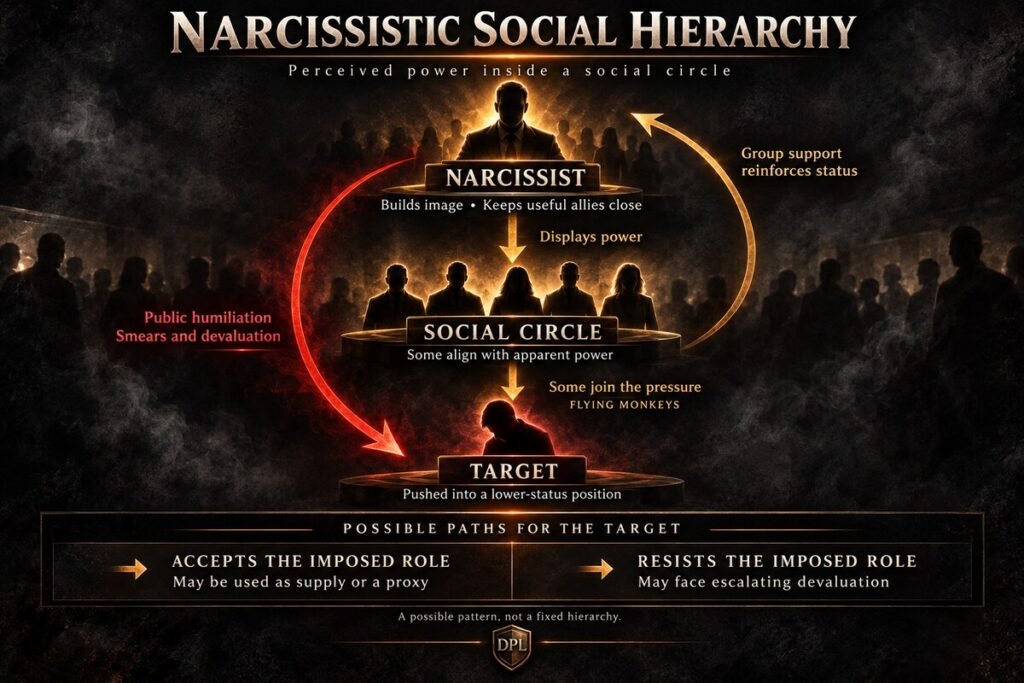
What happens next partly depends on how the person under pressure responds:
- If they accept the lower-status position imposed on them: they may become a source of narcissistic supply, an instrument to be used, or a naive lower-ranking flying monkey the narcissist can use when needed.
- If they resist that imposed position: they may become a target of devaluation, which can then spread through the social environment through gossip, increasingly poor public treatment, repeated “misunderstandings,” dismissiveness, and triangulation, which later makes the discard easier.
We created a systematic explanation of the narcissistic devaluation phase as a recognition map in our article:
The Narcissistic Devaluation Phase
Black Sheep Effect in Flying Monkey Dynamics
Once the target has been pushed into a lower-status position, a smear campaign can turn them into the group’s black sheep. By presenting the person as an idiot, disruptive, or harmful, the narcissist gives the surrounding group a common enemy and a reason to unite against them.
This draws on the black sheep effect, in which people judge members of their own group more harshly when they are seen as breaking group norms, while the narcissist often distorts and exaggerates that perception (Rullo, Presaghi, & Livi, 2015). Thus, while remaining within the same social circle, the target may become the group’s “weak link” and scapegoat, while resistance to that role can itself be interpreted as a threat.
The irony is that a narcissist is so deeply insecure that they have to mask it with grandiosity, both internally and outwardly, yet still dismiss other people as beneath them.
Biological Survival Instincts and Dominance Hierarchy
Through image and social support, the manipulator elevates themselves in the social hierarchy, while through humiliation they push down the status of more vulnerable people, further elevating themselves or at least feeding their ego. At the same time, they tend to avoid stronger individuals, those with higher status, or people who are difficult to influence. They hunt only where they feel safe.
This kind of “show” can create an impression of power, making the narcissist appear more influential than they actually are within the social environment they operate.
For flying monkeys and other people observing this display, older biological mechanisms that still shape human behavior (Eisenberger et al., 2015) may respond less through deliberate reasoning and more through instinct, pulling them toward the side that appears stronger. This survival logic can override moral evaluation. Awareness and morality often come later, as explanations for decisions that were made instinctively (Jonathan Haidt — The Righteous Mind, 2012).
This social dominance hierarchy helps explain, at both the sociological and biological levels, why people are often more likely to support the narcissist’s side. It may feel harsh, but flying monkeys resemble a kind of social herd. Instincts often win over reasoning and values. In reality, there are not that many heroes.
Flying Monkeys as Influence Amplifiers and a Means of Defense
Technically, flying monkeys act as both an influence amplifier and a safety barrier for the narcissist, who is often, though not always, socially established. Their facade is well suited to reinforcing that position.
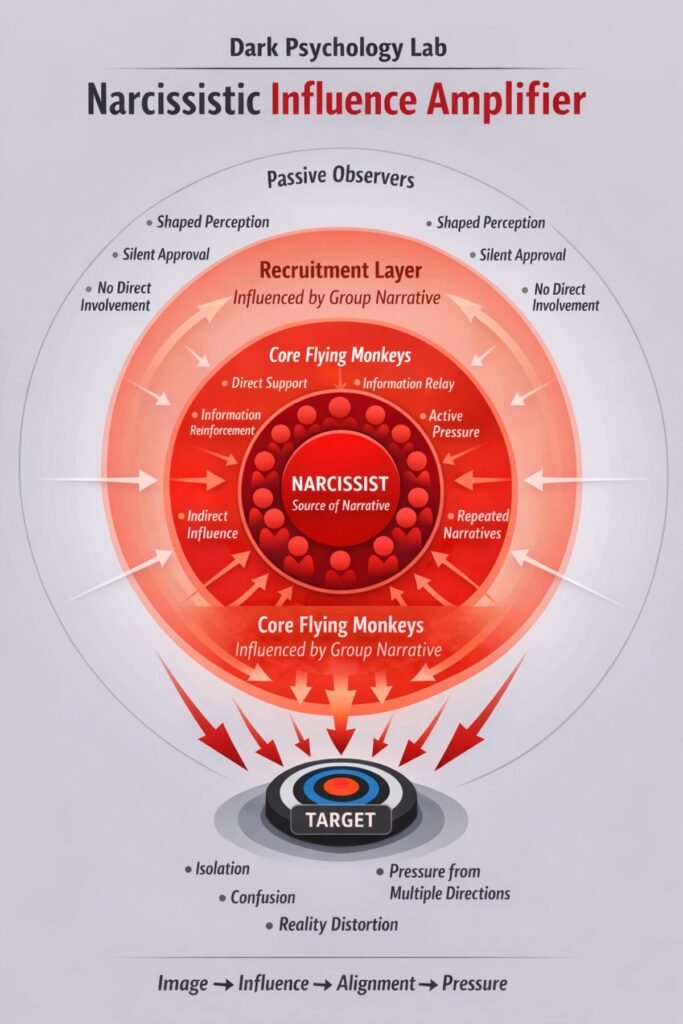
Flying monkeys allow the narcissist to:
- Avoid responsibility: the consequences of the narcissist’s actions are spread across the group, or the blame is shifted onto one of the most vulnerable individuals.
- Spread rumors and damage reputation: information moves through the flying monkey network, allowing narratives about the target to spread without direct contact.
- Test boundaries and probe the target: both passive and active flying monkeys pass information back through the network, helping the narcissist see how the target reacts and where pressure can still be applied.
- Maintain a clean image: a more strategic narcissist first smears the target and keeps enough distance to step back when needed, or stays within an environment that already accepts them.
There are situations, especially in covert or vulnerable cases, where the narcissist wears down the target from within through passive aggression and forms of manipulation that preserve plausible deniability. At the same time, they initiate pressure from flying monkeys through a group in which they are already established, by playing the victim or using sexual appeal. In practice, they barely need to act themselves directly.
A similar dynamic appears in our case study:
Covert and Overt Narcissist Conflict Analysis.
In toxic workplaces, the narcissist’s influence can become so deeply rooted that after a conflict, even seemingly ordinary and decent people begin applying indirect pressure to the target. People accept their sadistic behavior and still regard them as “indispensable experts.”
A similar situation is analyzed in our case study:
Manipulation Analysis of a Machiavellian Malignant Narcissist.
Types of Flying Monkeys and How to Recognize Them
DPL Framework for Identification
We divided flying monkeys into three main types: neutral, active, and covert, so this section can be used as a recognition tool. However, it is important to consider that flying monkeys are still people, which means their behavior and the range of actions they may take can differ depending on the situation.
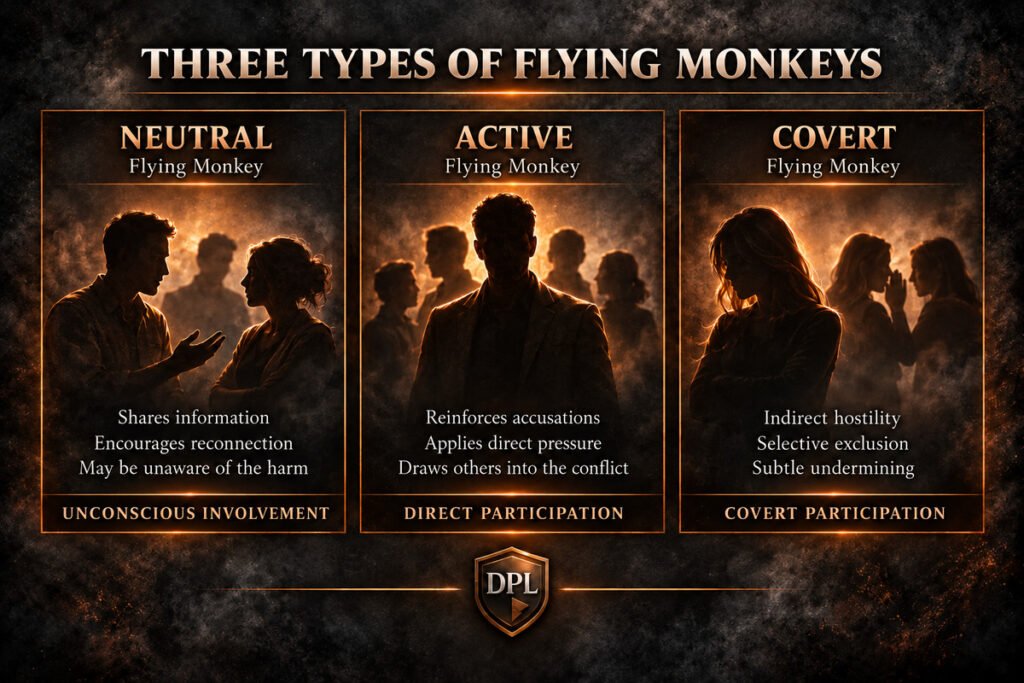
1. Neutral Flying Monkeys: Unconscious Involvement
Neutral flying monkeys are unconscious participants. They probably do not even realize that narcissistic dynamics like this exist or understand how they work. They may see you as an acquaintance, a friend, or simply a neutral person, while seeing the narcissist in much the same way, or even more positively, depending on how effective the smear campaign and devaluation have been.
Recognition signs:
- Do they repeat the narcissist’s narrative?
- Do they pass on information you share with them? Sometimes you can discover this accidentally through “this person said that, that person said this” situations. This is a good indicator.
- Do they suggest that you should reconcile with the narcissist?
2. Active Flying Monkeys: Direct Participation
Active flying monkeys act against the target of their own accord, even if their behavior is orchestrated by the narcissist. They may apply direct pressure, use manipulation that works through ambiguity, carry out orders, actively support the narcissist’s side, and still be convinced that they are acting independently.
Recognition signs:
- Are they being directly instructed? Has hostile behavior toward you appeared without any clear reason? Do they contact you and try to extract information? Have strange phone calls started where, if you do not answer immediately and call back later, the caller suddenly seems to have forgotten what they wanted?
- And then there is the darker version: deliberate gaslighting by proxy. People around you start lying, operating through ambiguity, and repeatedly telling you that you are confusing things, while your nervous system’s pattern recognition signals that something is wrong but cannot fully resolve what is happening.
3. Covert Flying Monkeys: Indirect Hostility
Covert flying monkeys operate on an invisible level. They can be compared to environmental toxins. Their presence can be felt through a worsening emotional atmosphere, passive-aggressive comments, avoidance, or other indirect behavior. In general, active flying monkeys can also use covert tactics, and often do, but what distinguishes the covert type is mainly their mode of operation, which is determined by their character traits, while the intention and function can remain similar.
- Have you noticed that people have started reacting to you differently? Covert flying monkeys spread gossip.
- Have misunderstandings become more frequent?
- Does every attempt to clarify things with them end in avoidance or redirection toward the narcissist or someone in their close circle? That is triangulation.
- Do they carry the conflict into other relationships or levels of authority? Do they repeat the narcissist’s narrative to friends, coworkers, relatives, or other people around you, turning what began as a conflict with one person into pressure from a wider environment?
When Flying Monkeys Become Visible
When dealing with narcissistic environments, it can be difficult to recognize a social system like flying monkeys. Most people do not notice this process while they are inside it or when first encountering narcissism from up close.
Flying monkeys become most visible when the relationship reaches the middle-to-late stage of devaluation, or moves into the discard phase. In many cases, the pain caused by their behavior is what finally opens the target’s eyes. Even then, some people never fully recognize the system operating around them, nor do the monkeys themselves.
Psychological Impact of Flying Monkeys and How to Manage It
Flying monkeys form a group, and it only takes one person alongside the narcissist for that group to begin. For this reason, depending on their type and whether the narcissist has managed to turn the environment against you, the psychological impact can be much stronger than dealing with a single toxic person.
Once you become a target of flying monkeys pressure, it can significantly lower your self-esteem while increasing anxiety. As a result, you may start making more mistakes, overexplaining yourself, and trying to fix the situation with the same people working against you.
It may be friends, coworkers, or even family members. You can start to feel pushed out of your own circle, alone in enemy territory.

Narcissists tend to use your vulnerable spots, moments when you were too open, or times when you reacted negatively, and spread that information throughout the surrounding social environment. On top of that, they build hostile coalitions within your own social circle. This pattern tends to repeat across narcissistic dynamics.
For this reason, radical acceptance can become an important defense. It means accepting the situation as it is, including the fact that some people may have turned against you and that you cannot control how every person sees you (Segal et al., 2025).
That means accepting yourself as well.
Self-Acceptance
Self-acceptance reduces internal pressure. As you integrate rejected parts, unresolved vulnerabilities, past wounds, reactive patterns, and moments when you felt ashamed, there are fewer internal hooks to react to.
Our own reactions reveal where pressure can be applied and what affects us most. Self-acceptance reduces that leverage, making it much harder for the narcissist to apply pressure or discredit you publicly.
This does not stop the narcissist or the surrounding environment from acting against you, but their actions do not have to control your internal reality.
It is not easy, but it is a way forward. The control point gradually shifts from the outside environment back to you.
How to Defend Against Flying Monkeys
The best defense against flying monkeys is understanding how social dynamics work. This article is designed to help you do that.
Start by recognizing their types.
- Neutral (low awareness): Usually harmless and non-hostile, simply influenced by the narrative or carries out the narcissist’s request.
Strategy: a short, clear statement, no extra information, a clear assessment of the situation, and action based on the circumstances. - Active (loyal to the narcissist): they act as a pressure tool.
Strategy: complete emotional shutdown (gray rock). - Passive-aggressive: they slander, gossip, and engage in indirect isolation.
Strategy: set short boundaries and ignore. Do not measure your self-worth by their behavior.
Usually, they are not the main aggressor. If you remove the narcissist’s influence, they would most likely step back as well. The relationship may never be the same again, but inner peace and safety are more important.
The goal is to remove their impact on you. This may mean changing your environment or leaving a group of old friends.
Dark Psychology Defense Guides
We have covered defensive techniques and practical analysis guides designed for self-protection in toxic environments.
Narcissists in relationships and close environments:
How to Deal With a Narcissist and What to Do When You Can’t Leave
Key techniques against manipulators:
Psychological Manipulation Defense: Safe Strategies and Dangerous Tactics Explained
Professional self-protection in a toxic workplace:
Workplace Mobbing Defense Playbook: 17-Step Guide
Final Thoughts
Flying monkeys are not a random layer in narcissistic environments. The more a narcissist depends on a facade such as power, image, and external validation, the more they rely on people around them.
This is why encounters with a narcissist are often more painful than they seem at first. The impact does not come only from the conflict itself. It intensifies when the environment shifts, when people around you become part of the pressure, and when your image is reshaped by group narratives that become increasingly negative as the narcissist’s devaluation progresses.
The earlier you recognize this, the better your chances of protecting yourself.
Disclaimer
This article is based on behavioral patterns and observed mechanisms in manipulative environments. It is not a clinical diagnosis and should not be used to label or diagnose any individual. Narcissistic Personality Disorder (NPD) can only be diagnosed by a qualified mental health professional. We do not assign labels, blame, or make definitive judgments about people.
The goal of this material is to provide clarity and support self-education, so readers can better understand what they may be experiencing and make more informed decisions. For more details, see our full Disclaimer page.
If you feel at risk, unsafe, or overwhelmed, consider reaching out to a qualified professional for support.
Dark Psychology Lab
Original content based on lived experience and independent psychological analysis.