

Different narcissistic types can look like very different personalities. Regardless of the type, many discard a devalued person to extract narcissistic supply and regulate themselves, but they tend to do it in different ways.
One discard can look like an open strike. Another can feel like quiet coldness. A third can resemble a coordinated attack against someone who is already barely holding themselves together.
In narcissistic dynamics, discard becomes the final act of control. The person is pushed out of the narcissist’s social circle and is often left with psychological wounds and damaged social status.
The Narcissistic Discard Phase Expansion: How Different Narcissists Discard
This article is part of a larger series that expands on the main discard phase overview:
The Narcissistic Discard Phase: A Deep Dive Into Antagonistic Self-Regulation.
In this section, we look at how different narcissistic types can operate during the discard phase and what forms narcissistic discard can take.
Many people are harmed not only by the discard itself, but by the confusion around it. They face hostility, psychological pressure, or sudden cruelty, but cannot clearly identify what is happening, why it is happening, or how to protect themselves. Recognizing the type, the mechanism behind it, and how it unfolds can help reduce the damage people experience when they have never faced this kind of malevolent behavior.
This is a recognition tool built for observation, awareness, clarity, and self-protection.
TL;DR
- Different types of narcissism, their discard mechanisms, and how to defend yourself.
- Different types of narcissistic discard and how to recognize them.
- One of the cruelest forms: emotional disposal while staying.
- The general model and analysis of the narcissistic group pressure system.
- Risk-gating defense tool for safer decision-making.
Download the Manipulation Recognition Guide
Not sure if you are being manipulated by a narcissist? Take a test. Press a button below. Sign up for Dark Psychology Lab, and we will send it to your email.
Overt Narcissist Discard: Coercive Dominance
The overt narcissist usually discards more visibly. This type of discard often comes after a devaluation phase, where the person’s status is gradually lowered, and the narcissist’s control keeps increasing. In some cases, that control can move into exploitation, intimidation, or psychological and physical abuse (Day et al., 2022).
At first, it may look like rough jokes, mockery, or pressure, then move to physical or social dominance. Over time, it can begin to feel like a never-ending system of abuse. Your boundaries are pushed, and your weak spots are used against you.
Once the overt narcissist has tested and conditioned the target privately, the pressure moves into the social field. People around you are slowly trained to see you as lower. This gives the narcissist more supply, more witnesses to observe their grandiosity, and more leverage against the target.
This type of discard carries a clear hierarchy underneath it:
- “I am above you, you are below me. This is how it works here. I decide. Do not resist.”
- “You are here as long as you are useful to me. Obey.”
- “When I no longer need you, you will be humiliated or thrown away.”
Overt Narcissist Operating Model During Discard Phase
Before the discard, an overt narcissist tends to try to extract as much value as possible: money, favors, social loyalty, help, status confirmation, or access to the target’s resources. The more they know about what matters to the target, the more leverage they can use. When the resource is depleted or the person begins to defend themselves more strongly, the narcissist may perceive this as a real threat and experience a strong ego-based narcissistic injury (Hart et al., 2021).
The overt operating model is based on escalating coercion. First, the narcissist attacks your confidence and your belief that you can defend yourself, and tries to shape you into a more controllable form. The pressure is continuous, escalating, and status-oriented until you are placed into a position that feels increasingly controlled.
In many cases, during the discard phase, the overt narcissist also begins using more covert tactics: more manipulation, smear campaigns, triangulation, and flying monkeys. Open dominance can turn into covert social warfare.
This is a hard discard. It is visible, forceful, and socially humiliating.
Defense Against Overt Narcissistic Discard
The first defensive step is to stop treating it as a private misunderstanding and to recognize the status game being played around you.
Covert Narcissist Discard: Deception, Attachment, and Silent Control
The covert narcissist discards differently. In the beginning, there is usually no obvious hit, only repeated passive-aggressive behavior. There may be warmth, normality, subtle attention, smiles, help, flirting, or the feeling that this person is safe, but that safety is an illusion (Eddy, 2021).
The manipulative techniques used by this type tend to attach the target both emotionally and psychologically. They create a false sense of safety, which later turns into confusion, pain, and strong attachment, especially when there is romantic or sexual tension involved.
That is exactly why the defense system does not turn on.
The covert narcissistic style is often gradual and indirect. Instead of applying open pressure immediately, they tend to move slowly, guided by emotional influence and ambiguity. They create an emotional field in which you begin to feel seen, chosen, understood, or emotionally safe, and then gradually take it away through coldness, emotional withdrawal, and subtle punishment. After some time, the covert narcissist tends to return to the previous “normal” pattern. If not interrupted, this cycle can lead to emotional exhaustion and condition the target to seek comfort from the very person causing the distress.
The person slowly becomes psychologically disoriented inside the emotional fog:
- “Maybe I misunderstood something.”
- “Maybe she was trying to say something.”
- “Maybe I overwhelmed her.”
- “Maybe I should explain it better.”
- “Maybe I should apologize.”
Note: In this section, we use “she” because some research links vulnerable/covert narcissistic traits more closely with women. This does not mean covert narcissism is exclusive to women. For a deeper breakdown, see our article:
The Narcissistic Woman.
This is where the trap inside narcissistic relationships begins, not just with the covert narcissist but with all of them. The attempt to repair the relationship becomes another way of revealing vulnerability.
With this type of narcissist, open dialogue is often not realistic, unless the conversation is about the weather or their needs. At first, it may even look like they appreciate emotional openness. The problem is that your openness can be exploited for information extraction. Normal advice, such as “tell them how you feel,” “use I statements,” or “communicate calmly,” can backfire if the other person uses your honesty to control you.
Covert Narcissist Operating Model During Discard Phase
The cycle looks like this: warmth → coldness → confusion → attachment → repair attempt → more control → repeat
In the end, the person is not only rejected. They are exhausted. What remains is a trauma bond, nervous system fatigue, brain fog, mood swings, cognitive overload from trying to understand chaos (gaslighting and other manipulations), self-blame, and the painful question: “Why did I attach so strongly to someone who was breaking me?”
The covert operating model is based on ambiguity and deception. They operate slowly. First, they probe your vulnerability, testing the waters over time until they feel safe enough, confident in the target’s attachment, and socially protected enough to begin degrading the target’s reputation. During the process, they often involve other people through smear campaigns, triangulation, the victim role, and flying monkeys. This type works carefully and defensively because protecting the facade matters to them. Then they create enough confusion that you begin to lose orientation yourself.
Once they feel they have control, the behavior can shift to more overt tactics: public contempt, shouting, excessive control, or open humiliation. What began as quiet emotional confusion can become direct domination once they believe the target is vulnerable enough.
This is a silent discard. From the outside, it may look like almost nothing. Inside, it can feel like psychological dismantling.
Defense Against Covert Narcissistic Discard
The first defensive step is to stop chasing clarity from the person creating the fog. When the pattern is confusion, coldness, and control, clarity usually begins with stepping back, documenting what is real, and protecting your nervous system rather than handling the situation impulsively.
Malignant Narcissist Discard: A Strike Into an Open Wound
Malignant narcissist discard is often the most dangerous form because it can begin when a person is already weakened. These individuals tend to react intensely when someone they perceive as lower status, vulnerable, or already damaged threatens their ego. Even a small act of resistance, disagreement, or self-protection can trigger narcissistic injury (Huprich & Malone, 2022).
After an overt narcissist, a person may be left with damaged status, lower self-worth, an exhausted nervous system, and weaker boundaries. After a covert narcissist, a person may be left in emotional fog, attached, confused, full of self-blame, and unsure what is real.
This is the state where a malignant narcissist detects vulnerability. Life may already feel difficult, and then another person appears with more predatory, sadistic, or psychopathic traits, someone who gains satisfaction from another person’s pain. Sometimes they simply notice the consequences: slower reactions, weaker boundaries, lower confidence, heightened sensitivity, exhaustion, and an already overloaded nervous system.
Then the testing begins. The question underneath the behavior can become: “Can I pressure this person and get away with it?”

Malignant Narcissist Operating Model During Discard Phase
Malignant discard is a destruction phase. It can move through public humiliation, social degradation, reputational attack, and psychological destabilization. The exact methods depend on the environment, the narcissist’s power, and how much social or legal control exists around them.
In a corporate or professional environment, the tactics are usually more covert and Machiavellian:
- Gaslighting
- DARVO
- Death by a thousand cuts (DBTHC)
- Involving other people through rumors, triangulation, and flying monkeys
In a closer environment, or in a setting with less monitoring and fewer consequences, the tactics may become more direct and cruel:
- Severe character degradation
- Open malice
- Intimidation or violence
- Stalking or harassment
At this point, the discard becomes an attack on the person’s position, reputation, and psychological stability. The goal can be to damage the target’s ability to stand, speak, defend themselves, and be believed.
The malignant mechanism is predatory. This type tends to strike when you are already weakened, targeting the injured areas directly. In some cases, the target’s pain becomes a source of power, control, or sadistic supply (Faucher & Gamache, 2024).
Even when malignant traits are present, these people can still be socially established. They often have a support circle, a clean public image, or people around them who help normalize the pressure. Their methods vary depending on the setting, their status, and what they can get away with.
This is predatory discard. It can be fast, cruel, and coordinated.
Defense Against Malignant Narcissistic Discard
The first defensive step is to stop expecting fairness from someone who is exploiting your weakness as leverage. When a reputational attack, intimidation, harassment, or coordinated pressure appears, the priority is safety, documentation, distance, and outside support.
Four Types of Narcissistic Discard
These types can overlap in real situations. The point is not to try to label every moment precisely, but to recognize the function: replacement, punishment, exposure control, or emotional removal.
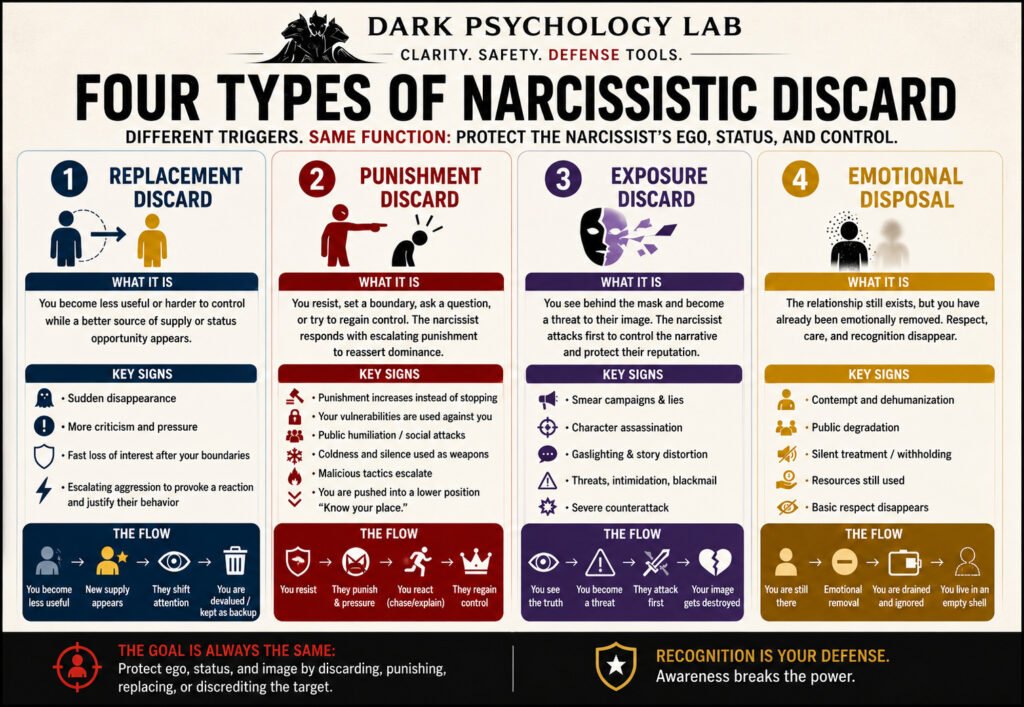
1. Replacement Discard
Replacement discard can happen when the target becomes too emotionally exposed while a more rewarding source of supply becomes available. Many narcissistic individuals have difficulty tolerating emotional openness because it threatens their internal defense structure. Attempts to repair the relationship through honesty, attachment, or emotional exposure are usually interpreted as weakness, dependency, or as a means of exerting control.
A narcissist may think: “You became too predictable, too emotionally dependent, and too easy to control. The next target offers more stimulation.”
One important detail is that narcissistic people often struggle to fully end relationships when the old target is still useful. In some cases, they treat the damaged target like a host, keeping access to their resources while emotionally moving toward someone else.
A replacement discard can also occur in a short-term connection. In those cases, the narcissist moves in quickly, tries to extract as much value as possible in a short time, and assesses the target’s usefulness. If the target remains compliant, they stay useful. If the target shows boundaries, the narcissist can take what they already gained and withdraw. This pattern is connected to lower commitment, greater attention to alternatives, and a more game-playing interpersonal style often associated with narcissism (Campbell, Foster, & Finkel, 2002).
Signs of Replacement Discard
- Sudden disappearance: They stop answering calls, ignore messages, disappear without explanation, and may block all forms of communication.
- More criticism and pressure: Your needs, boundaries, or questions suddenly start being framed as the problem.
- Fast loss of interest after your boundaries: When you show that you will not be easy to use, they suddenly become cold or disappear.
- Escalating aggression: They provoke a reaction with coldness, criticism, or disrespect until you respond, then use your response as justification to escalate their own cruel behavior.
Recognition tool:
The current target becomes less useful or more expensive to control →
A new supply source or status opportunity arises →
The narcissist shifts attention elsewhere →
The old target is devalued, pressured, or kept as a backup resource =
An easy target: the narcissist will either use them or replace them.
2. Punishment Discard
Punishment discard happens when the target clearly resists the narcissist’s pressure. They hold a boundary, refuse to obey, ask an uncomfortable question, or try to regain control during the devaluation phase, inside a hierarchy where the narcissist already sees them as lower. As a result, the pressure can increase instead of decrease. The narcissist may move into harsher forms of control, and the message underneath can sound like this: “If you try to take control back, I will make sure it costs you” (Vazire & Funder, 2006).
Over time, the target stops being treated like a full person. They become someone to punish, correct, silence, or push back into position. In some cases, this type of discard happens very quickly.
Signs of Punishment Discard
- You are punished more and more: Earlier, the narcissist may have pulled back when they felt they had crossed a line, but now they no longer stop.
- Your vulnerabilities are used against you: Anything you revealed earlier is used to exert pressure, control, or inflict humiliation.
- Social circles are used against you: The narcissist publicly humiliates you, attacks your character, or shapes a social narrative where you look like the problem.
- Sudden coldness becomes a weapon: If they sense that disappearance, silence, or emotional withdrawal hurts you, they use it.
- Malicious tactics escalate: Stronger manipulation, sabotage, or psychological pressure appear when the narcissist feels they are losing control.
- You are pushed into a lower position: The hidden message becomes “know your place.”
Recognition tool:
You resist →
The narcissist punishes you with withdrawal or pressure →
You panic, explain, chase, or try to repair →
They regain control =
The discard no longer injures their ego or status. Your value is lower, you are treated as an object, and can be thrown away at any time. The fact that they can punish you and get away with it proves this.
3. Exposure Discard
Exposure discard happens after the target has spent enough time close to the narcissist to see behind the facade. Over time, the narcissist usually reveals private information about themselves, including things that could damage their reputation, status, or public image.
This often happens because of impulsivity, inner hunger, and the need for narcissistic supply. The crack in the facade appears through unexpected confessions, strange openness, attempts to pull you into their private world, or impulsive actions that cross the line. This mechanism connects closely with the idea of the narcissistic facade, which we explore in more detail in our article:
The Narcissistic Facade.
After that, the target becomes too dangerous to the narcissist. Any public defensive reaction, any attempt to protect yourself using what you know, or even a small loss of control, can activate the narcissist’s antagonistic defense system (Weiss et al., 2019). The result is a severe counterattack. The narcissist defends themselves with disproportionate force and attack several times harder than the original threat required.

This is the discard that happens when the target begins to see fraud, lies, cheating, gaslighting, or anything that could expose the narcissist. Here, they not only withdraw. They try to control the story before you tell your version. The goal is to discredit you so deeply that your word no longer carries weight in their social environment.
This can happen slowly through smear campaigns and flying monkeys, or quickly if the narcissist knows your vulnerable points and can weaponize them.
Signs of Exposure Discard
- You catch a lie, cheating, a double standard, or gaslighting.
- Other people suddenly start looking at you strangely.
- A version of the story has already been spread in the social circle before you have said anything.
- They try to isolate you from people who might believe you.
- Your emotional reaction is used as “proof” that you are the problem.
- The narcissist rushes to take the victim position.
- Flying monkeys appear: people who pressure you, question you, defend the narcissist, or repeat their narrative.
- They try to ensure your word carries no weight in the social environment.
Recognition tool:
The narcissist reveals too much →
The target sees too much →
The narcissist feels a reputational or control threat →
The defensive attack begins →
The target’s credibility or reputation is damaged in advance =
The narcissist discards brutally and publicly.
4. Emotional Disposal While Staying
Emotional disposal while staying is one of the cruelest forms of discard because, from the outside, the relationship still appears to exist. Inside the relationship, the person has already been removed (Day et al., 2022).
The target has been shaped into a more easily controlled object. The narcissist no longer feels the need to treat them with basic respect. You may live together, work together, share children, run a business together, or still formally be in the relationship, but the narcissist behaves as if you are nothing.
This kind of pressure can damage the nervous system over time. A person may begin to develop learned helplessness, in which they keep seeking clarity from the very person who is causing the pain and confusion. The more they search for answers inside the toxic system, the deeper they sink into it.
This discard is emotional removal while keeping access to your resources. The narcissist may expect you to keep maintaining the relationship, managing the emotional work, explaining, chasing, forgiving, and trying to hold everything together.
For this to work, the strong attachment must be present, often a trauma bond, and the narcissist has to be placed on a pedestal. Their mood, approval, silence, anger, and small moments of warmth become the center of the system.
Signs of Emotional Disposal While Staying
- Contempt and dehumanization: Even though you still interact, the narcissist no longer treats you as a full person with feelings, needs, and dignity.
- Public degradation with private normality: In private, they still act normally when there is no audience, but in public, they show that you are beneath them.
- Escalating passive-aggressive control: Silent treatment, constant lying, gaslighting, and emotional withholding become normal parts of the relationship.
- Unreturned debts or taken property: Money, objects, favors, or practical resources are withheld, kept, or used as leverage to remind you who has control.
- Emotional access is removed while resource access stays: They stop giving warmth, care, or respect, but still expect your labor, loyalty, money, attention, or support.
- You begin asking for the bare minimum: Instead of asking for repair, you start asking for a normal tone, basic respect, or simple clarity.
Recognition tool:
You are still there →
But you are no longer treated as a full person →
Your resources are still being used →
Your pain is ignored →
You try to restore a connection with the same person who is breaking you =
The narcissist is in the fully dominant position. It does not matter that they are still beside you. You have already been discarded as a person with a will of your own.
The General Model
Different narcissistic types can look very different, but during the discard phase, they connect through the same underlying logic:
- The overt narcissist lowers your status through dominance.
- The covert narcissist lowers your clarity through destabilization and emotional manipulation.
- The malignant narcissist attacks when your status, clarity, or nervous system is already damaged, and in more sadistic cases, may feed on the pain itself simply because they enjoy the sense of power and control it gives them.
The general model is that, in many cases, narcissistic discard functions as a self-regulation mechanism designed to protect the narcissist’s grandiose self-image and restore a sense of control (Grapsas et al., 2020).
A person may believe they simply encountered several unrelated harmful individuals. In reality, a chain reaction can sometimes occur: one narcissistic relationship weakens your defenses, another person senses that weakness, and a third person takes advantage of it.
When Multiple Narcissistic Types Converge
In more complex social environments, several narcissistic styles can reinforce each other. For example:
A covert narcissist uses charm, emotional manipulation, love bombing, and a carefully maintained facade to attach herself to a more malignant narcissistic individual. The malignant narcissist understands her motives perfectly, but still protects and supports the dynamic because it benefits his own needs and interests. At the same time, an overt narcissist in the background operates like a hostile flying monkey, adding pressure, humiliation, or social force.
At that point, the situation is no longer just one narcissist and one target. It becomes a small narcissistic social group system where several people gain validation, control, status, or even sadistic supply from destabilizing one target while continuously reinforcing each other’s version of reality.
These groups are often socially protected. Narcissistic individuals can be highly social, skilled at impression management, and supported by their environment. When a coordinated group like this turns against a single target, the first line of defense is not emotional persuasion but clarity. Understanding the psychological mechanisms behind the behavior can become one of the few ways to reduce confusion, protect your reality, and begin rebuilding control.
To better understand the psychological mechanism of group pressure, read:
The Psychology of Group Pressure Escalation.
DPL Conclusion
Discard is not only the end of a relationship. In a narcissistic system, discard can be the final act of control.
The overt narcissist can leave while placing you lower in the social hierarchy.
The covert narcissist can leave you dependent on answers they will never give.
The malignant narcissist can come in when you are already wounded and try to turn your weakness into final destruction.
That is why the most important question is not only: “Why did they do this?”
The more important question is: what state was I in when this began, and how quickly can I rebuild my defensive field?
Risk Gating
If there is physical danger, a power imbalance, a reputational attack, workplace pressure, stalking, or coordinated pressure, an emotional explanation is never the right strategy. In these situations, the priority is not to prove your truth to the narcissist, but to reduce harm without escalating the conflict, while still keeping your boundaries and dignity:
- Step away from direct provocations.
- Document the facts.
- Do not reveal more vulnerability.
- Seek outside support.
- Protect your reputation and nervous system.
- Assess the real risk, not only your desire to explain everything.
When you are weakened, your defense has to be simpler, clearer, and safer.
Less explaining. More facts. Less emotional contact. More distance.
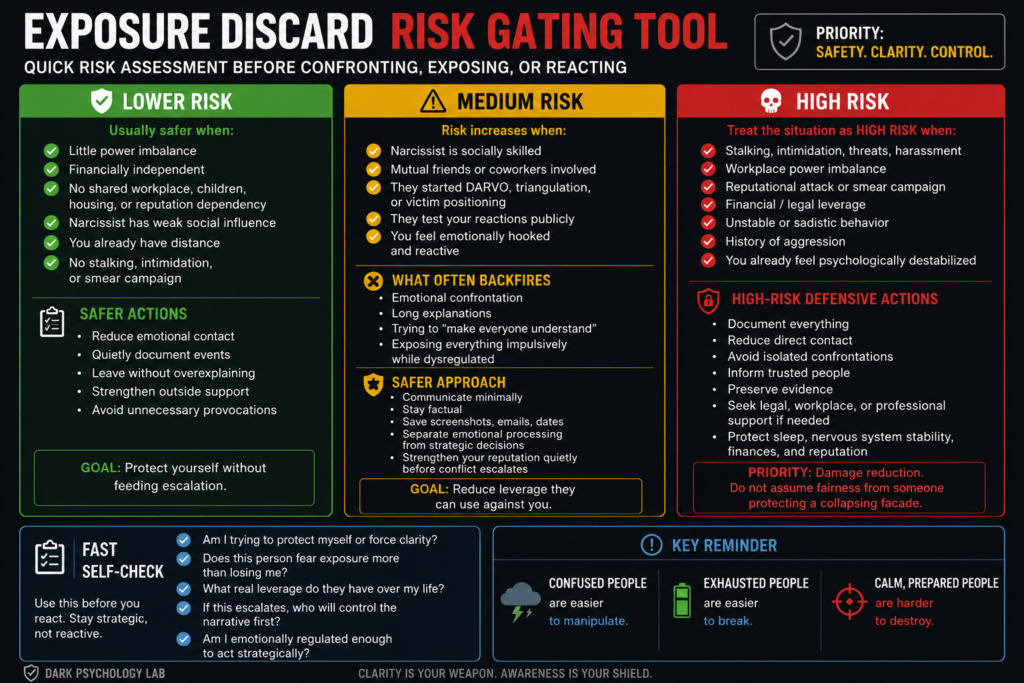
Exposure Discard Risk Gating Tool
Use this before confronting, exposing, or reacting.
When a narcissist feels their facade is threatened, the situation can shift from emotional conflict into reputation control, DARVO, smear campaigns, or direct retaliation. This tool helps you assess the risk level, avoid impulsive reactions, and choose a safer defensive response.
Save it as a quick checklist for clarity under pressure.
Defense Guides – Practical Self-Protection
Dark Psychology Lab focuses on clarity and self-protection in situations involving manipulation, power imbalance, and covert psychological pressure.
The following defense guides expand on practical tools to reduce psychological damage and regain control:
Psychological Manipulation
Psychological Manipulation Defense: Safe Strategies and Dangerous Tactics Explained
Narcissistic Dynamics
How to Deal With a Narcissist and What to Do When You Can’t Leave
Toxic Workplace
Workplace Mobbing Defense Playbook: 17-Step Guide
Disclaimer
This article is for educational and self-protection purposes only. It is not a diagnostic tool, psychological assessment, legal advice, or a substitute for professional mental health support. Narcissistic Personality Disorder and other clinical conditions can only be diagnosed by qualified professionals.
The goal of this material is recognition, clarity, and harm reduction. If you are facing physical danger, stalking, threats, workplace retaliation, legal pressure, or a serious power imbalance, prioritize safety, documentation, and support from appropriate professionals or trusted people around you.
For the full site disclaimer, read our Disclaimer page.
Dark Psychology Lab
Original content based on lived experience and independent psychological analysis.