

One of the most powerful tools in a manipulator’s arsenal is their influence over the social environment, often referred to as flying monkeys. Without them, the manipulator is just one person. With them, they gain real social power.
People who have never encountered this human-based leverage system may start asking questions like: Why does everyone turn against me? Who can I trust? Why does the group support a clearly wrong manipulator’s narrative?
In this article, we break down how this really works.
What Are Flying Monkeys
The term flying monkeys comes from The Wizard of Oz. In the story, they were controlled by the Wicked Witch of the West and used to locate, attack, and capture targets. Today, the term is commonly used to describe people who act on behalf of a manipulator, serving as an extension of that manipulator’s influence. This dynamic can resemble a gray mass, a group moving in the same direction, reinforcing the manipulator’s image.
They are most often associated with narcissists. Part of the reason is that a narcissist, using their facade and personality traits, can more easily influence and gather people around them. That is why narcissistic dynamics almost always involve flying monkeys. We explored this phenomenon in more detail in our article:
Narcissist Flying Monkeys: Signs
Research describes flying monkeys in corporate environments as proxies who may act on behalf of a narcissistic or psychopathic individual toward a target, through spying, gossip, pressure, threats, victim-blaming, or supporting the abuser’s narrative (Sakthivel, 2021). From observation and the often cruel behavior directed at one person, it may seem that this form of group control is mainly found among people with Dark Triad traits. However, similar manipulative group-control mechanisms can also be used by other types of manipulators.
The Flying Monkeys Mechanism Explained
A short formula for quick orientation:
Image (social proof) → Recruitment of people → Information control → Collective pressure → Target destabilization
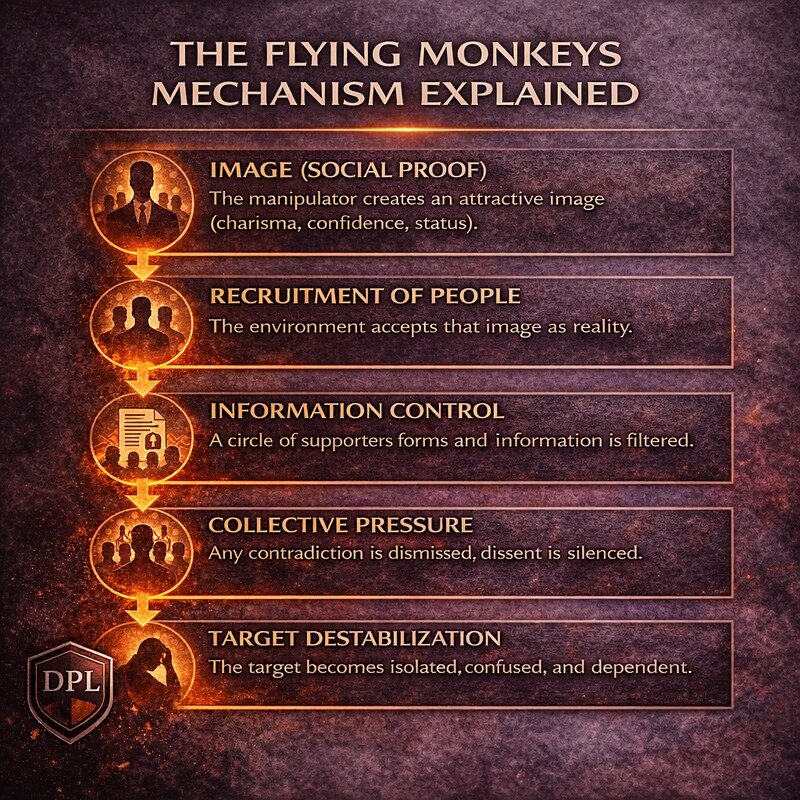
In this section, we will break down how flying monkeys are recruited, what techniques are used, how they form around the manipulator, and how this group pressure slowly wears down the targeted person.
Social Image and Social Proof
A manipulator’s social image often works as the first layer of credibility. A successful, attractive, social, respected, or well-connected person can appear more trustworthy, regardless of their real intentions. This does not prove that they are safe or honest, but it makes people less likely to question them.
Social proof begins when other people’s reactions start confirming that image (Lexicon of Psychology — Social Proof, 2024). If the group laughs with the manipulator, respects them, defends them, or accepts their version of reality, observers may begin to treat the manipulator’s narrative as socially validated rather than independently checking the facts.

People are social creatures. In uncertain situations, they often look toward the group to decide what is normal, true, or acceptable. This is where social proof merges with the conformity effect (Asch, 1951). Once enough people align with the manipulator’s version of reality, an illusion of the majority forms. Others may then follow the group rather than evaluate the facts independently.
Recruitment of People
At this stage, the manipulator has the opportunity to involve others in the process and make them part of the system. Rather than confronting directly, the manipulator acts through others, maintaining distance and protecting their image.
Most commonly used techniques
- Triangulation – other people are drawn in through artificially created situations, forming conflict and routing information through third parties.
- Smear campaign – selective or distorted information is spread to weaken the target’s reputation
- Authority leverage – status or authority is used so that others automatically support the manipulator.
Through these group manipulations, the manipulator strengthens their position while subtly weakening the target.
Information Control
Once people are involved, the manipulator takes control of the flow of information: what is said, to whom, and how it is interpreted.
This allows them to shape a social narrative useful to the controlling party.
Most commonly used manipulation techniques:
- Gaslighting – distortion or omission of information that causes the target to doubt their own perception.
- DARVO – shifting responsibility (deny, attack, reverse victim and offender), where the manipulator positions themselves as the victim.
- Silent treatment – selective isolation, ignoring, and social exclusion.
If you are not sure what manipulation is, we provide a detailed breakdown of it in our article:
The Psychology of Manipulation: Mechanisms, Tactics, and Defense
Information becomes filtered: one version is presented to the group, another to the target.
In this way, the manipulator systematically isolates the target, separating them from the group, increasing anxiety, while further strengthening their own position among supporters.
At this stage, a quiet discrediting of the target often takes place. The target begins to react to a distorted reality, reinforcing the manipulator’s narrative.
Collective Pressure
Technically, this is the core of flying monkeys.
After weakening the target’s position, the manipulator begins actively involving others. This can include family, friends, colleagues, or the entire social environment.
If the manipulator has done a good job building their version of reality, the target’s reputation is already damaged at this stage.
Most of the process happens out of sight. A silent coalition is formed. The target may start to feel as if everyone is against them.
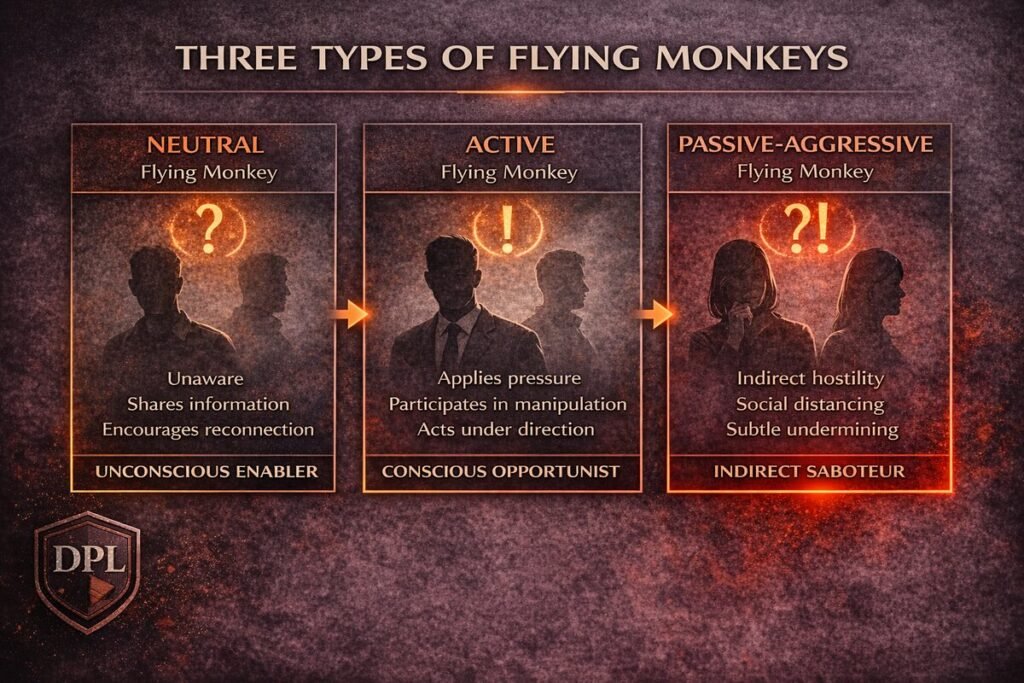
Within this system, several roles usually appear among flying monkeys:
- Neutral actors – collect and pass information, repeat the manipulator’s narrative. They often believe they are acting correctly, and are the easiest to influence. They should not be blamed.
- Active actors – directly support the manipulator, apply pressure, or attack the target. Often, more aggressive and conflict-oriented individuals.
- Passive-aggressive actors – avoid direct contact, subtly exclude the target from social space, and operate through gossip and reinforcement of group opinion. This is a more covert level.
This creates a social system that applies constant pressure on the target and isolates them within the group. This is what defines the flying monkeys’ dynamic.
The more people are involved, the stronger the pressure becomes, and the harder it is for the target to rely on their own sense of reality (Allen & Wilder, May 1977).

Not sure if you are being manipulated? Take a test. Press a button below. Sign up for Dark Psychology Lab, and we will send it to your email.
Target Destabilization
At this stage, the power imbalance is clearly on the manipulator’s side.
If the target becomes harder to control, does not support the narrative, or simply no longer fits the manipulator, pressure can increase rapidly.
The manipulator uses flying monkeys as leverage and escalates the impact through indirect techniques:
- Proxy manipulation – influence is applied through other people, avoiding direct conflict.
- Gaslighting by proxy – reality is distorted through information delivered by third parties.
- Collective shaming – group-based shaming or damage to reputation.
- Ostracism (social exclusion) – systematic removal from the group.
- Reputation erosion – gradual weakening of the target’s image through repeated small character attacks.
As this pressure accumulates, it reaches a peak, resulting in a social write-off.
This often happens through a technique of many small manipulative actions, known as death by a thousand cuts (DBTC). We explain how this technique works in our article, supported by case studies:
Coercive Control at Work and in Relationships: Death by a Thousand Cuts Explained
At this stage, the target often finds themselves in a situation with very few real options: leave the environment or continue enduring systemic pressure.
Over time, this can have serious consequences for the nervous system, including conditions such as PTSD or CPTSD (Guzman Torres et al., 2023).
How the Flying Monkeys Mechanism Affects the Target
In general, flying monkeys function as a force multiplier for the manipulator’s influence. When a group turns against a single person, the psychological pressure on the nervous system increases sharply.
If that group includes people you once trusted, the impact becomes more severe. Familiar faces in a hostile role can be more destabilizing than strangers.
This creates a sense of being in enemy territory.
The main damage comes from isolation. It does not need to be absolute or even fully real. An environment that turns against you, or simply begins to mirror the manipulator’s behavior, is often enough to trigger real psychological, social, and physical consequences (J. Kellerman, D. Rigler, S. E. Siegel, May 1977).
One of the brain’s primary functions is protection. When a threat is detected, whether real or imagined, it switches into fight-or-flight mode, redirecting energy and cognitive resources toward survival. Your system starts scanning the environment, looking for signals of danger, and preparing for potential attack.
This is where manipulation becomes dangerous. It works subtly, so the brain senses a threat but cannot clearly locate its source. As a result, the system remains activated, leaving you stuck in a constant state of reactivity.
Symptoms may include:
- Increased anxiety levels – persistent tension, hypervigilance, and a constant sense that something is off.
- Loss of self-confidence – self-esteem erodes, and even simple decisions become harder.
- Increased susceptibility to manipulation – without external support, it becomes easier for others to shape your perception.
- Heightened sense of threat – even neutral situations begin to feel unsafe.
Over time, this can create a feedback loop in which isolation increases vulnerability, and vulnerability in turn increases further isolation.
How Do People Become Flying Monkeys
Flying monkeys usually become targets of manipulation themselves, as techniques such as triangulation, love bombing, intermittent reinforcement, authority pressure, smear campaigns, and narrative control through selective restriction of information are used on them, subtly transferring control to the manipulator.
Most people do not become flying monkeys consciously. They respond to a situation that feels safer or more acceptable to them.
There is an old saying: A fish looks for deeper water, and a person looks for what is better.
Biological Survival Instincts and Social Hierarchy
Through image and social support, the manipulator elevates themselves in the social hierarchy.
Older biological mechanisms are still active in human behavior, which could be called old brain responses (Eisenberger et al., 2015). People respond to this less through logic and more through instinct, naturally gravitating toward the manipulator’s side.
This is survival logic, which can override moral evaluation. Awareness and morality often come later, as explanations for decisions that were made instinctively (Jonathan Haidt — The Righteous Mind, 2012).
As a result, most people get involved, and newcomers simply follow the direction of the group.
It may feel harsh, but flying monkeys can resemble a kind of social herd. Instinct chooses a side faster than reason can evaluate it.
How to Recognize Flying Monkeys
Because flying monkeys appear in almost all situations involving toxic environments or narcissism, there are many possible examples.
Here, we will use real-life case studies to better understand how they are recruited and operate, both consciously and unconsciously, to facilitate recognition.
Neutral Flying Monkey – Friend
After a grandiose (overt) narcissist discards a person and, with group support, isolates them along with strong discrediting, there are often still mutual acquaintances in that person’s environment.
For example, a friend you have known for about 20 years, since school. Sometimes they visit you, sometimes you visit them. You share your goals, achievements, and simply communicate in a relaxed way.
Why is this person a flying monkey?
- Unconscious attempt to pull you back into the narcissist’s environment: They occasionally suggest that you should meet up with everyone again and encourage reconciliation with the narcissist.
- Information sharing and supporting the narcissist: While communicating with the narcissist, they pass along information about you. They simply enjoy talking. In their mind, the narcissist is one of their closest acquaintances.
Over time, you may start hearing your own personal information from other people. They learned it from the narcissist, and the only person who originally knew it was your childhood friend.
This is an example of a flying monkey who does not even realize it.
Active Flying Monkey – Workplace Group Pressure
The manipulator (covert/vulnerable narcissist), a manager in the workplace, begins to subtly pressure a person using covert techniques such as gaslighting, silent treatment, and triangulation. She brings the environment into the process and starts actively using manipulation through other people (by proxy), for example:
Work incident
After a workplace incident, a woman from the insurance department calls and claims that the person marked the incident as the client’s fault, even though he clearly provided written confirmation that the mistake happened due to his own oversight.
Manipulation used: gaslighting by proxy.
Attacks on personality
The person once made a joke in a certain way. Later, an unrelated colleague from another department begins repeating the same behavior. When asked about it, he gives a random reason, maintaining plausible deniability.
Manipulations used: plausible deniability and indirect group pressure.
Triangulation involving a higher authority
After clearly setting the person up to avoid responsibility, the manager escalates the situation to a higher level of hierarchy, in this case, the director, who is a malignant narcissist.
The director also withholds information and supports the manager’s version of reality, even though the situation clearly violates the person’s rights. When a person defends themselves, they automatically enter into conflict with higher, more toxic layers of the organization.
Considering the sensitivity of a malignant narcissist to social image and the need to maintain the reputation of a powerful leader, the pressure increases further.
Manipulations used: Triangulation, authority leverage, information control, responsibility shifting (DARVO), collective pressure, authority-induced FOG.
Observation
In this example, flying monkeys actively operate under the manipulator’s direction.
The director, in this context, is also a manipulator and uses the covert narcissist manager as a flying monkey, while at the same time, becoming involved in her psychological games and being used as a flying monkey by her.
This is a very interesting real-life example of how two or more manipulators can use each other as agents.
Based on this real-life case, we created a Recognition and Self-Defense Guide:
How to Work With a Narcissist During the Devaluation Phase
Passive-Aggressive Flying Monkeys – Deteriorating Environment Behavior
This can involve a single person or a group, depending on how much the manipulator has influenced the environment against the target.
In this example, the manipulator is a grandiose narcissist. After 10 years of living together with a partner, whom she removed from her environment during the discard phase, she begins to actively hover over him through others and reshape how people see him.
For example:
- She calls the ex-partner’s former spouse and other family members, asking questions about him, gathering information while at the same time presenting her own distorted version of reality.
- Mutual acquaintances, neighbors, and the surrounding environment are involved. She tells them how he affected her, imposing her narrative onto them.
As a result, group opinion is formed through the narcissist’s distorted storytelling within the environment connected to the target.
It depends heavily on the people and the history, but if she manages to convince them of her version of reality, they become passive or passive-aggressive flying monkeys, further isolating the target.
Common Signs of Flying Monkeys
- Repeated similar phrases or stories about you, often without direct evidence.
- Information about you spreads indirectly: someone said…, I heard that…
- Conversations become one-sided: your version is ignored or minimized.
- Sudden behavior changes: neutral people become cold or distant.
- Indirect pressure: advice, criticism, or concern that aligns with the manipulator’s narrative.
- A growing sense of being watched or discussed, even without clear proof.
How to Protect Yourself
The presence of flying monkeys is a clear indicator of the manipulator’s intent. These are information gatherers or passive observers who look for your weak points or new details that can be used against you, and they actively share that information.
Depending on the environment, once flying monkeys are involved, their influence often becomes difficult to avoid. In such cases, the most effective means of self-protection is maintaining a clean image and independence.
As a key to defending against them, as with all manipulations, is emotional neutrality. Other steps include:
- Stop explaining yourself to everyone. Any information can and will be used against you.
- Observe who is actually initiating the pressure. If it is not clear at first, take time to identify the source and limit contact with that person.
- Reduce exposure. Evaluate people more carefully, consider their connection to the manipulator, and think through the consequences of interaction or mediation.
Internal Shift (DPL)
During prolonged manipulation, an internal split can occur. One part of the mind is affected, confused, drained, and pulled into constant pressure. At the same time, another part may begin to disengage and stop accepting the manipulator’s narrative.
In this way, reactivity drops, emotional engagement weakens, and a sense of internal distance appears. In some cases, this separation between your inner self and the situation even creates a temporary mood boost.
The key point is this: do not collapse internally. External control does not equal internal defeat. A core part remains untouched. This is where dignity is preserved.
How Exposure to Manipulation Changes Perception
Over time, this process can reshape a person. Exposure to manipulation may increase awareness, sharpen perception, and reduce tolerance for distortion. What was once destabilizing can become a source of strength or a useful internal change.
At first, these mechanisms are difficult to grasp. Indirect psychological pressure can feel intangible. The effects are real, but the structure is hard to see, almost like psychological ghost hunting.
With time, patterns become visible. And once they are recognized, the same system no longer operates in the same way.
Dark Psychology Lab Defense Guides
When dealing with flying monkeys, communication and interaction techniques with manipulators and others become especially useful.
We have analyzed defensive strategies for different situations involving psychological and manipulative pressure:
Psychological Manipulation
Psychological Manipulation Defense: Safe Strategies and Dangerous Tactics Explained
Narcissistic Dynamics
How to Deal With a Narcissist and What to Do When You Can’t Leave
Workplace Mobbing & Toxic Workplace Culture
Workplace Mobbing Defense Playbook: 17-Step Guide
Final Thoughts
Flying monkeys act as an amplifier and are one of the most destructive and dangerous tools in a manipulator’s arsenal.
In most cases, it is not that everyone independently arrived at the same conclusion. What happens is that the same narrative, shaped by the manipulator, reached them first.
Understanding this can restore orientation.
And when orientation returns, you are no longer fully inside the system. You become an observer, and that is no longer the position of a victim.
Group Pressure System (DPL Framework)
This article is part of a broader group-pressure analysis at the Dark Psychology Lab.
Understanding this mechanism helps reduce damage and regain control.
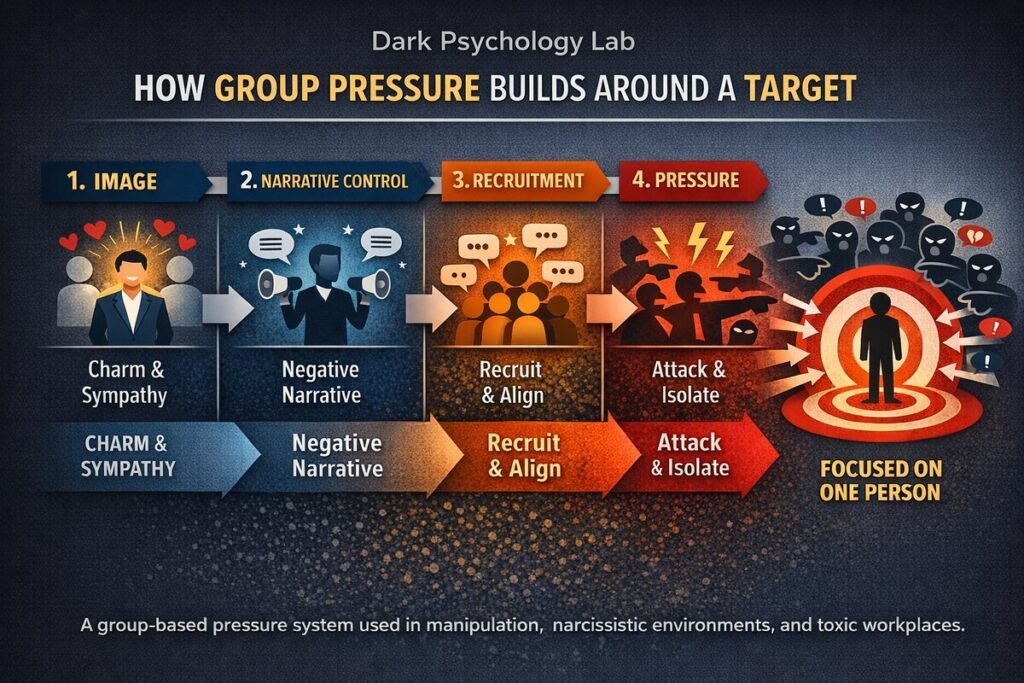
The same pattern appears across different contexts, but the way it is applied changes.
Explore the same mechanism in different environments:
Manipulation: How manipulators recruit and use groups of people against a single target through influence and narrative control.
Flying Monkeys Explained: How Manipulators Use People to Control Their Environment
Narcissism: How personality traits are used to recruit others, defend, attack, and maintain an external image.
Narcissist Flying Monkeys: Signs, Roles, and Psychological Impact
Toxic Workplace: The psychological impact of social exclusion and how group pressure is used in modern environments to isolate and push individuals out.
The Psychology of Group Pressure Escalation in Workplace Mobbing
Disclaimer
This article describes a real psychological mechanism that can be highly impactful when it appears in social environments. However, understanding it requires balance.
Not every disagreement, conflict, or group behavior is manipulation. Not every person who disagrees with you is a flying monkey. Over‑applying this lens can lead to unnecessary suspicion, isolation, and misinterpretation of normal social dynamics.
The purpose of this article is recognition and clarity.
Use this knowledge as a tool for awareness and self-protection, not as a label to apply to everyone around you.
If you notice patterns described here in your own environment, take time to observe before drawing conclusions. Focus on consistent behavior over time, not isolated events.
If you are experiencing strong psychological pressure, confusion, anxiety, or social isolation, consider speaking with a qualified mental health professional. An external perspective can help you assess the situation more accurately and safely.
It is also important to understand that terms like narcissism or Narcissistic Personality Disorder (NPD) have a specific clinical meaning. A diagnosis can only be made by a licensed professional. This article does not replace professional evaluation.
More about it in our Disclaimer Page.
Dark Psychology Lab
Original content based on lived experience and independent psychological analysis.
If reading feels exhausting right now, audiobooks can be an easier way to absorb information.
Listen on Audible