

Triangulation in manipulation involves bringing third parties into a relationship, either by mentioning them or directly involving them. It is a form of social manipulation that uses other people or groups as leverage. A manipulator draws others into a conflict, exploiting their influence and thereby strengthening their own position.
It can be a particularly effective tactic for influencing or controlling another person’s behavior in a toxic way, establishing dominance in a relationship by devaluing someone, or increasing pressure.
“Triangulation manipulation” is not a standard academic term. However, the phenomenon it describes can be observed in manipulative, toxic, and narcissistic dynamics. This article brings together independent psychological analysis and scientific research into a practical framework for recognizing manipulation and protecting yourself against it.
The Difference Between Relationship Triangles and Triangulation Manipulation
The term triangulation itself reveals quite accurately how it works. It describes a triangle formed between three people. This social phenomenon is quite common in relationships, friendships, and families. When a third person or group enters the triangle, it changes the relationship structure between the original two. Social games emerge, interactions change, and tension that previously existed between two becomes distributed among three. Coalitions and alliances may form, with some receiving more support and others becoming more excluded (The Bowen Center for the Study of the Family, n.d.). This alone is not manipulation. Manipulation begins when a manipulator exploits this triangular structure within a social environment, usually to increase their own power.
Many reasons can drive third parties to take sides in other people’s relationships and conflicts, since human motivations span a broad spectrum, from self-interest, moral positioning, and loyalty to jealousy and wounded ego (Yang et al., 2018). A persuasive manipulator exploits exactly this tendency by presenting a version of events that favors them. On top of that, they may have used one or more techniques beforehand to shape others’ perceptions and opinions.
Download the Manipulation Recognition Guide
Not sure if you are being manipulated? Take a test. Press a button below. Sign up for Dark Psychology Lab, and we will send it to your email.
One of the Key Factors in Triangulation Manipulation: Deception
What distinguishes manipulative triangulation from ordinary relationship triangles is precisely how the manipulator influences others and draws them into the situation. Primarily through deception, they change how people interpret the social situation (Kligman & Culver, 1992).
Deception does not necessarily involve outright lies, although it can. More broadly, the term conveys a person’s untrustworthy nature. A manipulator uses selective truths, omits crucial context, exaggerates certain details, or presents someone’s reaction while concealing what provoked it. The third party then witnesses an event or hears a story that gives them a reason to react and, in some cases, intervene. Because of the deception involved, a triangulated person may not even realize they are being used to pressure the target. However, in some cases, third parties act as the manipulator’s proxies and knowingly participate in the manipulation.
Interestingly, in many cases, it is difficult to distinguish between situations where people are being drawn into manipulation through a manipulator’s deceptive nature and tactics, and situations where someone genuinely needs help or is actually being attacked by another person.
Once the third party begins to act, the manipulator gains an additional source of leverage. Someone with their own influence or authority becomes involved in the conflict.
For more on the importance of leverage in manipulation and how to defend yourself by understanding exactly what the manipulator is exploiting, read our article:
The Psychology of Manipulation
Triangulation Manipulation Mechanism
DPL Framework
The triangulation mechanism begins with tension between the manipulator (A) and their target (B). To strengthen their position, the manipulator introduces a third person (C) and presents a version of events that favors them. Essentially, this is the core of triangulation.
The Roles of Different Participants in Triangulation
To better understand how triangulation manipulation works, we will examine it using the A, B, and C framework, focusing on each person’s role. Each model is also accompanied by an infographic to make it easier to understand how this interpersonal manipulation works.
A) The manipulator:
A person who uses covert control tactics, often relying on deception to influence how others interpret a situation.
B) The target or focus:
A person who may experience pressure directly or may not even be involved. This could be a partner, former partner, idealized person, a target of devaluation, or an enemy. Since triangulation can also be used to exert pressure on person C by using B as leverage, it would be more accurate to describe B as the manipulator’s focus in such situations.
C) The influenced party:
A person the manipulator has access to and whose perceptions or behavior they can influence or are attempting to do so.
Triangle Formation Variations in Manipulation
As the roles above show, triangulation can serve several functions. The following models illustrate how triangulation can operate in different ways.
Model 1: Recruiting Third Parties to Exert Pressure on a Target
A → C: A presents C with a selective account of events, reproaches, accusations, or a request to intervene in the interaction with B.
A → B: B is the target, a person A has singled out, often someone A is in conflict with or wants to pressure for some other reason.
C → B: If A succeeds in influencing C, C’s reactions or actions create pressure on B.

Model 2: Provocation and Defensive Manipulation to Recruit Bystanders
A → B: A uses indirect pressure techniques from the “covert control” series.
B → A: If the provocation works, B may react more defensively. This can lead to stronger emotional responses or attacks.
A → C: A uses social manipulation to recruit bystanders. Techniques include playing the victim, DARVO, and authority exploitation.
C → B: Neutral observers, people more distant from the manipulator or supporters, may get drawn into the conflict and exert pressure on B.

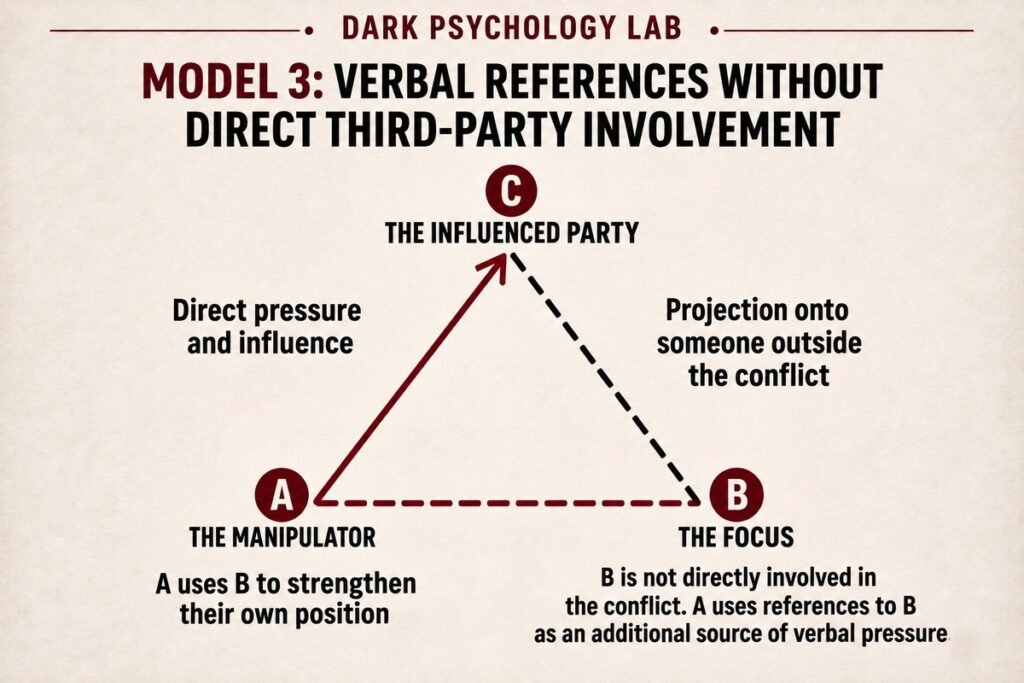
Model 3: Verbal References Without Direct Third-Party Involvement
In this form of triangulation, a manipulator uses references to real or imagined third parties to influence someone without directly involving those third parties. However, simply mentioning another person does not automatically constitute triangulation. The distinction lies in whether their perceived influence is deliberately used as leverage within the relationship.
A → C: A applies pressure directed at person C through comparisons, attempts to provoke jealousy, and constant references to others. Here, the manipulator tries to influence only C.
A mentions B to C: The focus of these references is B, a person or group who is not directly involved in or affected by the manipulation at that moment.
C → A: C may respond to the pressure with emotional reactions, self-justification, and attempts to please the manipulator. These responses can strengthen the manipulator’s control, gradually conditioning C’s behavior.
From a Single Triangle to a Network of Social Pressure
Triangulation functions as a form of social control, initially on a small scale. However, the triangle can expand like a cluster, drawing more people into the tension between the manipulator and the target. Eventually, the target may become easier to control within that social environment or be pushed out of it as the balance of power shifts. Moreover, as pressure increases, triangulated people may begin to involve additional third parties, turning this manipulation into a social spider web. Even after the target moves into a different relationship triangle, the effects of the previous triangulation may still affect that new relationship.

Triangulation is like a projection of the manipulator’s distorted versions of reality into the world. Some people are directly influenced by it, while others are more resistant.
Types of Triangulation Manipulation
1. Comparative Triangulation
Comparative triangulation is common in romantic relationships, although it is not limited to them. A third person is introduced verbally to devalue or idealize the recipient, provoke jealousy, or create competition. For example:
“My ex was better than you.”
Or, in the form of idealization: “You’re better than him.”
2. Social Approval Triangulation or Imaginary Consensus
The manipulator refers to other people’s opinions to support their claims and make their own judgment appear stronger. Technically, they strengthen their position by claiming to speak for “others.” However, these third-party opinions may be real or entirely fabricated. For example:
“Everyone thinks you’re acting strangely.”
“Yes, but everyone can see it…”
3. Family Triangulation
Tension and triangles between family members can become manipulative. Children or other relatives may be drawn into conflicts between parents or family members through guilt-tripping, gossip, and other tactics. In other cases, similar situations may simply reflect an unconsciously developed relationship structure within the family (The Bowen Center for the Study of the Family, n.d.).
4. Defensive Triangulation
When communicating with others, the manipulator portrays the target as problematic. A negative story about one person is presented to another, aiming to influence their judgment in advance and recruit allies. By the time the target takes any action, the perception of reality is already distorted, and the people around them may be biased against them and inclined to defend the manipulator. For example:
Someone tells their new partner about a “narcissistic ex who is still stalking them.”
Or a woman describes a man who supposedly approaches her against her wishes: “He keeps trying to talk to me. Sometimes he even gives me gifts, even though I’m clearly trying to ignore him. I think he must be up to something.”
It is very important to recognize that these stories may be true. A person may genuinely be trying to defend themselves, protect their reputation, or protect others. In such cases, this is not manipulation. Manipulation begins when deception enters the equation: stories are fabricated or context is deliberately concealed to recruit allies.
This raises a question: How can you tell the difference? Based on individual stories alone, it is almost impossible. You need to observe broader patterns of a person’s behavior.
5. Active Third-Party Triangulation
The manipulator actively draws other people into a conflict.
To recruit others to apply pressure, the manipulator uses their influence and social manipulation tactics to affect situations and people around them, such as playing the victim and DARVO. Manipulation by Proxy may also be used to exert pressure.
This is the most aggressive form of triangulation. For example:
- Playing the victim: The manipulator provokes and devalues someone, then tells their friends and mutual acquaintances: “What a bastard! Look how badly he treated me! He yelled at me! He keeps coming on to me!”
- DARVO: After a small confrontation, the manipulator publicly bursts into tears: “I only wanted what was best for us! There’s always something wrong with you! Why are you treating me like this?”
- Manipulation by proxy example: The manipulator fabricates a conflict situation following unlawful requests at work and directs the target to the company director, who supports the manipulator: “Call the director and sort it out.”
Manipulation Tactics That Interact with Triangulation
Successful triangulation is often the result of other manipulation techniques, with triangulation acting as a conduit for their effects. In this section, we will examine the techniques used to influence people in the surrounding social environment.
1. Preparatory Manipulation: Social Conditioning and Destabilization
These techniques are designed to influence the target’s reactions or change how others perceive them in advance, making subsequent triangulation more effective.
In active forms of manipulation involving third parties, the manipulator often conditions both the target and the perceptions of those around them in advance through techniques that undermine the balance of power. They are not essential for drawing someone into the triangle. In some cases, active manipulation techniques alone are enough.
Their main function is to lower the target’s perceived value within the social environment and in the eyes of the person being triangulated. Brutal, but people are far more likely to attack and confront vulnerable or weak individuals than those who can defend themselves effectively (Neves, 2014). This is precisely what conditioning is designed to achieve:
- Provocation: The manipulator provokes the target and creates conflicts to trigger an emotional reaction that can later be used against them through covert techniques such as gaslighting, the silent treatment, and scapegoating.
- Devaluation and public shaming: The target’s perceived value is lowered in the eyes of others through public devaluation, humiliation, shaming, and exploitation of vulnerabilities. As a result, their social standing deteriorates. This kind of systematic devaluation is common in narcissistic relationships, and we have analyzed it in depth in our article:
The Narcissistic Devaluation Phase - Smear campaigns, gossip, and selective narratives: The social environment is influenced indirectly through negative judgments and insinuations about the target, often based on distorted or entirely fabricated information that the manipulator uses to change how third parties interpret events. In this way, the manipulator’s deceptive nature creates a false narrative. There is no direct dialogue, just attacks on the target’s reputation behind their back. Their reputation is systematically damaged in their absence, making others more negatively disposed toward them and more likely to believe future accusations.
2. Active Manipulation: Third-Party Recruitment and Activation
These techniques are used to motivate a third person and directly involve them in a conflict.
- Playing the victim: The manipulator presents themselves as the injured party, encouraging others to defend them and support their position. As a result, third parties may become drawn into triangulation. We have prepared a case study illustrating how this technique works in our article:
Covert and Overt Narcissist Conflict Analysis - DARVO: During a confrontation, the manipulator denies responsibility, attacks the person making the accusation, and reverses the roles of victim and offender. A third person witnessing this may begin defending the supposed “victim” (Harsey & Freyd, 2020). For more on this technique, read our article:
What Is DARVO Manipulation - Active fabricated conflict: The manipulator creates or distorts a conflict situation in which the target is forced into a defensive position against third parties. In such cases, the target is operating on the manipulator’s terms.
- Manipulation by proxy: The manipulator directly uses people under their influence, sometimes simply giving them direct instructions, while in other cases their narrative controls the social environment. This is a mechanism of active social pressure that naturally involves third parties, which we have explored in our article:
Manipulation by Proxy

- Authority exploitation: In these situations, the manipulator is more protected, often by corporate or family structures. Any confrontation with them immediately involves third parties, allowing the manipulator to maintain their distance. The manipulator redirects conflicts to a supervisor, a respected family member, or another influential person, thereby exploiting that person’s authority. This creates a fairly strong defensive position and is a favored tactic among covert or vulnerable narcissists.
- Narcissistic dynamics with flying monkeys: It is important to mention these enforcers, people influenced by the manipulator. The flying monkey structure is very similar to triangulation and operates alongside it. Narcissists rely heavily on their social environment for self-regulation (Morf & Rhodewalt, 2001) and naturally use many of the manipulative techniques described here. As a result, unsuspecting people become involved in conflicts that are not their own or begin exerting pressure on the narcissist’s target. For more on this social structure, read our article:
Narcissist Flying Monkeys
3. Private Conditioning Techniques Without Direct Third-Party Involvement
This is a layer of the relationship with the manipulator where real or imaginary third parties become a means of gaining a superior position and devaluing the target. Here, triangulation is used more as a power struggle.
- Jealousy induction: The manipulator deliberately provokes jealousy in their partner by showing attention to other people, flirting, or highlighting potential rivals. Here, a third person is used to create insecurity, aiming to strengthen the manipulator’s power within the relationship (White, 1980).
- Social proof: Real or fabricated support from others is used to increase pressure. “Everyone does it,” “Everyone agrees with me,” or “You’re the only one who thinks that way.” The manipulator invokes the supposed opinion of the majority to make their own position appear stronger and the target’s weaker. This can encourage a person to question their own judgment and conform to imposed social norms (Deutsch & Gerard, 1955). Third-party involvement is unnecessary. The manipulator’s claims about their support may be enough.
- Devaluation as a deliberate form of control in relationships: The partner is constantly compared to other people, former partners, or members of their social circle. Their shortcomings are emphasized, while others’ advantages are highlighted. The insecurity this behavior can create becomes a manipulative form of control.
Risk Gating: Guidelines for Self-Protection
As we discussed in this article, manipulative triangulation often operates through lies and deliberate distortion of information. This means you cannot trust the manipulator’s words, requests, or fabricated situations. Paradoxically, by trying to strengthen their position through lies, the manipulator undermines their own credibility. Yet they may still hold a strong social position and use the support of others, even when their behavior clearly contradicts the image they present.
Because of this structure between the manipulator and the social environment that supports them, which is actually quite common, the target’s defense strategies against triangulation can become complicated. For example, open dialogue may provide the opposing party with more information to exploit instead of helping resolve the situation. Therefore, before taking action, it is worth assessing the situation, particularly how strongly the people around you have been influenced and whether they can be trusted at all.
Ways to Defend Against Triangulation and Attempts to Draw You Into It
Whether a toxic person tries to involve others directly in a conflict, tries to recruit you to exert pressure on someone else, or simply mentions them to gain the upper hand, the most important thing in defending yourself is to maintain your autonomy and refuse to accept the terms of the conflict imposed by the manipulator.
- Do not rush to react to provocations: One of the main ways a manipulator draws others into a conflict is by portraying the target as vulnerable, impulsive, aggressive, or unreliable. People are generally less likely to triangulate against a brick wall. Emotional detachment and a neutral position remain the best social defense.
- Do not do what the manipulator asks: This can be difficult, especially in workplace relationships. Before refusing, assess whether deception is actually recurring and whether there are enough indicators that the person making the request is unreliable. Be especially cautious when the manipulator chooses the person you are supposed to approach. The situation may have been fabricated.
- The best option is to distance yourself: The fact is, it is better to have nothing to do with manipulators at all. Of course, every situation is different, but it is better when you do not depend on them and can maintain your autonomy. There are many cases where such people are well known, create seemingly ideal conditions, and publicly support and care about others’ well-being. But as you get closer, you discover that their smiles are merely a public image. The closer you get, the more lies, passive aggression, and inflated ego games you encounter.
If someone tries to draw you into a conflict as a third party through triangulation, the guidelines are the same. You may also use a related defensive approach in Bowen family systems theory known as detriangling. It involves recognizing one’s role in a relationship triangle, reducing emotional reactivity, and maintaining an independent position rather than automatically taking sides or becoming involved in someone else’s conflict (Brown, 1999, p. 99). Be especially cautious when you are expected to reprimand, punish, or take sides against someone based on a single person’s story. Even a genuine desire to help can be exploited by the manipulator.
The strength of triangulation depends on how many people accept the fabricated interpretation of events and begin acting on it. The less your decisions depend on that narrative, the fewer opportunities the manipulator has to control you.
Dark Psychology Lab Defense Guides
Dark Psychology Lab focuses on understanding covert control and defending against it. These guides explore defensive techniques in greater detail across different areas.
Psychological Manipulation
Psychological Manipulation Defense: Safe Strategies and Dangerous Tactics Explained
Narcissistic Dynamics
How to Deal With a Narcissist and What to Do When You Can’t Leave
Workplace Mobbing & Toxic Workplace Culture
Workplace Mobbing Defense Playbook: 17-Step Guide
Final Thoughts
Triangulation is a relatively simple manipulation tactic, but its impact can be far greater than it initially appears. A manipulator can exploit other people’s influence, change how they perceive a conflict, and strengthen their own position. Sometimes, a single action in a situation the manipulator created is enough to unintentionally make an enemy who may remain hostile for a lifetime.
The manipulator may appear weak, mistreated, or in need of help, yet gain a much stronger social position through the influence of others. In this way, one person’s version of a conflict can spread through a social circle until an initial disagreement turns into pressure from multiple people.
It is not always possible to change others’ opinions or correct every false narrative. However, you can maintain your autonomy, establish boundaries, and prevent the manipulator from controlling your actions through others.
Disclaimer
Dark Psychology Lab is an independent research and educational project focused on understanding psychological manipulation, toxic behavior, and social control mechanisms. Our content is intended to promote recognition, education, critical thinking, and psychological awareness, helping readers better understand harmful behavior and make informed decisions.
The information presented in this article is for educational purposes and does not replace professional psychological, medical, or legal advice. Behavioral observations alone cannot establish a diagnosis or determine someone’s intentions. If you are experiencing psychological abuse, threats, or other forms of harm, seek support from qualified professionals or appropriate authorities. In situations involving immediate danger, contact emergency services. For more information, please read our full Disclaimer page.
Dark Psychology Lab
Original content based on lived experience and independent psychological analysis.