

When we think of narcissist flying monkeys, it’s easy to imagine a malicious person who knowingly follows a narcissist’s orders. In reality, it often looks much simpler and far less obvious. They are people through whom someone with narcissistic traits or another manipulator directly or indirectly influences their social environment. They don’t necessarily have to know they’re participating in manipulation. Some genuinely believe in the narcissist’s facade, a carefully constructed social image that conceals their antagonistic core (Jauk & Kaufman, 2018). Others go along out of loyalty, fear, personal gain, or simply a desire to stay on the stronger side of their social circle.
A flying monkey is a function, not a personality trait or an intention. That is why a well-meaning intermediary and an unwitting flying monkey can be the same person: from their own perspective, they are helping, but within the broader social dynamic, they serve as a channel for the narcissist’s influence.
This case study article brings together four real-life stories that reveal narcissistic influence from different perspectives, ranging from old friendships and revenge by romantic partners to workplace dynamics within a hierarchical structure.
DPL Anonymized Case Study: 4 Flying Monkey Cases
This material belongs to the Dark Psychology Lab case study series. Because of the sensitive information discussed here, all identifying details have been anonymized.
In this article, we examine several real-life cases of flying monkeys, exploring how these people are influenced and how they operate within broader social dynamics using interpretations developed through our independent research and analytical framework, aiming to improve the recognition of narcissistic dynamics, raise awareness, and help readers understand these situations from a different perspective.
If you want to explore the concept of narcissists’ intermediaries in greater depth, including their purpose, recruitment conditions, and how to recognize them, we cover these topics in our article:
Narcissist Flying Monkeys
When we use terms such as “narcissists,” we use them strictly within analytical frameworks based on observed behavioral patterns, repeated actions, and independent case analysis, not as diagnoses. NPD can only be diagnosed by qualified mental health professionals.
When referring to people as “flying monkeys,” we use the term as a working description of the roles they play, such as intermediaries, proxies, information channels, or active enforcers.
TL;DR: Analysis of Narcissistic Social Dynamics
- An overt narcissist is well-established in an old social circle and acts as a social beacon. He was toxic and harmed the target, causing their relationship to end. Yet information continues to reach him even when his former friend communicates only with old friends.
- An overt narcissistic woman contacts her former partner’s social circle after a breakup, reinterprets events, and asks others to help them reconcile to regain access to him.
- A covert/vulnerable narcissist exhausts a man who previously supported her by manipulating him. As disagreements increase, she uses a network of flying monkeys to pressure him during the devaluation and discard phases.
- A long-established narcissistic workplace hierarchy pushes out unwanted individuals through collective psychological abuse. The entire company operates as a network of flying monkeys.
- All four recruitment cases share two mechanisms: the narcissist’s facade influencing the social environment and reinterpretation of the target through gossip. However, the risks of public confrontation should be carefully considered.
Download the Manipulation Recognition Guide
Not sure if you are being manipulated? Take a test. Press a button below. Sign up for Dark Psychology Lab, and we will send it to your email.
1. An Old Friend and a Longstanding Social Circle: Unwitting Flying Monkeys
After a conflict caused by escalating devaluation from an old “friend” with grandiose narcissistic traits, the two eventually parted ways. After the separation, most of their mutual acquaintances sided with the narcissist. However, a few old friends remained in the person’s social circle. One of them had known him since childhood.
They occasionally visit each other, talk about life, plans, achievements, and other personal matters. At the same time, this friend stays in touch with the narcissist from whom our protagonist had distanced himself. Sometimes, he suggests that everyone meet again or reconcile.

The man stood his ground. He realized how much harm the toxic person was causing him. He had no intention of letting the narcissist back into his life, even though almost the entire social circle supported the narcissist and his version of events.
The problem with this close friend only became apparent later. He began hearing his own personal information from other people, information that originally only his old friend knew. These people told him that the narcissist had shared it with them.
Apparently, the old friend was acting as a flying monkey without even realizing it.
Flying Monkeys and Their Roles in This Situation
In this story, we can observe two functions of narcissist proxies:
- Mutual acquaintances: Their function as a tool of isolation.
First, after the conflict with the narcissist, a lot of their closer mutual acquaintances also left the target’s social circle. This may have been partly the target’s own fault, but considering narcissistic dynamics and how devaluation shapes others’ perceptions, often leading to social exclusion and subtle dehumanization, that explanation seems less likely (Park & Park, 2015). - Old friend: His function as an information channel.
The friend probably had no bad intentions. He might have thought he was simply talking to two people he knew. In practice, however, he became an information channel between the target and the narcissist he had tried to distance himself from. Through him, private information finds its way back into the old social network.
Flying Monkey Recruitment Mechanism: Social Beacon and Devaluation
DPL Framework
Social Beacon
In this case, the narcissist operated according to the Social Beacon principle. He was a well-established informal authority figure with many long-standing connections and a strong position within a local social circle that had formed in the neighborhood. He was well-liked and frequently talked about, both within his close group and in the broader social environment. This gave him informal influence. People around him were accustomed to his role within the group, and his judgments about others could easily spread through mutual acquaintances.
Research has found that people can identify individuals through whom information spreads most effectively within a community (Banerjee et al., 2014). This supports our Social Beacon model, developed through observations of narcissistic dynamics.
Devaluation
Another factor was the prolonged devaluation of the target. Constant belittling gradually weakened his social status within the group, as people judge others’ positions in social hierarchies by observing their interactions and behavior (Cook et al., 2026). This phenomenon is very common in relationships with narcissists. We explored it in depth in our article:
The Narcissistic Devaluation Phase
How Flying Monkey Recruitment Works: Power Asymmetry
The main mechanism behind this recruitment of flying monkeys is power asymmetry:
- Repeatedly devaluing the target weakened his social position.
- The narcissist’s status within the social environment served as a channel for spreading negative judgments about him through gossip and smear campaigns.
Gradually, group conformity developed, as people adapted to the position of a more influential member within an informal social hierarchy (Kim et al., 2021).
Neither the old friend nor the group could probably identify these processes consciously, but the synergy of these social dynamics further reinforced the black sheep effect within the group. The target became someone who no longer seemed to belong, while the majority sided with the narcissist (Rullo et al., 2015).
Here we can observe a partially passive mechanism of flying monkey recruitment. Their participation does not necessarily require direct instructions. Established social connections, a shared narrative, and the ordinary circulation of information can be enough. In this way, people may support a narcissist without even realizing the role they are playing: flying monkeys.
Recognition formula:
Social beacon → Prolonged devaluation → Spread of negative judgments → Group conformity → Weakening of the target’s social status → Group rejection
The way the narcissist uses intermediaries here closely resembles manipulation by proxy. The infographic below, taken from our broader analysis of this mechanism, illustrates how social credibility, informal authority, and group conformity can turn an established social circle into a network of proxies.

Although the mechanism is similar, in this case, the process unfolds through everyday social interactions, and the narcissist may have lacked the skills and authority to control the group more directly. If you want to explore the mechanisms of proxy control in greater depth, we conducted an extensive investigation in our article:
Manipulation by Proxy
2. Hoovering With a Weak Facade: Why Flying Monkey Recruitment Falls Short
After approximately five years of living together, the relationship ended due to the drastically worsening behavior of a woman with overt narcissistic traits. During their years together, she exploited her partner’s resources, used control tactics, and emotionally conditioned him. He became exhausted.
After the breakup, the former partner began contacting people in the target’s social circle. She called his ex-wife, family members, neighbors, and other people who knew him:
- First, she gathered information. She asked other people about her former partner, his behavior, and his past.
- Second, she shared information herself. When talking to others, she presented her version of the relationship, explained how he had affected her, and shaped his image through her own interpretation of events.
- Third, she asked some of these people to help her reconcile with her former partner. Some agreed to “help” and began encouraging the person who had suffered from her behavior to reconcile with her.
This was her method of recruiting flying monkeys. Gradually, more and more people became involved in their relationship drama.

This narcissist had difficulty controlling herself. People noticed her contradictory behavior, and she sometimes failed to maintain a flawless facade, although she knew how to present herself publicly. Perhaps her antagonistic core and the passing years had taken their toll (Leckelt et al., 2015). Many people around her had seen her true character, so the flying monkey recruitment process appeared to succeed with only a small proportion of those she approached (approximately 10–20%, based on the author’s observations):
- Some listened to her version of events but simply paid little attention to it, although her narrative still registered in their minds.
- Others already had a negative opinion of her and were against her, so they immediately dismissed anything she said.
- The remaining 10–20%, our easily influenced flying monkeys, contacted the target and supported the overt narcissist’s version of events.
Flying Monkey Recruitment Mechanism: Narrative and Requests for Help
DPL Framework
The narcissist appeared to be hoovering her former target, possibly out of revenge or because she wanted to regain access to him. That also seemed to be the intention behind recruiting flying monkeys. After their breakup, she actively sent him confusing messages, called him, and sometimes showed up near his home. Our target would sometimes let her back into his life, and her behavior would improve briefly before becoming even more cruel.
Her impulsive and sometimes aggressive actions may have been connected to her strong emotional involvement following the loss of narcissistic supply, which could explain her active hoovering and the methods she used to involve third parties. Since she had limited social influence, she used the tools available to her to recruit narcissist proxies:
- Narrative seeding within the social circle
The former partner’s contact with people in the target’s social circle allowed her narrative to reach more and more people, who could begin to view the situation differently based on what they heard, even without becoming flying monkeys themselves (Dores Cruz et al., 2021). - Recruitment through requests for help
When she asked others to help restore the relationship, she shared her version of events and may have presented herself as the victim or as someone misunderstood, creating a moral motivation for others to get involved (Jordan & Kouchaki, 2021). As a result, some people took on the role of mediators and began encouraging the target to reconcile with her, becoming neutral flying monkeys in the process (Schwabe & Gollwitzer, 2021).
This case shows how manipulation can exploit people’s natural desire to help. At the same time, we can see how people’s previous experiences and their independent assessment of the situation can limit the effectiveness of such recruitment.
Case Study Observation: The Importance of the Narcissistic Facade in Flying Monkey Recruitment
Depending on how convincing the narcissist’s facade is, playing the victim as a manipulation tactic can have a much stronger effect. It may attract actively involved malicious flying monkeys, and even turn an entire group against the target.
However, this effect did not occur in our case, revealing an important insight: people do not naturally support manipulative, habitually dishonest, vengeful, or malicious individuals. Yet they often side with narcissists who display these very traits (Miller et al., 2022). Why? Because of the facade they project into their social environment, a constructed version of themselves designed to maintain their social image. We explored this phenomenon in depth in our article:
The Narcissist Facade Explained
3. Covert/Vulnerable Narcissist: Controlling Flying Monkeys Through Her Facade
An attractive, charismatic, and very helpful woman begins getting closer to a man. She treats him extremely well. Gradually, he becomes attracted to her, starts trusting her, and publicly supports her image.
At first, he sees her as a kind, cheerful, trustworthy person, perhaps a little more sensitive than usual. So he naturally defends her position and believes her stories. After all, she treats him well. “It’s strange that some people speak badly of her.”
This is how an unwitting, neutral flying monkey thinks and behaves in narcissistic dynamics.
Later, following minor disagreements, her passive aggression appears and gradually intensifies, accompanied by episodes of covert control and inconsistent behavior in their relationship. The misunderstandings keep multiplying, but it turns out that many of them involve lying for the sake of lying, which is intentional gaslighting, while her sensitivity serves as emotional manipulation. The woman displays covert/vulnerable narcissistic traits, but the man cannot accurately identify them at this stage because he has never encountered a narcissist of this caliber before.
Over time, he becomes increasingly exhausted, yet at the same time, he grows more attached to her and tries even harder to repair the relationship.

The woman does not pull away either. She stays with him and exploits his attachment while her behavior continues to deteriorate. At the same time, she provokes him and runs a smear campaign within her social circle, portraying him as a fool or, depending on the situation, presenting herself as the victim.
She recruits her closer acquaintances as active flying monkeys to increase pressure on her target.
Gradually, she turns the people around her against him. When he tries to defend himself, she exploits his vulnerabilities, then discards and humiliates him both privately and publicly.
Eventually, her entire social circle turns against him.
Flying Monkey Recruitment Mechanism: Facade, Fog of Deception and Antagonistic Status Pursuit
DPL Framework
The main tools this covert/vulnerable narcissist uses to recruit flying monkeys appear to be a strong facade and an internal engine driven by lies and manipulation, whose projection into the social environment we call the Fog of Deception. Meanwhile, the escalation of pressure against the target was likely fueled by her vindictiveness and malice, stemming from her antagonistic core.
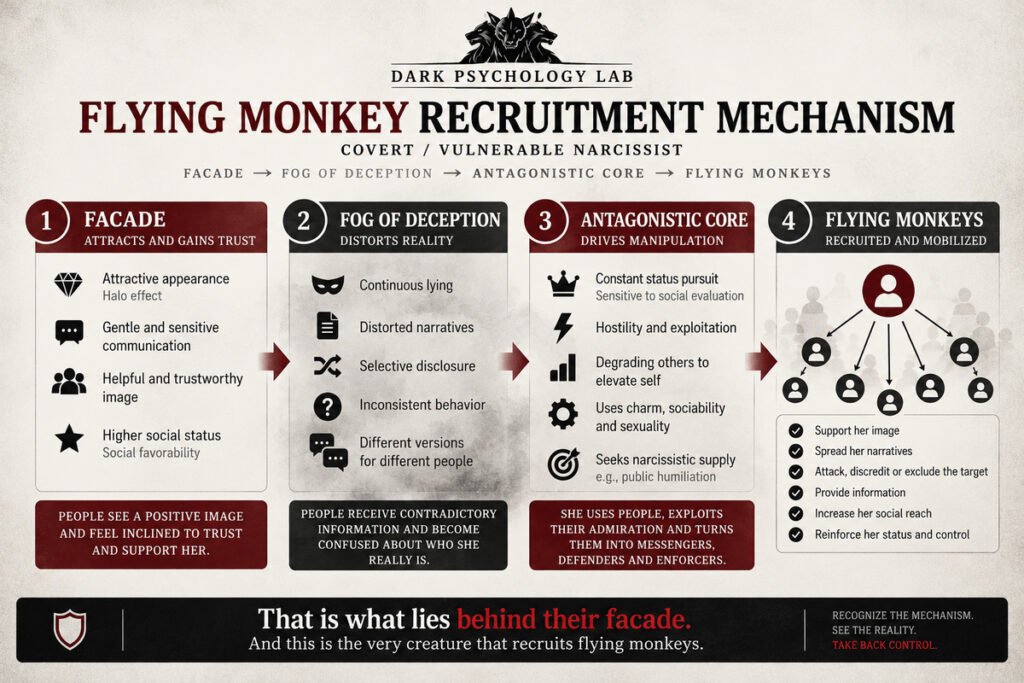
Facade
The woman was exceptionally good-looking, sexually appealing, gentle in her communication, and displayed sensitivity. These traits created what is known as the attractiveness halo effect: attractive people are more likely to be perceived as having favorable personality traits, particularly social competence (Eagly et al., 1991).
What makes this effect fascinating is how quickly people assigned her a higher social status, largely because of her physical appearance. Despite her personality, she knew how to present herself and appeared helpful and trustworthy. These qualities helped her build a positive image in the eyes of others.
This is how she recruited our target, and possibly most of the social circle that supported her. They saw what her facade reflected, the image she had constructed, and consequently acted as neutral flying monkeys.
Initial Mechanism:
Attractive facade → Halo effect → Social favorability → Trust → Support for the woman’s image → Network of potential flying monkeys
Fog of Deception
The second layer is her manipulative nature. Covert/vulnerable narcissists in general tend to be highly manipulative, regardless of whether their sensitivity is genuine or merely appears to be (Casale et al., 2019). Constant lying makes this difficult to distinguish.
Unlike the facade, which presents a carefully constructed image, the fog of deception emerges from a continuous pattern of lies, distorted narratives, selective disclosure, and inconsistent behavior. It spreads both externally, around the manipulator, and possibly within her as well.
The information people receive about her does not correspond to reality and differs significantly across sources. Different people encounter different versions of the same person, receiving contradictory information about her character, intentions, and actions.
Over time, these inconsistencies create something resembling a barrier of lies: the more you try to understand, the deeper you get lost in the fog. The more people interact with her, the more their understanding of who she actually is becomes distorted and fragmented.
Through her communication and behavior, this fog influences those around her, including her flying monkeys.
Antagonistic Core and Status Pursuit
Additionally, beneath the surface operates an antagonistic core that can manifest as hostility and exploitation (Jauk & Kaufman, 2018). In other words, they are simply malicious, and their perception of social interactions is shaped by concerns about status and their position within social hierarchies (Mahadevan & Jordan, 2022).
Combining these constructs with manipulativeness, we arrive at an inner world highly sensitive to social evaluation and status signals, characterized by constant lying, manipulation, and malice, where degrading others is perceived as a way of elevating oneself. She also knows how to exploit those around her through her sociability, charm, and sexuality. A formidable foe.
That is what lies behind her facade. And this is the very creature that recruits flying monkeys.
As the target began showing vulnerability and trying to repair their increasingly deteriorating communication, despite her degrading behavior, she appeared to receive large amounts of narcissistic supply by publicly humiliating him. Another person’s suffering can serve as a powerful reinforcement of grandiosity. We explored and analyzed this self-regulation mechanism in depth in our article:
Narcissistic Supply
Recruiting Flying Monkeys Through Manipulation
So we have her facade, supported by the people around her, a distorted reality built on lies, and antagonistic traits through which she may receive sadistic narcissistic supply. When a narcissist with this combination recruits flying monkeys against a single person, the process looks something like this:
- She communicates with people in the surrounding social circle, spreading distorted or fabricated stories about the target. She presents herself as the victim: “You won’t believe what he did to me!” Alternatively, she portrays him as a fool: “He doesn’t understand anything,” or “He’s such a worthless person.” This is smear campaign manipulation. Through this process, she creates a false narrative about the target while involving other people, some of whom are already her Intermediaries, while others join during the process.
- Smear campaigns and playing the victim gradually create an increasingly connected network of supporters:
Men defend her: rescue instincts and physical attraction.
Women support her: group conformity and moral positioning (Rudman & Goodwin, 2004). - She tells her active flying monkeys, who are fully under her influence and support her completely, to increase the pressure on the target.
- Next comes social manipulation. More people are drawn into the process through triangulation. By deliberately engineering conflicts, she pushes the target, who is already emotionally exhausted and attached to her, into situations where he is forced to defend himself publicly, thereby recruiting even more flying monkeys.
- Meanwhile, as the pressure on the target mounts, she responds to every attempt he makes to defend himself with DARVO manipulation. She denies responsibility, attacks the target, and reverses the roles of victim and offender (Harsey & Freyd, 2020). This manipulation influences how observers interpret the situation. As a result, the flying monkeys become even more aggressive.
- In this case, our protagonist had no intention of surrendering. He continued fighting back, but he also refused to walk away, which appeared to trigger an even stronger narcissistic injury in her. In response, the covert/vulnerable narcissist began deploying antagonistic defense strategies, mobilizing her entire network of proxies to escalate collective pressure against him before ultimately discarding him.
- Throughout this process, her facade protects her, whatever form it takes: a victim, someone who has been wronged, misunderstood, overly sensitive, under attack, abusive, or grandiose. Ultimately, she managed to protect her image, at least to some extent.
The sequence here shows the proxy recruitment methods of a highly skilled manipulator. She certainly seems to know how to exploit her strengths.
General formula for how a covert/vulnerable narcissist controls and directs pressure through flying monkeys:
Facade → Attractiveness halo effect → Fog of deception → Unwitting support for her image → Smear campaign → Emotional and moral recruitment → Triangulation → Mobilization of active flying monkeys → DARVO → Narcissistic injury → Escalation of collective pressure
This case study shows how the same facade that initially attracts people and secures their support can later turn the social environment against one of its former supporters. Role reversal occurs alongside the devaluation and discard phases as the conflict moves from a personal relationship into a broader social network.
We examined how women with similar personality traits operate in relationships. If you want to explore these dynamics in depth, read our article:
The Narcissistic Woman
4. Narcissists Using Each Other as Flying Monkeys: Hierarchical Structure
There are also more complicated situations.
In one workplace, judging by all the signs, a hierarchy of narcissists has become deeply rooted. The tragic yet fascinating part is that almost the entire company seems to operate as a network of flying monkeys. Within this network, we will identify the main players, individuals displaying different narcissistic traits, and examine how they use one another as intermediaries.

A Case Study of Social Dynamics in a Toxic Workplace
A covert narcissist uses charm, emotional manipulation, love bombing, and a carefully maintained facade to gain favor with a high-ranking company official who displays stronger malignant narcissism traits. This gives her protection within the workplace, allowing her to humiliate lower-ranking employees much more confidently, possibly to regulate her grandiosity through the people around her. As a result, conflicts arise from time to time.
During these conflicts, she uses provocations, smear campaigns, and triangulation to draw the malignant narcissist boss into the conflict as a flying monkey. He, in turn, seems to be trying to impress her, or perhaps the entire company, by publicly humiliating the target, “putting him in his place,” and sending his active proxies after him. These include people in the executive office, managers, and employees from other departments.
If their target continues resisting and escalating the conflict, they send an active malicious flying monkey with overt narcissistic traits after him. He takes responsibility for the attacks and increases the pressure on the target, crossing legal boundaries in the process. In return for his efforts, he receives the same protection within the narcissistic group and is even promoted later.
When the target tries to resolve the situation with anyone within this system, everyone lies, uses corporate DARVO tactics, and supports one another. Responsibility gets scattered across corporate delay tactics, a pleasant professional tone, and the facade of a company that makes millions while presenting itself as caring for its employees.
Our protagonist is being pushed out through collective psychological abuse known as workplace mobbing. Publicly, however, the company claims it wants him to stay, apparently to continue tormenting him.
This is an example of a rotten, toxic hierarchy created by narcissists. Yet the company continues operating and making money.
How Narcissistic Individuals Use Each Other as Flying Monkeys: One for All and All for One
DPL Framework
On one level, this is simply a narcissistic structure that pushes out people considered unsuitable, based on the judgments of one of the long-established narcissists operating within it.
Whether the entire company actively supports them, whether this is an established way of operating, whether the pathology of a few individuals has spread through their social circle, or whether they manipulate one another in their interactions remains unclear. However, in this story, we can observe some interesting social manipulation mechanisms behind how flying monkeys operate.
First Mechanism: Reciprocal Proxy Coalition
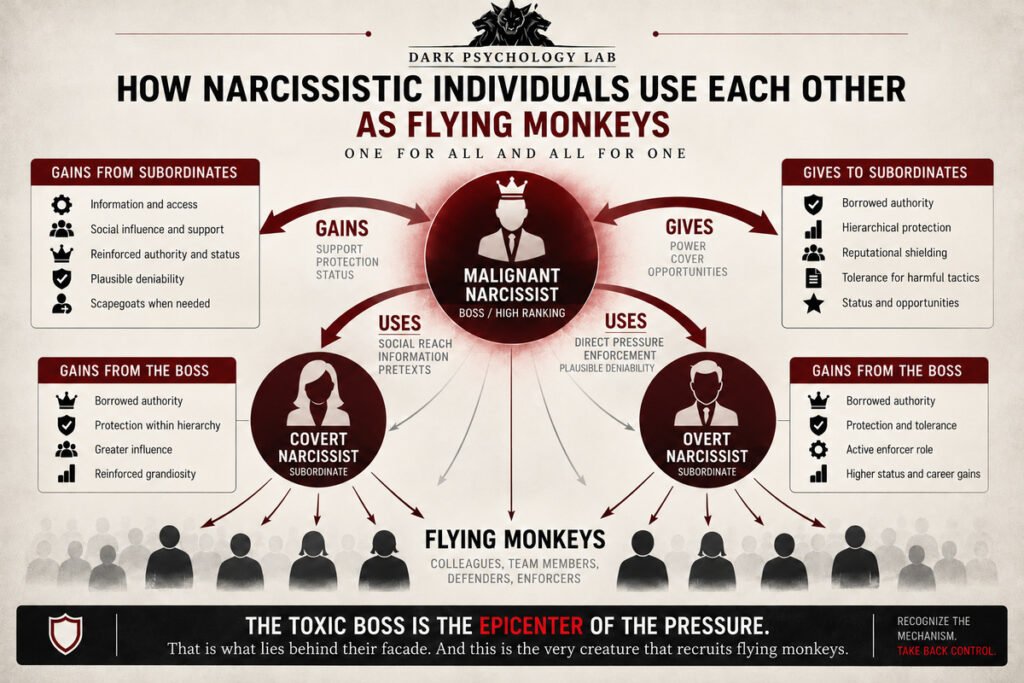
Our reciprocal proxy coalition model, based on observations from this workplace case, explains how manipulators at different levels of an organizational hierarchy exploit each other’s influence while providing mutual protection.
Lower-ranking narcissists using a higher-ranking figure
- Covert gains from Malignant
The covert narcissist gains borrowed authority, hierarchical power she does not possess herself. The boss’s support protects her within the organizational hierarchy and gives her greater leverage to expand her influence. By defending and vouching for her, he provides reputational shielding and creates opportunities to shift responsibility onto others or himself. This backing may also reinforce her sense of grandiosity. - Overt gains from Malignant
The openly aggressive individual also gains borrowed authority and hierarchical protection through this alliance. His tactics for undermining their targets are tolerated and justified as part of the company’s informal way of operating, while diffusion of responsibility provides another way to evade accountability. As an active enforcer applying pressure against their targets, he also gains increased status in the eyes of others and career opportunities, which may reinforce his grandiosity.
A higher-ranking figure using lower-ranking subordinates
- Malignant gains from Covert
The boss can benefit from her social network and its support. He may also receive attention and admiration from her, reinforcing his ego and status. Through her, he gains access to information and the opportunity to manipulate others using her as an intermediary. She can also provide pretexts for conflicts (considering his malignant traits), potentially reinforcing his sense of dominance. She becomes his covert flying monkey, providing information and extending his social influence.
Ultimately, if his own position were threatened, he could use her as a scapegoat to avoid accountability. - Malignant gains from Overt
The malignant narcissist uses a subordinate as a direct enforcer. He is a directly controlled active flying monkey. The boss can exert pressure through the overt narcissist while maintaining distance from the actions and relying on plausible deniability to protect his reputation if everything becomes public.
The subordinate takes on the visible part of the conflict and also serves as a scapegoat, so the main manipulator always has someone to shift blame onto and through whom to act indirectly (Roulet & Pichler, 2020).
Here we can see that this system’s structure largely depends on a person occupying a high-ranking position, a boss displaying malignant narcissistic traits. He is involved throughout the entire gains/gives structure and becomes something like the epicenter of the pressure in this toxic workplace. Technically, it would be much harder for lower-ranking narcissists to operate without his support. However, within such a hierarchy, they can act as each other’s flying monkeys.
The reciprocal proxy coalition model also indicates that if someone wanted to dismantle this structure, the main focus would have to be on the toxic boss. However, his flying monkeys act as obstacles that the target focuses on while defending himself, creating a barrier that makes it harder to assign responsibility (Mawritz et al., 2012).
We explored relatively safe ways to deal with similar individuals in our article:
How to Deal with a Toxic Boss Without Confrontation
Second Mechanism: Diffusion of Responsibility and Displacement of Responsibility
Hierarchical protection of the organization
As our protagonist continues trying to defend himself, more employees gradually become involved in the conflict. Some support management’s position, others pass along information, contribute to the pressure, or simply stay out of it and remain silent (Morrison, 2014).
When several levels of an organization become involved in a conflict, including almost the entire management and, in this situation, the internal structure itself, responsibility becomes dispersed as a protective function.
Complaints are redirected between managers, delayed, or dismissed with contradictory explanations: “It’s just a disagreement,” “Maybe that’s just how you see it,” or “Talk to your manager,” who, in this situation, is the epicenter of the pressure. On top of that, silence and delayed responses follow every difficult conversation. Manipulative tactics, ambiguous forms of pressure, and situations open to multiple interpretations create a favorable and relatively safe environment for workplace mobbing to operate, providing perpetrators with plausible deniability.
As a result, resolving the conflict within the workplace becomes impossible.
Narcissistic Workplace Case Defensive Insight
Narcissists operate on their own territory, surrounded by flying monkeys, like vampires at night. Therefore, one way to defend yourself is to drag them into the daylight. By that, we mean focus on the main perpetrator, in this case the malignant narcissist, or, if evidence is scarce, his active subordinates, the covert and overt narcissists. Considering the psychology of toxic individuals, there is a high probability that they will betray one another or shift responsibility onto the most vulnerable member. This may be their greatest weakness.
However, attempting to directly expose them is a high-stakes gamble. Considering how sensitive narcissists can be to threats to their public image, it will likely trigger narcissistic rage (Krizan & Johar, 2015). They will most likely retaliate, and they can do so brutally. It is the malicious behavior that follows their retaliation, especially when group dynamics draw in others who support the narcissists and dehumanize the target, that causes most of the psychological trauma. This is worth keeping in mind before escalating a conflict with them (Cortina & Magley, 2003).
When defending yourself against this kind of pressure, practically alone in enemy territory, it is always worth keeping the importance of documentation in mind. This is how you prepare to defend yourself legally.
Also, it is better to have an independent person or institution with no involvement in the conflict investigate the complaint (Acas, 2025). When approaching law enforcement, prepare for a lengthy court battle. Make sure you have sufficient evidence and resources. Consider what retaliation you might face from such individuals. In other words, you need to prepare very carefully, which is difficult if you have never encountered such a situation and do not understand how the system operates: the corporation involved may try to drag out the legal process, exploit ambiguity in the situation and legal gray areas, and try to strike back and shift the blame onto you.
We explored how to protect yourself from attempts to discredit you, along with other methods for dealing with narcissists at work. Our article covers these strategies in depth, ranging from assessing the situation and neutralizing the silent treatment to an internal shift we call the narcissistic paradox principle:
How to Work With a Narcissist During the Devaluation Phase
Case Study Conclusion: Facade and Target Reinterpretation
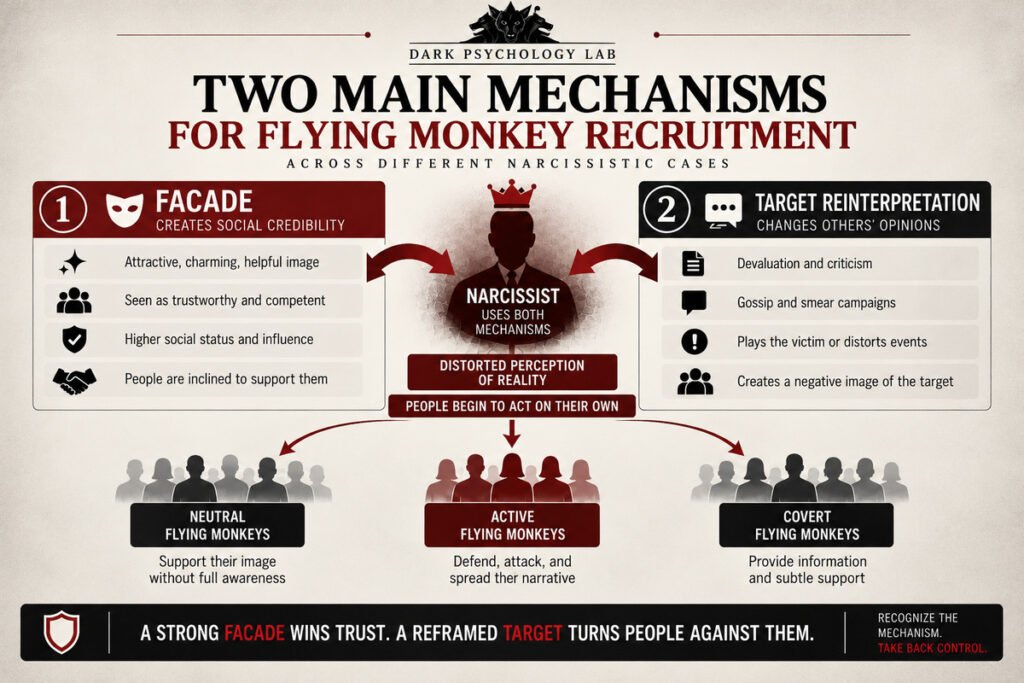
After examining four different stories involving people with various narcissistic traits, we identified a recurring mechanism of social manipulation across all four cases. Although their behavior, the environments in which they operated, their narcissistic subtypes, and their methods of influence differed, flying monkey recruitment largely relied on two main factors:
- A facade that provides social credibility
- Reinterpreting the target in the eyes of others
Facade: The Main Mechanism of Flying Monkey Recruitment
The second story revealed just how important the facade is in recruiting flying monkeys. In that case, the narcissist had difficulty controlling herself and sometimes gave herself away in public. Some people around her had already witnessed her impulsive and contradictory behavior. As a result, more perceptive individuals recognized these contradictions in her character, and her recruitment efforts worked with only a portion of her contacts. This story is particularly important because it stands in contrast to the other three cases. It shows how limited social credibility can reduce a manipulator’s ability to influence others.
In the third story, we observed the completely opposite effect of a covert/vulnerable narcissist’s influence over social environments. The woman had an exceptionally strong facade built on physical attractiveness, charm, and a display of sensitivity. Even her repeated lies, which clearly revealed her unreliability, and her contradictory behavior did not destroy her positive image among most people around her. Her facade helped her maintain supporters and gave additional credibility to her stories. As a result, she relied primarily on flying monkeys to increase pressure on the target.
In the first story, the person displaying grandiose narcissistic traits had a fairly convincing facade. His long-standing connections, popularity, and informal authority gave him influence within the group. People around him were accustomed to supporting his position.
In the fourth story, the facade’s function was partially taken over by the organization itself. Professional communication, corporate reputation, and the formal authority of management created the impression of a legitimate and trustworthy structure. Beneath this facade, narcissists operated with their own rules, ego games, and hierarchical power struggles, along with a network of flying monkeys embedded within the organization.
Based on our observations, the facade plays the greatest role in winning people’s favor and, consequently, becomes the main lever for recruiting flying monkeys. It acts as a filter through which people interpret new information. Of course, in more authoritarian hierarchies, direct power and fear among those involved can also play a role, but we are not analyzing those mechanisms here.
Target Reinterpretation: A Way to Change People’s Opinions
The second mechanism involves shaping how people perceive the target through the narcissist’s narrative. In some cases, this happens through simple devaluation, as the narcissist belittles, exploits, and pressures the target, lowering the target’s social status in the eyes of others. In others, it happens when the narcissist plays the victim or spreads their own version of events. However, different forms of smear campaigns appear in all our stories. Gossip and negative narratives circulating through social networks gradually change how people perceive the target.
Through these two main mechanisms, the facade and target reinterpretation, people begin acting as flying monkeys on their own. However, the nature of their involvement differs depending on their individual characteristics or level of involvement: it can be neutral, active, or covert.
Risk Gating: Self-Protection Insight
Based on our analysis, direct confrontation may seem like a logical way to defend yourself. If a narcissistic facade helps recruit flying monkeys, why not simply expose the manipulator’s true behavior to the people around them?
The problem is that narcissists tend to respond with severe retaliation when they feel their image or social position was threatened. They regulate themselves through their social environment (Grapsas et al., 2020), and they are usually highly social. Any threat to their self-image can activate antagonistic self-regulation, which is technically the narcissistic discard phase. This can manifest as aggressive retaliation, discrediting the target, mobilizing additional flying monkeys, and using any other available means to destroy the target’s reputation. We examined this behavior in depth in our article:
Narcissistic Discard Phase
Confrontation is particularly dangerous when you are exhausted, socially isolated, or dependent on the manipulator. Even if you expose their behavior, their strong facade may keep others from changing their opinion of you, especially if they have already damaged your reputation.
Before confronting a manipulator, assess your safety, your level of dependence, and the potential retaliation you may face. Limit information leaks through mutual acquaintances, maintain trustworthy social connections, and document harmful behavior. When necessary, seek help from independent professionals or institutions.
Direct confrontation can escalate the social conflict even further. Therefore, before defending yourself, it is worth preparing carefully and assessing the possible consequences, as well as the narcissist’s influence and capabilities, in advance.
Dark Psychology Lab Defense Guides
Dark Psychology Lab focuses on understanding covert control and defending against it. These guides explore defensive techniques in greater detail across different areas.
Psychological Manipulation
Psychological Manipulation Defense: Safe Strategies and Dangerous Tactics Explained
Narcissistic Dynamics
How to Deal With a Narcissist and What to Do When You Can’t Leave
Workplace Mobbing & Toxic Workplace Culture
Workplace Mobbing Defense Playbook: 17-Step Guide
Final Thoughts
In our case studies, we examined how narcissistic pressure operates through the social environment. Naturally, when things are going well, people rarely pay much attention to narcissistic dynamics. They are mainly studied because of the pain they cause.
Nevertheless, flying monkeys operate constantly. They are always in the background. Perhaps you’ve noticed how well people around you treat you when you’re on good terms with a narcissist, but their behavior changes when the relationship starts to deteriorate. Why do you think that is? These changes are consequences of the flying monkey recruitment mechanism. Their role simply becomes much clearer at that point.
Disclaimer
Dark Psychology Lab (DPL) is an independent research and educational project. We are not licensed psychologists, therapists, medical professionals, or legal advisors. The information presented in this article is intended for educational and analytical purposes and should not be considered a substitute for professional psychological, medical, or legal advice.
These case studies are based on anonymized real-life experiences. The explanations, interpretations, and DPL frameworks presented here reflect our analysis of behavioral patterns and social dynamics. They do not constitute clinical assessments or definitive conclusions about the individuals involved. Terms such as narcissist, covert narcissism, and malignant narcissism are used within an analytical framework. Narcissistic Personality Disorder (NPD) can only be diagnosed by qualified mental health professionals.
The information provided is intended to help readers better understand psychological manipulation and related social dynamics. Individual situations vary, and readers are responsible for how they interpret and apply this material. We encourage seeking qualified professional assistance when dealing with serious psychological, legal, or safety concerns.
For further information about our research approach, limitations, and liability, please read the full Disclaimer.
Dark Psychology Lab
Original content based on lived experience and independent psychological analysis.