

The narcissistic idealization phase is when the narcissist elevates you, supports you, and idealizes you. The phase itself is not the problem. On the contrary, it often creates an elevated emotional state in the person being idealized.
The problem begins when that feeling becomes dependent on the narcissist, as it creates an unstable but very powerful emotional bond that the narcissist can give or withdraw depending on shifts in their perception.
From the start, the idealization phase already contains the mechanism of future harm, as it activates narcissistic supply.
Narcissistic Cycle Overview: Idealization Phase
This article is part of the Narcissistic Cycle series.
Idealization → Devaluation → Discard → Hoover → Repeat
To understand how all phases connect into one repeating abuse mechanism, read:
Narcissistic Abuse Cycle Explained
TL;DR Idealization
- Narcissist types and how they operate
- Narcissistic love formula
- Idealization phases
- “Real narcissistic love”
- How long does it last
Download the Manipulation Recognition Guide
Not sure if you are being manipulated by a narcissist? Take a test. Press a button below. Sign up for Dark Psychology Lab, and we will send it to your email.
How Different Narcissist Types Operate in the Idealization Phase
Narcissistic behavior, especially the cycle and the idealization phase, repeats on a global scale regardless of type. This suggests we are not dealing with random actions, but with a recurring psychological mechanism. However, according to psychological research, different types of narcissists tend to operate differently within that cycle (Joshua D. Miller et al., 2010).
Based on observations, overt narcissists tend to appear more controlled and deliberate in their behavior, despite the antagonistic core (Jauk & Kaufman, 2018) and underlying need for narcissistic supply, which in some cases may escalate into coercive behavior. They tend to have better self-control, are more dominant, and are more goal-oriented in their behavior.
In contrast, covert narcissists may appear calmer and more composed on the surface, but internally they tend to be more impulsive and emotionally unstable. Their external facade can seem stable or engaging, while their internal processes are often more chaotic and driven by the same antagonistic core and need for supply. That said, they can also learn to regulate themselves over time.
Narcissist Types by Self-Awareness in the Idealization Phase
Because of these differences, especially when considering the level of awareness and self-control, we can group narcissists and their behavior during the idealization phase and relationships into the following categories.
More self-aware narcissists
They tend to maintain a controlled public image and follow social expectations. A self-aware narcissist may be fully capable of building and maintaining families. In such cases, they often develop supply regulation rituals, ways of managing inner hunger.
Less self-aware narcissists
They are more reactive to strong emotions. Their phases can shift quickly, and even small triggers may lead to narcissistic rage. This type of narcissist tends to operate more on instinct and may change partners every one to two years or faster.
For example, after about a year in a relationship, their behavior may noticeably worsen as devaluation becomes active.
- People who recognize this and leave: they can be perceived by the narcissist as inferiors who do not understand their feelings.
- People who do not leave and try to hold on: by the second year, this type of narcissist tends to wear them down internally and then discard them brutally at the end.
In addition, the idealization phase may overlap with the biological phase of romantic love, which typically lasts around 12 to 18 months, although its duration varies. As the initial neurochemical intensity begins to subside, romantic love can develop into a more stable emotional attachment that supports the long-term relationship (Marazziti & Canale, 2004). However, this type of narcissist may struggle to form that deeper connection because of limited empathy and a dysregulated neurotransmitter system, which we will discuss later in the section on the biological mechanisms behind idealization.
Adaptive Narcissists: Learned Self-Control
This behavioral pattern may be influenced by life circumstances or the environment, but usually develops with age and experience.
An older or more adapted narcissist may appear calmer and much more stable on the outside. However, despite this external stability, the lack of empathy remains, and the narcissistic supply mechanism continues to operate internally.
Internal Mechanisms Behind Narcissistic Idealization
Narcissistic love formula (DPL framework)
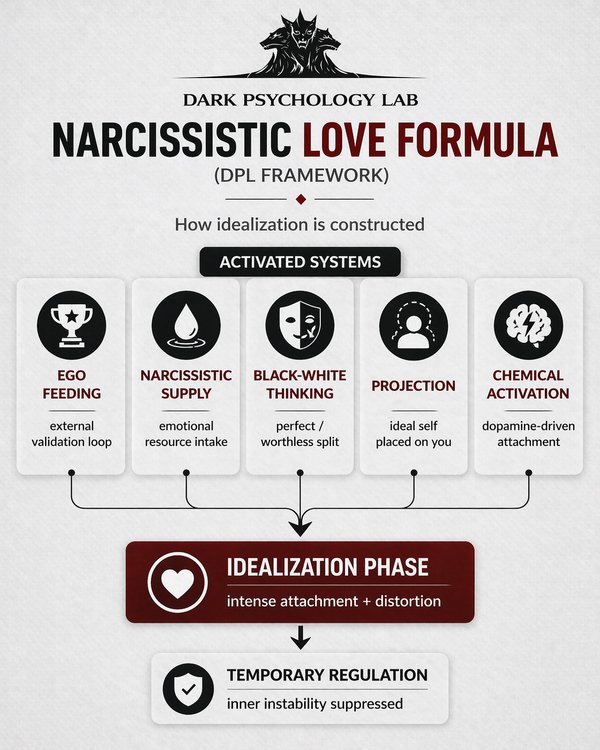
The narcissistic idealization phase commonly starts with a strong fascination with you. It is driven by the stronger emotions the narcissist is experiencing at that time.
This process often begins when you match something they are missing at that moment. You may have been a more difficult target, held a higher status in some area, or been perceived as easier to control, creating a strange mix of challenge and satisfaction for them. Through you, they received the validation they lacked.
Based on observations and scientific research, we can identify which psychological systems are activated in the narcissist and how they function during the idealization phase, thereby improving our understanding of them and their motives:
Source (related): Attachment and Object Relations in Patients With Narcissistic Personality Disorder — PubMed, Kealy, D., Tsai, M., Ogrodniczuk, J. S. (2013)
- Ego feeding
- Bioogical system
- Narcissistic supply
- Black-and-white thinking
- Projection
- Self-regulation through illusion of control
Ego Feeding: Idealization as Learned Narcissistic Behavior
At times, the narcissist’s behavior may look strategic, but this does not mean the process is fully conscious. More often, it operates like a learned pattern of behavior that has worked for them many times before.
Idealization → attention/control → reinforcement → repeat
Idealization creates a strong emotional response, allows them to get close quickly, feeds the ego, and temporarily reduces inner emptiness, which is frequently tied to an unstable inner personality structure that needs external validation to sustain itself.
Because of this, it makes sense to interpret the phase as a psychological and biological mechanism that keeps paying off for the narcissist.
Psychological Side
From a behavioral perspective, idealization follows a loop: behavior that produces attention, validation, and control gets reinforced and repeated. Over time, this may create a learned pattern that operates automatically rather than as a fully conscious strategy.
Source (related): Intersect between self-esteem and emotion regulation in narcissistic personality disorder — PubMed, Ronningstam, E. (2017)
Biological Mechanisms Behind Idealization
Some evidence suggests that certain forms of narcissism may involve heightened sensitivity to reward-related stimuli (Jauk et al., 2021).
This strengthens the idea that the commonly observed, recurring idealization phase in narcissistic dynamics can be partially linked to underlying neurological processes and is commonly associated with biochemical self-regulation systems involved in motivation, learning, habit formation, and bonding.
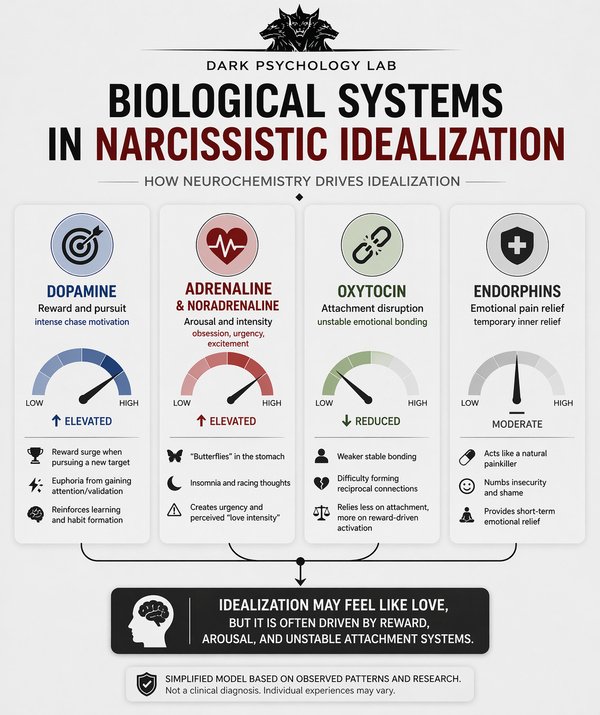
Dopamine (Reward and pursuit): The narcissist may experience a significant dopamine surge while pursuing a new target and gaining their attention, creating a sense of euphoria similar to a gambler hitting a jackpot (Render & Jansen, 2019).
Adrenaline and Noradrenaline (Arousal): These chemicals create the “butterflies in the stomach,” insomnia, and constant thinking about the partner. For the narcissist, this may produce a sense of intensity that, to them, can be associated with love (PubMed Central, 2022).
Oxytocin (Attachment): Research suggests that individuals with strong narcissistic traits may process oxytocin-related bonding differently. This can contribute to difficulties in forming stable, reciprocal emotional connections. As a result, the idealization phase may rely less on stable attachment and more on impulsive, reward-driven neurochemical activation (PubMed Central, 2014).
Endorphins (Pain relief): Idealization can function like a painkiller, temporarily numbing their ongoing inner insecurity and shame (PubMed Central, 2010).
Narcissistic Supply During Idealization
Due to the strong activation of neurochemicals at the onset of the idealization phase, the narcissistic supply mechanism is activated.
The narcissist becomes attached and begins to extract supply from the idealized target. This is one of the key reasons why it can be difficult for them to simply walk away when the relationship starts to fail. Once an emotional bond forms, a feeding tube is established.

Although the supply in the early idealization phase is positive, the narcissist can also feed on negative emotions. They may derive validation not only from the attachment but also from the target’s distress, pain, and confusion, as this reinforces their sense of importance. If a group becomes involved, this process can intensify further, feeding the narcissist’s ego even more.
We explored this mechanism, along with the Feeding Cycle, in the article:
Narcissistic Supply: What Narcissists Feed On
Narcissistic Psychology: Splitting and Black-and-White Logic
One of the main drivers of this phase is splitting, or black-and-white logic, a well-studied phenomenon in narcissistic psychology (Kernberg, 1975).
Narcissists tend to divide people into groups. You are either a friend or an enemy. Because of this tendency, there is typically ongoing social instability around them. They may be in conflict with some people, aligned with others, and forming temporary alliances while turning others into targets.
During the idealization phase, this internal process can make you a hero in their eyes. The narcissist places you on a pedestal, gives you their best, and ignores your flaws.
It looks solid, right? But because of this same mechanism, even small mistakes can unexpectedly put you on the other side.
Narcissistic Projection
Projection is a psychological defense mechanism in which a person attributes their own unacceptable feelings, impulses, or flaws to others. In this way, the individual avoids confronting their own shortcomings by externalizing them, for example, transforming internal anger into the belief that others feel hostility toward them (APA, n.d.).
Narcissistic projection tends to be more intense, more frequent, and more destructive than typical projection.
This psychological pattern is most often linked to negative expressions. However, during the idealization phase, the narcissist projects what they perceive as their best qualities onto you, treating you as a perfect reflection of themselves.
That is why, to them, idealization can feel like love, and that is why it collapses so quickly.
Idealization as Self-Regulation Through Illusory Control
Because their fragile ego often relies heavily on external achievements and the validation of others, narcissistic individuals tend to be deeply insecure at their core. As a result of the processes described above, they project their self-image onto the idealized target and use that reflection as a source of validation, temporarily regulating their internal instability. Through it, the narcissist may temporarily feel elevated and important, in what can resemble an idealization-driven distortion.
Research indicates that this behavior is rarely adaptive and is more often driven by defensive processes aimed at protecting self-esteem (Baumeister & Vohs, 2004).
The problem is that this regulation depends on external input. They are trying to resolve their internal issues through purely external sources. We cannot control other people’s perceptions or reactions, which means narcissistic self-worth can become tied to an illusion of control.
That is why even a small amount of criticism, or simply noticing their flaws, from an idealized target can feel like a direct threat to their psychological survival, potentially triggering intense inner distress.
This becomes especially visible when a person begins to deviate from a “perfect” image in the narcissist’s perception by showing boundaries, vulnerabilities, or independence. The illusion starts to break down. Depending on the narcissistic psychological profile, this can trigger a strong internal rejection, which marks the beginning of the devaluation phase.
The Idealization Sequence: The Hidden Beginning of Devaluation
This section breaks down the narcissist’s actions across the idealization sequence:
- Techniques used to create attachment
- Psychological state of the idealized person at each stage
- Where and how the shift into devaluation begins
1. Activation → 2. Attachment → 3. Distortion → 4. Dependence → 5. Collapse
The diagram below shows how the idealization phase progresses step-by-step toward emotional dependence and then devaluation.
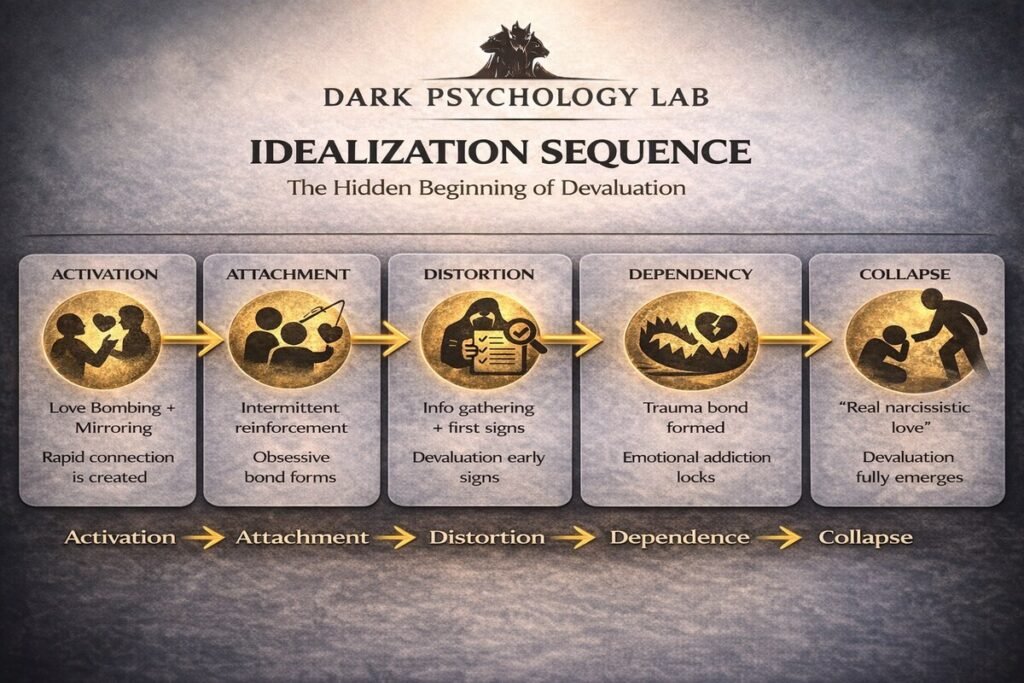
1. Activation
Love Bombing + Mirroring
At the start, narcissist attention becomes fixed on their ideal target, and they begin using techniques that can quickly create attraction:
Love bombing — creates emotional overload through attention, compliments, rapid closeness, promises, gifts, and the feeling that you have finally been truly seen.
Mirroring — can make the narcissist appear like an ideal reflection. They may absorb your values, needs, interests, and hopes, then reflect them back in a way that creates the impression of unusual harmony and emotional closeness.
Under the influence of the narcissist’s intense attention and attraction-building techniques, a person may begin to feel as if they have finally found the perfect partner. As the attraction builds, it feels natural to respond in kind to the narcissist’s behavior and try to get closer, which is what most people do.
2. Attachment
Intermittent reinforcement
Although narcissists tend to have lower empathy, they can be highly attuned to another person’s emotional state.
When the other person responds emotionally, opens up, invests, and becomes attached, narcissistic relationships tend to move to another level.
As long as you are a challenge, you remain valuable. Once the narcissist “has” you, your value drops. The chase and tension fade, and the idealized image begins to collapse. In its place comes closeness, which can activate shame, vulnerability, and inner instability in the narcissist, potentially triggering narcissistic injury (Kohut, 1977).
Intermittent reinforcement appears here as avoidance, toxic behavior, and criticism, followed by returns to the warmth shown at the beginning, as if the narcissist is not fully decided. After all, they were genuinely fascinated by you at first.
This pattern tends to amplify attraction to a narcissist and may even lead to obsessive attachment. We analyzed these processes in detail in our article:
Why You Can’t Stop Thinking About Them: How Intermittent Reinforcement Creates Obsession
Possession weakens idealization. Narcissists tend to value the chase, not the catch.
3. Distortion
Information gathering and early signs of devaluation
During idealization, flaws are ignored, but that does not mean they go unseen. A key insight is this: internally, devaluation begins during idealization. It simply becomes visible later.
While the person is being idealized, the narcissist may already be collecting material for later devaluation: boundaries, moments when you were vulnerable, your insecurities, and your weak spots.
Disappointed by their own delusion, the narcissist can later use this material as punishment, as a way to express the frustration of their collapsing illusion.
This is the moment when, instead of self-reflecting or acknowledging their own internal flaws or inconsistencies in judgment, they begin discrediting the other person to reassure themselves that their initial choice was a mistake. They begin targeting the other person’s identity to confirm their assumptions, which, in turn, creates greater emotional turbulence in the relationship while extracting more negative reactions that are stored as ammunition for the start of true devaluation.
This is where the early signs of the devaluation phase begin to appear. The internal erosion of the person begins, even before the relationship moves into the next stage of the narcissistic cycle.
4. Dependency
Identification and trauma bond
Idealization may create a strong emotional bond in a person idealized by a narcissist. A narcissist often already knows that a target is attached, but tries to make sure of it, as if approaching the boundaries you still tolerate and constantly poking their head through the door back and forth to be certain, thereby intensifying the push-pull dynamic in the process.
To confirm this, the narcissist may test with:
- Affection Withholding – Narcissists have a tendency to deny you exactly what you need. They use this constantly, but in this phase, it becomes more intensified and deliberate.
- Silent treatment – as punishment for perceived slights or undesirable behavior, and monitoring your reactions.
- Gaslighting – in a lighter form, so that it would be difficult to understand that it is being used, and to get away with it easily.
Then gradually worsen their behavior into a softer form of emotional abuse, but by sometimes returning to the positive version they showed at the beginning, they create a trauma bond in their partner.
Source (related): Pathological narcissism: An analysis of interpersonal dysfunction within intimate relationships — PubMed Central, Nicholas J. S. Day, Michelle L. Townsend, Brin F. S. Grenyer (2021)
5. Collapse
„Real narcissistic love“
Eventually, collapse comes. The narcissist’s ideal had already shattered.
After testing you, the narcissist realizes they have fully conditioned you. This is where the devaluation phase begins, the start of the real narcissistic feast.

Narcissists may see you as inferior, someone too blind to recognize what’s happening. As their behavior continues to deteriorate, you keep trying to hold the relationship together. From their perspective, your actions may seem incomprehensible.
By this point, they are already feeding on your attachment and your negative emotional reactions. You are no longer a person to them, only a source of supply, and they are fully satisfied with it and have no intention of letting you go.
The most brutal part of all this is that you may still try to fix the situation, hoping that it’s possible to bring back the version they showed in the beginning, but that version was an illusion from the start, a temporary neurochemical and emotional spike. In many cases, they struggle to form a healthy, secure, long-term attachment. Even if the relationship continues, you are treated as a resource.
Reality is what ends the fantasy.
Devaluation has already begun during the idealization phase. The narcissist simply has not shown it yet, possibly because they are not fully certain they have secured your attachment.
How Long Does the Idealization Phase Last
This phase does not always happen unnaturally quickly, but it very often does.
Its duration is not fixed. It may last a few weeks, a few months, or sometimes longer. It can last longer when:
- There is little contact.
- The person provides significant value.
- The narcissist has other places to discharge frustration.
- The narcissist is more self-aware.
How Idealization Appears in the Workplace
This mechanism is worth seeing more broadly. It does not function only in romance. In a narcissistic work environment, idealization may appear through the mask of a protector, mentor, or “good team terms.” There may be promises of exceptional opportunities, future bonuses, growth, or special status within the team.
Until disagreements or personal conflicts emerge, the narcissist’s unhealthy drive for dominance commonly remains hidden (Fezzey et al., 2023).
The form changes. The mechanism stays the same.
Healthy vs. Pathological Idealization
Healthy idealization can inspire, give direction, and motivate. It does not create dependence on another person.
Pathological idealization ignores reality, creates dependence, and leaves emptiness when it collapses.
Risk Gating
If a person is already psychologically vulnerable, the collapse of idealization can destabilize them. If dependence has already formed, the situation may be more dangerous than it appears on the surface. For this reason, it is important not to romanticize this phase or try to “restore” it, but to understand its mechanism.
This phase may feel the most engaging. That is exactly why it is so often misunderstood.
In the narcissistic cycle, this is the entry point through which an emotional bond is created. Based on our analysis, narcissistic supply is activated from the very beginning, which means devaluation will follow if you fail to maintain distance or disengage in time.
Understanding this cycle is the first step to reducing its impact.
Defense Guides – Practical Self-Protection
Dark Psychology Lab focuses on clarity and self-protection in situations involving manipulation, power imbalance, and covert psychological pressure.
The following defense guides expand on practical tools to reduce psychological damage and regain control:
Psychological Manipulation
Psychological Manipulation Defense: Safe Strategies and Dangerous Tactics Explained
Narcissistic Dynamics
How to Deal With a Narcissist and What to Do When You Can’t Leave
Toxic Workplace
Workplace Mobbing Defense Playbook: 17-Step Guide
Disclaimer
This article is for educational and informational purposes only. It is based on psychological concepts, behavioral patterns, and personal analysis, and is not intended to diagnose, label, or replace professional mental health advice.
Narcissistic traits exist on a spectrum, and not all individuals who display certain behaviors have a clinical disorder. The patterns described here are meant to help recognize dynamics, not to assign fixed identities to people. For full context, limitations, and how to use this information responsibly, please read the full Disclaimer Page.
If you are experiencing psychological distress, relationship harm, or trauma-related symptoms, consider seeking support from a qualified mental health professional.
Dark Psychology Lab
Original content based on lived experience and independent psychological analysis.