

Toxic workplace environments and difficult personalities that contribute to them, including narcissistic individuals, are not uncommon (Sui et al., 2026). When dealing with them for the first time, it is easy to become disoriented and make mistakes that can cost reputation, position, income, or even employment.
This article provides a contextual framework and practical, awareness-based techniques for working with a narcissist during the devaluation phase.
DPL Defense Guide: Devaluation at Work
This is a recognition and self-defense guide. It focuses on workplace situations where a person exhibiting narcissistic traits enters the devaluation phase, which is the process of diminishing another person’s value or status while positioning oneself above them. In other words, a form of psychological abuse. For a deeper explanation of systematic devaluation and how to recognize it, read our article:
The Narcissistic Devaluation Phase
The sections below are based on independent analysis and direct observation of covert and malignant narcissistic behavior in the workplace. If there is a significant power imbalance, assess risks realistically before applying any strategy.
This article is not a diagnosis, and we do not encourage readers to diagnose anyone with narcissism. Narcissistic Personality Disorder (NPD) can only be diagnosed by a qualified clinical professional.
TL;DR
- Understand what narcissists can represent inside a company and how they primarily operate through social circles and group influence as highly social individuals.
- Principles and 8 defensive techniques for dealing with narcissists at work, including the Narcissistic Paradox Principle as an important internal shift when their behavior worsens.
- Why their behavior may initially get worse after you withdraw attention and start applying defensive techniques.
- Analysis of potentially harmful techniques that may reduce conflict but can also weaken your position. Whether you use them is up to you, but we do not recommend them.
- The biggest and most common mistakes when working with narcissists.
- A checklist to help assess whether you are being devalued.
Download the Manipulation Recognition Guide
Not sure if you are being manipulated by a narcissist? Take a test. Press a button below. Sign up for Dark Psychology Lab, and we will send it to your email.
Narcissism in the Workplace: Value, Harm, Who Gets Targeted and Social Behavior
Before planning defensive actions against a narcissist, it is important to understand how they operate within the social environment. Their traits can produce very different outcomes inside an organization.
Their Value to the Organization
Individuals with narcissistic traits are often useful to companies. They are frequently well established within organizational structures and can function effectively in toxic environments, sometimes ones they helped create.
A moderate level of narcissism can help a leader rise within a hierarchy. In such settings, aggressive behavior may gradually be reframed as “high standards” or “strong leadership” (Maccoby, 2004).
Narcissistic traits that may benefit the organization:
- Decisive and harsh decision-making: reduced empathic concern makes it easier for such leaders to terminate employees or implement cost-cutting measures while viewing decisions primarily in terms of gain and loss. The sense of power associated with a leadership position can even make this process rewarding for them.
- High standards and ambitious goals: their competitive drive and need for recognition can contribute to company growth and performance.
- Charisma and social image (facade): they can shape a strong public image for themselves and the organization.
- Emotional stability in chaotic situations: Grandiose narcissism is generally associated with lower neuroticism (Miller et al., 2011), which increases stress tolerance, allowing them to remain composed during critical moments.
Consequences of Severe Narcissistic Dynamics
While a moderate level of narcissism may benefit performance, excessive levels can become destructive, especially for those working under or alongside such individuals. In more intense workplace situations, the following behaviors often occur:
- Interpersonal relationships are informally placed above company policies
- Acts of revenge over events, often minor ones, that injure their ego
- Systematic targeting and devaluation of individuals (psychological abuse)
- Reputational damage through smear campaigns
- Formation of hostile groups and coordinated group attacks against individuals deemed “unfit”
- Physical violence, if the circumstances allow it
Overall, when narcissistic dynamics take hold, character attacks against individuals occur more frequently (Duradoni et al., 2023). This article focuses specifically on these workplace dynamics.
People Narcissists Target at Work
- Colleagues or direct subordinates: If they sense any vulnerability, they tend to exploit it.
- High-performing employees: Due to insecurity, they often try to eliminate perceived competitors in various ways.
- Independent thinkers: In such dynamics, employees are usually divided into castes, while broader perspectives and behavior that do not align with their place in the company hierarchy are punished.
- Employees who challenge their authority: A challenge to their authority can be experienced as a threat to the narcissist’s grandiose self and their position within the hierarchy. This can produce a severe narcissistic injury and trigger retaliatory aggression (Green & Charles, 2019).
- Formerly favored employees who are now being devalued: This phenomenon is related to the fact that narcissists naturally repeat the abuse cycle, including an idealization phase, not only in private relationships but also in workplace relationships.
Understanding Narcissism as a Social Mechanism
Narcissistic behavior operates through the social environment (Leckelt et al., 2020). Devaluation rarely remains completely private: the target’s competence, character, or status is attacked in front of other people, shaping how the surrounding group perceives them.
This process also takes time. Before escalating pressure, narcissistic individuals usually make sure they are secure by establishing themselves within the company hierarchy and social environment.
For this reason, DPL considers immediate escalation to HR or management during workplace devaluation (narcissistic psychological abuse) potentially dangerous. A narcissist may already be deeply embedded in the social hierarchy. The side you see is not necessarily the side others see or are able to evaluate objectively.
This does not mean remaining passive. Resistance and direct confrontation are sometimes necessary. Before doing so, make sure your position is defensible: protect your credibility, document important events, understand the power structure around you, and remain professionally consistent.
Principle One: Winning Means Remaining Yourself
Do not copy the narcissist’s behavior. Do not compete through lies, humiliation, or manipulation as they tend to do. Defend your position, challenge false narratives when necessary, and apply pressure through facts, documentation, boundaries, and professional conduct. This will make it much harder for them to discredit you.
The goal is not to become better at their game. The goal is to remain yourself while becoming much harder to attack.
Most people make the same mistake. When engaging with a narcissist, they assume the interaction can lead to mutual understanding and constructive dialogue.
However, collective experience shows:
- They struggle to relate to others as equals, instead organizing relationships around status, value, and hierarchy (Grapsas et al., 2020; Krizan & Bushman, 2011).
- Their primary goals are to reinforce and protect a fragile ego (Morf & Rhodewalt, 2001). When they perceive another person as lower in status, the interaction is rarely approached as a dialogue between equals.
Defensive Techniques during the Devaluation Phase
DPL Framework
The primary defense rules when working with individuals who display narcissistic traits are:
- Do not give them excess information.
- Do not reveal vulnerabilities or obvious weak points.
- Keep them out of your personal space, your thoughts, and your emotional world.
1. Power Map: Strategic Assessment
Before taking any action, perform a risk assessment. Answer the question:
In what specific way can this person harm me?
- If it is a manager (formal power): they control your salary, working conditions, and career opportunities. During devaluation, it is therefore entirely possible for them to influence all of these areas, even indirectly.
- If it is an equal colleague (reputational power): they can cause harm through passive aggression, public attacks, lies, taking credit, obstructing work tasks, or manipulation of the team’s opinion.
- If it is a client or another department (resource power): the harm may appear through failure to fulfill commitments, intentional delays, or false information about your work.
Group opinion influence techniques such as smear campaigns or triangulation, and psychological manipulation such as gaslighting, can occur across all categories.
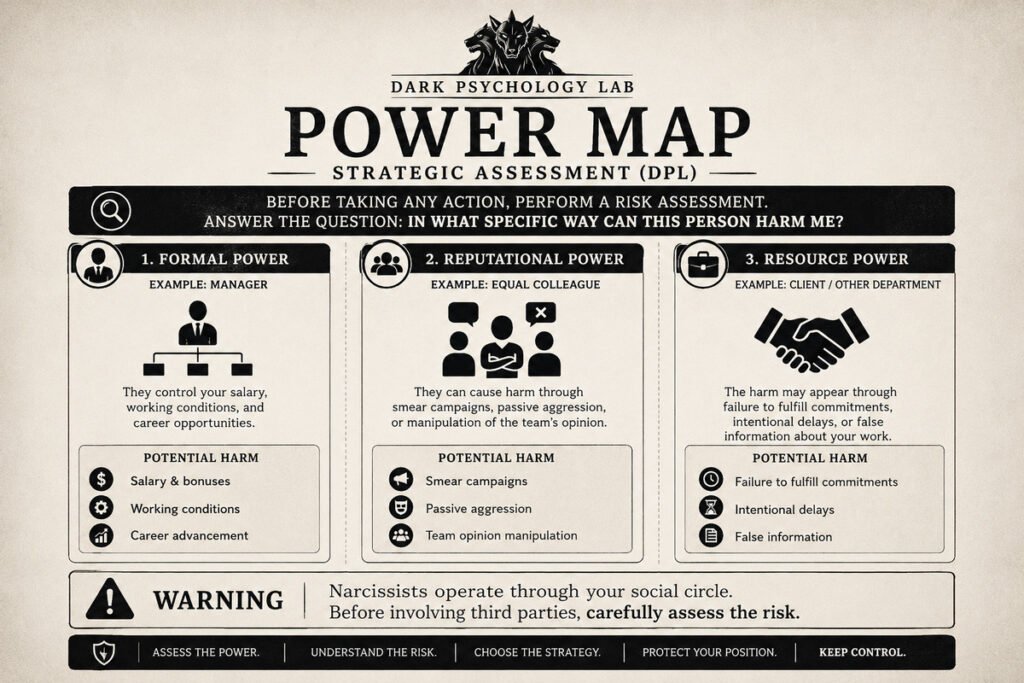
Narcissists operate through the social environment. If you are considering approaching other people within the company structure, carefully assess the risk and the narcissist’s influence before doing so.
2. Recognition of the Narcissistic Model: Abuse Cycle
Narcissistic relationships, including workplace-related connections, tend to follow the same repeating model. Knowing which stage you are in can be your greatest advantage.
- Idealization phase (Love bombing): At the beginning, the narcissist shows charm, pulls you in, praises your competence, and mirrors your needs.
- Devaluation phase: Aggression increases (often passive-aggression), mood instability grows, emotional distance appears, communication starts to break down, and the more damaging behavior escalates.
- Discard phase: Open contempt, disregard, and aggressive discrediting. You become unnecessary or dangerous to their image.
- Return phase (Hoovering): A refusal to fully let go of the target. This may look like “mobbing with a smile”: “It is a shame you are leaving; you were a good employee,” or a phone call after six months or later, offering cooperation again.
Recognizing the stages of the narcissistic cycle can help predict the narcissist’s behavior more accurately. Once devaluation begins, the workplace relationship is unlikely to return to what it was before. In the best-case scenario, if the narcissist realizes they have little leverage and are not being attacked, they may eventually withdraw.
Why does this work? When you understand that a narcissist’s charm, worsening behavior, or social aggression is part of their underlying biological and psychological mechanisms, you can make better decisions instead of expecting their internal system to simply change on its own.
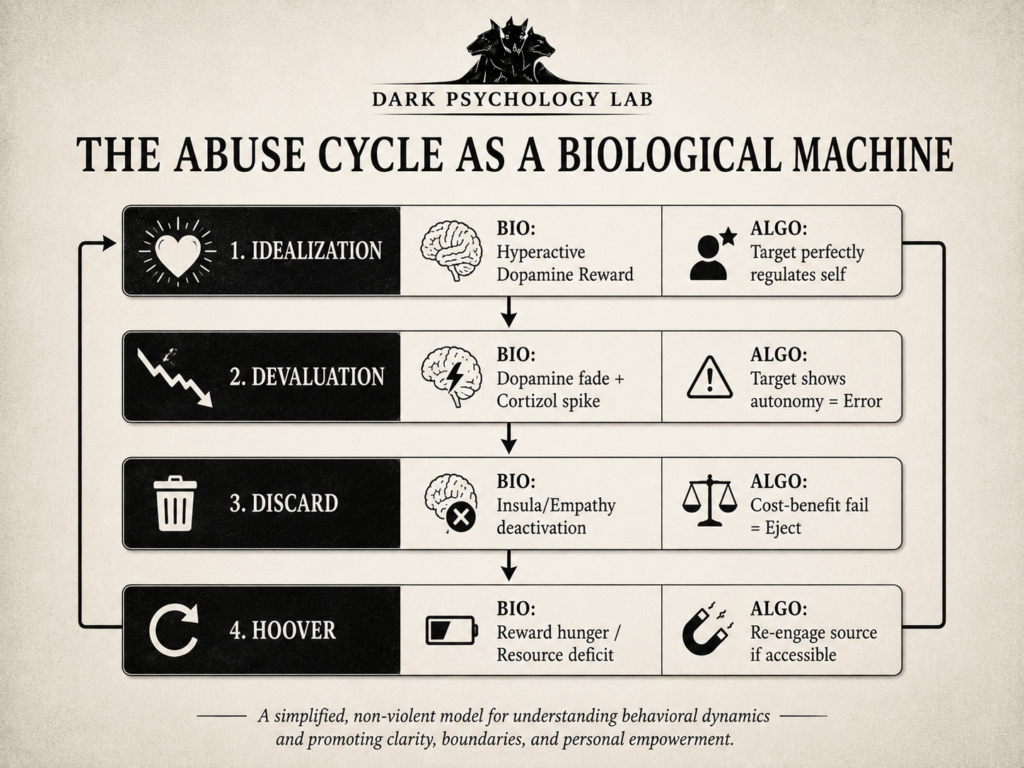
DPL has examined the repeating narcissistic abuse cycle in detail. If you want to delve deeper into narcissistic internal processes and better understand their behavior, explore the related article and its series:
Narcissistic Abuse Cycle Explained
3. Boundaries as Process, Without Drama
Boundaries work only when they are firm and procedural, not emotional or passive-aggressive. Stronger reactions reveal that the narcissist’s behavior is affecting you, and they may use that information against you later.
The less they know, the fewer levers they have.
- Focus all attention on the task scope, quality criteria, and deadlines.
- Protect your privacy: do not share personal problems, past trauma, relationship history, or other sensitive information.
- Use communication techniques against manipulators: BIFF, JADE, and BEAR are designed for this kind of situation. We cover these strategies in depth in our defense guide for dealing with manipulators in the workplace and beyond:
Psychological Manipulation Defense
Why does this work? Narcissists are skilled at shifting attention from work results to human relationships. When you turn boundaries into work processes, you remove their ability to dig into your feelings and force the interaction back to dry facts, where there is less room for manipulation.
4. Triangulation Defense and Audience Management
Narcissists often damage a target’s reputation within the social environment because it makes them feel more secure and gives them more leverage (social power) (Grapsas et al., 2020).
- If you believe you are dealing with this type of person, keep communication as clear and transparent as possible. This reduces the likelihood that the manipulator will reinterpret your words or distort information when presenting it to others. It is a form of social protection.
- Rely on facts and use them consistently, even when those facts may harm the narcissist’s position. They often assume that you will not escalate pressure or defend yourself because the human relationship will hold you back.
- When third parties are pulled into the conflict, respond calmly, factually, and, if possible, publicly in a shared email thread or meeting. Document the accurate narrative if possible.
Template: “So that everyone is clear and we see the same picture: here are the facts, here are the deadlines, and here are the assigned responsibilities.”
Why does this work? Narcissists thrive in shadows on the “broken telephone principle”. When information is presented transparently and publicly, they lose space to create false interpretations behind your back.
5. Neutralizing the Silent Treatment: Strategic Ignoring of Silence
Silent treatment directly affects the nervous system. It tends to reduce self-confidence and make communication more difficult. Over time, you may begin to feel as if you are walking on eggshells and start doubting your own actions.
Again, switch off the emotional response as much as possible. The fact that a toxic person is manipulating you does not reduce your value in any way. Continue making decisions and completing tasks without them as professionally as possible.
All written information is documented, whether by you or by them. The less room there is for interpretation, the better.
- Do not send dozens of messages and do not ask, “What happened? Why are you silent?” This will only feed their ego and give them a sense of power.
- Communicate as professionally as possible.
- Do not suppress your character. If you believe the information is necessary for the work, keep communicating it regardless of the form of covert control being used against you.
- Move to a strictly formal communication channel and set a boundary: If there is no X, then there will be Y.
Template: “In order to move forward, I need your confirmation. If I do not receive it by 12:00, I will proceed according to plan Y.”
Why does this work? This shows that the narcissist’s silence has no impact on your work or emotional state. Decisions are made without their approval. Although this can cause narcissistic injury as the narcissist loses control, retaliation may follow, often in the form of aggressive attempts to regain it. But this move is necessary for self-protection.
If you want to delve deeper into silent treatment manipulation and understand how it works, read:
Silent Treatment: Mechanism, Escalation, and Defense
6. Micro Allies: Support Group
Narcissists attack and escalate devaluation primarily against vulnerable individuals, and isolation is a powerful form of vulnerability. For this reason, maintain a healthy connection with the community and prevent the narcissist from isolating you or creating “he said / she said” situations that can further damage your name.
- Identify 1 to 2 colleagues who value facts, communicate in a healthy way, and with whom you are able to work constructively. This helps ensure that you are not left alone against the narcissist and their “flying monkeys.”
- Address critical issues only in the presence of a third person, such as a team leader, project manager, or colleague.
- For “difficult” conversations, choose more public spaces or send official calendar invitations that include other participants.
Why does this work? It becomes much harder for the narcissist to shape a negative image about you when other team members have direct, positive, and professional experience working with you. Allies function as your social armor.
If you want to understand how narcissists operate through the social environment and recruit social intermediaries, read:
Narcissist Flying Monkeys
7. The Narcissistic Paradox Principle
By discrediting, lying, devaluing, spreading rumors, damaging your reputation, and manipulating, narcissists try to write you off within the workplace, maybe even end your career and fire you.
And this is where the biggest paradox appears: by devaluing you, they write themselves off.
They become unreliable. No sensitive information should be shared with them, and ideally, communication should be kept to an absolute minimum. Nothing important should depend on them, and normal or reasonable decisions cannot be expected from them.
This understanding creates both awareness and an internal shift, making it one of the strongest defenses against a devaluing narcissist in the workplace.
8. Escalation to HR or Management: Behavior, Not Labels
If you consider escalating the situation to HR, we strongly recommend reviewing our article:
Workplace Mobbing Defense Playbook: 17-Step Guide.
It is important to understand that narcissists are often financially useful to the company, and a narcissistic facade (constructed social image) can be highly convincing to people around them (Back et al., 2010), which is why we do not recommend trying to resolve the conflict through people within the same social environment.
HR or management will most likely not solve relationship problems, which means leadership may tolerate their toxicity or dismiss the devaluation with something like, “It was just a misunderstanding,” or “You know, conflicts happen. Maybe your personalities simply do not match.” And in the end, everything may simply be wrapped in polite corporate language and dismissed as your overreaction, which can become a form of corporate gaslighting in toxic workplaces.
Also consider that a narcissistic person experiences exposure as a serious threat. It can trigger a strong revenge response. They may use whatever means are available to discredit you as quickly as possible (Bushman & Baumeister, 1998). This escalation can become severe. While leadership can address process failures, escalation can intensify the interpersonal conflict, and a poorly prepared confrontation can therefore make the situation considerably worse.
If you still decide to approach HR or management:
- Make sure that your position is strong within the organization.
- No diagnoses: Do not use labels such as “narcissist,” “toxic,” or “manipulator.” These sound subjective and unprofessional.
- Speak in terms of benefits and costs: usually, HR and CEOs care about the company’s profit and image, not your emotions. Emphasize risks to the project, team productivity, or potential financial loss.
Formula:
Their behavior → Impact on the company’s profit → Action recommended.
Example: “Employee X systematically delays providing information (behavior), as a result, the team is delayed on stage Y (impact), therefore, I request clearer accountability procedures (action).”
If Narcissists Escalate the Pressure: This Is Normal
After recognizing that you are likely dealing with a narcissistic personality, applying these techniques, withdrawing attention from them, and refusing to engage in pointless psychodrama or power struggles, pressure often escalates at first. They may intensify their search for new vulnerabilities, and provocations can become more aggressive.
This is normal. This phenomenon is known as an extinction burst (Lerman & Iwata, 1995): they sense they are losing control and try to regain it through different means.
What does this mean in practice? During the first weeks or months, it may seem that your strategy is not working. In reality, this is often a sign that it is working very well. You removed their leverage for control, so they are desperately searching for new entry points.
Harmful Tactics: For Recognition Only
Sometimes you can find advice on how to manipulate, improve the relationship, or use a narcissist to your advantage, especially in the workplace when leaving quickly is not a simple option. In this section, these tactics are analyzed solely to help you understand the mechanism. We do not recommend using these strategies.
1. Becoming a “Useful Resource”
This means giving the narcissist credit, allowing them to take ownership of ideas, or making yourself useful to their status. We do not recommend it because it can reduce conflict but gradually weaken your visibility, authority, and professional standing. In the end, once you fully understand who you were dealing with, realizing that you supported and enabled this kind of person can be deeply unpleasant.

2. Controlled Compliment
Strategic praise can temporarily improve communication by feeding the narcissist’s need for recognition (ego). Used consistently, however, such compliments can reinforce a hierarchy in which the recipient is placed on a pedestal and your recognition gradually loses its value, becoming seen as sycophantic flattery, which in this case is exactly what it is.
3. Unconditional Agreement
Avoiding disagreement can prevent immediate escalation and create temporary calm. Over time, repeated concessions can normalize inappropriate behavior and teach the other person that pressure produces compliance, causing the pressure to increase in this kind of dynamic.
4. Competence Without Competition
This approach involves demonstrating value while deliberately minimizing ambition or avoiding the appearance of competitiveness. We do not recommend it because maintaining safety by making yourself smaller can suppress professional growth and strengthen the existing power imbalance.
Behavior Not Recommended When Working with a Narcissist
Working with narcissists is a constant balancing act between their fragile ego and your own future opportunities. It is important to understand that their decisions are not reliably guided by affective empathy (Shukla & Upadhyay, 2025). What appears as their “sincerity” is often just an act or simply your own projection, an attempt to see goodness where it does not exist.
The biggest mistakes when working with a narcissist
Waiting for them to change
Once devaluation begins, the likelihood that their behavior will improve is low. From that point, it worsens progressively. In many cases, continued attempts to repair the relationship can prolong exposure to psychological harm (Day et al., 2020).
Direct confrontation, such as “You are a narcissist”
First, people with narcissistic traits can only be properly assessed and diagnosed through clinical evaluation, and a reliable assessment also depends on their willingness to cooperate and provide reasonably honest information. Narcissistic individuals may minimize or distort their own problematic traits (Cooper et al., 2012), so simply calling someone a narcissist proves very little on its own. More importantly, confrontation of this kind is commonly associated with worsening behavior and stronger retaliation from them afterward.
Trying to negotiate logically and rationally
This is the most common mistake. In high-conflict situations with a narcissist, logic alone does not work.
Open confrontation without evidence
A narcissist will almost certainly try to avoid responsibility. Be prepared for that. Without solid facts or in an emotional state, you can become labeled as a “problem employee.”
Moralizing and offering empathy
Expecting fairness from someone who consistently prioritizes self-interest and a grandiose image over mutual standards may lead to disappointment.

Checklist: Are you in the Devaluation Phase at Work?
This list includes behaviors commonly associated with narcissistic devaluation. The more questions you answer positively, the stronger the indication that you may be dealing with a narcissistic person who is actively devaluing you.
- Grandiosity: Do they keep trying to position you as inferior? Constantly criticize or pick apart your actions? Abruptly cut off communication?
- Lies: Are you starting to notice that they lie constantly? Have you begun asking other people to verify what they told you?
- Boundary testing: Does their behavior keep getting worse until you are forced to defend your boundaries? After some time, do they return to the same behavior again?
- Use of information or trauma: After getting a negative reaction from you, do they keep repeating the same behavior? Is personal information later used against you?
- Provocations: Do they insult you directly? Flirt to provoke an emotional response? Make subtle degrading comments?
- Silent treatment / Stonewalling: Do they deliberately ignore normal communication? Withhold information?
- Gaslighting: Are misunderstandings becoming more frequent? Are errors appearing where they normally should not? Are there unusually many of them? Do they keep repeating? Have you started checking the accuracy of information several times?
- DARVO manipulation: When you confront them, do they avoid responsibility? Blame you instead? Try to convince you that you misunderstood the situation? Use ambiguity to shift the blame back onto you?
- Smear campaign: Do you notice people reacting differently to you? Are comments or rumors starting to reach you through others?
- Triangulation: Do they deliberately push you to resolve problems they created through other colleagues? Maybe even through managers?
- Flying monkeys (proxy intermediaries): Do people who were previously uninvolved suddenly start asking things from you? Asking for information? Acting unpredictably or differently without a clear reason?
If you answered YES to some of them, it is already a sign that you should step back and observe their behavior more carefully.
Dark Psychology Lab Defense Guides
We have analyzed and developed defensive strategies for different situations involving psychological and manipulative pressure:
Psychological Manipulation
Psychological Manipulation Defense: Safe Strategies and Dangerous Tactics Explained
Narcissistic Dynamics
How to Deal With a Narcissist and What to Do When You Can’t Leave
Toxic Workplace
Workplace Mobbing Defense Playbook: 17-Step Guide
Conclusion: The Real Goal
Real success is not controlling or changing the narcissist.

It is the ability to build a career in an environment where your work is evaluated objectively, where growth opportunities exist, and where your nervous system is not under constant pressure.
It is simply not worth wasting your time or risking your career over a war about who is right with a hostile person whose system is driven by an antagonistic core, a fragile and vulnerable inner self, and a narcissistic supply mechanism that helps regulate it.
Simplified model of the narcissistic system:
Antagonistic core → vulnerable self → external regulation/supply → social behavior → control/status seeking.
Disclaimer and Responsible Use
This article is intended for recognition, education, and workplace self-defense. It does not diagnose Narcissistic Personality Disorder or provide psychological, medical, legal, or therapeutic advice.
Not every difficult person or workplace conflict involves narcissistic pathology. The strategies described are defensive and may work differently depending on the power imbalance, organizational structure, and the risk of retaliation.
Dark Psychology Lab does not encourage retaliation or manipulative counter-tactics. Recognition is for protection, not escalation. If you face threats, harassment, severe distress, or feel unsafe, prioritize safety and seek qualified local support.
For full limitations, see our Disclaimer Page.
Dark Psychology Lab
Original content based on lived experience and independent psychological analysis.