

One of the strongest tools in a manipulator’s arsenal is the ability to act through other people, a mechanism known as manipulation by proxy. Instead of acting directly, they use their social field to elevate, reinforce, and protect their own position, eliminate rivals or competitors, and sometimes simply destabilize, isolate, and humiliate a person who has become inconvenient to them.
People who have never encountered this human-based leverage system may start asking questions like: Why does everyone suddenly seem to turn against me? Why is everyone lying? Why does the group support a manipulator’s version of events?
In this article, we explain how manipulation by proxy works. We look at how other people are drawn into the process and used against the target. We also examine how information is controlled and how indirect social pressure can be used against one person.
TL;DR: How Manipulators Use and Control Proxies
This is an in-depth guide explaining manipulative group pressure dynamics.
- How proxies are used: acting through other people gives the manipulator distance from the visible action. Proxies can function as a defensive barrier, helping preserve plausible deniability, social image, and the manipulator’s position within the surrounding environment.
- How the proxy network forms and escalates: people are recruited largely through narrative control. Once influenced by the manipulator’s narrative, separate individuals begin interacting, reinforcing similar versions of events, and applying pressure from different positions. The network can eventually become partly self-reinforcing, continuing to generate pressure without requiring constant direct control from the manipulator.
- Defense: maintain order, limit unnecessary information, keep moving and remain difficult to predict, and above all, do not give in internally. External pressure does not require internal submission.
What is Manipulation by Proxy
In a manipulation context, a proxy describes a person or group who acts on behalf of a manipulator and serves as an extension of their influence. They become part of the social field through which manipulation is carried and distributed.
The basic principle of acting through other people is relatively simple. It is the process of influencing others’ actions, thoughts, and opinions and directing them against a person, group, or structure. For this to work effectively, however, the manipulator usually needs a convincing social image, enough self-control to maintain it and some position within the hierarchy.
What makes manipulation by proxy more complex is the amount of power it can give to a skilled manipulator. It can extend their reach, help protect their own position, and create much greater social weight, or at least the illusion of it, which is also common given the deceptive way they tend to operate.
Download the Manipulation Recognition Guide
Not sure if you are being manipulated? Take a test. Press a button below. Sign up for Dark Psychology Lab, and we will send it to your email.
What a Manipulator’s Proxy Network Is Used For
Group dynamics can act as an amplifier of influence, status, and almost any form of pressure, making manipulation by proxy extremely potent for covert manipulators.
Leverage: Group as Force Multiplier
For manipulation to work, it needs leverage. It can be identified by observing the person, watching their reactions, and finding points of vulnerability.
However, a strong position within the social environment can provide powerful leverage on its own. The greater the manipulator’s social reach and ability to shape how others respond, the more social force they can generate through those around them. This is why we call it a human-based leverage system.
Infographic showing where leverage is used in manipulation:
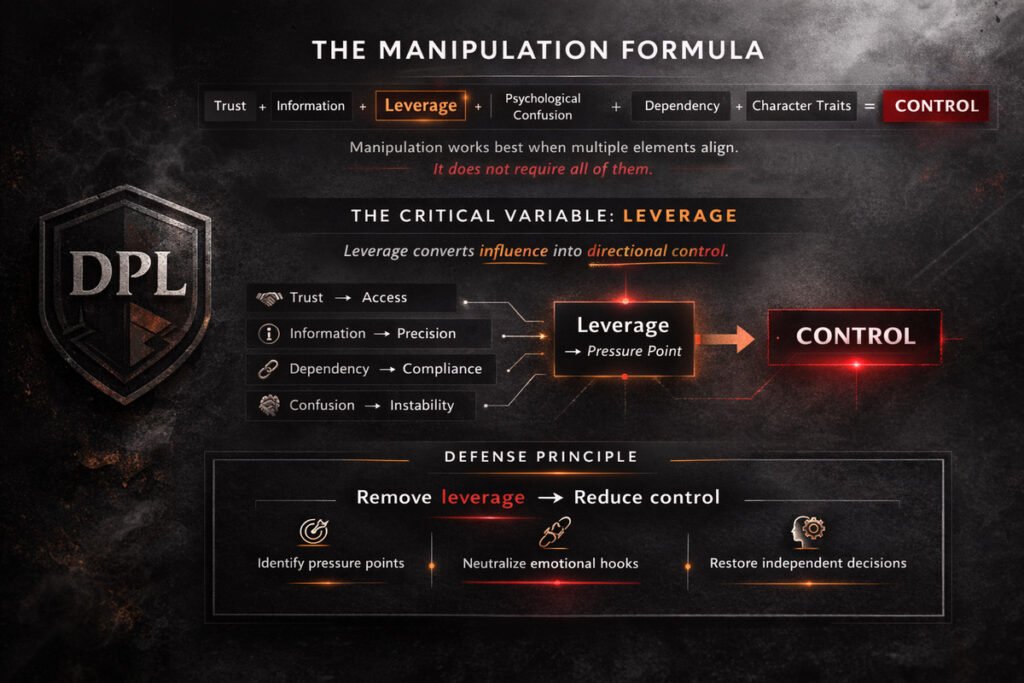
To better understand the manipulation mechanism and where leverage is used within it, read:
The Psychology of Manipulation
Flying Monkey Mobilization
People who support the manipulator may become what are commonly called flying monkeys: third-party enablers acting on behalf of a manipulator.
They can be:
- Conscious: fully influenced by the manipulator and acting intentionally in their interests or against someone else.
- Unconscious: some of them do not realize they are being used as transmitters of someone else’s will. They may be strongly influenced by distorted facts, manipulation, or the facade presented by the controlling party.
This phenomenon is especially common in narcissistic dynamics. Narcissists are highly social “creatures,” and their self-regulation strongly depends on the surrounding environment (Morf & Rhodewalt, 2001). As a result, people are naturally and continuously drawn into the narcissist’s system, and some of them become flying monkeys.
We explore this mechanism in more detail here:
Narcissist Flying Monkeys
Influence at a Distance
A manipulator can act against a target without maintaining direct contact. Sometimes well-placed rumors are enough. In other cases, reputation is damaged through smear campaigns, neutral people are involved through triangulation, or flying monkeys are encouraged to keep pressure on the target.
This allows the manipulator to remain physically or socially distant while the effects of the manipulation continue to reach the person.
Swarm Pressure
One person’s influence is amplified into pressure coming from several people, sometimes from an entire group. What began as an individual conflict can grow into collective targeting.
The same narrative can begin arriving from friends, colleagues, family members, authority figures, or several parts of the social environment at once. In more complex situations, it may begin to feel as if hostility is coming from everywhere and everyone has suddenly turned against the target. Social media and modern communication channels are especially well suited for swarm pressure manipulation. The target may notice increased monitoring on social platforms, unclear phone calls, unusual messages, or posts that indirectly reference them. Even when these signals remain subtle, their accumulation can create significant cognitive load.
Psychologically, coordinated or repeated actions from multiple people place a much greater load on the nervous system than the actions of a single individual, even when they remain indirect (Tobin et al., 2018), making this pressure system extremely potent for destabilization of the target.
Human Shield and Diffusion of Responsibility
When actions are carried out through other people, responsibility becomes less clear. It can be divided between several actors, displaced, or simply denied. Plausible deniability operates here in the same way it does in many covert techniques. The situation can be interpreted in several ways:
“I never told anyone to do that.” “You are imagining things.”
The manipulator may appear disconnected from what is happening even when they helped create the conditions for it. Other people become a kind of human shield between the source of the manipulation and the visible action.
Imposed Isolation: A Manipulator’s Territory
Isolation itself can be useful for growth, discipline, reflection, or character development. However, when isolation is deliberately created or reinforced by a manipulator, it becomes a significant vulnerability, especially when dealing with someone who operates through the surrounding social circle.
A proxy system may deepen this isolation even further by gradually separating the target from neutral or supportive relationships while strengthening the controlling person’s position within the same environment. As outside perspectives disappear, they gain more control over the information surrounding the target.

What makes this especially destructive is that the reactions of other people may be based on distorted information, selective facts, or a narrative originally shaped by the manipulator. The more isolated the target becomes, the easier it is for a constructed narrative to dominate the surrounding environment.
Information Network
Other people become channels for collecting information. The manipulator no longer needs to learn everything directly.
Proxies may pass along private information, reactions, plans, conflicts, vulnerabilities, or changes in the target’s behavior. This turns the social environment into an information network. Even people who do not see themselves as part of any manipulation can feed information back into the proxy structure simply by talking.
It works almost like a spider web: touch one point, and the information can quickly spread through the entire system.
Camouflage and Source Concealment
One of the strongest advantages of manipulation by proxy is that it can hide the original source of the pressure.
The target begins reacting to separate people, explaining themselves to different actors, defending their reputation, or trying to understand why several unrelated people are suddenly behaving in a similar way. Meanwhile, the original source of influence can remain in the background.
This creates a strong defensive position for the manipulator. The visible conflict becomes fragmented across several people, while the person who initiated or shaped the process remains difficult to identify, confront, or connect directly to what is happening.
One example of this kind of defensive positioning is playing the victim. We analyzed the behavior of a covert narcissist in one of our case studies, where this technique and its effect on the surrounding environment can be seen. Read more:
Covert and Overt Narcissist Conflict Analysis
Manipulation by Proxy Mechanism
DPL Framework
This section is based on observations of high-control environments and the systematic analysis of manipulation. We will break down the mechanism from the beginning: how people are recruited, why some accept the manipulator’s narrative and become easier to influence, while others resist and may become targets themselves.
We will also look at the types of people who become involved, how information is controlled, and how collective pressure techniques can destabilize a target.
Every situation is different, but underneath many of them we can observe a subtle mechanism of collective control that is difficult to see when looking only at surface-level events. The purpose of this section is education and clarity.
A short formula for quick orientation on how proxies are recruited and used to create social pressure and destabilize a target:
Image (social proof) → Recruitment of people → Information control → Collective pressure → Target destabilization

1. Social Image and Social Proof: The Axis of Manipulation by Proxy
A manipulator’s social image works as the first layer of credibility.
Attractive, successful, social, respected, well-connected, and articulate people tend to inspire more trust. Others often perceive them more favorably, and they naturally receive more support from the surrounding environment. They appear more trustworthy, regardless of their real intentions. Much of this mechanism operates below conscious awareness (Dion et al., 1972).
Ironically, manipulators often possess exactly these traits. They can be highly social and well regarded within their community, and as more people begin to support them, social proof further reinforces their position. Others observe how people respond to them and interpret those reactions as a signal of significance: their opinion carries more weight, their position appears more important, and their social status rises further (Psychology Lexicon — Social Proof).
Humans are social creatures. As more people support the same position, the conformity effect begins to take hold (Franzen & Mader, 2023). The crowd starts following the behavior of the group, while attention becomes focused on a social beacon, which in this mechanism is the manipulator.
This is the first step toward controlling a proxy network. Technically, manipulation can still work with less social influence, for example through smear campaigns, triangulation, or by operating within a smaller personal sphere. However, the stronger the social image effect is, along with the hierarchy, authority, and decision-making power attached to that position, the easier it is to shape perception and control behavior within the relevant group. This axis is essential for group control to work. However, it can be relatively complex. A simple formula can make the mechanism easier to understand:

Social image → Credibility → Social proof → Increased social weight/status → Conformity → Social beacon → Influence over the relevant group → Proxy network control
This part of group manipulation closely resembles the narcissistic facade. Not all manipulators are narcissists, but narcissists are especially adapted to operating through social image. A convincing facade creates trust, trust increases social weight, and that position gives them more room to shape how others interpret the target.
We break down this mechanism in more detail here:
The Narcissist Facade Explained
2. Recruitment of People
Building a proxy network naturally fits environments such as companies with strong leadership hierarchies, closed friendship groups, families, or tightly connected communities. These structures already operate through relational systems. When the conditions are compatible, a kind of symbiosis can develop between the manipulator and the surrounding environment: the manipulator’s personality fits the group dynamics, while their conscious intent or natural need for control may further shape the system around them. From the outside, this can look like a completely natural environment, and in some cases it is. It is also important to accept that manipulativeness or some Dark Triad traits alone do not automatically make someone unfit for leadership (Grijalva et al., 2015).
Once a social system forms, people begin drawing one another into it. This is a natural movement, a kind of social flow, especially in larger groups. Some people fit the structure well, while others do not.
People Who Fit the Proxy Structure
- Authority-oriented people: they may feel that being close to the manipulator gives them value, status, access, or a better position within the group. Manipulators often display Dark Triad traits, and people higher in these traits tend to prefer people who are easier to control and who do not threaten their own position (Jonason & Schmitt, 2012).
- People who think less critically or independently: they can be easier to influence, more naive, dependent on others, or simply comfortable staying “in their place” within the existing structure.
- People who do not fully understand what is happening because the environment works for them: they may simply have good conditions, benefits, or a comfortable position. Being part of a manipulator’s proxy network does not automatically mean that everyone inside it is being systematically exploited. For example, a company generating millions under a polished facade may still have a toxic leader whom employees protect because the system works well enough for them.
People Who Do Not Fit the Proxy Structure
Not everyone fits the structure. These are the people we refer to as targets (🎯):
- People who resist the system, defend honesty, or stand by their values: they do not accept the manipulator’s control and continue holding their own position. If the manipulator has strong narcissistic traits, this resistance may also injure their ego and trigger devaluation.
- Independent thinkers: they try to solve problems, express their own opinions, and offer dialogue, but eventually notice that their words carry little weight. In some environments, this independence may even be punished.
- Competitors and successful individuals: the same social image and social proof mechanisms work around them as well. They naturally attract other people, carry their own social weight, and may represent the opposite of the manipulator’s toxic control structure. This makes them a direct threat to the manipulator’s social sweet spot, giving the controlling party a reason to push them out.
These individuals usually become targets of manipulation by proxy. Once a person no longer fits the structure, the mechanism, guided by the manipulator, can shift toward intentional, coordinated collective pressure directed against them. This is the next part of the mechanism we will examine.
3. Information Control: Isolation and Social Narrative Formation
Here we focus on covert pressure, the kind that remains socially acceptable in a politically correct environment precisely because much of it is difficult to see. In more direct power environments, such as gangs, certain nightclub scenes, or settings where law enforcement is weaker, the same methods can become much more open and explicit. Our focus, however, is on covert manipulators.
When operating through the surrounding environment, the manipulator, already acting as a social beacon, has considerable leverage. Many people can hold this kind of social position. The problem is that manipulators often display strong antagonistic traits (Krueger et al., 2012), meaning they are more likely to be exploitative, devaluing, humiliating, and malevolent toward people who do not support them or fit their interests.
Isolation
Within this kind of environment, the target is usually probed first. Reactions are observed, boundaries are tested, and weak points are identified. Isolation can then begin through mechanisms such as:
- Covert control: a passive-aggressive form of hidden psychological control that influences another person and their behavior through difficult-to-detect methods of psychological pressure and probing. These techniques test boundaries and identify emotional vulnerabilities.
- Devaluation: a gradual process of reducing another person’s perceived value, lowering their social position, and pushing them into a role that is easier to control, while increasing the manipulator’s relative power over them.
These techniques, by their nature, when applied publicly, gradually isolate the target through humiliation and devaluation of character. To people around the manipulator, especially those already accustomed to their dominant position, the target begins to be shaped as someone rejected, inferior, almost like a lower form of life.
As a result, the surrounding social circle begins to distance itself. The process resembles a dominance hierarchy unfolding in real time inside a toxic environment: the person who does not fit is gradually pushed downward, while others withdraw and align with the dominant position through conformity, reinforcing the manipulator’s side (Maner & Mead, 2010). It’s a power game where one side raises its status by lowering the opposition.
Narrative Formation

This is how a narrative around the target begins to form. They receive less information, less support from the surrounding environment, and are gradually pushed out of the group even while technically remaining part of it.
Opinion-shaping techniques are often used during this process:
- Smear campaign: gossip becomes selective or distorted, and information is spread in ways that weaken the target’s reputation.
- Triangulation: other people are drawn into artificially created situations, conflict is created, and information is routed through third parties.
In this way, the manipulator systematically isolates the target, separating them from the group while strengthening their own position among supporters. This can also increase the target’s negative emotional state, as separation from the group can have negative psychological and biological consequences (Eisenberger et al., 2003).
4. Collective Pressure: The Core of Manipulation
If the manipulator has succeeded in forming the narrative, the surrounding environment no longer supports the target. By this point, they are isolated. They receive little or no information, their reputation is already damaged, and the social circle begins to treat them differently.
Once this position has been established, the manipulator begins using methods of group control. Whether the goal is to remove the person from the social network, simply degrade them for sadistic satisfaction, or pursue some other outcome, the situation can take many forms.
Proxy Network Control Through Narrative
The manipulator’s mechanism of influence changes depending on their position within the hierarchy and the people they are interacting with. Technically, this is the central axis of manipulation by proxy: group control through narrative. In this way, the manipulator doesn’t need to apply pressure personally. They simply act through other people in different forms.
Narrative control can be divided into:
- Covert narrative control: a way of drawing people in through manipulation, making their involvement partly indirect or fully indirect.
- Total narrative control: when the manipulator holds substantial influence and can basically order others to apply pressure on the target.
The network itself partly resembles an uncontrolled mass. It is almost surprising how strongly narrative control can shape people’s behavior, considering that directly controlling every individual is practically impossible (Cialdini & Goldstein, 2004).
Types of Proxy Network Actors
As a result, participants in manipulation by proxy separate into different actor roles. These roles form based on their personality traits, level of involvement, or position within the structure:
- Neutral actors: collect and pass information, repeat the manipulator’s narrative, or simply follow the surrounding social flow. They often believe they are acting correctly and may be among the easiest to influence. They should not automatically be blamed. Naivety, in its own way, is a form of blessing.
- Active actors: directly support the manipulator, apply pressure, or attack the target. In some situations, these are more aggressive individuals or people who occupy positions of power. They can be influenced in different ways.
- Covert actors: often passive-aggressive, avoid direct confrontation, subtly exclude the target from social space, and operate through gossip or reinforcement of group opinion.
From this point, some members of the surrounding network begin applying pressure to the target themselves, either directly or indirectly.
The Proxy Network Phenomenon: Self-Reinforcing Pressure System
The proxy network itself consists of separate individuals who are not necessarily under centralized control, but can collectively create a phenomenon that no single person could produce alone. Influenced by the manipulator’s narrative, they begin interacting with one another, directing their actions against one person and repeating a similar narrative, each from their own position. In doing so, they reinforce the manipulator’s narrative, which can strengthen conformity and, as a result, increase the pressure placed on the target (Wilder, 1977).
From a broader, deeper perspective, this is manipulation by proxy. Rather than simply using a third person directly, the manipulator, not necessarily continuously, shapes the fabric of social dynamics.
The social environment becomes almost like a self-reinforcing machine operating partly unconsciously, built from separate individuals who continuously reinforce one another. Once set in motion, it becomes a social mechanism that can be extremely difficult to stop.
5. Target Destabilization
At this stage, the manipulator begins actively involving others. This can include family, friends, colleagues, or, in more developed cases, much of the surrounding social environment.
Bandwagon Effect: If Everyone Else Does It, I Will Too
From the outside, and even while being inside this kind of dynamic, it can seem strange, but manipulators and their proxies are often very cautious. They usually do not fully escalate a conflict until they feel sufficiently secure in their own position.
Once this happens, the people who contribute to the proxy network become bolder. More aggressive personalities begin applying stronger pressure to the vulnerable, rejected target, while covert actors become even more passive-aggressive and manipulative. They are often joined by more neutral people as well, as individuals begin aligning their behavior with what others around them are already doing: “Kicking someone when they’re already down costs me nothing” (Bandwagon effect, APA Dictionary of Psychology).
The cruelty is that, quite often, although certainly not always, the people who turn against the target come from their own former social circle. These are individuals who were once considered their own. That is what makes it feel like a knife in the back. Hostility from an enemy is expected. Hostility from your own people is betrayal.
These are the sides of human behavior you often see only when you are already at the bottom, and there is little social cost for treating you badly.
Group Pressure Techniques
Pressure from manipulation by proxy can feel as if enemies are everywhere, and in some cases, they are. Below are some of the most commonly recurring techniques seen in high-control environments:
- Gaslighting by proxy – More members of the social circle, along with unrelated people, begin intentionally using gaslighting in different situations.
- Group digital and social monitoring – An uncomfortable sense of being watched can begin to develop, as if every action is being monitored. Social media activity is monitored continuously, with an unusual increase in views, interactions, or other signs of attention. The manipulator may intentionally orchestrate this to create pressure.
- The collective fog of deception – Words don’t match reality, nothing is clarified, and the person is deliberately kept in lies and uncertainty. This is a form of covert gaslighting carried out by the same social circle. It often becomes clear only later.
- Collective shaming (Swarm pressure) – Collective humiliation, either direct or indirect, from the wider group.
- Ostracism (social exclusion) – Similar to silent treatment or stonewalling, but carried out collectively. It can feel like being pushed out of the group.
- Mass coercion – the coordinated use of direct force or coercive pressure by multiple people against a single person. It is more commonly seen in closed groups.
How Group Pressure Affects the Target
When a group turns against one person, psychological pressure can become severe, especially when the group includes people the person once trusted. Familiar faces becoming hostile can create a sense of being trapped in enemy territory.
Isolation and repeated social threat, even when subtle, can keep the nervous system scanning for danger. When the threat is difficult to predict or control, the person may remain in a prolonged state of stress and hypervigilance (Kastner-Dorn et al., 2018). Over time, social isolation and sustained stress can produce psychological and physical consequences (Sherman et al., 2024).
Symptoms may include increased anxiety, loss of self-confidence, heightened threat perception, hypervigilance, and greater vulnerability to further manipulation. With prolonged or severe exposure, the damage can become substantial and may contribute to trauma-related conditions such as PTSD or CPTSD (Guzman Torres et al., 2023).
How to Protect Yourself
Emotional Neutrality and Order
There is an interesting phenomenon: people who have been harmed by manipulators often feel shame or regret about their own reactions, including their attempts to solve problems within toxic group dynamics. In many cases, they suffer more from their own reactivity to it than from the harm inflicted on them directly.
For this reason, one of the strongest forms of defense remains emotional neutrality and orderly communication.
Steps include:
- No excess information
Stop explaining yourself to everyone. The information will spread, and what you say can and will be used against you. - Observe and think
Consider the hierarchical structure of the environment where you feel the pressure. Look at how the people within it are connected and how they interact with one another. Toxic dynamics often develop over a long period of time. The people involved may all be connected. There may be several initiators, flying monkeys who are useful for applying pressure, rescuers who are only playing a role, and friends who may be two-faced. - Reduce exposure
Reduce contact as much as possible. Of course, this is not always possible, but in many situations the manipulator and the people connected to them are unlikely to benefit you in the future.
Unpredictability
When dealing with more serious group pressure, similar to the mechanism described above, the manipulator may avoid full escalation until they feel secure in their own position and have assessed your ability to defend yourself. The less information they receive, the better. In these cases, constant movement and unpredictability can create a form of protection. When your actions, routines, or social circle are difficult to predict, it becomes harder for others to anticipate where you will be, what you will do next, or how to position themselves around you.
Internal Shift: The Refusal to Submit
During prolonged manipulation, an internal shift can occur. The person may still be confused, emotionally destabilized, and affected by the pressure, while another part of the mind begins to disengage and stops accepting the manipulator’s narrative or authority.
Paradoxically, this can happen when the external situation is at its worst. The person may be humiliated, rejected, or socially defeated, yet internally become calmer. Reactivity begins to drop, the need to listen or comply weakens, and a strange sense of relief, sometimes even euphoria, can appear.
Full clarity does not necessarily come at the same time. Emotions may still be deeply unbalanced, and the person may not yet understand what has happened. But something internally has already changed.
The key point is this: do not give in. Do not collapse internally. External social rejection does not equal internal defeat. Your inner core remains your own. This is where dignity is preserved.

Dark Psychology Lab Defense Guides
When dealing with manipulation by proxy, techniques for communicating and interacting with manipulators and others become especially useful.
We have analyzed defensive strategies for different situations involving psychological and manipulative pressure:
Psychological Manipulation
Psychological Manipulation Defense: Safe Strategies and Dangerous Tactics Explained
Narcissistic Dynamics
How to Deal With a Narcissist and What to Do When You Can’t Leave
Toxic Workplace
Workplace Mobbing Defense Playbook: 17-Step Guide
Final Thoughts
Proxies act as amplifiers. They allow one person’s narrative, influence, and hostility to spread through a wider social environment and eventually take on a life of their own.
In many cases, the people involved did not independently arrive at the same conclusion. They were exposed to the same narrative, reinforced it through one another, and became part of the pressure structure.
Understanding the mechanism changes the position completely. What once looked chaotic begins to reveal a structure.
Once the structure is visible, it becomes easier to decide what deserves a response. Some situations require defense. Others are simply not worth your attention.
Understanding creates distance. Distance creates choice.
Disclaimer
This article is intended for recognition and education. Not every conflict, disagreement, or group behavior is manipulation, and isolated incidents should not be treated as proof of a harmful pattern.
Use this information for awareness and self-protection, not to diagnose or label others. Terms such as narcissism and Narcissistic Personality Disorder (NPD) have specific clinical meanings, and NPD can only be diagnosed by a qualified professional. This article is not a diagnostic tool and does not replace professional evaluation. For full limitations, see our Disclaimer Page.
If you experience serious psychological pressure, anxiety, confusion, or social isolation, consider seeking professional support.
Dark Psychology Lab
Original content based on lived experience and independent psychological analysis.