

In some organizations, leadership crosses the line from demanding to psychologically harmful. In organizational psychology, sustained hostile leadership behavior is formally described as abusive supervision (Tepper, 2000).
Because these individuals contribute to profitability or have long-term ties to ownership, they often secure their positions within the organization, thereby creating a toxic workplace culture in the process. Some of them become perceived as “indispensable” experts.
Once you become a target of a toxic boss, attempting to resolve the situation through dialogue or direct confrontation can often result in job loss or, in some cases, serious harm to your psychological health.
TL;DR
In this article, we analyze how toxic leaders operate, what drives them, and what steps you can take to protect yourself.
- Motivation: What drives this type of behavior?
- Operating principles: How do they manipulate their environment?
- Defensive strategies: What can you do when your professional future depends on this person?
Difference Between Demanding and Toxic Leadership
High standards and firm feedback are normal in many workplaces. Toxic leadership begins when the direction of pressure shifts from performance to personal credibility.
Control Tactics Used by a Toxic Boss
Trying to win an argument with a toxic boss usually fails, as it often does with emotional manipulators. Facts alone can be easily twisted and rarely determine the outcome.
Toxic leaders tend to avoid direct confrontation with people who can challenge their position. Instead, they focus on individuals who are emotionally responsive and more easily destabilized.
In the early stages, they often use subtle “tests,” which may include techniques such as gaslighting, DARVO, or silent treatment, used to probe your reactions and psychological boundaries.
A toxic boss can target your human side and often uses the same control pattern:
- Shift tone: nice → cold → joking → threatening → feigned concern
- Subtle provocations while observing your physical reactions: facial expressions, posture, and tone of voice.
- Deploying manipulative tactics while assessing your psychological profile.
The most common reaction they are looking for:
- Emotional reactions.
- Public discomfort.
- Signs of distress, confusion.
Download the Manipulation Recognition Guide
Not sure if you are being manipulated? Take a test. Press a button below. Sign up for Dark Psychology Lab, and we will send it to your email.
The Psychological Drivers Behind Toxic Leadership
It depends on a leader’s personality, but a common driver is ego reinforcement through dominance. Research on abusive supervision and leader narcissism shows that certain leaders escalate hostile behavior when control is threatened or when they can extract reinforcing reactions from a vulnerable target (Gauglitz & Schyns, 2024).
This mechanism overlaps with what is described as narcissistic supply, the emotional reactions a narcissist craves for their validation. We analyze this cycle in depth in our article:
Narcissistic Supply: What Narcissists Feed On.
If they become convinced that you have difficulty defending yourself, that you are anxious about job security, finances, future goals, or personal problems at home. If they sense that you depend on your current position and react to their negative behavior, they are likely to increase the pressure.
Why a Toxic Boss Selects Certain Targets
It is important to understand that a toxic boss usually does not choose targets because of poor work performance. As in classic mobbing cases, the attack is rarely related to professional competence. Most often, someone ends up on the manager’s “black list” because of the leader’s own internal insecurity or personality disturbances.
Main causes of aggression:
- Threat to authority: Any constructive criticism or questioning of the manager’s decisions may be perceived as a threat to their character or professional competence.
- Healthy boundaries and independence: If you refuse to carry out unethical or, in rare cases, even illegal demands and set clear personal boundaries, a toxic leader may interpret this as a personal insult.
- Pathological jealousy and competition: Your professionalism, personal charisma, or simply visible positivity can trigger unhealthy competition in a toxic leader. Although this topic is often ignored in professional environments, one common cause of aggression is jealousy related to attention from members of the opposite sex.
- Malicious sadism: Although less common, some leaders simply derive satisfaction from feeling power over others. They use their position as leverage to create confusion and distress, gaining personal gratification from it.
Source (related): The “Evil Pleasure”: Abusive Supervision and Third-Party… PDF (2020).
This reveals the core problem of toxic leadership: they use psychological abuse and social status as weapons against employees in lower positions.
Public Escalation and Social Leverage
When a toxic boss is able to trigger visible negative reactions, he may expand the situation into a group setting. By bringing others into the interaction, he reinforces his ego-validation mechanism and strengthens his position.
Common tactics at this stage include:
- Manipulation by proxy: distributing pressure through third parties instead of acting directly.
- Triangulation: positioning others between you to distort communication and create division.
- Flying monkeys: recruiting individuals who validate his narrative and apply social pressure.
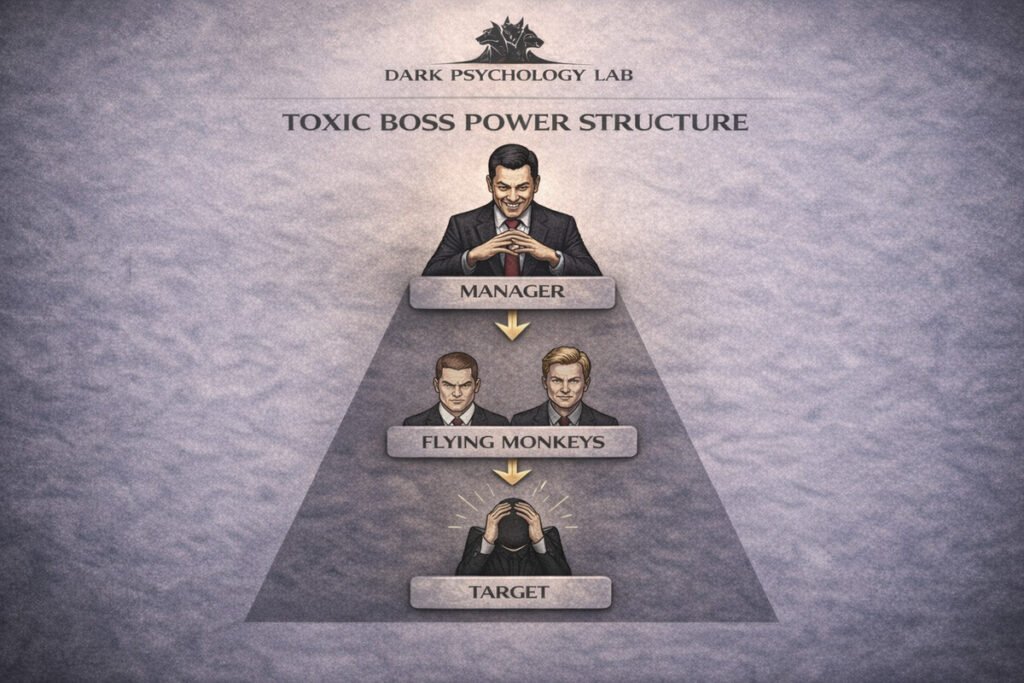
By involving the group, psychological pressure increases significantly (the group acts as an amplifier). In this setting, it becomes easier for him to provoke negative reactions, undermine your credibility, and reinforce dominance in front of others.
Research support (open access): Mobbing and Psychological Terror at Workplaces — Violence and Victims, PDF Leymann (1990).
If you attempt to confront him directly at this stage, especially when the situation already resembles mobbing, it can escalate into coordinated and systematic psychological pressure. We analyze this pattern in detail in our case study:
Covert Coercive Control Technique: Death by a Thousand Cuts Explained
Reducing a Toxic Boss’s Control Without Direct Confrontation
A toxic boss frequently operates through emotional confrontation, using personal reactions as control leverage. The safest response is increased professionalism: limit personal disclosure, rely on documented procedures and legal standards, and reinforce both external protection and internal stability.
If you are dealing with a toxic boss, the following steps provide a practical framework for self-protection.
The Nervous-System Switch: From Helplessness to Agency (DPL)
Hierarchical dynamics within an organization create an asymmetry of authority, which can intensify psychological pressure when dealing with toxic leadership. Therefore, the initial steps should focus on internal stabilization and emotional regulation.
Research on learned helplessness shows that repeated exposure to stressors you perceive as uncontrollable can push you toward passivity and shutdown, while a sense of control supports active coping and more stable emotional processing.
Source (related): Learned Helplessness: A Review of the Theory and Its Evidence – Maier & Seligman – PubMed Central (2017)
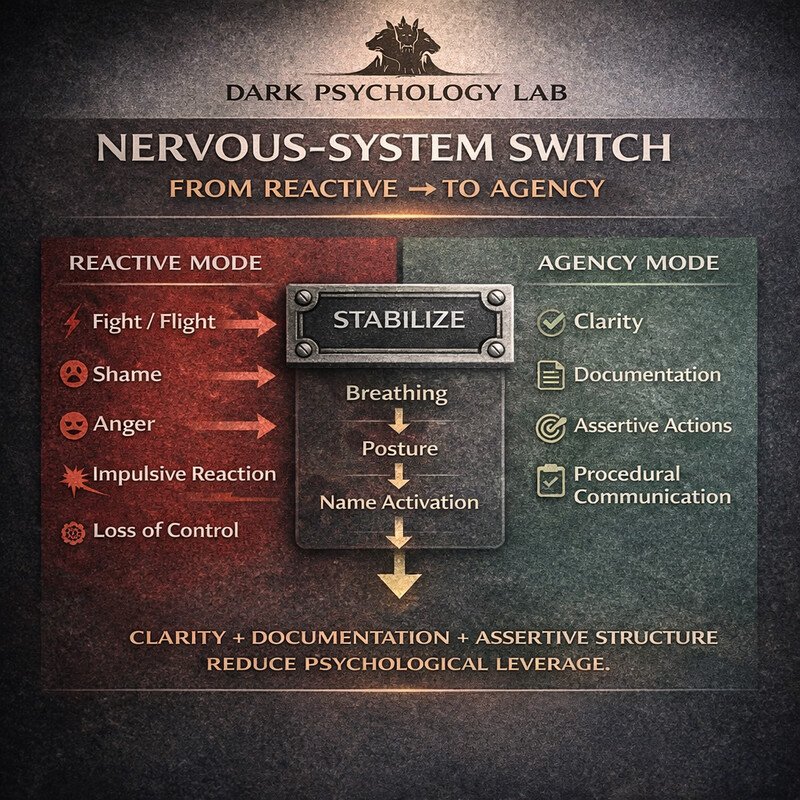
Due to the power imbalance, the fight-or-flight system is activated almost automatically. From a nervous system and self-esteem perspective, outcomes tend to improve when perceived control increases. For this reason, it is generally healthier to shift toward an agency-oriented response rather than remain in a reactive state.
A brief explanation of how nervous system states influence psychological functioning:
- Flight — defensive posture (body language), shame, fear, avoidance, anxiety, self-blame
- Fight — reactivity, loss of control, anger, impulsive confrontation, risk of escalation
- Agency — nervous system regulation, deliberate and controlled action without emotional reactivity or self-blame
Physiological and Psychological Foundation of the Model:
Perceived Control and Health — American Psychological Association (2018)
Autonomic Nervous System (ANS): What It Is & Function — Cleveland Clinic (Last reviewed 2022)
How to Shift the Nervous System into Agency Mode
Small defensive actions and wins that put you in an action-oriented position without aggression may help you get out of the nervous fight-or-flight loop.
1. Psychological Nervous System Regulation
- Slow, controlled breathing: Promotes parasympathetic activation and increases vagal tone, supporting nervous system regulation.
- Stabilize your posture: Feet grounded, spine upright, so that your brain registers that you are not hiding.
- Name the activation internally: Reduces amygdala reactivity. “This is stress activation, not immediate danger.”
2. Cognitive Reframing — Perceived Control
- Situational awareness: Identify what they are attempting to gain, trigger, or control.
- Define What Is Actually at Risk: Professional role, employment stability, self-worth.
- Reframing the Situation as Lessons: “Regardless of the outcome, this will provide valuable lessons for the future.”
3. Behavioral Agency — Action Restores Control
- Seek professional advice outside the organization: Legal professionals, psychologists, and independent consultants.
- Use communication techniques designed for dealing with manipulators: BIFF and JADE.
- Consciously limit communication with a toxic manager: In the most professional manner possible.
A toxic leader may try to keep you on the defensive, but clarity puts you back in the agency. In some cases, reduced reactivity decreases their escalation, which is more likely when the vulnerability is visible, a pattern often mistaken for “strong leadership.”
Managing Narcissistic Dynamics in the Workplace
There is a significant likelihood that a toxic boss displays narcissistic traits, possibly at a pronounced level. Narcissism is a well-researched personality construct. While workplace observation does not allow for clinical diagnosis, defense strategies developed for narcissistic behavior can still be applicable. These frameworks are explored in our related guides:
How to Work With a Narcissist During the Devaluation Phase
Defensive Measures Against Workplace Manipulation
In modern work environments, manipulation remains one of the most effective forms of psychological pressure. It is often subtle enough that toxic leaders can disguise the harm they cause as simple misunderstandings.
A structured analysis of defensive strategies against manipulation is provided in our guide:
Psychological Manipulation Defense: Safe Strategies and Dangerous Tactics Explained
Reputation, Procedure, and Legal Accountability
In some environments, toxic behavior may be tolerated due to weak oversight or a normalized culture of pressure. However, most organizations operate within legal and reputational constraints.

Even a “professional” toxic leader is aware that documented exposure creates measurable risk. Formal complaints, procedural documentation, and third-party review can shift the situation from interpersonal conflict to organizational liability.
Workplace harassment and bullying are taken seriously because they generate legal, reputational, operational, and financial risk.
When interactions move into a documented procedure, the dynamic changes. What was once informal pressure becomes traceable accountability.
Duty of Care and Psychosocial Safety — Global Standard
Modern occupational standards expect employers to address not only physical hazards, but also psychosocial risks such as harassment, intimidation, and prolonged psychological pressure.
Psychological harm at work is a safety issue.
Anti-harassment and equal-treatment standards
In many jurisdictions, harassment is classified as serious workplace misconduct, triggering:
- Formal reporting duties
- Internal investigations
- Corrective or disciplinary action
- External oversight when cases are mishandled or ignored
While the legal details vary by country, the pattern is consistent globally:
- Repeated humiliation
- Abuse of authority
- Retaliation for speaking up
- Workplace bullying
- Harassment and intimidation
This is why toxic leaders rarely act openly and rely on ambiguity. Documented exposure can create significant professional risk.
International Legal and Safety Standards:
ISO 45003:2021 — Psychological Health and Safety at Work — International Organization for Standardization.
ILO Violence and Harassment Convention — International Labour Organization, 2019 (No. 190).
Dark Psychology Lab Workplace Mobbing Defense Playbook
We have developed a calm and structured defense action plan for situations involving intense group psychological pressure in the workplace.
Its purpose is to introduce structure into chaos.
It includes actions ranging from legal documentation to the protection of your nervous system and overall well-being. This framework can also be adapted for situations involving a toxic boss in the workplace. You can find it here:
Workplace Mobbing Defense Playbook: 17-Step Guide.
Final Thoughts
A toxic leader’s leverage depends on emotional access and hierarchical advantage. When reactions decrease, and communication becomes documented and procedural, that leverage declines.
Stability is built through professionalism, traceability, and external guidance, not escalation or pointless emotional fights. Control is restored gradually, through regulation and structured response.
That is the attack-without-aggression move.
Disclaimer
This article is intended for recognition, education, and safer decision-making. It does not provide legal, medical, psychological, or HR advice and does not diagnose individuals or guarantee outcomes.
Workplace laws, reporting procedures, recording rules, and employer policies vary by location. Consider local rules before documenting, recording, or filing a formal complaint. If you face serious harassment, retaliation, legal risk, severe distress, or feel unsafe, seek qualified local support.
For full limitations, see our Disclaimer Page.
Dark Psychology Lab
Original content based on lived experience and independent psychological analysis.