

When interacting with narcissists, what you see on the surface is often not the real person, but a constructed version designed to maintain their social image.
This is the narcissistic facade.
This facade depends on external validation, making any form of criticism a threat to the narcissist’s self-image (Lowen, 1997). Direct confrontation often backfires and triggers retaliation. Exposure is rarely the safest option. A more effective approach is to step back and stop participating.
This article is intended for recognition and defense. If there is a power imbalance, reputational risk, or physical danger, safety should always come first.
The Mechanism of the Narcissist Facade
People differ, and narcissistic behavior does not follow a single universal script. However, many narcissistic dynamics share a similar internal mechanism.
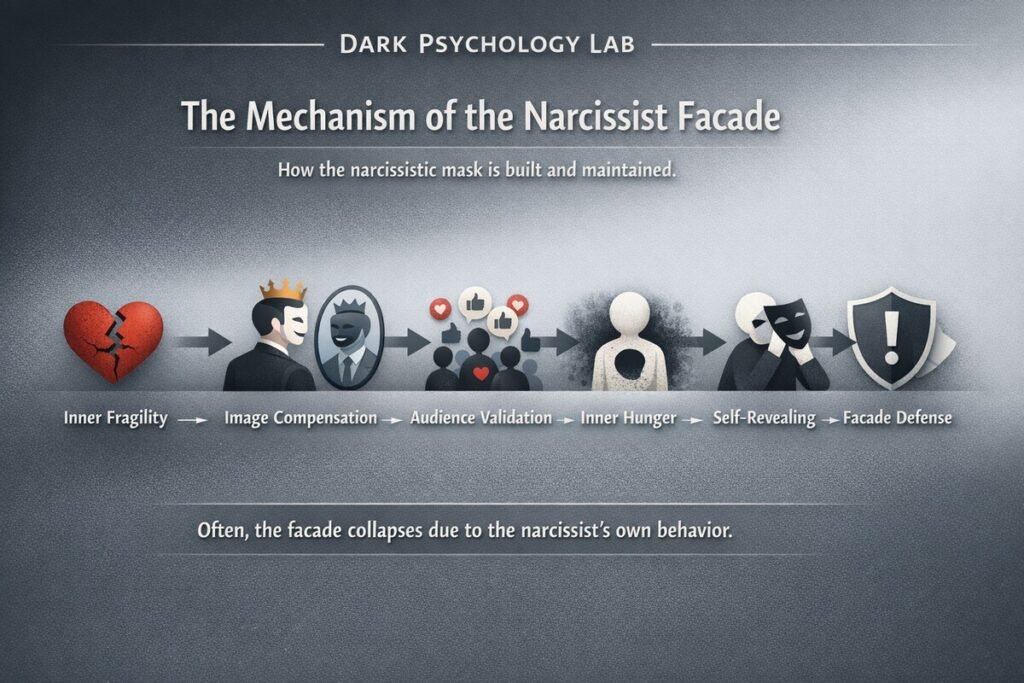
The sequence below illustrates one of the most common patterns through which the narcissistic facade is formed and maintained.
A simplified formula:
Inner fragility → compensation through image → audience validation → inner emptiness/hunger → self-revealing behavior → defense of the facade
Download the Manipulation Recognition Guide
Not sure if you are being manipulated by a narcissist? Take a test. Press a button below. Sign up for Dark Psychology Lab, and we will send it to your email.
The Inner Fragility Behind the Facade
Behind the narcissist’s facade, there is usually a very fragile sense of self that is difficult to maintain without constant external validation. Because of this, an image is constructed that appears stronger, smarter, more correct, or more valuable than the person’s inner core can realistically sustain.
From the outside, such a person may appear very successful. In practice, the opposite is true: the more a person depends on the facade, the less they can tolerate any kind of feedback that does not favor them.
For this reason, the facade is also a vulnerability.
This is why criticism, boundaries, fact-checking, or simply refusing to participate in the narcissist’s game can trigger reactions that seem disproportionately strong compared to the situation. Why? Because you are touching the structure that holds their self-image together.
How the Narcissistic Facade Creates Social Advantage
Despite internal instability, the narcissist appears charming and social and knows how to use it (Tholkes, 2023). The facade acts as a public shield, designed to create advantage in the social environment through:
- External charm: attracting people and creating trust in advance.
- Protecting a fragile ego: through displays of status, competence, or “specialness.”
- Validation supply: gaining narcissistic supply through attention, admiration, control, or humiliation of others, then reframing it as a display of power.
- Avoiding accountability: by adopting moral positioning, victim roles, or a carefully managed reputation.
The stronger the public image, the easier it becomes for the narcissist to control the narrative.
What the Facade Hides in Different Contexts
Behind the polished social image lies a very different person from the one people see on the surface. Depending on the situation, it may appear in the following ways:
- In relationships, early idealization is followed by increasing control and psychological games.
- At work, a “professional” mask that hides humiliation, devaluation, or reputation games.
- In social settings, a flawless public image is maintained, while a completely different side emerges behind closed doors.
Mirroring as a Tool of Emotional Access
The facade works because it relies on basic mechanisms of human psychology. When you receive attention, validation, signals of similarity, and emotional intensity at the same time, the brain tends to interpret it as friendship, closeness, or compatibility.
One of the most important tools here is mirroring. First, the person observes your values, weaknesses, desires, and insecurities, collecting information.
If a narcissist decides to let you get closer, all of this is reflected back to you, often in an intensified form.
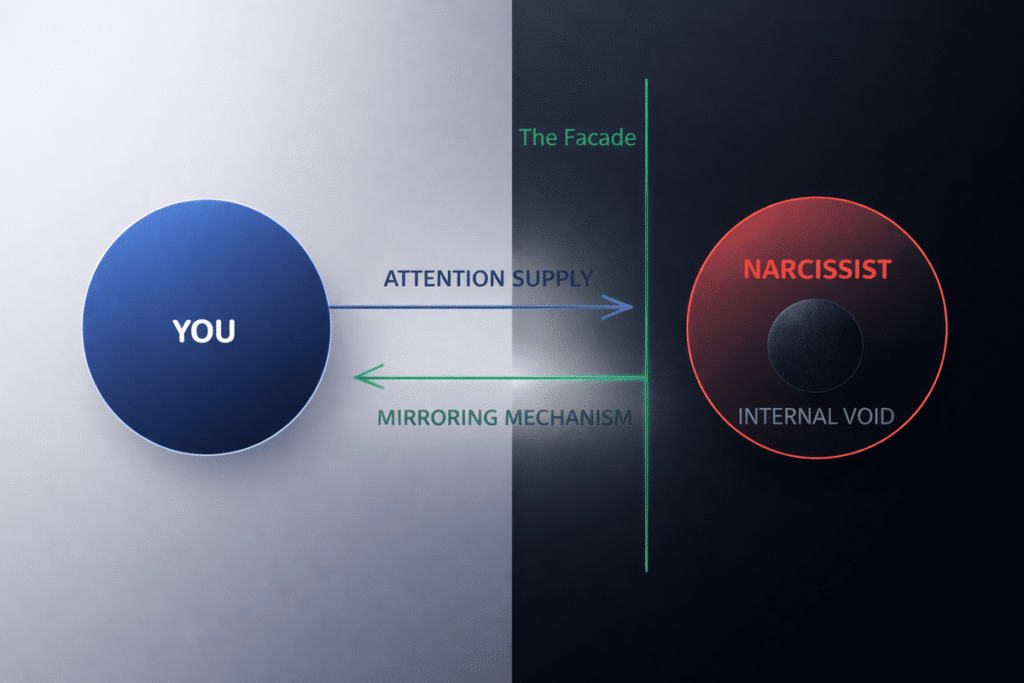
In romantic relationships, this can appear as love bombing, creating the illusion of deep closeness. You may feel as if you have finally met someone who truly “sees” you. In reality, you have simply been read very accurately. This technique is called weaponized empathy.
Source (related): The Chameleon Effect: The Perception–Behavior Link and Social Interaction – Journal of Personality and Social Psychology (Chartrand & Bargh) (1999)
Whatever the narcissist’s goal may be, mirroring makes it much easier for them to get closer.
Inner Emptiness and the Need for Supply
Despite this image, the internal emptiness remains. Over time, hunger, boredom, inner instability, or a constant need for emotional reactions from the environment may emerge.
For this reason, narcissists may begin escalating situations themselves.
They often choose people who are more sensitive and emotionally responsive to the narcissist. In these cases, it becomes easier to activate the mechanism known as narcissistic supply, a cycle in which the narcissist receives attention, emotions, and reactions from others. If you are not familiar with narcissistic supply, our article explains it in detail:
Narcissistic Supply: What Narcissists Feed On
Once this mechanism is activated, conflict can intensify. In many cases, escalation becomes difficult to stop without ending contact.
If facts or reactions appear that contradict the narcissist’s constructed image, they can be neutralized through various tactics: belittling, gaslighting, DARVO, public shaming, or attempts to discredit the other person.
When these attempts fail, and the narcissist encounters resistance, what is called narcissistic rage may emerge as an intense emotional reaction aimed at restoring control and “putting the other person back in their place.”
If a person who previously served as a source of narcissistic supply stops responding to control tactics, the relationship may shift into the devaluation phase, where that person is gradually devalued and may eventually be pushed out of the narcissist’s social circle (discard phase).
Narcissistic Supply Regulation Rituals
In DPL terms, inner emptiness is a constant internal pressure, a persistent need for validation, stimulation, adrenaline, novelty, and even another person’s emotional pain.
This is what narcissistic supply actually is. It functions more like hunger.
Some narcissists learn to temporarily fill this emptiness through status, attention, or intensity. Some of them develop their own rituals.
For example, every two weeks, they may leave for another city to temporarily detach from the environment that constrains them. There, they may engage in relationships, break rules, use substances, or seek other forms of stimulation to feed that internal emptiness.
For a time, this can calm the narcissist, sometimes for a week or so. But the underlying structure does not change. The hunger returns, and the cycle repeats.
When private rituals are no longer enough, the narcissist begins to seek fuel in the external environment.
Social Turbulence: Why Conflicts Appear Around Narcissists
One of the stranger phenomena people notice after spending longer periods around narcissists is constant social turbulence. It often feels as if something is always happening around a narcissist: disagreements, conflicts, gossip, sudden rivalries, or alliances that keep shifting.
At first glance, this may look like a coincidence or simply a “complicated environment.” However, this dynamic is connected to how the narcissist maintains their facade and emotional “fuel.”
In these situations, narcissists can begin positioning people around them in different ways, encouraging some to support them, distancing others, and framing certain individuals as opponents.
As a result, their environment fills with constant:
- conflicts
- alliances
- gossip
- reputation games
When relationships become calm and stable, this mechanism begins to weaken. For this reason, some narcissists unconsciously or deliberately reintroduce tension.
This behavior is connected to three mechanisms.
1. Audience Management
The narcissist’s facade only works when there are people who see it and react to it. For this reason, narcissists create situations where others become a kind of audience.
To some people, they display charm and competence. To others, they speak about their “enemies,” and to another group, they present themselves as victims. In this way, different groups of people begin to see different versions of the narcissist.
2. Distribution of Social Roles
Around a narcissist, people tend to be assigned certain roles, sometimes subtly, sometimes quite openly. For example:
- those who support or admire them
- neutral observers
- people the narcissist presents as competitors or enemies
- the so-called “flying monkeys,” who repeat the narcissist’s narrative or help apply pressure on others
In fact, flying monkeys are one of the narcissist’s most effective tools in the social sphere. Through them, information is gathered, pressure on the target is reinforced, and rumors are spread. They function as a group-level amplifier.
In this way, the narcissist creates a social field in which they can shape the narrative and influence how others react.
3. Provocation and Reaction Testing
Some narcissists consciously or unconsciously test people. They may:
- provoke
- spread information about others
- create small tensions between people
Through these situations, they observe who reacts, who resists, and who remains neutral. This allows them to understand how to navigate their environment.
Because of this, from the outside, it can seem as if some kind of “social drama” is always happening around the narcissist. In reality, it is a constantly shifting network of relationships in which the narcissist tries to maintain their facade while maintaining and reinforcing their social image.
When Narcissistic Chaos Shapes Other People’s Public Image
Using their charm and social skills, narcissists can shape public perception of the people around them according to their own inflated ego and distorted view of reality. Considering that behind the facade, there is often an insecure, aggressive, resentful, and highly sensitive person, this creates a strange internal dissonance.
In social dynamics, this may appear as jealousy, exploitation, hostility toward competitors, criticism, and impulsive reactions.
At the same time, the narcissistic facade and carefully maintained image allow them to influence social narratives through smear campaigns, triangulation, and devaluation by involving the group.
More on how group dynamics intensify psychological pressure, including a workplace example, in the article:
The Psychology of Group Pressure Escalation in Workplace Mobbing
In this way, narcissists begin assigning social status to others based on who they can control, sometimes indirectly by shaping narratives or publicly discarding people.
Source (related): A Process Model of Narcissistic Status Pursuit – Perspectives on Psychological Science / PMC (Grapsas et al.) (2020)
How Narcissists React When Their Facade Is Threatened
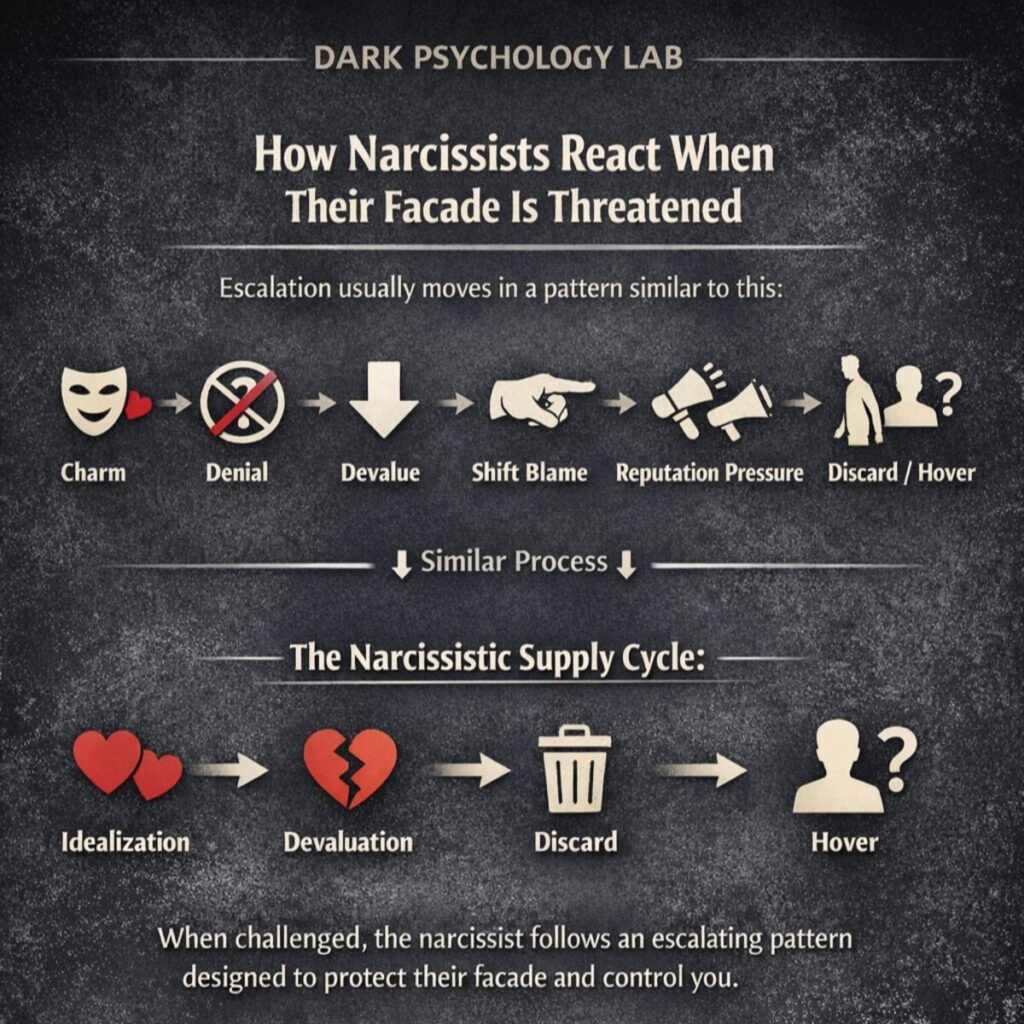
Escalation usually moves in a pattern similar to this:
Charm → denial of contradictions → devaluation of your social status → shifting blame → reputation protection through pressure → Discard or hover
A related pattern can also be seen in the narcissistic supply cycle:
Idealization → Devaluation → Discard → Hover (if a target is not too dangerous to facade).
At first, your questions are dismissed as misunderstandings. Later, you may be subtly made to feel that you are overreacting, misinterpreting events, or that raising such questions is itself the problem.
After that, defensive anger may appear, along with passive aggression (more common in covert or vulnerable types), arrogance, emotional coldness, or a tone that presents the narcissist as the victim.
This is a critical moment. At this stage, many people still try to “calmly work things out.” But if you are dealing with a vindictive narcissist, someone defending their public image, a rational conversation can quickly turn into a situation where you become the accused.
Climax: The Narcissistic Discard
If you have reached this stage, the relationship with the narcissist has entered the discard phase.
Once the narcissist concludes that you are no longer useful and is convinced that you are no longer a threat, their feeding on your reactions may intensify, causing their behavior to deteriorate dramatically.
At this stage, the core objective is to protect the facade and prevent the narcissist’s constructed narrative from collapsing in public. They may do almost anything to preserve their social image, and in some situations, the behavior can become quite ruthless.
Source (related): Pathological Narcissism and Interpersonal Functioning – Journal of Personality (Wright et al.) (2017)
Because of this, the situation often looks paradoxical: the more obvious the problem becomes to you, the more the environment around you suggests that you are the problem. This is one of the most disturbing aspects of the facade. It allows a person to harm others while wearing a perfectly respectable social costume.
Main Narcissistic Types and the Facades They Use

Not all narcissists operate in the same way. These are not strict clinical categories, but recurring behavioral profiles that appear across narcissistic behavior.
Source (related): Narcissistic Personality Disorder – PubMed Central (National Library of Medicine, NIH) (2023)
Overt / Grandiose (Status and dominance)
Strong, confident, status-oriented, with an attitude of “I know better.” Tough, dominant, and sometimes visibly successful. They attract people through impression, authority, charisma, and an aura of competence or superiority.
Example
Corporate meeting: “I’ve closed deals twice this size. Trust me, I know what I’m doing here.”
Facade: Competence and authority.
Reality: He has never closed deals of this scale, but cannot admit uncertainty.
Effect: Others begin to doubt themselves rather than him.
Covert (Reliability and social image)
Socially smooth, adaptive, subtle, “normal,” sometimes even overly correct or professional. They attract people through trustworthiness, a clean image, morality, helpfulness, and charm.
The facade of a covert narcissist closely resembles that of a vulnerable narcissist. In practice, these styles frequently overlap, and the same individual may shift between them depending on context. Learn more about this personality type in our article:
The Narcissistic Woman: Recognizing Subtle Patterns of Covert Control
Example
After you raise concern: “I’m just trying to help. I thought we were on the same team here. But if you feel that way…”
Facade: Victim of your “misunderstanding.”
Reality: Deflecting accountability.
Effect: You apologize for raising the issue.
Vulnerable (Victim and empathy pull)
Sensitive, unappreciated, wronged, submissive, and fragile, sometimes appearing very “good” or even seductive, yet carrying deep internal resentment. They attract people through false vulnerability, a form of emotional manipulation that triggers empathy.
Example
Rescuer baiting: “Nobody appreciates how hard I try. I’m always the one who gets blamed. You’re the only one who understands me.”
Facade: Misunderstood empath.
Reality: Pulling you into the rescuer role through emotional manipulation.
Effect: You begin defending them to others.
Malignant (Darker, more hostile profile)
Can appear either tough or socially smooth, depending on what benefits them. The surface changes, but the core remains more hostile and manipulative. They attract through a mixture of fear, fascination, and confusion, appearing strong, impressive, and dangerous at the same time.
Example
Workplace conversation after you question a decision: “I never said that. You’re imagining things again. Maybe you’re just under too much stress.”
Facade: Calm, rational authority.
Reality: Gaslighting and psychological intimidation.
Effect: You begin doubting your memory, while others assume that a narcissist is the reasonable one.
Which Narcissistic Facades Are the Most Dangerous
The type of facade usually depends on the type of narcissism, but narcissists can also shift their facade depending on the situation.
In many cases, the most confusing and emotionally damaging experiences come from covert, vulnerable, or malignant narcissistic presentations. These facades are socially acceptable, believable, and polished enough that people begin to doubt not the narcissist, but your reaction to them (Kjærvik & Bushman, 2021).
Grandiose narcissists tend to display dominance more openly, which sometimes makes their behavior easier for others to recognize (Wink, 1991).
The greatest emotional damage in a modern, socially safe environment is caused through indirect psychological aggression rather than direct pressure: gossip, emotional manipulation, social pressure through flying monkeys, and other forms of indirect influence.
This is where covert and vulnerable types are especially effective.
The more socially acceptable the narcissist’s facade appears, the harder it becomes for others to believe that manipulation may be hiding underneath it.
Defense: What to Do When You Realize You Are Dealing With a Narcissistic Facade
If the person is aggressive, holds power, or can damage your reputation, direct “exposure” is a poor strategy. Telling a narcissist that they are a narcissist can provoke strong retaliation, which is why this approach is generally not recommended.

Supporting a narcissist’s facade while knowing what may hide behind the mask is something we do not recommend.
In the beginning, especially if you are emotionally attached in some way, it is natural to try to repair the relationship. Many people attempt to talk things through, clarify the situation, or give another chance, sometimes more than once.
However, analyses of social research and real-life experiences show that these attempts usually go nowhere, and the cycle simply repeats.
For this reason, if you begin to see through the narcissistic facade, one of the most practical defensive strategies is maintaining distance and clear boundaries. These boundaries will frequently be tested or deliberately crossed, so consistency and reduced emotional engagement are essential.
Dark Psychology Lab Defense Guides
We have analyzed defensive strategies for different situations involving psychological and manipulative pressure:
Psychological Manipulation
Psychological Manipulation Defense: Safe Strategies and Dangerous Tactics Explained
Narcissistic Dynamics
How to Deal With a Narcissist and What to Do When You Can’t Leave
Toxic Workplace
Workplace Mobbing Defense Playbook: 17-Step Guide
Final Thoughts
The narcissist’s facade is a social tool that allows a person to control impressions, hide contradictions, and maintain influence even when their behavior harms others.
Because of this, it can seem very convincing, especially at first. Over time, however, it is rarely exposed by a single “bad moment,” but rather by the way a person reacts to your boundaries.
The most important thing is to understand the mechanism well enough so that it no longer controls you.
Clarity does not always fix everything. But it can reduce the damage.
Disclaimer
This article is intended for education and recognition. It discusses behavioral patterns that may appear in narcissistic dynamics but does not diagnose individuals or label specific people as narcissists.
The goal is to help readers recognize potentially harmful behavior without judging or stigmatizing anyone. Dark Psychology Lab does not provide medical, psychological, therapeutic, or legal advice.
If you face serious distress, abuse, or safety concerns, seek qualified professional support.
For full limitations, see our Disclaimer Page.
Dark Psychology Lab
Original content based on lived experience and independent psychological analysis.