

The name Death by a Thousand Cuts refers to a historical form of execution in which a person was gradually killed through repeated wounds (Brook, Bourgon, & Blue, 2008). In the context of psychological manipulation, it refers to cumulative harm caused by repeated, subtle acts. It operates as a covert coercive control technique in abusive, manipulative relationships and is often a part of narcissistic dynamics.
This is a recognition and self-protection guide. Dark Psychology Lab is not a licensed mental health or medical service, and we do not teach people how to manipulate. We explain manipulation mechanisms so you can see them early and reduce damage.
TL;DR: Understand the Mechanism
- Covert coercive control is a subtle system of domination, power, leverage, and isolation.
- Death by a Thousand Cuts (DBATC) is the tactic within that system: passive aggression, silent treatment, blame-shifting, reality-distortion techniques, and other forms of covert pressure that are repeated and amplified over time.
- Gaslighting and DARVO are often just the “visible tip of the iceberg” when these techniques are applied. They allow the manipulator to neutralize accusations and maintain plausible deniability.
- If a group becomes involved, it drastically increases the effectiveness of this mechanism. Smear campaigns, triangulation, and the use of third parties (flying monkeys) are used as covert pressure amplifiers.
- Defense and risk assessment: Manipulators rarely escalate when they know the target can defend themselves. Coercive control is already a criminal offense in some countries.
Covert pressure escalation infographic:
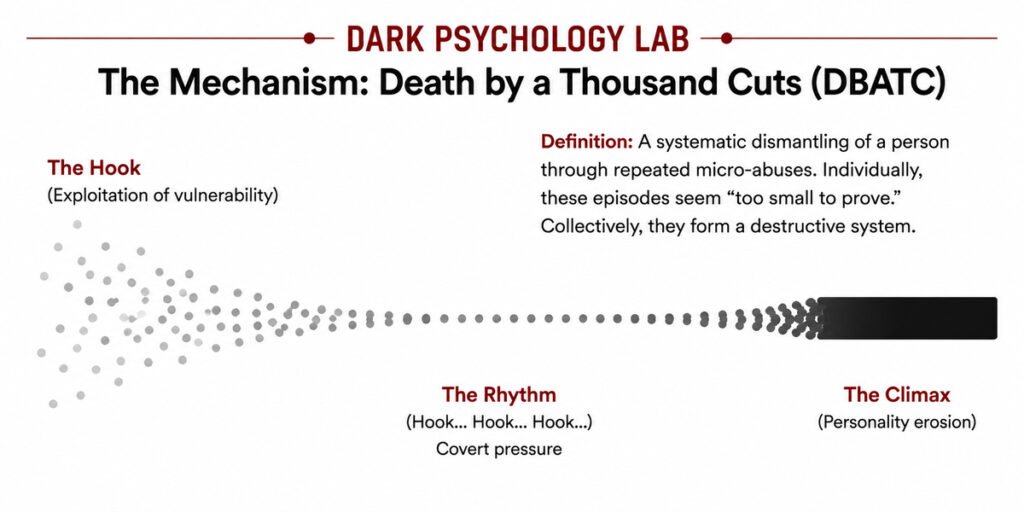
This article explains the mechanisms and the escalation path. Everything described here operates through manipulation. We explain manipulation in detail here:
The Psychology of Manipulation: Mechanisms, Tactics, and Defense
Download the Manipulation Recognition Guide
Not sure if you are being manipulated? Take a test. Press a button below. Sign up for Dark Psychology Lab, and we will send it to your email.
Covert Coercive Control: A System of Domination
In general, coercive control is the use of power and leverage to control another person against their will. In other words, if the person does not fully submit, pressure is applied until they are broken down and forced to comply. This form of domination has been studied in the context of men’s violence against women (Stark, 2007). A man is usually physically stronger, and when a woman is emotionally or practically attached to him, he may use force, threats, and fear to control her behavior.
Covert coercive control follows the same logic, but it is carried out through emotional abuse, manipulation, passive aggression, and psychological pressure. Physical strength becomes less important because control is built through attachment and emotional leverage. This allows women, as well as men, to establish a covert system of control (UK Home Office, 2023).
Core Conditions for Covert Coercive Control
For this system to work, the manipulator requires a power imbalance, meaning the other party has the upper hand, and it is difficult to leave a relationship. The involvement of a group can significantly increase its effectiveness.
Conditions that create an imbalance and reduce the person’s power:
- Leverage: This can include many different conditions. For example: the manipulator knows your vulnerabilities, your reputation depends on them, they are physically stronger, have a larger social network, hold a higher position in a hierarchy that affects you, or have significant influence over your quality of life, income, etc.
- Dependency: A form of emotional attachment (trauma bond in particular), family ties, financial dependence, or work relationships.
- Isolation: The person is cut off from their support network and left without reliable allies. This can be achieved through narrative control and smear campaigns, public humiliation, restrictive living conditions, or other forms of isolation.
Without these conditions, a form of pressure like DBATC would probably not work. People who encountered it would simply set boundaries and withdraw, thinking, “What is going on with this person?”
What Is Death by a Thousand Cuts (DBATC) in Psychology?
DPL Framework
It is a term used to describe repeated micro-abuse: subtle manipulations designed to distort, confuse, and systematically devalue another person, gradually turning them into an easier target to control. It is abuse without physical marks.
In the Death by a Thousand Cuts (DBATC) technique, each individual episode seems small on its own, but together they form a destructive mechanism of cumulative harm. A combination of many manipulative and non-obvious forms of psychological abuse operating at the same time works like an internal poison. Over time, repeated exposure causes the harm to accumulate, weakening resilience and gradually eroding the person from within.
It is equally destructive in personal relationships and families as it is in professional or any other social environment.
This covert coercive control technique often emerges within narcissistic dynamics. It does not require physical strength, but it can function as a powerful tool of psychological control, making it particularly effective when used by covert/vulnerable narcissists and female abusers. We created a recognition guide for the personality structure that may use this technique effectively through passive aggression and emotional manipulation:
The Narcissistic Woman
Why Would a Manipulator Use DBATC?
DBATC is a powerful devaluation technique based on control through humiliation. It gradually reduces another person’s sense of worth, both internally and socially. In its most extreme form, this becomes psychological dehumanization: the target is no longer seen as an equal person, but as an object to be broken down and controlled, or degraded and removed.
Possible motives include:
- Revenge: A desire to punish the target for a real or imagined offense.
- Anger and resentment: Accumulated anger, envy, bitterness, or unresolved grievances.
- Abuse of power: Some manipulators use it simply because they can. This is a form of sadism.
- Devaluation: Gradually reducing the target’s value, reshaping them into a more controllable form, and restoring dominance while using the process to justify increasing pressure. This technique may weaken the person while simultaneously building a narrative that presents them as the problem.
- Antagonistic defense (Discard): Within narcissistic processes, DBATC may function as a way to protect a vulnerable and unstable inner self (Krizan & Johar, 2015) by destroying or removing someone who threatens their self-image. We provide a detailed analysis of how this narcissistic defensive mechanism works in the article:
The Narcissistic Discard Phase: A Deep Dive Into Antagonistic Self-Regulation
By using DBATC, the manipulator has already destroyed any possibility of trust or a normal relationship. In effect, this is already a form of discard. However, because of the covert nature of the technique, the manipulator may keep the person trapped in the system for a prolonged period, using repeated humiliation and destabilization as a continuing source of emotional supply or sadistic gratification. Intermittent reinforcement helps maintain the attachment by alternating harm with occasional relief, attention, or approval, often while the target remains unaware of the mechanism keeping them emotionally invested. Or the power imbalance may be so extreme that withdrawal is simply impossible.
The DBATC Escalation Process: From the First Hook to Psychological Erosion
This technique relies on what we call a Hook: the exploitation of vulnerabilities that are identified through the repeated use of manipulation or other mistreatment.
Once the pressure starts, the target may begin to defend themselves, resist, or sense that something is wrong. Within a covert coercive control system, every negative reaction, attempt at self-protection, or even a calm effort to clarify the situation gradually gives the passive-aggressive manipulator more material to use against them.
The Beginning: The First Hook
Everything could begin at the moment when your behavior, whether it is excessive openness, competence, or simply a small human mistake, displeases the manipulator. They deliberately magnify this “mistake” and begin applying subtle punishments: passive aggression, reproaches, or the silent treatment.
Trying to respond the way one would in a healthy environment, you may begin to communicate openly: name the behavior that is bothering you and expect dialogue. However, instead of taking responsibility, the manipulator activates a defensive attack:
- Avoidance: the manipulator withdraws, refuses to acknowledge their actions, and can use emotional outbursts to reinforce the victim narrative.
- Gaslighting: Facts are outright denied: “you imagined it,” “we never agreed on that,” or “nothing is ever good enough for you.”
- Shifting responsibility: Later, the manipulator shifts into attack mode. Blame is skillfully redirected back onto you. The manipulator does everything possible to make you feel like you are the source of the problem.
This behavior is a form of DARVO manipulation. Technically, it functions like a “Gaslighting Shield.” We explain this mechanism in more detail in the article:
What Is DARVO Manipulation? How Blame Gets Reversed
At this point, the manipulator has obtained a “hook”; they have identified your vulnerability. The next time you potentially “misstep,” they pull out the same tool and use it as a lever for control. This is how the exhausting cycle begins.
A visual representation of cumulative escalation:
Hook ———- Hook ———- Hook ———- Hook…
Escalation: The Search for Weaknesses
Hook exploitation leads to constant tension that may begin to exhaust your psyche, and as a result, you can start making mistakes. In some cases, you are still trying to explain to the manipulator which behaviors are unacceptable to you and where your boundaries lie.
However, the boundaries you set are continuously violated, and every new mistake you make is later used against you. These may be complete trivialities that are turned into weapons:
- A word turned into a weapon: the manipulator subtly weaves it into communication, repeatedly bringing it up as a manipulative hint. It is left ambiguous, but it carries subtext.
- Emotional reactions: moments where you lost patience or reacted sensitively are constantly brought up or deliberately provoked again and again.
- Moments of confusion: your doubts or disorientation become the basis for further devaluation.
- Information withholding: Information is deliberately withheld from you, increasing confusion.
- White lies: small lies that gradually increase until they become part of your everyday reality.
The manipulator’s arsenal grows denser, and the attacks become more frequent.
Hook — Hook — Hook — Hook — Hook — Hook…
Escalation: The Introduction of Group Pressure
On top of the initial pressure, heavy artillery is introduced:
- Smear campaigns: Your image is systematically and consistently damaged in the eyes of others, often without you even realizing it.
- Triangulation: Other people are pulled into the conflict.
- Flying monkeys: The manipulator recruits people from their social circle whom they can influence to act against you.
- Public humiliation: Carried out not necessarily openly, but through passive aggression, jokes, or ambiguous remarks made in front of others.
- Playing the victim: The manipulator keeps their distance to flip the situation so you appear to be the aggressor, while they present themselves as the suffering party.
Every attempt you make to clarify the situation can end in the same outcome: the manipulator categorically denies everything and avoids responsibility by exploiting the plausible deniability provided by covert manipulation techniques (Cambridge Dictionary, n.d.). Gradually, you may begin to doubt yourself and start double- and triple-checking everything, searching for logic where none exists.
Hook – Hook – Hook – Hook – Hook – Hook – Hook…

Climax: Personality Erosion and the “Glass Eyes”
When manipulation becomes constant, and group pressure is applied, the number of hooks reaches a critical mass. They merge into an unbroken, suffocating chain.
Under this kind of pressure, the mind eventually becomes submerged in a fog of manipulation. A strange sense of fatigue begins to set in. Behavior becomes impulsive and often irrational. You can become constantly irritable and begin making even more mistakes. It may feel as though every attempt to resolve the situation only causes further harm to you.
Your gaze becomes almost “glassy,” a state of deep emotional disorientation in which it is difficult to understand what is actually happening. You may begin to desperately seek external validation, yet the manipulator continues to deny everything, twist facts, and use DARVO again to cover their tracks.
If you try to clarify what is happening or seek help in a manipulative environment, manipulators often resort to another insidious tactic called Information Gathering: they pretend to be an ally and begin to ask clarifying questions like “What exactly is wrong?” or “Can you explain?” From the outside, this looks like an attempt to help, but in reality, they are assessing risk: “Are you still dangerous?” “Do you still have the strength to defend yourself?” “Do you understand the manipulation or are you unaware of covert pressure?”
Remember: manipulators would not attack if they believed you could easily defend yourself. They strike when you are in the most pain and when you are at your most vulnerable.
HookHookHookHookHookHookHook…
The Most Destructive Part of Death by a Thousand Cuts
1,000 cuts — 1,000 hooks. This is where the name Death by a Thousand Cuts comes from. It is a thousand small traumas that, over time, create immense pain. They can progressively erode self-trust, self-worth, and core aspects of identity.
If someone remains in such an environment long enough, they simply begin to “psychologically melt down.” Covert techniques that indirectly affect the nervous system can make a person emotionally reactive, hypersensitive, nervous, confused, and easily destabilized. An easy target, easy to control, and even easier to discredit.
Hohhhhhohohohhhookhhohhho…

We created a case study analyzing how a high-caliber manipulator with Machiavellian and malignant narcissistic traits used the DBATC technique in an attempt to drive an employee into psychological collapse. To examine the manipulation techniques used to apply pressure and better understand the manipulator’s behavior, read:
Manipulation Analysis of a Machiavellian Malignant Narcissist
Consequences of Prolonged Psychological Pressure
Long-Term Effects of Covert Systemic Pressure:
- Emotional and physical exhaustion: Constant, chronic fatigue, increased irritability, and an unexplained, paralyzing anxiety that can persist for a long time (de Mendonça & Ludermir, 2017). It may feel like emotional brain fog.
- Psychosomatic symptoms: Severely deteriorated sleep (insomnia or nightmares), body tremors that may feel like shivers in the body, and constant muscle and nervous system tension (Center for Substance Abuse Treatment, 2014).
- Reactive abuse: Covert techniques are built around plausible deniability, allowing the manipulator to use ambiguity as a form of defense. At the same time, these techniques place direct pressure on the nervous system and provoke the target into defending themselves. Under sustained pressure such as DBATC, reactions can become aggressive, emotional, and unpredictable. This is often described as reactive abuse. The target of covert pressure then becomes easy to discredit.
- “Glass eyes”: A stage of complete emotional burnout and dissociation due to cognitive overload caused by the manipulation (Massazza et al., 2021). The mind can become so exhausted that it can no longer “connect the dots,” think logically, or find the strength to resist. You may begin to feel as if you are switched off or have strange fatigue.
Coercive control is associated with significant trauma-related consequences, including PTSD, while emerging evidence also links prolonged exposure to complex PTSD (Lohmann et al., 2024).
Risk Gating: Situation Assessment and Defense
Situation Assessment
Defending against this technique is particularly difficult due to its subtle nature. When encountering this pressure system for the first time, the mind may struggle to understand what is happening.
Manipulators tend to rely on it when they perceive a strong position of power and safety. They often avoid escalating the pressure when they sense that you can resist or understand what is happening. This is one of the keys to defending yourself against manipulators. To prevent them from discrediting you under this level of pressure, your conduct must remain beyond reproach.
After assessing the harm being caused and the manipulative dynamics involved, withdrawal from such an environment or relationship is often the safest option. Naturally, this can be difficult due to financial obligations, family ties, or an existing trauma bond.
Legal Systems Are Increasingly Recognizing Coercive Control as a Pattern of Abuse
Coercive control is recognized as a criminal offense in several jurisdictions (Stuart, 2025). In 2026, Canada enacted the Protecting Victims Act (Bill C-16), creating a new Criminal Code offense based on a pattern of coercive or controlling conduct toward an intimate partner. In the Australian Capital Territory, the Crimes (Coercive Control) Amendment Bill 2026 was introduced to establish a standalone offense based on a repeated pattern of family violence. The proposed Australian law explicitly recognizes that coercive control can occur without physical violence (Department of Justice Canada, 2026; ACT Government, 2026).
These reforms reflect a wider legal shift. Coercive control is increasingly assessed as a cumulative course of conduct rather than as a collection of isolated conflicts. A single incident may appear minor or ambiguous, while the complete pattern reveals isolation, intimidation, manipulation, and the gradual removal of another person’s autonomy.
Practical Defense Steps
1. Awareness
The first step toward freedom is recognizing and naming that this technique is being used against you. Understanding that the problem is not your “sensitivity” but a systematic attack can serve as a protective shield for your nervous system.
2. Documentation
Because this technique is almost “invisible,” you must systematically document facts (dates, quotes, actions). This helps preserve your sanity and may become evidence if you need to defend yourself legally or expose the situation.
3. Social Support
The manipulator has likely already influenced your immediate environment, so it is better to seek external support. Talk to people who are not connected to that toxic environment. They can help you restore your “sense of reality,” which this technique can drastically distort.
4. From Helplessness to Agency
DBATC becomes more effective when prolonged pressure creates internal resignation and the sense that self-defense is no longer possible. This perceived helplessness is one of the mechanisms that allows the technique to continue. When a person internally rejects that resignation and maintains self-respect, alertness, and a calm, consistent willingness to defend their boundaries, they begin to regain agency. Viewing difficulties as challenges and opportunities to become stronger, more self-aware, and more resilient may help shift the nervous system into a more adaptive state. As the person moves from perceived helplessness into a proactive stance, the indirect pressure on which the technique relies begins to lose its leverage.
This may reduce some of the technique’s psychological leverage, although it does not remove the external power imbalance or make direct confrontation safe.
Dark Psychology Lab Defense Guides
DPL focuses on defensive understanding and self-protection.
This article provides orientation and risk awareness rather than exhaustive guidance. For more detailed defensive frameworks and contextual analysis, see the following sections:
Manipulation:
Psychological Manipulation Defense: Safe Strategies and Dangerous Tactics Explained
Narcissism:
How to Deal With a Narcissist and What to Do When You Can’t Leave
Toxic Workplace:
Workplace Mobbing Defense Playbook: 17-Step Guide
Conclusion
DBATC gains power through repetition, ambiguity, and the target’s inability to see the separate incidents as one system. Recognition changes that position. Once the hooks are mapped, documented, and assessed within the wider power imbalance, the pressure becomes easier to name, and safer defensive decisions become possible.
Disclaimer
Dark Psychology Lab operates as an independent research and analysis project. We are not licensed psychologists, psychiatrists, psychotherapists, trauma clinicians, or medical professionals.
This article is based on independent psychological and behavioral analysis, real-world observation, and scientific sources. It is intended for education, recognition, and self-protection and should not be treated as a diagnosis, treatment plan, or substitute for professional care.
For more information about the limits and intended use of DPL content, read our full Disclaimer Page.
Dark Psychology Lab
Original content based on lived experience and independent psychological analysis