
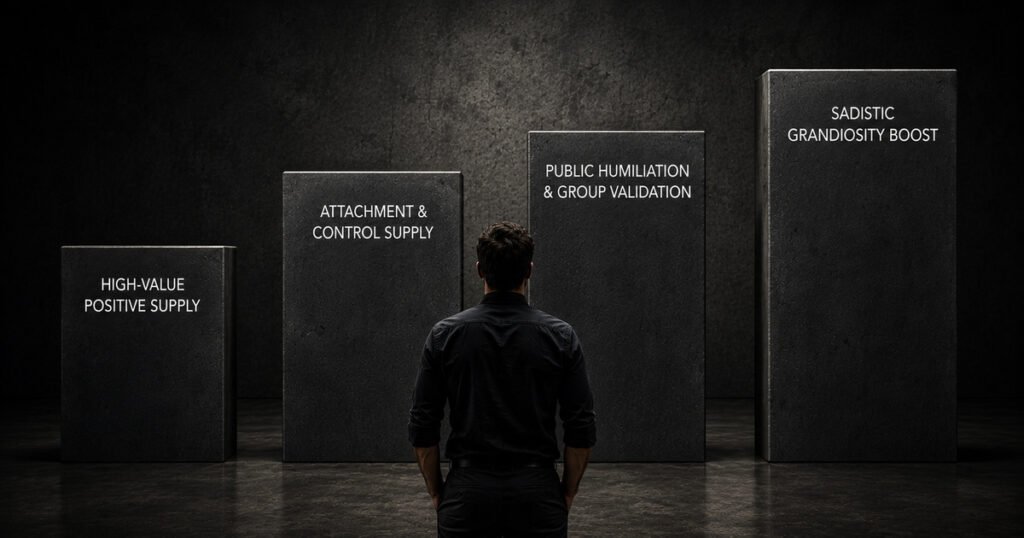
In DPL, narcissism is treated as a system that regulates the self by extracting reactions from the environment. In this article, we will break down the narcissistic supply concept from both psychological and biological angles, using scientific research and observation to understand how one of the most important and damaging mechanisms in narcissism works.
This is a recognition guide, not a diagnostic tool. Narcissistic personality disorder (NPD) can be diagnosed only by qualified professionals.
TL;DR
- Deep breakdown of the narcissistic supply mechanism to better understand the narcissist’s internal processing and its paradox
- Objectification of people
- Supply variations and different sources
- Narcissistic supply can resemble an attachment mechanism
- The narcissistic abuse cycle is a way of extracting supply
- The narcissistic supply feeding cycle as a recognition tool
- About defense and risk
What Is Narcissistic Supply
Narcissistic supply is one of the most sensitive and central components of the narcissistic system. It helps explain their often exaggerated reactions to evaluation, social status, and achievements, as well as their envy of others, hypersensitivity to criticism, and, at times, sadistic satisfaction when psychologically overpowering or hurting others (Rogier et al., 2023).
People with high narcissistic traits often have unstable self-esteem organized around polar opposites: fragility and grandiosity. To maintain this fragile self-image, they seek external confirmation: recognition, validation, attention, and emotional reactions from their surroundings.
Narcissistic supply can be understood as social feedback that reinforces the narcissist’s internal narrative and constructed image. A reaction that boosts their grandiose persona, whether positive or negative, can temporarily stabilize their internal state, but the effect usually fades quickly. Therefore, the narcissistic system tends to operate as a supply-extraction mechanism, constantly scanning the environment for reactions that confirm its constructed image.
In more antagonistic or malignant forms, they may also seek fear, emotional distress, humiliation, or another person’s pain to fulfill the same need.
Download the Manipulation Recognition Guide
Not sure if you are being manipulated by the narcissist? Take a test. Press a button below. Sign up for Dark Psychology Lab, and we will send it to your email.
Mechanical Ego Regulation Block: Supply Is an Automatic Process
When an individual’s internal sense of worth is unstable, they begin to use other people’s reactions as emotional fuel. Self-regulation models suggest that narcissistic behavior comes from automatic motivational processes and status-seeking, rather than from a fully conscious malicious plan (Grapsas et al., 2019).
Neurobiological research (fMRI) shows that people with high narcissism may have differences in the prefrontal cortex and the salience network, which are involved in empathy and self-regulation. This supports the view that narcissistic functioning may involve deficits or disturbances in emotional regulation and social-affective processing (Fan et al., 2011; Jauk & Kanske, 2021).
Based on these studies, narcissism can be understood as a biologically influenced and developmentally shaped system. Over time, the person with high narcissistic traits learns interpersonal strategies that help regulate internal instability.
This also explains why covert/vulnerable narcissists, who hide their grandiosity behind a fragile facade, are often identified as experiencing more negative emotions. In close relationships, their behavior can become especially cruel (Oliver et al., 2024). They regulate themselves less through open admiration from the environment, as overt narcissists often do, and more through covert control, resentment, emotional punishment, and the extraction of supply from private interpersonal situations.
The supply system itself works automatically. Many narcissists may not even realize that they are narcissists, and they may not even know what narcissism is, while the need for supply and the ways of getting it remain active. To better understand how it works and how to protect yourself when it becomes hostile, we will break down the supply mechanism.
The Core of Supply: External Reaction Becomes an Internal Stabilizer
Because of their fragile inner selves, people with high narcissistic traits tend to orient themselves toward social status and seek external recognition to maintain a positive sense of self-worth (Grapsas et al., 2019). As a result, external validation briefly reduces internal tension.
For narcissists, supply can become similar to alcohol for an alcoholic. They feel an inner hunger, which can be described as emptiness, and their behavior switches on and escalates to calm that hunger. This explains why their behavior persists. Logical explanations or attempts to “make them understand that they are hurting you” often fail. If they have access to a person and that person’s emotional fuel works for them, they will continue their feeding cycles.
The narcissistic supply mechanism resembles addiction:
external reaction → temporary ego stabilization → stability fades → a new source is searched for
It is worth emphasizing that, based on this model, narcissists who care the most about their appearance and external image may internally be the most insecure. In psychology, this is called compensation (APA Dictionary of Psychology, n.d.). Through appearance and achievements, they try to mask a very vulnerable self. As a result, they may need more narcissistic supply to maintain themselves.

For example, a beautiful and widely liked covert/vulnerable narcissistic woman tortures men who get close to her through manipulation and psychological abuse, while her social circle supports her public facade and victim narrative, creating even more confusion and pressure on her target. Later, she turns the environment against the exhausted target, extracting a large amount of sadistic supply in the process.
By turning her surroundings against the target, she receives two things at once: secondary supply, because bystanders sympathize with her as the “victim,” and sadistic primary supply, because she gets to watch her former partner’s confusion, collapse, and social destabilization. In this dynamic, this can become one of the strongest reward signals for the narcissistic system.
The Narcissism Paradox: External Grandiosity Covers Internal Lack
Dynamic self-regulation models show that narcissism is not a static trait. It is a continuous, active, and cyclical process of self-construction (Morf & Rhodewalt, 2001). The biggest paradox of this mechanism is the coexistence of grandiosity and extreme vulnerability:
- Internal state (vulnerability): unstable, fragmented self-esteem, deep inadequacy, emptiness, and a constant fear of being exposed.
- External projection (grandiosity): a grandiose, illusion-based, and inflated self-image that displays superiority, perfection, and independence.
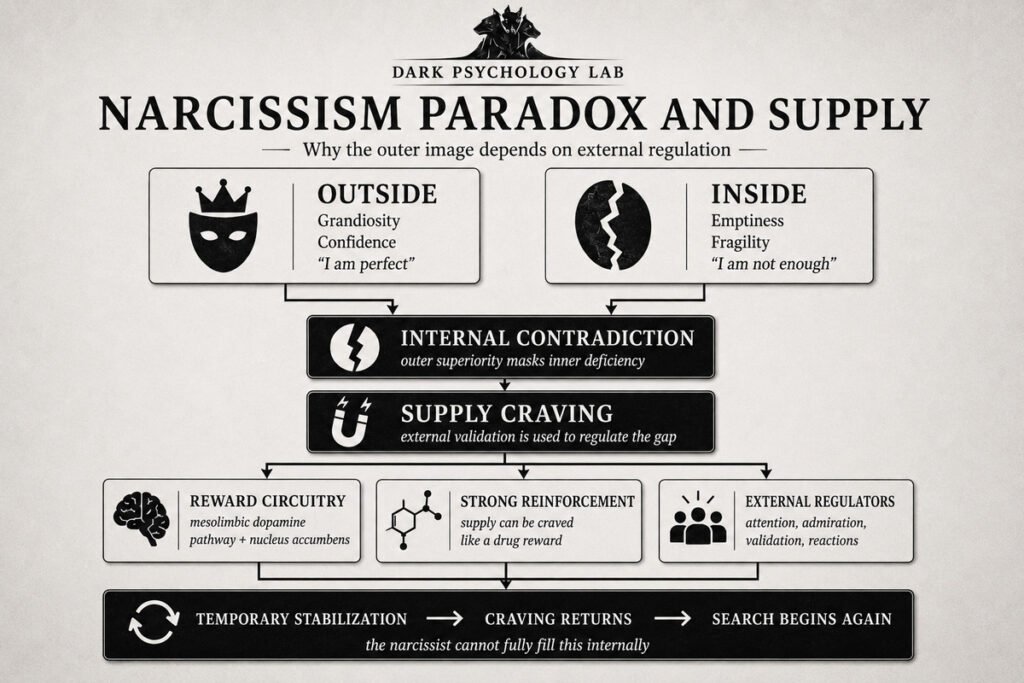
Because the grandiose self is built on deception, and the narcissist may partly know this, the whole structure becomes highly vulnerable. The persona (facade) must be defended because, underneath it, the system knows it is not fully real. This is the most fragile point in the narcissistic structure.
Based on self-regulatory models of narcissism, the narcissistic ego can be understood as an “endless construction site on quicksand”: external validation briefly stabilizes the system and reduces internal tension, but once the effect fades, the structure starts sinking again, demanding a new dose of reactions (Zeigler-Hill et al., 2010).
Healthy Self-Esteem vs. Narcissistic Regulation
Although narcissists may appear confident and successful, and often do look that way externally, this image can be misleading. People may gather around them, admire them, like them, and even place them in leadership positions. But there is a difference between healthy self-confidence and narcissistic functioning.
Healthy self-esteem is autonomous. It is generated from within, based on real achievements, integration, and the ability to withstand criticism or social indifference without the inner framework collapsing.
Narcissistic self-esteem is dependent. Yes, these individuals can function autonomously in practical life. They can work, lead, perform, organize, achieve, and look highly capable from the outside. But for them, professional roles are not self-expression but a secondary means of extracting resources. Without external confirmation or when they face serious frustration, criticism, rejection, or loss of status, their structure may stop functioning normally (Zeigler-Hill et al., 2008).
Narcissists’ Reactions to a Toxic Environment
There is an important nuance here. In a negative or toxic environment, even people without narcissistic traits can begin to collapse. It is difficult for anyone to stand alone against a toxic system for too long. But narcissists often react to this much more intensely, as if their whole internal structure resists the experience and enters a deep crisis.
The paradox is that narcissists are highly sensitive to toxic pressure against themselves, yet they often create toxic environments around others. They cannot tolerate destabilization directed at them, but they can use it when it gives them power over others. Inside such contexts, they may function extremely well because chaos gives them leverage. A system built around internal deception can adapt surprisingly well to external situations marked by deception and confusion. Evolutionary biology suggests that deep self-deception evolved precisely as a strategic tool for mastering interpersonal exploitation without cognitive dissonance (von Hippel & Trivers, 2011).
When the social field stops supplying the needed energy or directly questions the narcissist’s grandiosity, a deep ego injury occurs, known as narcissistic injury. Because the system does not have enough internal resources to regulate this crisis, an automatic defensive alarm switches on: narcissistic rage or sudden devaluation of another person, aimed at restoring status at any cost.
The Supply System as an Objectification of People
Narcissistic supply is not only about reactions from social circles. It also involves the people who become suitable for maintaining this internal framework: those who do not leave even after many boundaries have been crossed, and those whose vulnerabilities are already exposed to the narcissist.
Research shows that objectification tendencies are better predicted by exploitation and entitlement than by narcissism level alone (Lachowicz-Tabaczek et al., 2025). This is important because it emphasizes that narcissists are not the only people who can objectify and exploit others.
However, in narcissistic dynamics, dehumanization often becomes part of a broader internal regulatory system. Other people may be perceived more as functional sources of narcissistic supply or what Kohut’s self psychology calls selfobjects, whose primary utility is to stabilize the narcissist’s fragmented inner state (Kohut, 1971; Kernberg, 1975).
This becomes especially visible after the narcissist gets close enough. At the beginning, the narcissist often tests boundaries carefully. It takes time for them to become more confident. The more a target values the narcissist, the more vulnerability they show, and the longer they tolerate toxic behavior, the more easily the individual becomes a controlled object with a function. When they see that a person can be emotionally affected, they may become more aggressive, humiliating, pressuring, or provoking, because the other person’s reactions become a resource for their ego regulation, a source of narcissistic supply.
The cycle of objectification:
person → source of reactions → object of control → used as long as they provide value → discarded when they start resisting
Empathy Processing in Narcissism
There are several types of empathy. Typically, people tend to feel other people’s emotions and resonate with them. After reaching a certain point, they stop or do not want to “hurt” another human being. Emotional empathy evolved as a biological survival brake: a mechanism that restrains members of a species from destroying their own kind (Decety & Holvoet, 2021).
Narcissists often filter empathy through self-protection, status, and regulatory needs. Weaker emotional resonance means that another person’s pain fails to trigger an internal brake effectively. Prefrontal, cingulate, and fronto-limbic regions connect emotional signals with self-control less effectively, so the narcissist can see a painful reaction and still continue the harmful behavior due to these neurological differences (Shukla & Upadhyay, 2025).
Types of Empathy and Their Difference in Narcissists
- Affective empathy is emotional resonance, emotional contagion, and reaction to another person’s emotional signals. In most individuals, this usually creates restraint, while in those with high narcissistic traits, this type of empathy is less effective. So when the narcissist sees another person’s pain, the brakes do not switch on properly.
- Cognitive empathy is the ability to understand another person’s thoughts, feelings, and perspective without a necessary emotional response. In narcissism, cognitive empathy may even function as a compensatory tool: when emotional empathy is low, the narcissistic mechanism can still read people cognitively and use that information strategically. Research on Dark Triad traits supports this operational model, showing that an intact or enhanced cognitive empathy paired with affective callousness creates a precise neuro-cognitive architecture tailored for strategic interpersonal exploitation (Wai & Tiliopoulos, 2012).
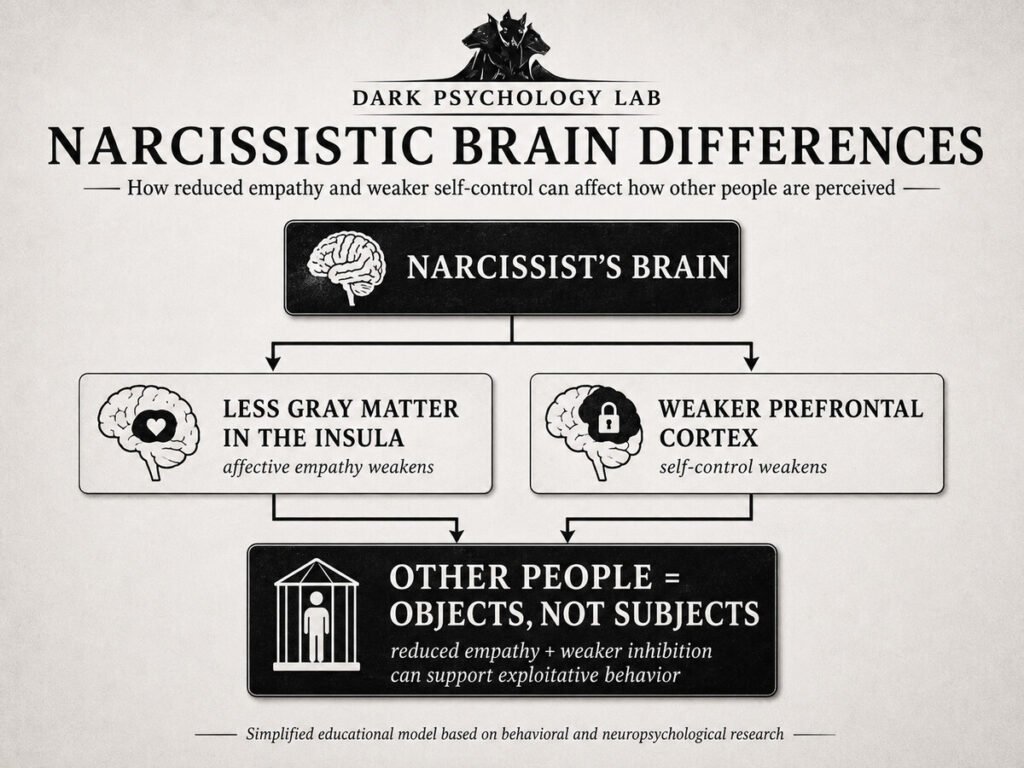
Based on this, we can assume that the narcissistic system works differently, as if it were designed to exploit its own kind. This explains the objectification of supply sources and, in some cases, even sadistic satisfaction without guilt while torturing, deceiving, betraying, exploiting, or humiliating those within their reach.
less empathy + weaker inhibition → other people more easily become objects instead of subjects
Supply Quality: Different Sources Have Different Values for the Narcissist
Validation from a high-status person, an attractive partner, a respected specialist, or a socially important group has more value than random attention. Because of this, the narcissist may specifically target people who stand out with qualities they like or with higher status: more cheerful, positive, good-looking, higher-status, or financially stable people.
The higher the perceived value of the supply provider in the narcissist’s eyes, the stronger the ego confirmation.
Types and Sources of Supply
Supply cannot exist without the presence of others. This feeding system is very similar to ordinary recognition from the environment, but in narcissism, it becomes much more sensitive than in most people and often develops into more complex, antagonistic forms.
Positive / Negative
- Positive supply: praise, admiration, sexual attention, status recognition, compliments.
- Negative supply: fear, anger, jealousy, confusion, pain, conflict, tears.
Primary / Secondary
- Primary supply (high-intensity): more emotionally resonant supply. It creates stronger reward-system activation and may function like a dopamine-related self-esteem high for the narcissistic system (Kastner-Bosek et al., 2021). It includes attention, admiration, closeness, control, status, obedience, attachment, strong emotions, domination, power display, contempt, and mockery. If a person reacts strongly, the narcissist receives a reinforcement signal.
- Secondary supply: more external confirmation and recognition. It keeps the narcissist’s system running over time, almost like daily ego maintenance. It includes appearance, living conditions, position, public standing, family, and other social markers, all of which are regularly validated as important.
The Group as a Supply Amplifier
Because supply loses its meaning without external confirmation, the display of the grandiose self in a group amplifies the supply effect even more. For example, an overt narcissist behaves fairly normally with an old “friend” when they are alone. Dialogue is possible, and he respects some boundaries. But when a group joins, the same narcissist starts publicly humiliating that “friend” in front of others and receives a strong dose of narcissistic supply from it.
This overt narcissistic behavior is called raising social status through another person’s devaluation. In this situation, the supply types are control, status, domination, public recognition, and if the narcissist manages to extract stronger emotions from the “friend,” maybe even tears, it feeds the narcissist even more instead of slowing them down.
The Reward System: Why Supply Resembles a Neurological Addiction
Neurobiological studies suggest that people with strong narcissistic traits have differences in brain structure and function, and their dopamine system works according to an anomalous, addiction-like model. Diffusion tensor imaging (DTI) studies show that the narcissist’s frontostriatal tract, the neural pathway connecting the prefrontal cortex responsible for self-perception with the brain’s reward center, is physically weaker (Chester et al., 2016; Kastner-Bosek et al., 2021). This helps explain why some narcissistic individuals rely heavily on external affirmation and admiration. Meaning, it may be harder for them to biologically generate inner satisfaction or a stable sense of self-worth on their own, but a more sensitive dopamine system tends to seek external reinforcement.
The addiction-like nature of narcissism can be explained through dopamine signaling dysregulation. The narcissist’s brain system may be adapted for instant, fast reward-seeking, which can create short-term but intense dopamine-related reward hits. This fits the narcissistic supply model because admiration, validation, status, and ego repair can serve as external reward signals that temporarily stabilize self-esteem (Kastner-Bosek et al., 2021).
From an evolutionary perspective, we can hypothesize that this brain architecture resembles predatory behavior or parasitism. It may be similar to an archaic resource-extraction mechanism that has survived evolution and now seeks to adapt to modern society’s moral norms, rules, and social conditions. Since direct predatory behavior is punished in modern societies, the system has adapted to drain resources and extract dopamine through psychological manipulation and other forms of control.
This neurochemical hunger helps explain constant impulsivity and why there is always some kind of chaos around the narcissist. Their lives often revolve around changing enemies, situations, conflicts, and new heroes. Drama and conflict are quick ways to provoke strong reactions from others, which can trigger fast reward hits in the narcissistic system.
The Neurological Addiction Cycle
Narcissistic supply is similar to a neurological addiction, working through this mechanism (every situation is different, so this formula is presented as an introductory recognition tool):
supply → reward feeling → temporary relief → effect fades → new supply is searched for
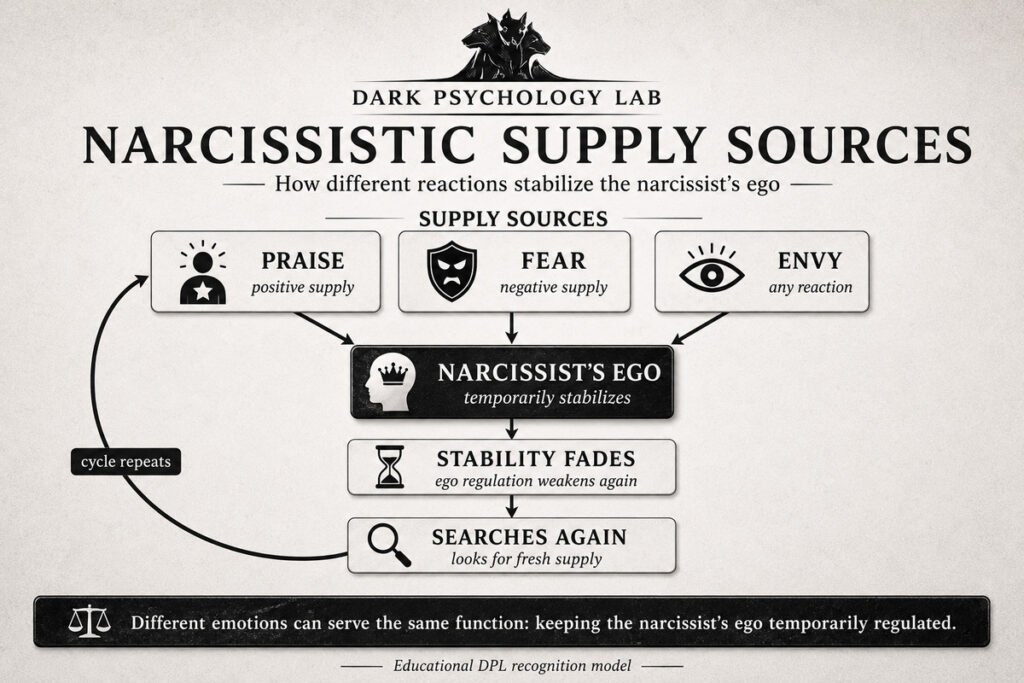
This cycle has a tendency to grow in terms of tolerance. Over time, the narcissistic system may need more to stabilize itself:
- a larger number of reactions;
- stronger emotional intensity;
- new, unused sources.
When the amount of supply decreases, for example, when the target starts running out of strength or shows vulnerability, neurochemical hunger may increase in the narcissist’s system. This can trigger irritability, anger, sudden devaluation of the target, and increasingly stronger provocations, through which the narcissist tries to force out the missing emotional fuel (Baumeister, 2001).
This also explains why some narcissists become attached to specific sources of supply. When one person reliably produces intense emotional reactions, the narcissistic system may begin to treat that person as a high-value reward source. Losing access to that source can trigger hoovering: repeated attempts to pull the person back into the cycle and restore access to the supply stream.
The Rotation of the Narcissistic Supply Cycle
As we explained, narcissistic supply includes not only romantic relationships but the narcissist’s entire way of functioning. The same mechanism can operate within families, friend groups, workplaces, social media, communities, or hierarchical structures.
People with high narcissistic traits use the narcissistic supply system as a temporary self-esteem stabilizer. However, this external self-regulation mechanism quickly runs out and can lead to relationship cycles dominated by idealization, devaluation, and frequent discard, where the narcissist devalues, humiliates, and removes the person from their environment who was their supply.
Based on our analysis, narcissistic supply rotation is closely connected to the narcissistic abuse cycle, a frequently observed and recurring phenomenon in narcissistic dynamics. Ameen et al. (2025) argue that the narcissistic abuse cycle deserves clinical and research attention.
In the next section, we will examine the narcissistic abuse cycle and the types of supply the narcissist receives during each phase.
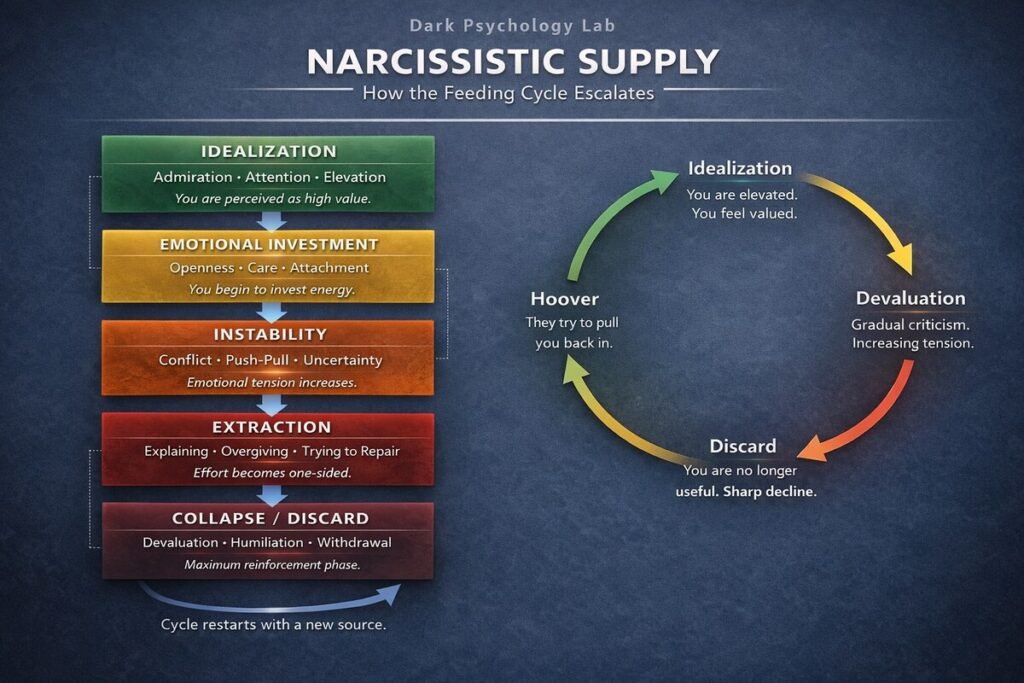
The Narcissistic Cycle Overview: Supply Rotation
All narcissistic relationships are different, but across many cases, this phenomenon is consistently observed as a core part of narcissistic relationships. Once the narcissist allows a person to get close, the supply mechanism activates almost automatically, and the narcissistic abuse cycle begins at the same time.
DPL has researched and analyzed the narcissistic cycle in detail. You can access the related articles by clicking on the titles.
Idealization → Devaluation → Discard → Hoover → Repeat
To understand how all phases connect into one repeating abuse mechanism, read:
Narcissistic Abuse Cycle Explained
Idealization
You are seen, admired, and mirrored. They adapt to you. The narcissist reflects and amplifies your best qualities. At the same time, they begin collecting information about your vulnerable points. During a strong emotional high from idealization, or when they project very high value onto the target, they may not yet use that information
Devaluation
The narcissist begins devaluation tests. Gradually, subtle criticism appears. Ordinary human traits or moments of vulnerability become more noticeable and are pointed out. When they see greater vulnerability, they may begin to doubt whether the target is still the same person they once valued. To test this, they start pressing harder on the vulnerable points.
Discard
The narcissist mentally reclassifies you as defective, low-status, or no longer useful. Once devaluation has lowered your value in their eyes, a discard response becomes an antagonistic form of self-regulation. They remove, humiliate, replace, or socially discredit you to restore control, protect their facade, and justify the reality they need others to believe.
Hoover
Over time, they may try to pull you back because they miss the access and the way your emotional fuel regulated them. This does not always happen through direct contact. It can appear through small hooks: messages, posts, gestures, mutual contacts, unexpected appearances, or a sudden “remembering” of unfinished business. The goal is to test whether the old supply source is still reachable.
Repeat
If they manage to regain access, the cycle repeats, but usually in a faster, more cruel phase.
The Narcissistic Abuse Cycle Runs Mostly on Negative Supply
After analyzing the narcissistic cycle, we can notice an important pattern in close supply-based relationships. During the idealization phase, the narcissist mostly receives positive supply: admiration, excitement, and emotional intensity. But once devaluation begins, most of the cycle is fueled by negative reactions elicited from the target. From that point on, the narcissist raises their own status by lowering the target.
Based on this, we can argue that the narcissistic system, in its raw form, often responds more strongly to negative than positive emotional fuel. Negative supply destabilizes the target, makes them easier to control, increases dependency, and elevates the narcissist’s sense of power and superiority.
The Feeding Cycle
DPL Framework
To make supply extraction easier to recognize inside the narcissistic abuse cycle, we created the Feeding Cycle Framework: a five-stage model showing what type of supply the narcissist receives at each point while the abuse cycle unfolds in parallel. This model applies to situations where the narcissist gets close, senses vulnerability, uses it, and begins extracting more sadistic forms of supply. It is designed mainly for close relationships, friendships, or longer-term workplace relationships, where attachment can form and a power imbalance can emerge.
1. Positive Supply: Admiration, Status, Mirroring, and Emotional High
At first, the narcissist is drawn to the positive supply you provide: admiration, attention, emotional intensity, status, or the feeling of being seen as special. They may idealize you because you reflect something they want to believe about themselves. The higher your perceived value, the stronger the supply. They want the version of themselves that your attention creates.
In this phase, supply feels exciting and almost romantic. But beneath the surface, the system is already measuring access, value, and emotional influence.
2. Emotional Caretaking
You let the narcissist in. At first, they behave well enough to make you invest. They know how to please you and how to make you become used to their presence. You begin to care and monitor their emotional state. Gradually, you show more of yourself. More openness. More vulnerability.
The narcissist notices it and registers it as access. Your care and effort become supply. The more you try to hold the connection together while their behavior deteriorates, the more important and powerful they feel. To the narcissistic system, your effort is confirmation that you are already emotionally invested and that they have leverage.
3. Conflict and Drama
Something shifts. Their behavior becomes colder, sharper, or more unstable. By this point, the narcissist may have already created an emotional pull: attachment, obsession, or even a trauma bond. If this feels familiar, we explore it here:
How Intermittent Reinforcement Creates Obsession
Now the conflict becomes supply. They press vulnerable spots, increase control, and provoke stronger reactions. If you try to hold on, you reveal attachment. In their mind, that means they “have you.” Even when they treat you badly, you do not leave. The narcissist no longer faces a challenge, no longer needs to “try,” and that, too, feeds the dynamic.
Their behavior will not improve on its own because they are getting too much narcissistic supply from your reactions.
4. Tears, Explaining, Bargaining
Boundaries are tested, crossed, then crossed again.
After a longer period inside a push–pull dynamic with a narcissist and ongoing psychological abuse, their behavior continues to deteriorate. They sense how much they can get away with and keep escalating supply extraction.
Because narcissists are drawn to control that creates emotional engagement and attachment, you may become an ideal target. In this phase, you often try to fix things, holding on to the hope that the earlier version of the narcissist will return. If you endure and do not leave as the relationship sinks into emotional exhaustion and anxiety loops, you become a particularly rich source of supply.
5. Anger, Breakdown, Collapse
Humiliation and dehumanization.
This usually occurs during the discard phase and rarely lasts long. This is the stage where the narcissist tries to consume what is left of you. Their behavior can become almost inhuman. They extract the most emotional fuel here, and their conduct is often at its worst.
This is where you may see the narcissist’s true face: restraint collapses, the facade disappears, and what remains is chaos, contempt, and insatiable emptiness.
In this phase, you feel the worst, while the narcissist feels the strongest. Having drained the most energy, they experience it as a peak. The phase rarely lasts because there is little left to take. Once everything is consumed, they discard what remains and move on.

The Vampire Metaphor and Why it Fits
Narcissistic supply is one of the crueler mechanics: your best qualities, empathy, loyalty, and patience can be converted into a feeding tube.
This is why the emotional vampire metaphor fits this process: narcissists tend to feed on the emotional energy of others, especially the energy they themselves provoke and direct back toward themselves. They become the center of the emotional field and draw narcissistic supply from the turbulence they create.
The more people value them and invest in the connection, the more “juicy” a source of supply they become. Trying to fix, explain, or repair things just feeds their ego even more and increases their control, while targets panic, overexplain, and expend emotional effort, further fueling the supply loop.
About Defense
If the narcissistic system feeds on your reactions, giving it more fuel keeps you inside the same extraction loop. Explaining, proving, defending, begging, and trying to make them understand can all become material for the system to use.
The first layer of defense is reduced access: less emotional display, less explanation, less personal information, and less exposure of your inner world.
When safety allows it, distance is the cleanest boundary. If distance is not possible, emotional disengagement becomes the practical shield: short answers, written communication, no emotional negotiations, and no participation in chaos designed to provoke reactions in you.
Defense Guides – Practical Self-Protection
Dark Psychology Lab focuses on clarity and self-protection in situations involving manipulation, power imbalance, and covert psychological pressure.
The following defense guides expand on practical mechanisms to reduce psychological damage and regain control:
Psychological Manipulation
Psychological Manipulation Defense: Safe Strategies and Dangerous Tactics Explained
Narcissistic Dynamics
How to Deal With a Narcissist and What to Do When You Can’t Leave
Toxic Workplace Culture
Workplace Mobbing Defense Playbook: 17-Step Guide
Risk Gating
This article describes common patterns, not a diagnosis. The goal is not to label every difficult person as a narcissist, but to recognize when a dynamic is becoming psychologically harmful.
If calm boundaries repeatedly lead to escalation, blame-shifting, intimidation, humiliation, threats, stalking, coercive control, or attempts to isolate you from others, stop trying to solve the situation through explanation alone.
In higher-risk situations, prioritize distance, documentation, outside support, and professional help where needed. Do not confront the person dramatically or reveal your strategy if doing so could increase the risk. Reduce emotional access, protect private information, and prioritize safety.
Final thought
Narcissistic supply and the feeding cycles it creates explain why the connection with them can feel so emotionally draining, why narcissists are often extremely sensitive to praise, evaluation, and social status indicators, and why, in some cases, they may experience sadistic satisfaction from humiliating another person, especially when the humiliation becomes public and gains validation from a group.
Once the mechanism becomes visible, the fog begins to lift. The vampire no longer looks powerful, only dependent: a predictable biological and psychological system.
Disclaimer
This article is for informational and educational purposes only. It does not provide medical, psychological, or therapeutic advice and is not a substitute for professional diagnosis or treatment. The term narcissistic supply is used here to describe commonly discussed relationship and behavioral patterns in psychological literature, not to diagnose individuals or assign clinical labels. Narcissistic Personality Disorder (NPD) can only be diagnosed by qualified mental health professionals. The metaphors and examples used in this article are intended to clarify dynamics and effects, not to stigmatize, dehumanize, or promote hostility toward individuals with narcissistic traits.
If you are experiencing ongoing emotional distress, confusion, or harm in a relationship, seeking support from a licensed mental health professional or appropriate support services is strongly recommended.
For full context and limitations, please see our Disclaimer Page.
Dark Psychology Lab
Original content based on lived experience and independent psychological analysis.