

This article is for educational and self-protection purposes only. It does not promote manipulation or replace mental health support. The mechanisms of obsessive attachment and intermittent reinforcement are examined here to help readers understand what they are and how they work. Understanding is the first step toward awareness and self-protection.
What Is Obsession in a Relationship
Obsessive patterns often begin with an intrusive thought that refuses to leave, circling in your mind even when you do not want it there. That thought is typically linked to discomfort, a mix of mild stress, inner tension, and uncertainty (🔴).
To reduce that discomfort (🟡) and restore relief (🟢), the brain may begin creating small mental loops or checking behaviors. Over time, these responses can turn into habits. What started as a single intrusive thought gradually becomes a persistent obsessive pattern.
This is the basic structure of how obsession forms. In this article, we will examine how it operates within relationship dynamics so you can recognize it and protect yourself.
Understanding the Mechanism
To understand this article, you first need to understand the neurobiological and psychological forces that shape obsession.
The brain is wired to avoid pain and seek resolution + predictability. It does not distinguish much between survival needs and emotionally meaningful attachment. If your mind registers something as important, your nervous system reacts accordingly.
- Stress (🔴)
When access to that predictability becomes unstable, stress activates. Cortisol, the primary stress hormone, rises. You feel tension, discomfort, and restlessness. It is not dramatic, just unpleasant enough to seek a resolution. - Intermittent reinforcement (expectation🟡)
The most powerful part is intermittent reinforcement. Most of the time, there is tension, uncertainty, or mild pain. Occasionally, there is relief. That unpredictability strengthens attachment. - Relief (🟢)
When the connection is restored: attention, reassurance. A dopaminergic reward circuit is activated. Relief follows. The discomfort drops. Your brain marks this as significant.
Sources supporting the psychological and neurobiological mechanisms described above:
Cleveland Clinic (Last reviewed on 02/14/2025) — Cortisol: What It Is, Function, Symptoms & Levels
Pruessner (PMC) et al. (2004) — Dopamine release in response to a psychological stress…
Penguin Press (May 2, 2017) — Behave: The Biology of Humans at Our Best and Worst (Robert M. Sapolsky).
This is how a toxic or manipulative dynamic can create psychological pull without ever fully committing, keeping you engaged without fully letting you go.
And this is exactly why unpredictable attention becomes so powerful in certain relationships.
Download the Manipulation Recognition Guide
Not sure if you are being manipulated? Take a test. Press a button below. Sign up for Dark Psychology Lab, and we will send it to your email.
Obsession Start: A Simple Real-World Scenario
Obsession in a relationship usually begins with something that seems small on the surface, a light but consistent level of toxicity.
You meet a person. Everything is perfect at the start, but something feels off.
One day, you wake up with them in your head and fall asleep replaying a look, a silence, a message “left on read”. You may begin to check your phone repeatedly because something inside won’t calm down until you do — a kind of emotional pain. (stress🔴).
Your brain reacts to this as a pain trigger and starts searching for a solution (tension🟡). So you may begin to perform small rituals:
- checking if they’re online
- rereading last messages
- analyzing their tone
- overthinking
- looking for signs on social media
The next day, maybe not immediately, your phone lights up. You receive a reply. You may have been thinking about it since the evening before, feeling a quiet tension because it mattered to you. The person you were waiting for has finally responded. A small release of dopamine follows (relief🟢).
This is the starting point of obsession.
The Obsession Loop
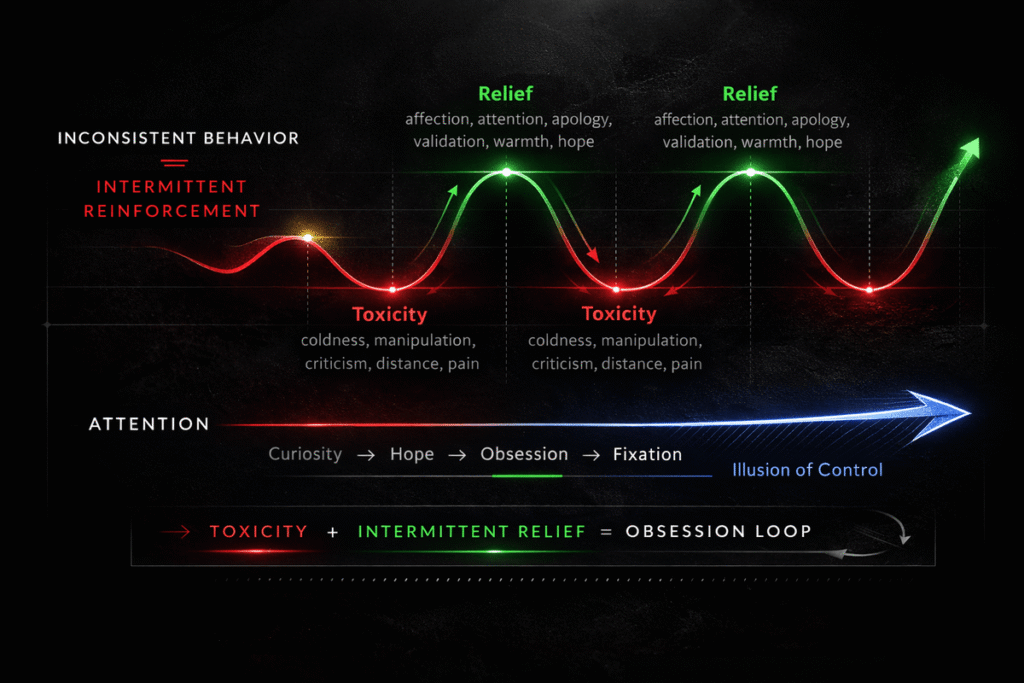
There is a simple formula for obsession in a relationship:
Attention to one person + Uncertainty = Anxiety
Anxiety + Liking = Obsession
The brain learns a pattern:
Discomfort (🔴) → Tension (🟡) → Temporary relief (🟢)
This is the seed of obsession.
A Positive Side of Obsession
From a rational standpoint, if the mechanism of obsession could be redirected toward constructive goals, such as self-care, training, study, hobbies, work, finances, or business, it could become a powerful driver of progress.
Even though it can strain the nervous system, obsession may function as a highly effective tool when consciously channeled toward meaningful objectives.
Intermittent Reward and the Psychology of Manipulation
If you are not familiar with what manipulation is or how it works, our article explains the concept in detail:
The Psychology of Manipulation: Mechanisms, Tactics, and Defense
Important boundary
This article does not teach or promote manipulation. Its purpose is to explain these behaviors so you can identify unhealthy patterns and make safer choices in your relationships. We describe these mechanisms for recognition and self-protection, not to encourage their use.
The Skinner Box Experiment
They use a principle first observed in animal experiments, the Skinner box:
- If reward (food) comes every time, the animal is motivated but not desperate.
- If reward comes sometimes, yes, sometimes no, for no clear reason, the animal becomes much more persistent, almost addicted to trying.

Research in behavioral psychology shows that when rewards are unpredictable, behavior becomes much harder to stop. The animal keeps pressing the lever even after the rewards disappear.
Psychologists call this intermittent reinforcement.
A Toxic Side of Obsession
The same neurological loop can also lock someone into an unstable attachment.
Some individuals, particularly those with manipulative or narcissistic traits, may consciously or unconsciously exploit this pattern. We covered one personality type capable of triggering obsessive attachment in our case study:
The Narcissistic Woman: Recognizing Subtle Patterns of Covert Control.
If you’ve been in a relationship marked by inconsistency and emotional withdrawal, you may recognize how attachment intensifies over time.
- Sometimes you receive warmth, attention, love, and intimacy.
- Sometimes you receive coldness, distance, blame, or silence.
And you may not know which version of them you will encounter.
Uncertainty keeps the system activated. The brain starts chasing the possibility of a positive moment. Over time, relief can become neurologically linked to the same person who causes the distress.
When attachment is already present, this uncertainty can create a powerful form of psychological dependence.
Sustained exposure to this cycle can result in a trauma bond.
Sources supporting research and the psychological claims described above:
Verywell Mind (Updated Nov 20, 2025) – “Understanding Behavioral Psychology: the Skinner Box.”
APA Dictionary of Psychology – Intermittent reinforcement (Apr 19, 2018)
Cleveland Clinic (Mar 29, 2023) – Here’s What Trauma Bonding Really Is and How To Recognize the Signs. “We form a strong attachment to someone who is causing us harm.”
Obsessive Checking and the Illusion of Control
At some point, you might start wondering: “I can’t stop thinking about them. This is not normal anymore.” That is when obsession becomes visible, and the search for answers begins.

The nervous system interprets checking as a form of control. In reality, it strengthens the attachment. Attention narrows. Other areas of life receive less energy. Your needs, goals, and physical signals become secondary. What dominates is the anticipation of their next move.
Over time, this creates an illusion of control while reinforcing dependence through rumination and intrusive thoughts.
Obsession vs Affection: Two Different Worlds
It’s easy to confuse obsession with affection, especially if chaos and emotional hunger feel familiar from childhood or past relationships. Let’s put them side by side:
Obsession may be like:
- grows from anxiety, fear, and uncertainty
- may feel like we must monitor and control the other person
- keeps our thoughts racing and our bodies tense
- depends on unpredictable attention and emotional spikes
- may slowly disconnect us from ourselves
Affection may be like:
- grows from trust and curiosity
- let’s both people be ourselves without constant fear
- brings more peace than drama
- survives disagreements with a mutual respect
- a stable, secure emotional connection
This is not a statement, just an observation: If the connection feels like constant emotional tension, if your self-worth depends on their last message, you’re likely dealing with obsession.
How to Recognize Obsession in Yourself
Here are some signs that may occur during obsessive relationships:
- can’t stop thinking about them, even when you’re exhausted from it
- mood depends almost entirely on their attention or silence
- feeling of strong anxiety when they don’t reply, even for short periods
- constant checking of their online status, posts, stories, and likes
- rereading conversations, trying to find out “what I did wrong”, overanalyzing
- minimize or explain away toxic behavior just to keep them
Also, it may be helpful to ask yourself this:
- Do they act in clearly toxic ways? Punishing with silence, disappearing, and then returning as if nothing happened?
- Do you feel constant uncertainty? If yes, uncertainty itself is already a form of pain.
- Do they try to control you? Taking the upper hand, making all decisions, blaming, and criticizing.
If the answer is often “yes,” then the probability of obsession may be higher.
How to Escape Obsession
The Basic Ways
First, small steps may include gently shifting your attention back to yourself, one small movement at a time:
- naming the pattern,
- noticing your rituals,
- inserting small pauses,
- bringing your focus back to your world,
- and questioning the fantasy around the relationship.
Seeking support can make this process easier to untangle, whether through a therapist, a support group, trauma‑informed education, or one trusted friend who helps you stay grounded in reality.
Obsession Redirection: The Significance Principle (DPL)
Now you understand how obsession works. The first step is clarity, and that is what this article aimed to provide.
The second step is redirection.
The nervous system avoids pain and moves toward what it perceives as significant. If failure carries no meaningful cost, it rarely motivates change. If success feels vague or emotionally neutral, the brain does not prioritize it.
To redirect obsessive energy, two conditions are required:
- Make the cost of stagnation emotionally real (🔴).
- Make the goal meaningful enough that the mind registers it as important (🟢).
- Technically, the intermittent reinforcement factor is the anxiety that something might not work out (🟡).
This is not simple. It requires conscious restructuring of attention and priorities. But the principle is straightforward: attention follows perceived significance.
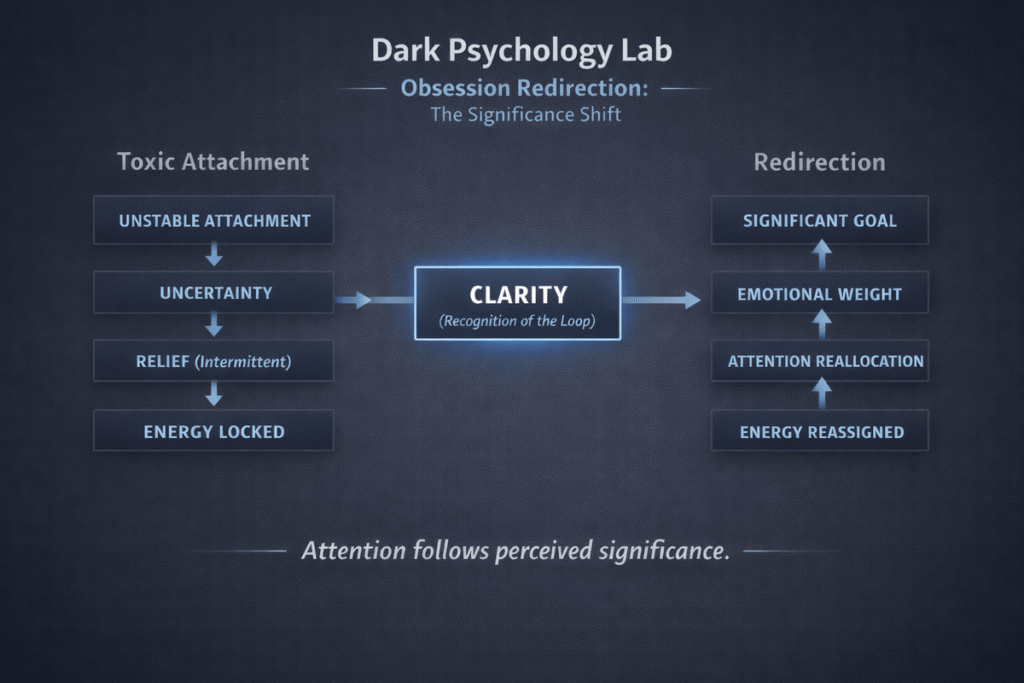
When the brain is given a task it considers more important than the unstable attachment, the grip of the toxic bond weakens. The system reallocates energy.
Obsession does not disappear overnight. But it can be reassigned.
Dark Psychology Lab Defense Guides
Dark Psychology Lab focuses on clarity and self-protection in situations involving manipulation, power imbalance, and covert psychological pressure.
The following defense guides expand on practical mechanisms to reduce psychological damage and regain control:
Psychological Manipulation
Psychological Manipulation Defense: Safe Strategies and Dangerous Tactics Explained
Narcissistic Dynamics
How to Deal With a Narcissist and What to Do When You Can’t Leave
Workplace Mobbing & Toxic Culture
Workplace Mobbing Defense Playbook: 17-Step Guide
Final thoughts
In many cases, obsession attaches not to reality, but to a fantasy created during emotional deprivation. When emotional needs are unmet for a long time, the mind may cling to imagined closeness, meaning, or future promises as a way to regulate pain.
Disclaimer
This article is for informational and educational purposes only. It does not provide medical, psychological, or legal advice, and it does not replace professional diagnosis or treatment.
While this article references mechanisms also discussed in conditions such as obsessive-compulsive disorder (OCD), it does not suggest that relationship-based obsession equals OCD or any clinical diagnosis. Only qualified mental health professionals can assess and diagnose mental health conditions.
The patterns described here are meant to explain common psychological responses to uncertainty, emotional stress, and toxic relational dynamics, not to label or pathologize individuals.
If obsessive thoughts, anxiety, or emotional distress feel overwhelming or unmanageable, seeking support from a licensed mental health professional is strongly recommended.
For full context and limitations, see our Disclaimer Page.
Dark Psychology Lab
Original content based on lived experience and independent psychological analysis.