

In the past, being expelled from a group often meant death. Without the tribe, a person was left without warmth, food, or protection from predators. Over thousands of years, sensitivity to rejection and exclusion became closely linked to human threat responses. While we cannot directly observe the brain’s evolutionary development, modern neuroscience supports this association.
Even today, despite significant changes in modern living conditions, the brain remains highly responsive to social isolation as a critical stressor. In more sensitive individuals, it can trigger existential anxiety that feels comparable to the fear of death.
Source (related): The pain of social disconnection: examining the shared neural underpinnings of physical and social pain — Naomi I. Eisenberger (Nature Reviews Neuroscience) (Published online 3 May 2011).
Although changing jobs, environments, or living locations often is manageable, our biology can still perceive exclusion as a survival-level threat. For this reason, the escalation of psychological abuse within a group can have a profoundly destructive effect on the nervous system. In many cases, it contributes to conditions such as Post-Traumatic Stress Disorder — PTSD or Complex Post-Traumatic Stress Disorder — C-PTSD (Walker, 2025).
The Escalation Trigger: Status Testing and Reinforcement
Everything can begin with one person taking the initiative to publicly lower someone else’s status. This may appear as irony, reputation damage, or subtle devaluation, often disguised as an “innocent joke.” What matters most is not the content of the comment, but the fact that it happens publicly. In some cases, it functions as a “status test.”
The aggressor observes not only the target but also the environment, evaluating:
- Will anyone step in to defend the target?
- Can the target respond effectively?
- Does the existing hierarchy allow this behavior?
If, due to surprise, fatigue, anxiety, or power imbalance, the target does not respond, the group may interpret the silence as acceptance.
At this stage, a social reinforcement begins:
- Reinforcement: If the aggressor faces no consequences, resistance, or social disapproval, the behavior becomes more likely to continue.
- Reward: Emotional reactions from the target, or approval and attention from the group, act as confirmation. The aggressor experiences this as validation of power.
- Safety Signal: Most aggressors do not attack if they sense that the target can defend themselves or has support. If the environment remains silent, the behavior is perceived as low-risk. Actions without negative consequences tend to be repeated.
How Pressure Becomes Collective
If one person continues subtle social humiliation, others may begin to pick up on it. Over time, a group narrative can form: If this person can be treated this way without consequences, their status is lower. At this point, the escalation mechanism gains momentum.
If the mistreatment goes unchallenged or others join in, the nervous system may interpret it as: “I’m outnumbered.” “I can’t defend myself.” “No one is stepping in.” “This behavior is allowed.” “Everyone is against me.”
The Defense Trap
When the nervous system senses an escalating threat, it usually shifts into a fight-or-flight state. This often leads to one of two reactive extremes:
- Withdrawal and a defensive posture: This rarely stops the process and may even intensify the group attack.
- Impulsive aggression: An aggressive attempt to defend yourself can allow the aggressor to discredit you easily, framing your reaction as “inappropriate” or “toxic” within the context of social norms.
In any case, in this situation, the internal state changes, and anxiety begins to emerge.
Bottom of the Social Hierarchy Theory
A recurring phenomenon can be observed: after a person spends prolonged time in a reactive state in a manipulative or destructive environment, others may begin to treat them worse.
It is a paradoxical situation. Over time, the targeted person begins to feel more insecure, but instead of the situation de-escalating, some individuals apply even more pressure. These are often toxic personalities. They may attempt to exploit vulnerabilities, disregard boundaries, and even engage in financial deception, sometimes doing so simply to laugh or feel superior.
Why does this happen?
Classic criminological research has shown that offenders sometimes evaluate people based on movement, posture, and walking style, deciding who may be an “easier target.” In other words, vulnerability can be read through nonverbal signals.
This includes tone of voice, eye contact, and visible nervousness. In general, a defence posturing mechanism.
As noted in a well‑known study by Grayson & Stein (1981), offenders showed strong agreement in identifying individuals they perceived as likely victims based solely on gait and body movement: “Observers were able to reach significant consensus in judging vulnerability from walking style.” (Grayson & Stein, 1981, Attracting Assault: Victims’ Nonverbal Cues).
Power Regulation and Toxic Personality Traits
Individuals with narcissistic or sadistic traits may use the devaluation of others as a tool to elevate their own status. If the target reacts with visible sensitivity, the aggressor can use this response to construct a narrative framing the person as “unstable,” and then further isolate them.
It is not possible to diagnose personality disorders such as NPD in everyday environments. Such diagnoses can only be made by qualified mental health professionals, yet certain individuals may consistently display narcissistic traits both in personal and professional contexts. When this occurs at work, practical defense strategies can be helpful. Our guide:
How to Work With a Narcissist During the Devaluation Phase
The Collective Effect and Status
If the group sees that a person is systematically and maliciously devalued as a personality, allies often become scarce. What may remain are distant, observing looks. It feels safer, from a social dynamics perspective, to align with the majority than with the targeted individual. Reactions to this pressure may vary:
- Some withdraw and observe from the sidelines.
- Others adapt to the dominant side.
- Some actively join the attack.
- Only in rare cases do defenders step in.
The greater the power imbalance, the fewer people are willing to defend the target. Isolation, status degradation, and discrediting can create a chain reaction. The likelihood that other group members will join the aggressor increases over time.
Biological Response: Social Pain
Group rejection activates the same brain regions involved in physical pain:
- The dorsal anterior cingulate cortex (dACC).
- The anterior insula.
In research, this is called the social pain overlap theory.
Source: The salience of self, not social pain, is encoded by dorsal anterior cingulate and insula — Scientific Reports (Nature / Springer Nature) (Published 18 April 2018).
How Group Conformity Fuels Workplace Mobbing
If the aggressors face no consequences and hold a strong position in the hierarchy, their behavior sets an example.
Over time, the group begins to treat it as normal. Silence is read as permission to continue.
At this point, group conformity activates. Solomon Asch’s experiments suggest that people tend to agree with a clearly incorrect majority opinion simply to avoid standing out.
Source: Opinions and Social Pressure — Solomon E. Asch, Scientific American (1955).

Because social exclusion can activate neural systems associated with physical threat, belonging to the group becomes a priority that can override personal morality or rational judgment. This is where the Bandwagon effect appears: the tendency to adopt dominant behavior, especially when it is modeled by a majority (APA Dictionary of Psychology, 2018).
This process is more instinctive than logical. Under normative social influence, group members attempt to reduce their personal risk of becoming the next target by adjusting their behavior toward what appears “safe.” Joining the attack often becomes a distorted form of self-protection.
The group reinforces the belief that a lower-status member can be diminished without consequences. Over time, repeated behavior may become normalized, and the initial individual signals can evolve into collective action.
Diffusion of Responsibility: The Bystander Effect in Group Escalation
In a group, personal guilt often dissolves into collective noise. This is where the principle of diffusion of responsibility (Bystander Effect) operates: the more people who witness a situation, the less personal pressure each individual feels to intervene.
Source: Bystander Intervention in Emergencies: Diffusion of Responsibility — John M. Darley & Bibb Latané, Journal of Personality and Social Psychology (1968).
This effect allows cruelty, mobbing, or corruption to unfold with little immediate resistance. When actions are carried out within a group, responsibility becomes diffused. No single member feels fully accountable, and personal moral limits begin to erode.
As a sense of collective safety develops, aggressors feel protected by numbers. This perceived safety makes it easier to justify harmful behavior and shift blame outward. Group pressure allows participants to deflect responsibility with statements like “I didn’t start this” or “I was just following the group.”
In such a toxic environment, behavior can shift dramatically. Under the influence of group dynamics, individuals may become cruel, indifferent, or cynical. These are actions they would likely avoid if they were alone and fully aware of their personal responsibility.
The Scapegoating Manipulation
Scapegoating is a manipulation tactic in which one person or group member becomes the consistent target of blame for the problems, failures, or mistakes of others. It shifts responsibility away from those who caused the harm.
The target is gradually turned into a “symbol of the problem.” Frustration, envy, tension, organizational errors, and unresolved conflicts are projected onto them.
Once scapegoating becomes established, the attack gains moral justification. Phrases begin to appear: “It’s his own fault,” “It’s always like this with him,” “He’s strange.”
Manipulative Tactics That Follow Group Isolation
Defending yourself against a collective is extremely difficult due to isolation and group pressure. Emotional exhaustion often increases. When several people repeat the same narrative, internal confusion and self-doubt begin to grow.
In this environment, other manipulative tactics often emerge — gaslighting, silent treatment, DARVO.
Not sure if you are being manipulated? Take a test. Press a button below. Sign up for Dark Psychology Lab, and we will send it to your email.
As group dynamics intensify over time, the process can escalate into coercive control. One of the more severe forms of this escalation is examined in our case study:
Coercive Control at Work and in Relationships: “Death by a Thousand Cuts” Explained
When Group Escalation Becomes Workplace Mobbing
In the workplace, collective psychological pressure is known as mobbing. At this stage, not only is reputation at risk, but also income, career, and overall life stability. This can intensify the stress response, as the situation becomes directly connected to survival.
The escalation shifts to a systemic level. Reputation damage, isolation, restriction of information, highlighting of mistakes, and constant micro-devaluation begin to appear. The pressure is no longer a series of isolated episodes. It becomes a consistent environmental pattern.
The conflict expands through triangulation. Intermediary enforcers (“flying monkeys”) become engaged, and a smear campaign begins to form. Over time, the person becomes isolated, and in some cases, their reputation erodes without open confrontation.
Even when appealing to higher authorities or formal channels, proving systemic psychological pressure can be difficult. A toxic workplace culture often protects itself behind public image, reputation (even if superficial), and legal structures.
In such a situation, feeling powerless is a realistic response.
To learn more about how systems push out those they consider “inconvenient,” see the article:
Workplace Mobbing: Signs, Tactics, and the System Behind It
The Final Escalation Phase: Normalization and Isolation
Over time, the initial aggression can become normalized. Behavior that at first appeared to be an isolated incident gradually turns into an unwritten group rule.
At this stage, the environment no longer questions why it is happening. People accept it as an obvious reality in which one person is consistently treated as “the other.”
When new members join the group, they arrive with a pre-formed assumption shaped by the environment: “There is something wrong with that person.” Newcomers adopt the group’s narrative rather than verified facts, without any personal basis for such a judgment.
Mobbing then becomes a self-sustaining process that no longer requires active effort from the original aggressor.
This is the final stage of systemic group pressure — reputational death within the collective. The person becomes isolated because of an imposed image rather than their actual actions.
For the nervous system, prolonged social exclusion can produce sustained stress responses, as the brain may register it as a persistent threat. Remaining in the same environment makes recovery extremely difficult.
Group Pressure Escalation Model (DPL)
The following model outlines a typical progression of collective psychological pressure observed in workplace mobbing and group-based exclusion. While real situations may not follow every step in a strict sequence, the pattern below reflects a commonly recurring escalation pathway.
Initiator → Social Signal → Conformity (Bandwagon Effect) → Diffusion of Responsibility → Scapegoating → Systemic Pressure
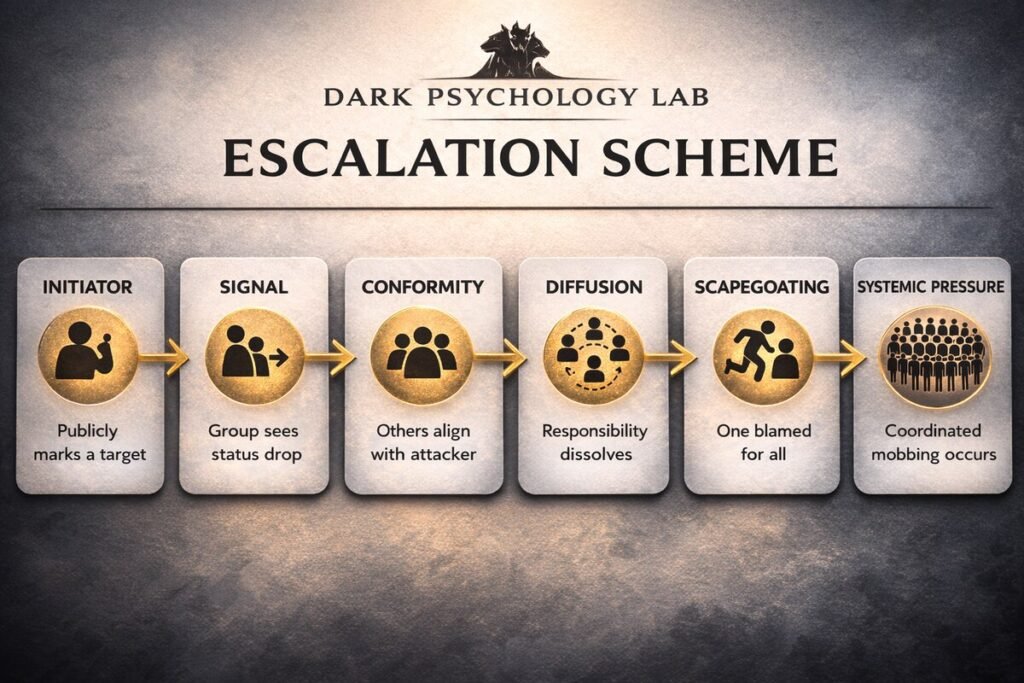
The longer this process continues, the more it can erode the targeted person’s personality, psychological health, and self-worth.
Defensive Strategy Against Group Pressure
The DPL principle is harm reduction, not escalation.
Why Gray Rock May Not Work
Emotional non-reaction alone is often insufficient.
In cases of workplace mobbing, the situation frequently involves more than one person. A group, sometimes influenced through triangulation or smear campaigns, may already be aligned against you. The initiator, often a narcissistic or otherwise toxic individual, may seek to demonstrate control or status in front of that audience by escalating the psychological pressure.
Once an audience is involved, silent endurance rarely stops the behavior. If you remain outwardly calm but internally overwhelmed by anxiety or shame, the situation may continue unchanged.
In group settings, behavior is often reinforced socially. If the aggressor receives attention, approval, or subtle encouragement from others, the pattern can strengthen rather than fade.
What works in such situations?
Internal strength. Internal dialogue. The knowledge that self‑defense is possible. Self‑worth grows from internal certainty that no matter what happens externally, recovery remains possible. Even when a group acts in a coordinated way, experience gained and the ability to survive build confidence.
Group vs. Group Method
In this type of situation, the safest strategy is often withdrawal and external support. If several members support each other or are aligned with the initiator, restoring balance within the group may be unrealistic.
When toxic individuals attempt to isolate you, it becomes important to have people who can validate your internal reality. These are individuals who remind you that nothing is inherently wrong and who provide steady backing in difficult situations.
From a threat-regulation perspective, supportive relationships can down-regulate stress and threat responses, which is why external support often reduces psychological damage in high-pressure group dynamics (Coan, 2014).
We do not recommend seeking allies within the same toxic environment. In such settings, information is often shared between individuals, and given the dynamics discussed above, some may only pretend to be supportive.
For this reason, it is safer to seek support externally.
Why does it work?
Humans are social beings. This is biology, not sentiment. You can isolate yourself in an apartment or move far away to a small village, interacting only when necessary. But prolonged social isolation rarely benefits the nervous system.
We function better with allies than alone. From a practical standpoint, one of the most effective counterweights to group pressure is the presence of a different, supportive group.
Dark Psychology Lab Psychological Defense Guides
Collective psychological pressure can be addressed using structured defense strategies. The following resources outline practical approaches:
Manipulations
Practical Defense Guide: Psychological Manipulation Defense: Safe Strategies and Dangerous Tactics Explained
Narcissism
Practical Defense Guide: How to Deal With a Narcissist and What to Do When You Can’t Leave
Workplace Mobbing and Toxic Workplace Culture
Practical Defense Guide: Workplace Mobbing Defense Playbook: 17-Step Guide
Conclusion: From Chaos to Recognizable Structure
Although group aggression may appear spontaneous and chaotic, it often follows an internal logic, structure, and biological processes. Understanding that this is not a random sequence of events but a systemic social process is the first step toward clarity.
When you recognize the dynamics and the manipulation, it loses part of its power.
Conscious awareness of the situation does not guarantee an easy or quick outcome, but it can significantly reduce psychological damage. Clarity may help restore control and, most importantly, preserve your perception of reality in a toxic environment.
If the situation involves physical danger, severe power imbalance, or open aggression, safety and professional support must be the priority.
Disclaimer
This article is for educational and informational purposes only. It does not replace professional psychological, medical, or legal advice. If you are experiencing severe distress, safety risk, or ongoing abuse, seek qualified professional support.
For full details, visit our full Disclaimer page.
Dark Psychology Lab
Original content based on lived experience and independent psychological analysis.
If reading feels exhausting right now, audiobooks can be an easier way to absorb information.
Listen on Audible