

How a Toxic System Quietly Pushes You Out
Research on workplace bullying and mobbing shows that self-blame is a common early reaction among targets.
Source (related): Workplace Bullying and Self-Blame: Psychological Responses of Targets – MDPI (2024)
This article breaks down what mobbing feels like, how it works, and why it’s so hard to handle alone.
How Do You Know If You Experienced Mobbing?
Not every conflict is systematic psychological abuse at work. Every day, workplace tensions include:
- One-time disagreements
- Clear performance feedback with improvement plans
- Temporary stress during organizational change
- Personality clashes that remain professional
Mobbing begins when normal conflict escalates. You are likely dealing with it when the pressure becomes repeated, targeted, and isolating, and when problems no longer revolve around your work, but around you as a person.
This distinction was first clearly defined by Swedish-German psychologist Heinz Leymann, one of the world’s leading authorities on workplace mobbing, who described mobbing as “hostile and unethical communication” directed systematically at one individual over time.
Source (related): Harassment at the Workplace – European Parliament (2001). Based on the work of Heinz Leymann, a pioneer of workplace mobbing research
How to Distinguish Mobbing from Workplace Bullying?
Workplace bullying usually involves repeated mistreatment by one individual toward another.
Mobbing is systemic: In most cases, it is a collective process; it happens when a group of people, managers, or even the whole company systematically targets one person, often with passive or active psychological pressure, to isolate, discredit, and push them out. It usually works by keeping abuse subtle at a passive-aggressive level. This makes it easy to deny, but it is still very damaging to the person targeted.
Source (related): Workplace Mobbing: Causes, Consequences, and Prevention – Griffith (2022)
Workplace Bullying Usually Starts With Relationships
In most cases, workplace bullying doesn’t stem from poor results or lack of competence. It begins through human relationships.
Source (related): 2021 U.S. Workplace Bullying Survey – Workplace Bullying Institute (2021)
It may start with something small
A colleague, let’s call her Jane, has always been friendly, helpful, and professional. You work side by side. One day, you receive praise, but Jane doesn’t.
Jane says nothing. She stays polite. But internally, resentment builds. She shares her frustration with others. Small comments appear. Questions about why you and not her. Subtle doubts are planted where you’re not present, and a smear campaign starts.
Soon, important information to finish work won’t reach you on time. Important details are “forgotten”. When you ask for clarification, Jane’s response is confusion or an emotional outburst.
Quietly, your name has been damaged for a while. Jane is spreading rumors that the whole office cannot work properly because of your “mistakes”.
Why you and not her?
At that point, it no longer matters who works better. What matters are relationships and influence. A sweet, helpful Jane has close ties with management.
This is how workplace bullying often starts and grows to mobbing: not from work mistakes but from jealousy or status threats. Minor misunderstandings and provocations build up and cause real damage while remaining easy to deny, a perfect place for passive-aggressive and manipulative Jane.
It is important to note that: You didn’t cause this by doing your job. You stepped into a social dynamic, a toxic workplace environment that has little to do with fairness.
If You Feel This Way, You’re Not Alone
Shame and confusion are common reactions in a toxic workplace culture.
Mobbing may hurt because it doesn’t just attack your work. It attacks your personality: your dignity, identity. It is similar to public humiliation and may be very hard to handle.
Many organizations can humiliate people while wearing a clean shirt and calling it “professionalism.” They hide behind procedures, polite emails, and HR language. While the reality on the ground feels like manipulative psychological violence.
In some companies, mobbing is used to push people out without paying severance. In others, it comes from a management culture where power is more important than honesty or fairness. And in others, a wealthy and rich company may hide a deep, dark shadow that only some people have seen.
This crosses a line from management failure into a violation of basic human dignity.
How Workplace Bullying Becomes a Systematic Collective Psychological Pressure (Mobbing)
Let’s remove one of the most toxic myths right now:
In many documented cases, psychological pressure at work is not about your performance or your character, and if it starts, performance usually has nothing to do with it.
Source (related): Organizational case studies on workplace psychological pressure – London & Barcelona (2024)
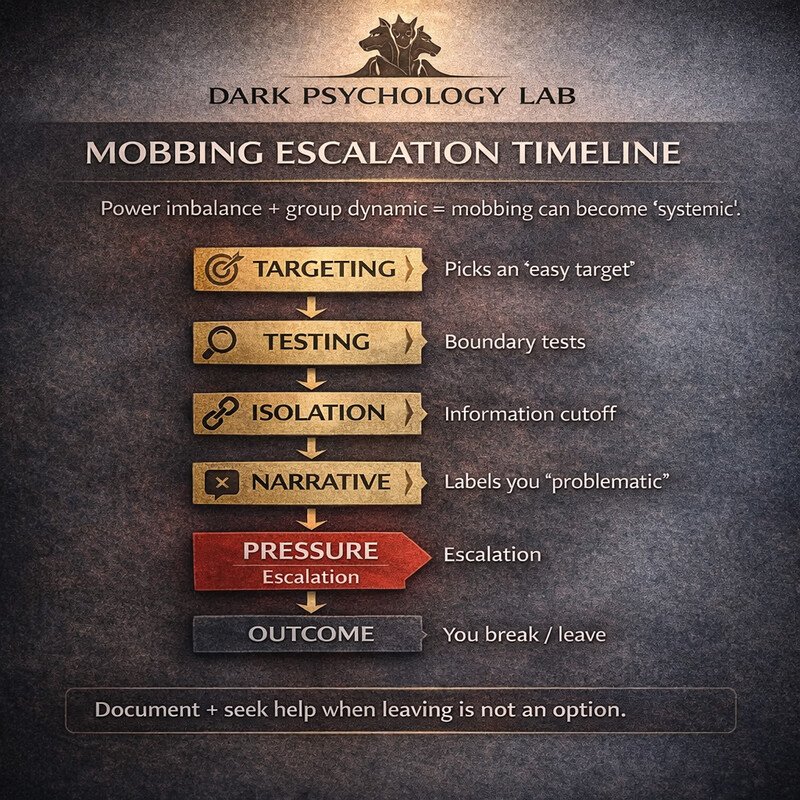
Sometimes it’s a removal strategy, an internal policy of “getting rid of people”. Sometimes it’s a social dynamic: older employees quietly pushing out someone they don’t like, someone who doesn’t fit their unwritten rules.
Not every workplace is the same. Not every conflict is mobbing. But when this pattern starts, you can notice a key feature:
In many mobbing situations, people report that available authorities or internal support structures feel ineffective, inaccessible, or conflicted by organizational interests.
Management may support the behavior directly or allow it because it serves their interests. Some leaders even participate themselves.
It is easier to replace one person than a group, even from a logical perspective of company profitability. The organization may decide, “You’re the problem.”
The trap of a toxic environment:
- If you stay calm, you’re “cold” or “not a team player.”
- If you react emotionally, you’re “unstable.”
- If you defend yourself, you’re “aggressive.”
- If you say nothing, you “accept it.”
And any move that is not perfectly documented or calmly and directly coordinated can backfire. It’s like walking on eggshells.
What you’re facing is not a normal disagreement. It’s a power struggle.

A Difficult Truth: Why Support Often Fails You
There are countless cases of workplace bullying and mobbing around the world. But still, even when it’s illegal in principle, it can still be extremely hard to prove or win against it in practice.
Why?
Because mobbing is often in the form of psychological abuse, indirect, and carried out through subtle actions that appear harmless and are difficult to confirm.
Many systems, legal, corporate, and even social, are mainly built to respond to obvious events that can be proven. They struggle with invisible, indirect psychological pressure.
So, usually when trying to solve the workplace bullying problem with authority or institutions, you get vague responses:
- “Have you tried communicating?”
- “This is just one disagreement.”
- “We need more evidence.”
Meanwhile, corrupt leaders exploit the gap. They use ambiguity to protect the organization.
There is no easy fix to this.
What we can do is help you name the structure, so you stop self‑blaming.
How Mobbing May Start
Mobbing rarely begins with direct insults. It usually begins with subtle, passive-aggressive small acts that slowly destabilize you. The goal is to point out that you are the problem for the company.
Common early signs:
- You don’t get the information or materials needed to do your job.
- You’re “forgotten” in meeting invites.
- Your requests are ignored or delayed until you look incompetent.
- Communication becomes selective: everyone else is updated, you’re left out.
- Your competence is questioned indirectly (“Just double‑checking… are you sure you can handle this?”).
- You’re isolated socially while your name is slowly damaged.
A list of subtle manipulation tactics that are commonly used for mobbing execution:
- Gaslighting – constant lying, denying, misinterpreting, or twisting events. More about this technique in our article: What Is Gaslighting?
- Stonewalling – refusing to engage, answer, or clarify.
- Silent treatment – punishment through absence, ignoring requests, and communication.
- Scapegoating – accusing you of being the cause of team failures.
- Projection – accusing you of what they are doing: aggression, dishonesty, incompetence.
- Triangulation – pulling others into the conflict to isolate you and control the narrative.
- Smear campaigns – subtle reputation damage through rumors.
And more…
Many people exposed to prolonged manipulative tactics report increased stress, confusion, emotional exhaustion, and difficulty concentrating. Over time, this psychological pressure may affect emotional regulation and overall well-being.
In some cases, people who had experienced mobbing describe a specific feeling: it becomes hard to lift their eyes.
The Silence: Why Mobbing Gets Dismissed as “Misunderstandings”

Workplace mobbing is often subtle enough to be dismissed as:
- just a misunderstanding,
- behavior under pressure,
- hypersensitive reactions to stress.
Psychological abuse leaves no bruises. In many documented cases, the psychological impact accumulates over time.
Companies often hide these dynamics to protect their image. HR may prioritize risk management over human reality. Managers may avoid conflict to protect their position. Coworkers may stay silent because they don’t want to become the next target.
Why It Becomes Almost Impossible to Stop
You can do your job well and still be targeted. In many cases, mobbing is based on relationships, and your job performance has nothing to do with it.
Mobbing may work like a social erosion process. The common steps are:
- They weaken your position.
- They isolate you.
- They damage your name.
- They provoke reactions.
- They use your reactions to justify the outcome.
When a social group has already rejected you, even when formal complaints or institutional interventions address parts of the behavior. They may stop the most obvious abuse, but they cannot restore trust or healthy team cooperation.
It is completely understandable that changing jobs can be hard, especially when you like the work, have financial obligations, or have grown accustomed to the stability that the job provides.
But it is important to ask yourself: Is this environment actually good for you? Or are you staying in a place where you are not respected and valued?
Conclusion: Naming the Pattern Is the First Exit
We want to point out:
Workplace mobbing is not normal, not “just a stress.” In many countries and organizational frameworks, sustained psychological harassment may violate labor laws, workplace policies, or human rights standards, even when expressed through formal or corporate language.
Source (related): Workplace Mobbing, Psychological Harassment, and Legal Frameworks – Grotto-de-Souza et al. (2023)
When you can name the structure, you stop blaming yourself for being human.
Defense Guides – Practical Self-Protection
Dark Psychology Lab focuses on clarity and self-protection in situations involving manipulation, power imbalance, and covert psychological pressure.
The following defense guides expand on practical mechanisms to reduce psychological damage and regain control:
Psychological Manipulation
Psychological Manipulation Defense: Safe Strategies and Dangerous Tactics Explained
Narcissistic Dynamics
How to Deal With a Narcissist and What to Do When You Can’t Leave
Workplace Mobbing & Toxic Culture
Workplace Mobbing Defense Playbook: 17-Step Guide
Disclaimer
This article is for informational and educational purposes only. It does not provide legal, medical, or psychological advice and should not be interpreted as a formal assessment of any workplace, organization, or individual.
The term workplace mobbing is used here to describe documented patterns of sustained psychological pressure and collective mistreatment, as defined in organizational psychology research. Not every workplace conflict, management failure, or interpersonal disagreement constitutes mobbing.
This article does not diagnose individuals, assign legal responsibility, or replace professional evaluation. Labor law violations, psychological harm, or workplace misconduct can only be formally assessed by qualified legal, medical, or mental health professionals.
If you are experiencing ongoing psychological distress, workplace harassment, or feel unsafe at work, seeking support from appropriate professionals, labor representatives, or legal advisors is strongly recommended.
For full context and limitations, please see our Disclaimer Page.
Dark Psychology Lab
Original content based on lived experience and independent psychological analysis.
If reading feels exhausting right now, audiobooks can be an easier way to absorb information.
Listen on Audible