

Manipulation is a strategy of psychological influence that can operate covertly or openly, though it more often relies on emotional leverage, narrative framing, and social pressure.
People often assume manipulation is always indirect: subtle hints, deniable pressure, or “hidden control.” This is partly true. Because it often operates quietly, it tends to go unnoticed, and most people are never taught how it works.
Some philosophers characterize manipulation as covert influence, effective because the target lacks knowledge or understanding of how they are being influenced.
Source (related): The Ethics of Manipulation – Stanford Encyclopedia of Philosophy (2018)
This article examines the psychology of manipulation, how it works, the mechanisms and tactics involved, and how it can be recognized and defended against for educational and self-defense purposes.
The Mechanism of Manipulation
In general, manipulation seeks to direct another person’s behavior toward a desired outcome, often without their full awareness or genuine consent.
Manipulation is often perceived as a single incident: a lie, a guilt trip, a moment of pressure. In isolated situations, that may be true.
For example, a partner might say, “Maybe we should break up,” presenting it as uncertainty while observing your reaction: reassurance, compliance, fear of loss, or disinterest. The statement may function as a probe to measure emotional leverage.
As a one-time event, this can reflect insecurity or poor conflict skills. It becomes manipulation when the same leverage is used repeatedly to maintain control and shape the emotional dynamic of the relationship.
Manipulation becomes truly effective when it develops into a structured process. Once certain elements are in place, influence shifts from random behaviors to systematic control. Over time, a person may gradually become dependent on the manipulator without fully realizing how that shift occurred.
For this mechanism to function effectively, three core elements are typically required: your trust, your emotional vulnerability, and the manipulator’s ability to shape or restrict access to objective information.
Source (related): Manipulation: An integrative framework of unethical influence – Journal of Business Research (Elsevier / ScienceDirect) (Arango-Kure et al.) (2025)
In most cases, a manipulator cannot influence someone they do not understand. They must first learn enough about you to identify your vulnerabilities, such as fears, unmet needs, or insecurities, in order to use them as leverage. When these conditions are in place, it becomes significantly easier for the manipulator to impose their will. You may begin adjusting your behavior in ways that align with their goals, often without fully realizing that your decisions are being shaped by external influence.
The Manipulation Formula
Formula:
Trust + Information + Leverage + Psychological Confusion + Dependency + Manipulator’s Character Traits = Control
This model represents an ideal environment for manipulation to operate at maximum effectiveness. In reality, such a complete configuration is possible, but rare. Manipulation does not require every element to be present.
One or more components may be absent, and influence can still occur.
The Critical Variable is Leverage (DPL)
Leverage is what converts influence into directional control. Trust may increase access. Information may improve precision. Dependency may strengthen compliance. But without leverage, an emotional, social, financial, or psychological pressure point, manipulation is far less likely to work.
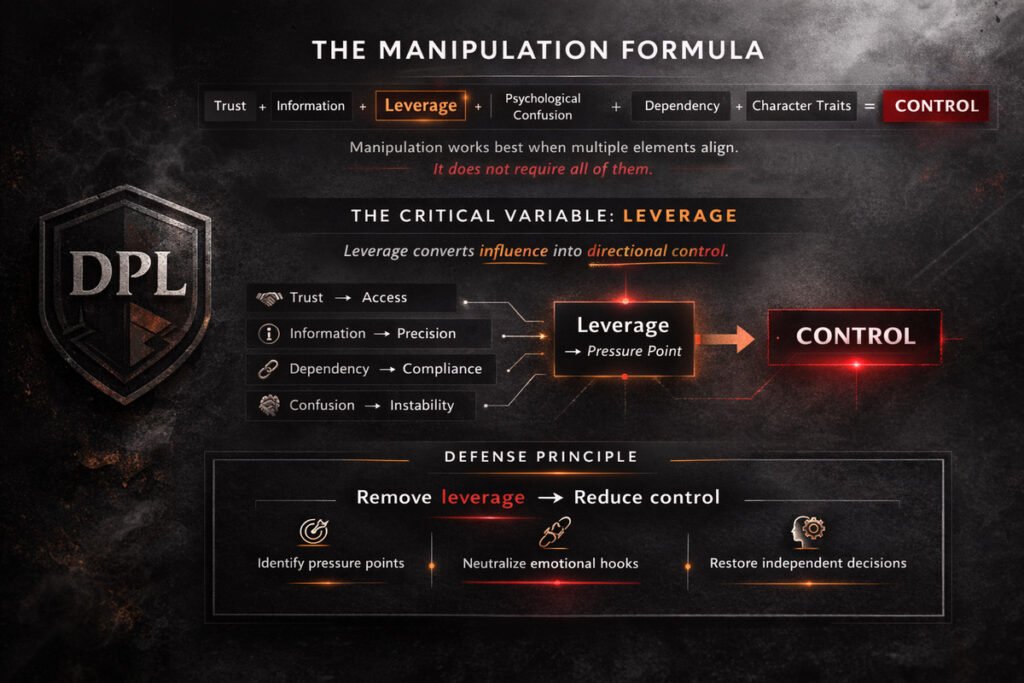
In practice, leverage is the operational core. The other elements amplify it, stabilize it, or make it less visible.
Logically, the most effective way to reduce a manipulator’s influence and regain control is to remove the leverage they are using.
Our defense guides focus precisely on this principle: identifying pressure points, neutralizing emotional hooks, and restoring independent decision-making. For a structured breakdown, see:
Psychological Manipulation Defense: Safe Strategies and Dangerous Tactics Explained
The Manipulator’s Sequence of Actions
Manipulation is a methodical process that typically unfolds through the following stages:
1. Trust Building
At the first stage, the manipulator seeks to lower your defenses. The primary goal is to reduce critical thinking and become emotionally accessible and trusted.
2. Information Gathering
Once a connection is established, active observation begins. The manipulator looks for your “weak points”: fears, insecurities, need for approval, unresolved trauma, or emotional dependencies. Over time, more vulnerabilities are explored, which can later be used to apply pressure.
3. Emotional Activation (Leverage)
Instead of relying on logical arguments, the manipulator targets emotions. Guilt, shame, fear, or the threat of loss are commonly used. Strong emotional arousal narrows perception and weakens rational evaluation, which can lead to reactive and impulsive decisions.
4. Control of Reality Interpretation
At this stage, the manipulator’s “heavy artillery” begins techniques designed to distort your perception of reality. This may involve selective presentation of facts, distortion of events, direct lies, or gaslighting, a psychological manipulation that causes a person to enter a state of psychological confusion.
Source (related): The Sociology of Gaslighting – American Sociological Review (SAGE) (Paige L. Sweet) (2019)
5. Dependency Reinforcement (“push-pull”)
Finally, behavior becomes unpredictable. Warmth is suddenly replaced with coldness; attention turns into withdrawal. This “hot–cold” dynamic creates cycles of stress and relief. The person may begin to unconsciously adjust behavior to avoid discomfort and regain approval.
When repeated over time, this sequence can significantly weaken autonomy and lay the foundation for coercive control.
Example of Manipulation Techniques Used in Sequence
The following section illustrates how specific tactics may align with the stages described above. These techniques are not always used in this exact sequence, nor are they necessarily applied together. The model is intended for educational purposes, to help you understand how control can gradually shift into the hands of the manipulator.
1. The Illusion of Safety
(Trust Building techniques used to gain access and lower defenses)
- Mirroring: copying your values, language, and style to create instant similarity.
- Love bombing / Overvalidation: intense attention and praise to accelerate attachment.
- Benjamin Franklin effect: the manipulator asks for a small favor, and after you help, your mind may rationalize the action by increasing trust and liking toward them.
2. Vulnerability Mapping
(Information Gathering techniques used to identify leverage)
- Strategic self-disclosure (planned vulnerability): the manipulator shares a personal “secret” or trauma first to trigger reciprocity, prompting you to reveal your own vulnerabilities for later leverage.
- Boundary testing: small rule breaks to see what you tolerate and how you respond.
- Reaction testing with cold reading: subtle jabs, jokes, or pressure to observe what destabilizes you. Profiling based on reactions to predict which “buttons” will trigger the response they want.
3. Applying the Leverage
(Emotional Activation techniques used to trigger compliance through emotion)
- Guilt-tripping: “After all I did…” attempt to induce guilt in you and exploit your empathy.
- Insecurity amplification: the manipulator identifies your hidden self-doubts and subtly reinforces them, often through remarks, comments, backhanded compliments disguised as praise.
- Threat of loss (“I’ll leave you,” this was mine all along): using the fear of abandonment or exclusion as leverage to force agreement or submission.
4. Psychological Confusion
(Control of Reality Interpretation techniques used to distort perception and create dependency on their narrative)
- Gaslighting: denying, twisting, or rewriting events to make you doubt yourself.
- DARVO: deny, attack, reverse victim/offender so your reaction becomes the “problem.”
- Plausible deniability: avoidance that creates ambiguity that protects the manipulator from direct accountability.
- Information starvation/withholding: deliberately withholding important context or explanations to keep you confused and dependent.
- Weaponized ambiguity: vague criticism, vague rules, shifting meaning so you keep guessing.
5. Dependency Reinforcement
(Dependency Reinforcement techniques used to condition behavior and stabilize control)
- Intermittent reinforcement: unpredictable warmth and coldness that creates attachment.
- Silent treatment: withdrawal as punishment to force chasing and surrender.
- Negative reinforcement loop: sustained tension or disapproval is removed only after compliance, conditioning you to equate conformity with emotional relief and increasing self-censorship to prevent future discomfort.
6. Social Escalation Tactics
These tactics use other people and social standing as leverage. They often appear later in escalation, when the manipulator wants compliance, isolation, or reputation damage.
- Triangulation: pulling a third person into the dynamic to control the narrative and shift power.
- Smear campaign: subtle or systematic reputation damage that weakens your support network.
- Public shaming: “jokes,” comments, manipulations, or criticism in front of others to lower your status.
The tactics described above reflect patterns of interpersonal manipulation documented in psychological research and clinical literature. They rarely appear as isolated incidents; rather, they tend to operate as coordinated strategies of influence and control.
Scientific references (related):
Tactics of Manipulation (full text PDF) – Journal of Personality and Social Psychology (APA) (Buss et al.) (1987)
Emotional Manipulation: Signs, Tactics, and Outlook – Healthline (Reviewed by Danielle Wade, LCSW) (Updated 2023)
Manipulative Behavior: Signs, Causes, and How to Respond – Verywell Health (Reviewed by Steven Gans, MD) (Updated 2023)
Psychological Profiles Linked to Manipulative Strategies
For many individuals, manipulation is a learned behavioral pattern shaped from childhood experience. Others adopt it intentionally, influenced by social, dating, or online advice culture. Some manipulative behaviors do not require conscious planning. When a tactic has repeatedly produced results in the past, it can become an automatic response embedded in the person’s behavioral repertoire. In such cases, manipulation operates less like a calculated move and more like a conditioned reflex, efficient, practiced, and difficult to detect in real time. When dealing with such manipulators, a common question may arise over time: “Do they actually lie all the time?”

However, when manipulation becomes sustained and deliberate, it is more likely to reflect stable personality tendencies rather than isolated behavior.
Personality research identifies the Dark Triad — Machiavellianism, narcissism, and psychopathy — as traits associated with exploitative interpersonal strategies and emotional detachment. These traits do not automatically produce manipulation, but they increase the probability that influence will be used deliberately, repeatedly, and without regard for psychological cost to others.
The original research described Machiavellianism as “the manipulative personality,” highlighting a shared core of self-promotion, duplicity, emotional coldness, and instrumental use of relationships.
Source (related): The Dark Triad of Personality: Narcissism, Machiavellianism, and Psychopathy – Delroy L. Paulhus & Kevin M. Williams (2002)
How Control Escalates: Covert, Overt, Coercive
It is important to note that stronger forms of control, such as coercion, can be used immediately without prior covert manipulation. However, when applied abruptly, they often trigger significant resistance from the person subjected to them.
Experienced manipulators tend to build dependency first through subtle, covert techniques, which reduce resistance by increasing the perceived cost of confrontation or separation. Once attachment or leverage is established, they may gradually escalate to more direct and forceful methods. This way, subtle manipulation can, over time, escalate into stronger forms of control, sustained by the same underlying tactics applied in harsher, more direct ways. Escalation rarely replaces earlier tactics; it layers stronger ones on top of an already conditioned dynamic.
Covert Manipulation
(soft control)
Subtle influence that distorts or bypasses informed, voluntary choice, often through psychological leverage: ambiguity, lies, hints, deniable intent, emotional leverage, and distorted or selective information.
Escalation is easier once the target’s perception of normal interaction has already been altered.
Overt Manipulation
(open pressure)
Psychological leverage applied openly, such as guilt, shame, public pressure, exaggerated affection, or withdrawal of approval, is used to push compliance without explicit force. Deception or ambiguity is not required. The defining element is psychological pressure that shifts your decision without imposing a direct penalty.
Once leverage is secured, resistance reduced, and the target isolated from support, open pressure can escalate into coercion as the perceived risk of retaliation declines.
Coercion
(hard control)
Coercion is different: it relies on explicit consequences and power, including threats, intimidation, sanctions, and dominance through authority, access, or resources (Britannica, n.d.). Hard tactics may include persistent monitoring, public pressure, coalition-building, and fear-based compliance. For example, blackmail uses fear and threat as leverage. There is no ambiguity. The formula is simple: “Do this, or else.”
Control Escalation Model
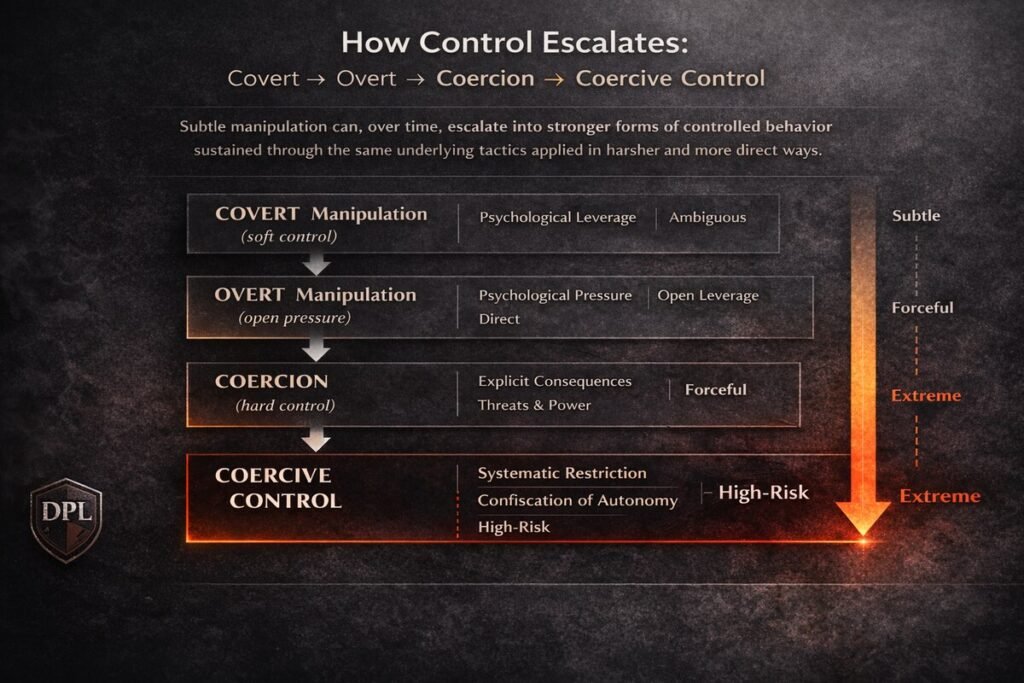
Covert manipulative dynamics can escalate into overt pressure and, in higher-risk cases, into coercion. When these tactics are applied systematically over time to restrict autonomy, the pattern is commonly described as coercive control (AIHW — “Coercive control,” last updated: 24 Feb 2026). Our case study examines this process in:
Coercive Control at Work and in Relationships: ‘Death by a Thousand Cuts’ Explained.
This escalation structure mirrors patterns documented in narcissistic abuse cycles, where early idealization or “love bombing” is followed by devaluation and increasing control. In higher-risk cases, these dynamics can progress toward coercive control once leverage over the target’s autonomy is established (Narcissistic Abuse Cycle Deserves Clinical and Research Attention, December 2025).
The Boundary Between Influence and Manipulation
To define manipulation accurately, it is necessary to distinguish it from the broader concept of social influence. Social influence includes all the ways people affect each other’s behavior, beliefs, or emotions. However, not every form of influence is manipulative.
Source (related): Social Influence – Annual Review of Psychology (Annual Reviews) (Cialdini & Goldstein) (2004)
Social Influence vs. Manipulation
Influence becomes manipulation only when it relies on deception, exploitation, or hidden intent. Inspiration, leading by example, or even unintentionally triggering an emotional reaction, is not manipulation by itself. If there is no element of concealed control, the interaction remains a healthy form of social exchange.
Persuasion
Persuasion differs fundamentally from manipulation because of its transparency. It is based on logical arguments, open exchange of ideas, and clearly stated intentions. The person understands that they are being persuaded and retains full freedom to agree or disagree. This is a partnership, not the use of another person as a tool.
Nudging – Positive Shaping
Nudging refers to structuring choices in ways that encourage beneficial decisions (such as healthier eating or saving money) without restricting freedom of choice. Providing information, warning signs, or a transparent choice is not manipulation as long as the individual remains free to make the final decision.
Contractual or Consensual Influence
There are situations in which a person voluntarily agrees in advance to certain forms of control. This may be described as legitimate enforcement. For example, by signing a bank loan agreement, you accept the rules and the consequences of failing to follow them. There is no hidden agenda or ambiguity — the terms are clear. This is not manipulation but a contractual obligation.
In summary, influence becomes manipulation when it is covert, bypasses informed choice, and prioritizes control over personal autonomy. Transparent, voluntary, and reason-based interaction remains a legitimate and healthy form of social influence.
If this feels familiar
What often stands out in manipulative situations is a specific feeling afterwards: resentment or unease. Wanting a closure that never came and most often never will, a confusion.
Healthy conflict usually leads to fatigue. There may be tension, disagreement, and even emotional pain. One may feel tired, yet still grounded in what actually happened.
Manipulative dynamics feel different. They quietly destabilize and may feel more like a slow erosion of self, which over time diminishes a positive outlook on life, assertiveness, and self-trust.
Attention shifts inward at night when sleep is hard to come by, because painful events keep replaying. Events that were never fully clear at the time, yet still hurt deeply, and only begin to make sense much later. Rethinking second-guessing: tone, reactions, intentions, memory.
It is a predictable effect of sustained ambiguity, a psychological aftereffect of manipulation. It works by pulling behavior and self-perception out of balance. The issue is usually exposure to a system where fairness is quietly punished, and confusion becomes a tool.
FAQ: the unfinished feeling
Was something wrong with me?
No. Confusion is a normal response to hidden, manipulative pressure.
If not me, what happened?
A process happened. Your attention and emotions were pulled into someone else’s agenda.
Why did I not see it in the moment?
Manipulation is subtle and difficult to recognize or confront in the moment. It is designed to look like “nothing,” hiding in ambiguity and deniable intent.
Why do the effects hit later?
The effects often become clear only later, after reflection and time to think. Manipulation targets thinking, self-trust, and the nervous system, so its impact unfolds gradually rather than immediately.
Can this be understood and named?
Yes. Naming the pattern is the first step out of the confusion manipulation creates.
Defense Guides – Practical Self-Protection
Dark Psychology Lab focuses on clarity and self-protection in situations involving manipulation, power imbalance, and covert psychological pressure.
The following defense guides expand on practical mechanisms to reduce psychological damage and regain control:
Psychological Manipulation
Psychological Manipulation Defense: Safe Strategies and Dangerous Tactics Explained
Narcissistic Dynamics
How to Deal With a Narcissist and What to Do When You Can’t Leave
Workplace Mobbing & Toxic Culture
Workplace Mobbing Defense Playbook: 17-Step Guide
Not sure if you are being manipulated? Take the recognition test. Press a button below. Sign up for Dark Psychology Lab, and we will send it to your email.
Final thought

Our goal is to give you a map to expose what manipulation looks like, name the patterns, and explain how to recognize and protect against them.
Clarity and understanding are the first steps out of the confusion created by manipulative effects. Knowledge becomes a tool that allows confrontation and reduces the psychological impact.
We offer names, patterns, and a behavioral psychological map to understand hidden dynamics.
Disclaimer
This article is for informational and educational purposes only. It does not provide medical, psychological, legal, or therapeutic advice, and it is not a substitute for professional evaluation or support.
The term manipulation is used here to describe repeated patterns of hidden influence and control, not isolated misunderstandings, normal persuasion, or everyday social influence. Not all difficult behavior, conflict, or poor communication is manipulation.
This article does not diagnose individuals, assign clinical labels, or determine intent. The examples and categories described are meant to help readers recognize patterns, understand their psychological effects, and reflect on their own experiences, not to accuse, pathologize, or promote suspicion.
If you are experiencing ongoing emotional distress, confusion, or harm related to interpersonal dynamics, seeking support from a qualified mental health professional or appropriate support services is strongly recommended.
For full context and limitations, please see our Disclaimer Page.
Dark Psychology Lab
Original content based on lived experience and independent psychological analysis.
If reading feels exhausting right now, audiobooks can be an easier way to absorb information.
Listen on Audible