

DARVO is a defensive manipulation strategy. This technique functions like a “Gaslighting Shield”: it allows the manipulator not only to avoid responsibility but also to push the person encountered into doubting their own judgment.
This model is activated when a manipulator is confronted and needs to avoid blame.
Source (related): Deny, Attack, and Reverse Victim and Offender (DARVO) – Journal of Aggression, Maltreatment & Trauma (Taylor & Francis) (2020)
What Is DARVO?
DARVO is a form of gaslighting (our article: What Is Gaslighting?), a manipulative strategy made up of three core stages:
- Deny (denial)
- Attack
- Reverse Victim and Offender (switching the roles of victim and perpetrator)
If you are unfamiliar with manipulation and how it works, our article explains it in detail:
The Psychology of Manipulation: Mechanisms, Tactics, and Defense
The term was introduced by Dr. Jennifer Freyd to describe a typical reaction used by abusers or manipulators when they are confronted about harmful behavior. Instead of acknowledging responsibility, the manipulator activates a “defensive mechanism” that completely distorts perceptions of the situation.
Usually, this technique appears in narcissistic relationship dynamics or in interactions with toxic partners and colleagues.
Subtle forms of DARVO may appear early in relationships, especially with covert or vulnerable narcissistic traits, often disguised as avoidance or passive aggression.
Source (related): DARVO — Jennifer Joy Freyd, PhD (n.d.)
A Closer Look at the DARVO Mechanism
1. Deny (Denial)
Denial is the first defensive step. It begins the moment a manipulator receives any criticism or is asked to take responsibility. At this stage, the manipulator categorically rejects facts, events, or your emotional experience that you attempt to bring into the conversation.
The primary goal of this phase is to achieve plausible deniability (the strategic use of ambiguity, vague language, or feigned ignorance to avoid accountability for actions). The manipulator relies on ambiguous language, passive aggression, or claims of “forgetfulness” so that the victim cannot technically prove wrongdoing. When you attempt to present evidence, the manipulator skillfully avoids giving a direct answer.
Common denial tactics include:
- Information starvation: deliberately limiting or ignoring communication.
- Open lying and rewriting reality: “That never happened,” “You’re making this up,” “This has nothing to do with me.”
- Memory manipulation: claiming they “simply don’t remember” critical events.
This behavior is a strong early indicator of manipulation. Early denial may be misinterpreted as personality quirks. Over time, as the manipulator becomes more comfortable and stops trying to maintain a positive image, denial tends to grow more overt and aggressive.
At this point, denial becomes a form of gaslighting designed to deflect attention from the original issue, a pattern that can be interpreted as “deflective gaslighting”.
2. Attack

This is the second phase, which follows immediately after denial. Once the manipulator has rejected responsibility, they move into attack mode.
- Avoidance strategy: In some cases, the Deny phase can last a long time, with the manipulator simply ignoring the issue altogether.
- Immediate attack: If the manipulator feels cornered or has become accustomed to you, they may shift rapidly into attack. The primary goal is to confuse you and force you into a defensive position.
When dealing with individuals displaying covert narcissistic traits, the attack phase often begins only after they feel fully secure and have mapped your psychological landscape. By knowing your vulnerabilities, fears, and values, they can target your emotions with precision.
Common attack techniques include:
- Tone manipulation: A sudden shift from a normal, calm tone to a cold, patronizing, aggressive, shouting, appealing, or moralizing tone that may make you feel small or childlike.
- Labeling after provocation: The manipulator deliberately provokes you until you lose composure, then weaponizes your reaction: “You’re unstable,” “You need medication,” “Look at how you’re yelling.”
- Systematic credibility erosion: Repeated phrases meant to undermine your sense of reality: “Something is always wrong with you,” “You exaggerate everything,” “You’re too emotional.”
- Institutional attack: In workplace settings, managers or colleagues may use your past mistakes as weapons, claiming that you “brought this on yourself.” The manipulator’s behavior is minimized, while responsibility is shifted onto you.
This form of behavior can be interpreted as “aggressive gaslighting”. Its goal is not only to divert attention away from the original issue, but to convince you that you are the true cause of the conflict.
3. Reverse Victim and Offender
This is the final stage of the DARVO cycle, where roles are turned upside down. The manipulator presents themselves as the true victim of the situation, while casting you as the offender. The result is predictable: you feel pressured to justify yourself, explain your intentions, and eventually apologize for things you did not do or simply for daring to raise a legitimate concern.
At this stage, the manipulator skillfully targets your empathy. They may present themselves as confused, helpless, or deeply hurt. The goal is not only to confuse your perception of reality, but also to turn others against you.
Common behaviors in this phase include:
- Triangulation: Third parties are pulled into the conflict to validate the manipulator’s victim narrative. In narcissistic dynamics, this often involves so-called “flying monkeys,” people who side with the manipulator and help apply pressure on you.
- Cry on command: A sudden emotional collapse designed to trigger guilt. Once your empathy is activated, the manipulator uses it as leverage to force you to back down.
- Clarifying questioning: Instead of responding to your concerns, the manipulator overwhelms you with trivial, irrelevant questions until you become exhausted and start doubting the accuracy of your own statements.
- Dragging up past mistakes: Any old error is reframed as proof that you “always behave this way” and are the real aggressor.
- Emotional blackmail: Phrases aimed at fully shifting responsibility onto you: “You caused all of my suffering,” “I can’t believe you would think this about me after everything I’ve done for you.”

This stage represents “defensive gaslighting”. Its purpose is to make you feel so guilty about your supposed “attack” that you become afraid to ever confront the manipulator’s behavior again.
How DARVO Plays Out in Real Life
Below is a typical scenario showing how an initial issue gradually turns into your “fault.”
- You – Name the Behavior (Starting Point): “Yesterday you said you would do X, but you didn’t. Today, you blamed me for us falling behind. It feels like this isn’t the first time you’ve mixed up the facts.”
- Manipulator – Denial (Deny): “I never said anything like that. You’re making it up. You’re just looking for reasons to attack me.”
- Manipulator – Attack: “Something is always wrong with you! You’re constantly looking for problems. Ask my friend, he saw how hard I was trying (“flying monkey”). It’s impossible to talk to you. I don’t have time for your nonsense arguments.”
- Manipulator – Reverse Victim and Offender (RVO): “I’m the one being attacked here! You’re humiliating me. Everyone can see how you treat me. How am I supposed to feel safe in a relationship when you’re constantly attacking me?”
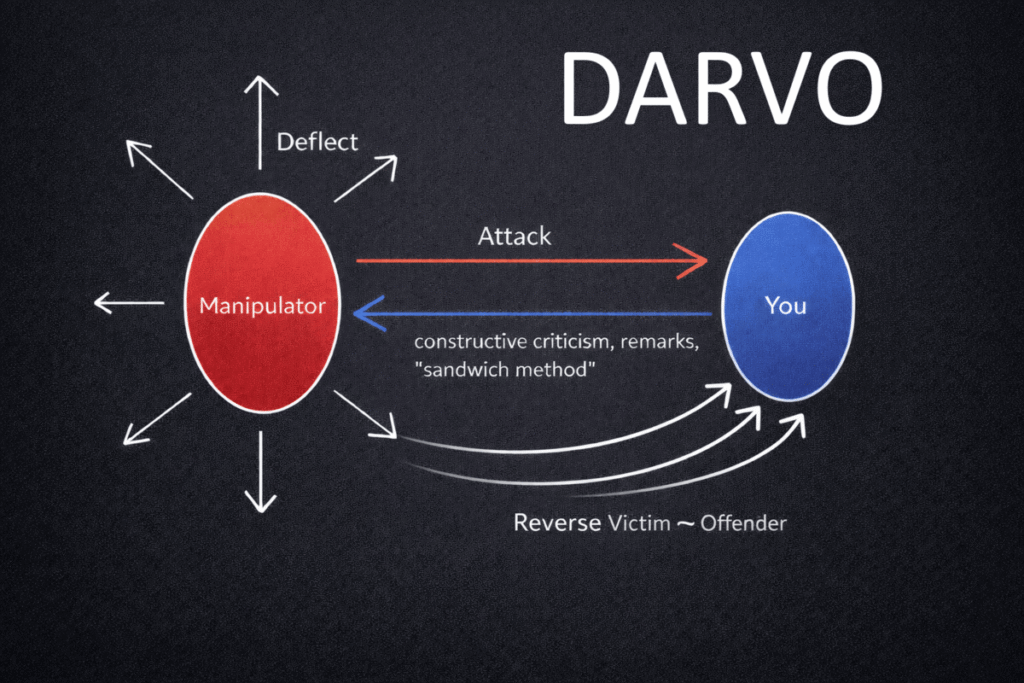
Result: An Emotional Smokescreen
After this sequence, the original problem, a broken promise or a lie, disappears into an “emotional smokescreen.”
Not sure if you are being manipulated? Take a test. Press a button below. Sign up for Dark Psychology Lab, and we will send it to your email.
Why Does DARVO Work So Effectively?
Like gaslighting, DARVO has one core characteristic: the manipulator lies consistently and without hesitation. This can create a powerful illusion of truth.
1. The Power of Confidence and “Offense.”
DARVO exploits a natural human reflex. When we see someone who appears highly confident while also seeming deeply offended, we instinctively tend to believe them. Our brain may make a faulty assumption: “If they defend themselves so boldly and appear so genuinely hurt, then I must have done something wrong.”
Source (related): The Persuasive Power of Knowledge – PLOS ONE / PubMed Central (2018).
2. The Empathy Trap
Even more damaging is how this tactic cynically exploits your empathy. If you are an emotionally healthy person, fairness matters to you. You do not want to accuse someone unjustly, hurt them, or act unfairly. The manipulator leverages this moral compass as a pressure point, gradually shifting the focus from their behavior to your own intentions.
3. The Defense Trap
The moment you start defending yourself or trying to logically prove your position, you are already at a losing stance. Why? Because by explaining yourself, you unconsciously accept the rules of the game the manipulator has set. You stop talking about what they did wrong and start trying to prove your credibility.
The goal is achieved: attention is successfully shifted away from the manipulator’s behavior and redirected toward your attempts to justify yourself. When this happens, the manipulator wins.
DARVO at Work: Toxic Workplace Culture
In workplace settings, DARVO becomes a reputation management tool. Instead of addressing the actual issue (abuse of power, manipulation, mistakes), attention shifts to your reaction.
The narrative may already be shaped before you speak. Doubts about your “emotional instability” may circulate quietly, so when you defend yourself, it reinforces the image that you are the problem.
Soon, you are labeled “emotional,” “conflict-prone,” or “difficult,” while the manipulator maintains the role of the “calm professional.”
More about toxic workplace culture in our case study: Workplace Mobbing: Signs, Tactics, and the System Behind It.

How DARVO may Damage your Inner World
The greatest damage caused by DARVO happens internally. After spending a long time with a manipulator, you may:
- Questioning your own memory: You begin to doubt what you saw and heard. “Maybe I really misunderstood everything?” This is a direct result of gaslighting.
- Over-explaining: You feel compelled to over-justify your motives, emotions, and logic, hoping that if you can just find the right words, the manipulator will finally understand.
- Hypervigilance: You start collecting “evidence” screenshots, recordings, notes, even to support basic facts, because you may start doubting your competence internally.
- Constant rumination: You repeatedly replay past conversations in your head, wondering what you could have said differently to avoid becoming the one at fault.
- Self-isolation and silence: Eventually, you stop speaking about your needs or problems altogether, knowing that any attempt to address conflict will likely be turned against you.
Psychological Consequences and Coercive Control
When the DARVO cycle repeats over time and occurs under conditions of power imbalance within families, toxic relationships, or hierarchical work environments, it can lead to serious consequences: chronic anxiety, emotional exhaustion, dissociation, and even symptoms associated with post-traumatic stress.
Source (related): The Trauma and Mental Health Impacts of Coercive Control: A Systematic Review and Meta-Analysis – PMC / National Library of Medicine (NIH) (2023).
Manipulators often secure their position in your life before aggressively using DARVO. This is known as coercive control, a pattern in which the manipulator:
- Isolates you: Gradually distances you from supportive friends or family so that they become your only perceived source of reality.
- Creates dependency: Financial, emotional, or professional dependence that makes it harder for you to leave.
- Uses leverage: Information gathered about your vulnerabilities or past mistakes is turned into a weapon to ensure your silence.
We have covered how manipulators may use coercive control to gradually erode a person’s character in our case study: Coercive Control at Work and in Relationships.
How to Stop “Feeding” the DARVO Pattern
DARVO is a control model that turns any attempt to demand accountability into a trial where you can end up unjustly sitting in the defendant’s seat.
Two essential points matter most:
- The first step is learning to recognize the pattern in real time, before it fully unfolds.
- The second step is firmly refusing the role the manipulator is trying to assign to you. You are not required to justify actions you did not commit.
Clear perception of the situation is your strongest shield. It significantly reduces the damage caused by manipulation, especially before this toxic pattern becomes a normalized part of your life. Truth does not need to be negotiated. It simply exists.
Like most forms of manipulation, DARVO “feeds” on emotional engagement. The primary goal here is not to defeat the manipulator but to minimize contact and protect your emotional health.
1. Recognize the Pattern Before You Fall Into It
The moment you notice yourself shifting into a defensive or self-justifying mode during a conversation, pause. Ask yourself a control question:
“Did the topic just shift from their behavior to an evaluation of my character?”
If the answer is yes, the DARVO mechanism is already active.
2. Refuse the Imposed Frame
Do not argue with the labels placed on you (“emotional,” “unstable,” “dramatic”). By engaging, you only feed the manipulator’s ego and give them more ammunition. Bring the conversation back to the concrete action:
“ We can discuss my tone later. Right now I’m talking about a specific fact.”
“ I’m not discussing labels. I’m discussing the event.”
3. Shift to Brief, Factual Communication
If the situation is unavoidable (work, shared parenting, family systems), reduce live communication.
Write briefly. Stick to facts only.
Document everything: dates, decisions, agreements.
Important: DARVO does not tolerate documentation because it disperses the fog. However, stay alert; once a manipulator senses that events are being recorded, they may attempt to discredit you to others. Keep documentation secure.
4. Stop Seeking Validation From the Manipulator
This is one of the most dangerous traps. You explain the situation again and again, hoping the manipulator will finally “see” the truth and understand you.
Face reality: DARVO exists precisely because this person refuses to take responsibility. If they were capable of doing so, this pattern would not be necessary. Validation must come from healthy individuals, your therapy, your supportive people, and objective facts, not from someone who systematically manipulates you.
5. The most important rule
If you feel unsafe, your physical and psychological safety always takes priority over confrontation or proving the truth.
When risk is high, structure becomes your strongest form of protection:
- Careful documentation of events (stored on a secure device).
- Consultation with professionals (therapists, legal advisors).
- Clear legal boundaries if the behavior escalates into harassment.
- Professional support when planning an exit from a toxic environment.
Dark Psychology Lab – Defense Guidance
We focus on defensive psychology across three core areas where psychological pressure is most common:
- Toxic Workplace — Workplace Mobbing Defense Playbook: 17 Steps Guide
Summary: How the DARVO Cycle Ends
Manipulators most often use this technique against empathetic people precisely because their conscience, sense of responsibility, and desire to understand others are easy to exploit.
When DARVO is successful, the conversation ends in confusion. You may find yourself justifying, explaining, and apologizing for things you did not do. Over time, you may begin to feel unwarranted guilt or shame and even start defending the manipulator yourself (“maybe they didn’t mean it,” “maybe I was too harsh”).
Disclaimer
The content provided by Dark Psychology Lab (DPL) is for informational and educational purposes only.
Dark Psychology Lab and its authors are not licensed psychologists, psychiatrists, therapists, legal professionals, or medical providers. Nothing on this website should be interpreted as psychological, medical, legal, or professional advice.
The information presented is intended to help readers better understand psychological patterns, manipulation dynamics, and behavioral models. It is not a substitute for professional diagnosis, treatment, therapy, counseling, or legal consultation.
Any actions you take based on the information found on this site are taken at your own risk. Dark Psychology Lab does not assume liability for decisions, actions, or outcomes resulting from the use or interpretation of this material.
If you are experiencing psychological distress, abuse, legal conflict, or safety risks, we strongly encourage you to seek support from qualified professionals in your area.
For full legal terms and limitations, please review our complete disclaimer: Read the full disclaimer.
Dark Psychology Lab
Original content based on lived experience and independent psychological analysis.
If reading feels exhausting right now, audiobooks can be an easier way to absorb information.
Listen on Audible