

Some narcissistic traits are harder to detect, especially in covert or vulnerable forms, yet they can be just as harmful as overt and grandiose expressions. In these cases, control operates through emotional intensity, strategic vulnerability, and indirect influence rather than open dominance.
Narcissistic traits occur across genders and may manifest differently due to socialization and relational strategies.
This article examines covert narcissistic traits in women within relationships with men. Many of the behaviors described may also appear in friendships, workplace settings, and other relational contexts, despite gender differences. Its purpose is recognition and self-protection before covert control escalates into devaluation. This is not a clinical diagnosis.
Key points:
- Narcissism is not exclusive to women.
- Narcissistic Personality Disorder (NPD) can only be diagnosed by qualified professionals.
Why Male and Female Narcissism Can Look Different
Vulnerable vs. grandiose expression patterns
Clinical psychology distinguishes between grandiose narcissism, more commonly observed in men (overt dominance, entitlement, and grandiosity), and vulnerable or covert narcissism, more frequently observed in women (relational control, emotional influence, and covert strategies), which is associated with emotional volatility, hypersensitivity to criticism, and indirect manipulation.
Research References:
These differences are primarily shaped by social norms and expectations rather than biology. (E. et al., 2015, pp. 261-310)
Reflecting on narcissism – APA (2011)
Covert and Vulnerable Narcissistic Traits in a Woman
Sometimes you feel this strange pull toward someone, maybe a woman you recently met, a colleague, or someone you pass on the street every day. You might not have paid much attention to her. But suddenly, there’s an attraction. It feels like she’s perfectly in sync with you, carrying herself with a gentle, feminine charm. She mirrors your interests, your humor, even your pace. The chemistry feels natural.
But over time, you begin to sense that something is off. The tone shifts. Warmth becomes selective. Silence appears where clarity once existed. Small corrections, subtle pressure, emotional reactions that feel slightly disproportionate. Nothing overt, nothing you can easily point to. A covert control.
When you try to address it, the response is rarely direct. You may receive avoidance, deflection, or quiet passive aggression (DARVO). The conversation does not resolve the issue. Instead, it often deepens the imbalance. The more you try to fix it, the more her behavior is reinforced. Your effort becomes validation.
Gradually, the structure changes. You may begin adjusting, explaining, justifying, and trying to stabilize what feels unstable. And the more you compensate, the more influence she gains. Communication narrows while her control expands.
Why?
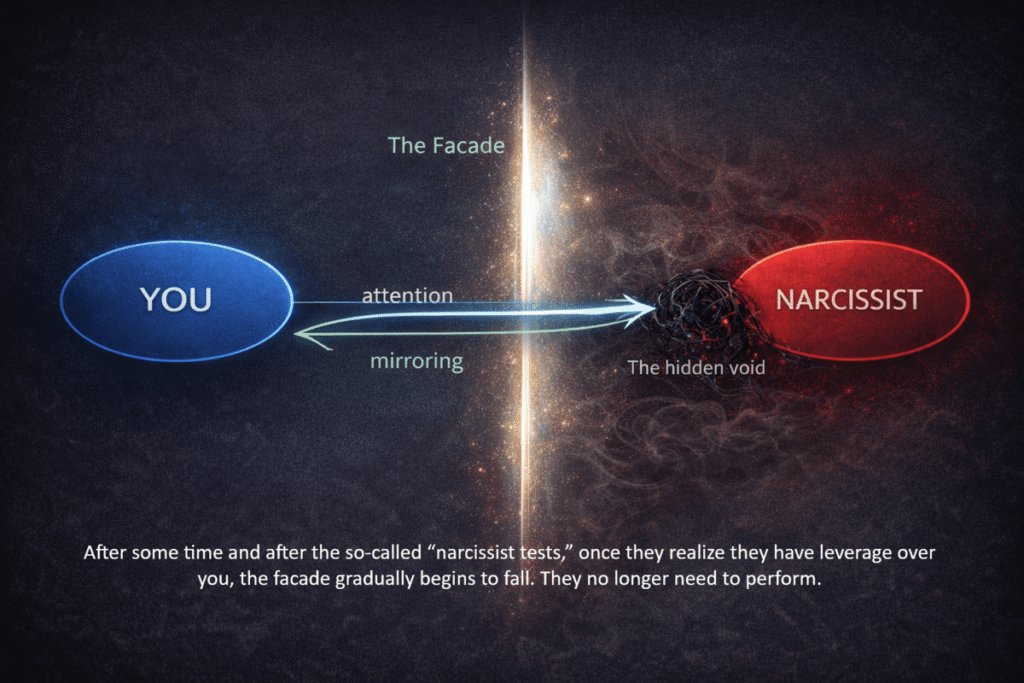
When you get closer, the facade begins to drop, and the narcissistic supply mechanism activates:
Idealization → Devaluation → Discard → Hover (Renewed attention followed by idealization and an attempt to reengage)
More about the narcissistic “feeding cycle” and how it works in our other article: Narcissistic Supply: What Narcissists Feed On.
Warmth can function as a hook. Emotional intensity can create rapid closeness. Attention feels exclusive. Then inconsistency appears. What begins as chemistry may gradually lead to confusion, dependency, and power imbalance.
Everything Is About Her: The Classic Narcissistic Woman Trait
The first and most common sign: consistent expectation that situations revolve around her needs and desires. She has charm, knows how to get attention, and enjoys being the center of everything. Conversations drift back to her, compliments never feel enough. She changes the topic if it doesn’t serve her image or pleases her.

A female narcissist may be deeply competitive with other women and extremely sensitive to comparison. She may surround herself with people she feels superior to, so she can shine brighter.
If she has no need to pretend with you, you might even notice the glimmer of her real self from the start, a woman who expects the world to treat her as special by default.
Narcissistic Woman: Praises And Admiration
Many people with these traits thrive on external validation. She needs to feel admired, noticed, desired. Compliments almost work like a drug, especially if they come from someone she considers “worthy.” If you publicly praise her, she may melt. Not because she feels admired, but because her image and her ego are being fed.
It goes another way as well. Criticism, even the smallest kind, hits her like a personal attack. She cannot tolerate the idea that someone might question her competence or her superiority. Instead of reflecting, she becomes offended, defensive, and quietly resentful.
Her motto often seems to revolve around the question: “What will others think?” Much of her focus may center on how she appears, how she is perceived, and how others evaluate her. At times, admiration can serve to regulate insecurity or maintain a desired self-image (her facade).
Female Narcissist Idealizes You at First, Only to Hook You
At first, she may act in a way that feels unreal. Sweet, feminine, supportive. A covert narcissist will match your energy, your preferences, and your interests. This may feel like affection, but it can also be a strategy. She can give off the vibe of: “I read books and watch content about how to make a man fall in love.” They may learn tactics and practice them, and when they find a man they consider “valuable,” and in some cases controllable, they apply everything:
- compliments
- kindness
- perfect behavior
- sudden intimacy
- mirroring your traits
- making you feel like the chosen one
This is the pedestal phase. You become the hero, the king, the prize. But remember one truth: a female narcissist idealizes you only to gain leverage. Once the hook is in, everything changes. She has you – there is no need to pretend.
Emotional Intensity, The Chaos That Pulls You In
A female narcissist is usually emotional, intense, and impulsive. She can be exciting, unpredictable, and wild. At first, that brings pleasure, a rush, a high. Something new, a right amount of toxicity that pulls you in.
But chaos always has a price. Her emotional storms become addictive. She can maintain tension by withholding exactly what you crave: warmth, approval, clarity, affection, and certainty. This withholding, in some sense, does function as a tactic of control and indirect punishment. It works by stretching your dopamine system.
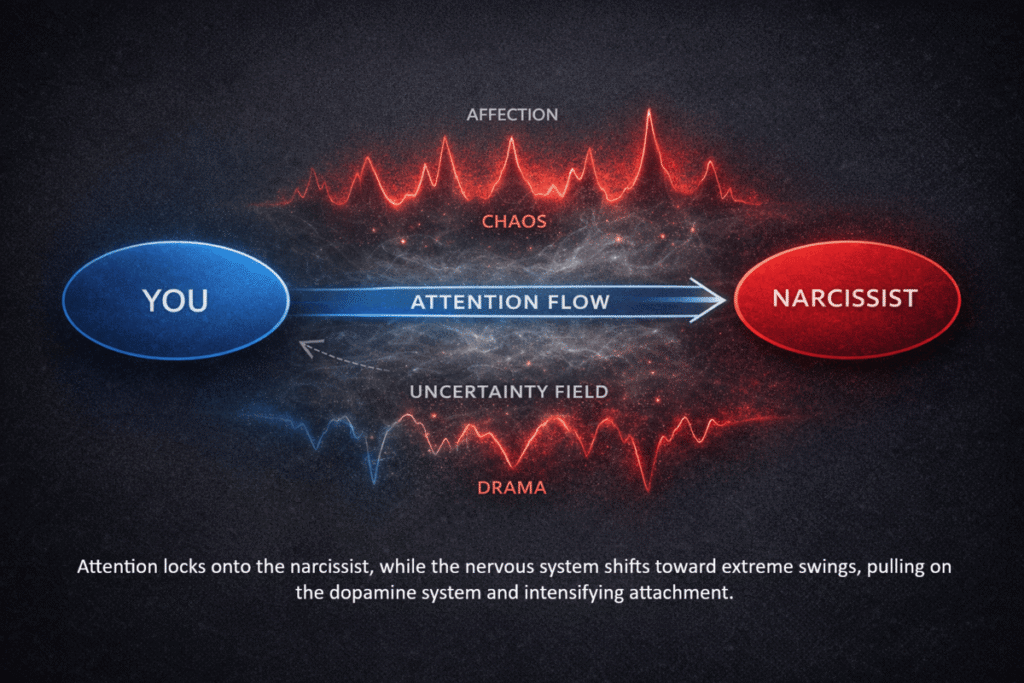
When you never know when the next reward will arrive, your brain shifts into an intermittent reinforcement pattern, the same mechanism behind addiction to gambling, social media, and slot machines.
Over time, this type of behavior can contribute to the development of obsessive attachment. You can learn more about this in our article: Relationship Obsession Explained. If the pattern is not interrupted, it may later evolve into what is commonly referred to as a trauma bond.
Source (related): Dopamine, Learning, and Reward Prediction Error – Wolfram Schultz, Nature Neuroscience (2006)
The uncertainty keeps you on edge, and before you know it, you realize: You’re no longer in a relationship; you’re in a psychological drama game.
Push-Pull Manipulations, “I’ll Leave You.”
This technique is well-known and is often promoted in dating advice. It can also be found in pickup culture, certain self-help materials, social media relationship content, and even in some sales or persuasion strategies where creating tension and uncertainty is used to increase interest.
Individuals with pronounced covert narcissistic traits may shift between:
- affection – punishment
- love – coldness
- attention – withdrawal
- closeness – rejection
She may use break-up threats as a control tactic: “If you do that again, I’ll leave you!” Or even better, a well-thought-out threat: “If you leave the toilet seat up one more time, I will leave you!”
Arguments begin over nothing, a tone of voice, a delayed reply, a forgotten detail. In some cases, she is ready to walk away. You can start to wonder: How can she leave so easily after everything was perfect at the start?

Source (related): Diagnostic and Statistical Manual of Mental Disorders (DSM-5-TR) — American Psychiatric Association (2022)
This is the hook test. She may be assessing: “Will you chase, beg, try harder? Do I have him?” Once she senses that you are emotionally attached and that leaving would be difficult for you, the balance can shift. She has identified leverage – your vulnerability – and it can be exploited. After that, behavior often escalates, and the decline rarely reverses.
Narcissists Exploit Weakness to Gain Control
Every detail you share: your doubts, fears, past mistakes, insecurities, can be used against you the moment you disappoint her, or fail to meet an unspoken expectation. Those same confessions can resurface as passive-aggressive punishment.
If you’ve known her long enough, she already has a psychological map of you. She knows your weak spots where you bend, break, and which emotional buttons to trigger. Her control often operates through a familiar pattern: reward, punish, a behavioural training loop that keeps you unstable and dependent.
Source (related): Coercive control literature review – Australian Institute of Family Studies (1 Jun 2023)
Some relationship experts claim vulnerability strengthens a connection. With a female narcissist, usually the opposite is true. Your vulnerability can be a tool she uses to control you. And if you “behave,” she may temporarily switch back to her older self you once knew, as leverage to keep you exactly where she wants you.
Passive-Aggression: Way Over The Border
She rarely confronts problems directly. Direct communication requires honesty, clarity, and responsibility, three things she usually avoids. Instead, she uses something far more suitable for her: passive-aggression. It’s silent, subtle, and delivered with a smile.
A narcissistic woman can be deeply offended, burning inside with rage, and still act like your closest ally if that performance benefits her. She won’t tell you what’s wrong, won’t communicate openly. She will simply twist the emotional atmosphere: a delayed reply, a polite but cold tone, an exaggerated sweetness that hides hostility.
Source (related): Grandiose and vulnerable narcissism, identity integration and aggression – PubMed Central (2021)

Constant Lying, From Small Jokes to Manipulative Gaslighting
Her lies begin as jokes, small stories, things that seem harmless. At first, you don’t even recognize them as lies. “She might not even know it, okay…” But over time, the pattern becomes clear: she lies often, sometimes even about the most minor things.
What you thought were misunderstandings turn out to be calculated moves. Her sweetest persona hides passive-aggressive tactics. She tells half-truths, creates confusion, and denies the obvious.
This is how gaslighting starts, one common tactic of a covert narcissist. The goal? A control tactic designed to make her feel superior by putting you down. It makes you doubt your reality, making it easier to manipulate you.
For a deeper structural explanation, see: What Is Gaslighting?.
Not sure if you are being manipulated? Take a test. Press a button, sign up for the Dark Psychology Lab, and we will send a test to your email.
She Doesn’t See Anything Wrong With Her Behavior
A female narcissist may grow accustomed to minimal consequences and limited accountability. Direct confrontation often triggers defensive reactions rather than reflection. If you try to confront her, she’ll:
- deny
- blame you
- twist the narrative
- play the victim
- cry if needed
- turn the story against you
This behavior has a name: DARVO manipulation. It is a well-documented and widely recognized pattern. You can read more about it in our article: What Is DARVO Manipulation? How Blame Gets Reversed.
She may come to expect forgiveness and assume you will remain. When her behavior is repeatedly tolerated, it can reinforce an inflated sense of entitlement, strengthening the belief that there will be no real consequences. In many cases, this process does not appear fully conscious. Avoiding responsibility may function less as a deliberate strategy and more as a learned pattern or an unresolved developmental wound.
Source (related): Attachment Theory and Pathological Narcissism – Frontiers in Psychology
Eventually, she may begin to look at you with contempt, once she perceives that you are fully within her control.
If She Realizes You See Her Real Face – Discard
There is one thing a covert narcissist may fear the most: exposure. If she senses that you understand the inconsistencies, that you see through the facade she presents publicly, and that her image is at risk, the dynamic can shift. She may become defensive or even vindictive, potentially escalating behaviors mentioned above, sometimes involving allies or so-called “flying monkeys.”
In some cases, escalation can include attempts to discard you, publicly humiliate you, or harm your social standing.
Her real personality comes out only when she has nothing to hide, and in some cases, it is cold, empty, cruel, and chaotic.
And the scariest part? She does it all beneath the surface, carefully curated so she can still play the victim at any moment. Every word you say can be twisted, weaponized, or repeated to someone else in a way that makes you look unstable, cruel, or dangerous. She can be sweet, feminine, sexual, warm, and then shift into a cold demeanor if this is your weak spot.
A narcissistic woman can quietly turn people against you: men, women, friends, coworkers. It doesn’t matter. One possible motivation is simple: damage your name before you can damage hers. She can cry on command, act confused, behave like a fragile girl who says, “I don’t understand. What did I do wrong?”
This is her final line of defense. And this may confirm patterns you have already noticed.
If you are dealing with a narcissist at work, we cover practical strategies for maintaining your position and professionalism during the devaluation phase in our article: How to Work With a Narcissist During the Devaluation Phase.
Covert Narcissistic Hovering Can Take Much Subtler Forms
After a breakup with a covert narcissist, which often ends in a complicated and emotionally intense way, and in some cases may even contribute to trauma symptoms, the narcissistic supply dynamic does not necessarily switch off.
Source (related): What Is Hoovering? 7 Signs and How To Handle It — Cleveland Clinic (Sep 22, 2023)
Everything depends on the situation, but in certain cases, the cycle continues. The narcissist may attempt to draw you back in, transitioning the dynamic into what is commonly referred to as the hoover phase.
Covert narcissists rarely show up unexpectedly at your home or suddenly “remember unfinished business” as overts do. Instead, they may attempt to re-engage you through indirect, manipulative signals or through other people, often referred to as “flying monkeys.”
Examples may include:
- Making previously private social media photos visible again, or posting more openly with hints.
- Unclear or unexplained phone calls from third parties.
- Sudden apologies that lack real accountability if contact is not completely cut off.
- Reappearing in the same places you frequent.
- Casual “accidental” encounters designed to trigger contact.
The goal is often the same: to test access, reopen emotional hooks, and see whether the connection is still alive (“will he engage?”).
Defense Guides – Practical Self-Protection
Dark Psychology Lab focuses on clarity and self-protection in situations involving manipulation, power imbalance, and covert psychological pressure.
The following defense guides expand on practical mechanisms to reduce psychological damage and regain control:
Psychological Manipulation
Psychological Manipulation Defense: Safe Strategies and Dangerous Tactics Explained
Narcissistic Dynamics
How to Deal With a Narcissist and What to Do When You Can’t Leave
Workplace Mobbing & Toxic Workplace Culture
Workplace Mobbing Defense Playbook: 17-Step Guide
These resources are designed as defensive tools, not long-term solutions. Clarity remains the primary layer of protection.
Final Thoughts
Most of the examples here are extremes. Not every narcissistic woman acts maliciously. Many are in pain themselves, which they have not yet learned to admit openly. But understanding her patterns can save your mind and your future. If several traits from this article match someone you know, be cautious. Some things look good only from a distance.
Throughout this article, the siren archetype is used strictly as a metaphor to illustrate emotional allure. It is not a psychological definition or a label, but rather a visual aid that illustrates how attraction can precede conscious awareness.

Disclaimer
This article is for informational and educational purposes only. It is not medical, psychological, or legal advice, and it does not replace professional diagnosis or support. More at our Disclaimer Page.
Descriptions of narcissistic traits and behaviors are not diagnostic criteria. Narcissistic Personality Disorder (NPD) can only be diagnosed by qualified mental health professionals. The patterns discussed here are generalized observations, not labels applied to any individual.
If you are experiencing psychological distress or harm, seeking professional support is strongly recommended.
Dark Psychology Lab
Original content based on lived experience and independent psychological analysis.
If reading feels exhausting right now, audiobooks can be an easier way to absorb information. You can explore more about the narcissistic personality type we covered in this article:
Listen on Audible