

After a conflict, we often assume that silence is simply stubbornness, a difficult personality, or childish resentment. In psychology, however, the silent treatment takes on a much darker meaning. It is a deliberate control mechanism and a form of manipulation used to destabilize another person and to maintain an unequal power balance in a relationship.
Source (related): “The quiet cruelty: Ostracism as intimate partner violence” — Current Opinion in Psychology (Review), Epub 2025-12-08
What Is the Silent Treatment?
The silent treatment is a form of manipulative passive aggression that operates through complete restriction of communication and emotional withdrawal. It is a conscious decision to ignore another person in order to punish, control, or apply psychological pressure.
Emotional Blackmail and Dominance
This manipulation is far more powerful than it may appear at first glance. By using silence, the manipulator aims to:
- Trigger intense anxiety: Uncertainty about what is happening makes the target feel unsafe.
- Force compliance: The target often begins apologizing for things they did not do, just to end the silence.
- Devalue the other person: Communication is withheld to lower the other person’s standing.
It’s a dominance strategy. Only the manipulator decides when contact will be restored. This leaves the target in total uncertainty and dependent on the other person — if that person is important, that is.
If you are not sure what manipulation is or how it works, our article explains it in detail:
The Psychology of Manipulation: Mechanisms, Tactics, and Defense
For silent treatment to work as a form of control, there has to be some kind of dependence on the manipulator: emotional, family, finances, reputation, career, or obligations.
How to Recognize the Silent Treatment
The silent treatment is an active behavior. Below are the main signs that this tactic is being used against you:
- Avoidance: The person openly refuses to discuss the problem, even if you approach it calmly.
- Systematic ignoring: It occurs whenever there is a conflict or a situation that the manipulator dislikes.
- Delayed responses: The manipulator intentionally postpones replying to messages or calls, even urgent ones, forcing you to wait and worry.
- “Block–Unblock Game”: A strong digital manipulative control tactic used to punish, control, or get attention.
- Demonstrative social exclusion: Used publicly, it can function as a subtle way for a manipulator to assign you a lower value. In some cases, the manipulator expects tears, anger, or pleading, which gives them leverage (an emotional “hook”).
- Stonewalling: Physical and emotional withdrawal. Eye contact is avoided, the body turns away, defensive gestures, such as crossed arms, appear, and attempts to communicate hit a “stone wall.”
Healthy Pause or Silent Treatment: How to Tell the Difference
Not every form of silence is manipulative. It is essential to understand the difference between healthy boundaries and psychological manipulation.

Healthy Pause – Time-Out
In healthy relationships, silence is used to process emotions, not to punish the other person. Almost everyone sometimes needs time to step back and think. A healthy pause is usually communicated in words.
Silence as a Personal Boundary
The silent treatment exists in the context of commitment. It requires an existing relationship where communication is normally expected. Without a meaningful connection, silence is often simply distance.
Most people use silence as a boundary-setting action. Their withdrawal does not necessarily mean manipulation.
Manipulative Silence – Silent Treatment
This is a power play designed to hurt the other person.
- Goal: To punish, isolate, and force the other person to submit.
- Communication: The silence begins without warning, and questions go unanswered.
- Ending: Unknown. Contact is restored only when the manipulator decides.
When Does Silence Become Punishment? The Start of the Mechanism
It often begins with your real, or more commonly, perceived, “mistake.” The manipulator only needs to interpret any of your actions as inappropriate in order to justify the “right” to punish you with silence.
If the manipulator sees that this tactic affects you, it becomes a recurring tool of control.
Rationed Hope
If the silent treatment is used as a control tactic, the manipulator will not withdraw completely on purpose. They return when they sense their objective has been achieved or when you disengage. After a prolonged withdrawal, the manipulator may suddenly return with an intense wave of affection known as hoovering and love bombing.
The mechanism:
withdrawal → anxiety → compliance or disengagement → hoovering
Who Most Commonly Uses the Silent Treatment?
While almost anyone may use silence at some point in life, in certain environments and personality types, it is noticed most frequently.
Environments Where Silence Becomes a Weapon:
- Romantic relationships: The most common space for manipulation, where emotional connection is used as leverage.
- Workplace: Isolating a colleague to push them out of the team or make them feel incompetent.
- Family: A control method used by parents against children, often leaving long-term damage to a child’s self-esteem.
Psychological Profile
Research on conflict avoidance, emotional withdrawal, and Dark Triad traits suggests that manipulative or strategic use of silence may be associated with narcissistic and Machiavellian tendencies (Jones & Paulhus, 2014; Gottman & Levenson, 1992).
The Silent Treatment as an Indicator
This pattern is frequently associated with covert narcissistic traits in the early stages of a relationship. Unlike the overt narcissist, this type usually avoids direct confrontation. When asked about a problem, the person may shut down, withdraw, or provide unclear responses, leaving the other partner confused.
An isolated episode of silence does not define a personality structure. However, if unexplained withdrawal becomes a repeated response after disagreements, it may function as an early warning sign worth paying attention to.
For a deeper analysis of covert narcissistic traits and indirect control strategies, see our article: The Narcissistic Woman: Recognizing Subtle Patterns of Covert Control
The Silent Treatment Cycle: What Happens Inside You?
When you are being ignored, the brain activates neural systems that detect threat. Research shows that the brain processes social rejection and exclusion in a way similar to physical pain (Eisenberger et al., 2003, pp. 290-292).
The Destructive Cycle
The silent treatment almost always follows the same loop, which becomes more damaging with each repetition:
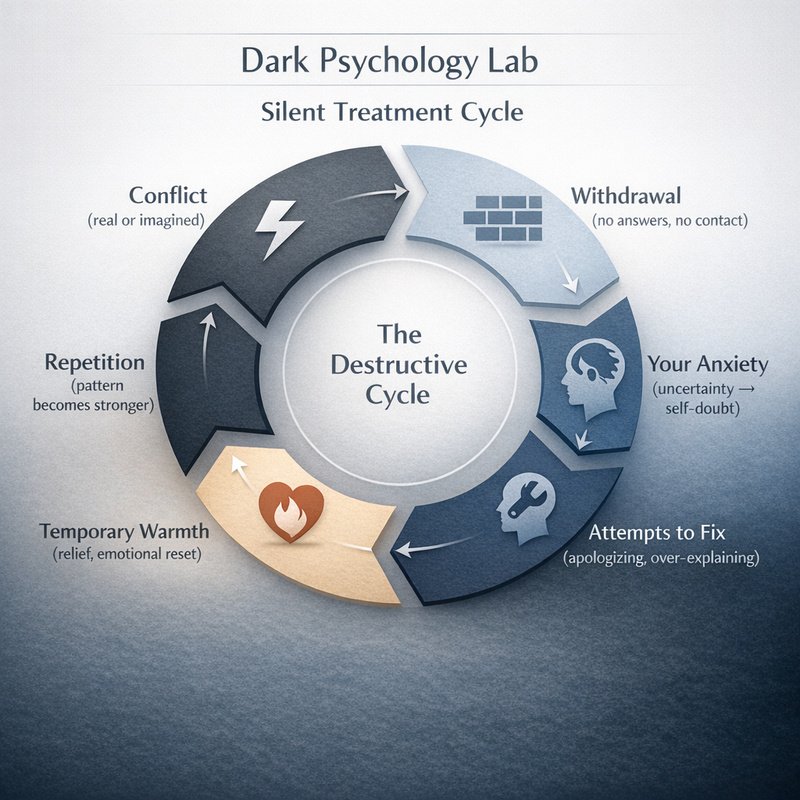
- Conflict (real or imagined): The manipulator finds a reason to feel “offended.”
- Withdrawal: A sudden “stone wall” appears, no answers, no contact.
- Your anxiety: Uncertainty forces your brain to work overtime, searching for fault.
- Attempts to “fix” the situation: In some cases, you may apologize or try to please the manipulator just to end the silence.
- Temporary warmth: The manipulator “forgives,” contact returns, and you feel intense relief.
- Repetition: The cycle closes and becomes a pattern.
Not sure if you are being manipulated? Take a test. Press a button below. Sign up for Dark Psychology Lab, and we will send it to your email.
Psychological Conditioning and Dependency
Why, in some cases, is it so hard to escape? Intermittent reinforcement plays a key role. Because you never know when the next “dose” of contact will come, its value in your mind may increase.
- Push–pull: The push (silence) and the pull (sudden attention) over time can create an obsessive attachment. We explore how this mechanism works in our article: Why You Can’t Stop Thinking About Them: How Intermittent Reinforcement Creates Obsession.
In personal relationships, the silent treatment can be interpreted as the manipulator’s leash. Over time, your nervous system may learn to anticipate punishment and begin to behave in ways that are convenient for the other person, simply to avoid pain.
Research sources backing the claims above:
Is the Silent Treatment a Form of Abuse? — PsychCentral (2022)
Antecedents and consequences of silent treatment in close adult relationships: a systematic review — Frontiers (2026)
Escalation Model
If the manipulator holds strong leverage, such as social status, children, shared work, finances, or living conditions, and has become accustomed to using it, the silent treatment intensifies. What began as mild ignoring can gradually evolve into systematic emotional pressure. (The Silent Treatment: Causes and Coping, 2023)
Over time, it can turn into:
- A severe form of psychological pressure: The duration of punishment increases, and its intensity grows in order to break your will.
- Emotional rejection as a norm: Silence becomes the constant background of the relationship, not the exception.
- Public reputation damage: Silence is moved into the public space, where you are demonstratively ignored in front of others.
- Triangulation and “flying monkeys”: Third parties are involved. They may act as intermediaries or begin mirroring the manipulator’s behavior, further isolating the target.
It is important to understand that the escalation of silence tactics is a slow psychological takeover. Gradually, independence may erode until the person becomes dependent on the manipulator’s emotional “recognition” or approval.
Silent Treatment in the Workplace and Group Escalation
In workplace environments, silent treatment expands beyond individual conflict. It often appears as information withholding, psychological pressure, or subtle professional sabotage.
If the group is involved, it can be part of systematic group pressure known as workplace mobbing. Our article that explains it: Workplace Mobbing: Signs, Tactics, and the System Behind It.
If communication becomes increasingly unpredictable and periods of silence are used as punishment, this is a serious signal of toxic workplace culture.
In some cases, silent treatment functions as one component of a broader psychological destabilization process. More about it in our case study: Coercive Control at Work and in Relationships: “Death by a Thousand Cuts” Explained.
Consequences of Prolonged Silent Treatment
Long-term silent treatment can lead to direct consequences on a person’s mental health, physical condition, and overall quality of life. This happens because the body, experiencing ongoing rejection, shifts into a chronic fight-or-flight state.
Source (related): Dickerson, S. & Kemeny, M. (2004). “Acute stressors and cortisol responses: A theoretical integration and synthesis of laboratory research.” — Psychological Bulletin, 130(3), 355–391.
Long-term silent treatment commonly triggers the following processes:
- Self-esteem erosion: Constant ignoring sends a silent message: “You are nothing.” If a person’s self-worth is already fragile, this tactic reinforces the belief in their own worthlessness.
- Reactive abuse: Pushed to the limit, the target may cling, yell, cry, or act aggressively.
- Depression and FOG (Fear, Obligation, Guilt): This creates chronic anxiety, mood instability, and repetitive overthinking loops.
- Psychosomatic symptoms: Sleep and appetite can be disrupted, and chronic fatigue may develop. Substance use or harmful coping habits, in some cases, intensify as well.
- Shame and social isolation: If this behavior is tolerated for a long time, you may begin to feel ashamed in front of others. This encourages withdrawal and avoidance of social contact.
- Self-censorship and “walking on eggshells”: You begin constantly monitoring yourself, afraid that any word or action may trigger another wall of silence.
Defense Guide: How to Confront the Silent Treatment
Emotional neutrality is often the safest and most useful tactic against silent treatment.
The Core Formula
The silence tactic reflects the manipulator’s inability (or unwillingness) to communicate in a healthy way. It is not your fault.
In a healthy environment, communication is not intentionally ignored. Consider who you are dealing with.
From Recognition to Structured Defense
If the silent treatment is not an isolated event but a recurring behavior, the situation shifts from emotional conflict to manipulative pressure.
Depending on the context, different strategies apply:
Narcissism: How to Deal With a Narcissist and What to Do When You Can’t Leave
Manipulation: Psychological Manipulation Defense: Safe Strategies and Dangerous Tactics Explained
Workplace: Workplace Mobbing Defense Playbook: 17-Step Guide
Each guide breaks down stabilization, documentation, retaliation risk, and boundary strategy in detail.
Conclusion: From Silence to Clarity
The silent treatment is effective because we are social beings. For the brain, connection with another person has evolutionary meaning. It signals safety. Sudden withdrawal of that connection signals threat. The manipulator exploits this biological vulnerability.
When contact is turned into a weapon, the antidote is a firm internal structure. In this power struggle, emotions become fuel for the manipulator, while cold clarity becomes your shield.
Clarity directly reduces the damage caused by silence. When you understand the rules of the game, you stop participating. Regaining control does not begin when the manipulator speaks. It begins when you recognize the manipulation and decide that your value does not depend on someone else’s silence.
Disclaimer
This article is for educational and informational purposes only. It describes behavioral mechanisms and power dynamics, not clinical diagnoses.
Experiencing the silent treatment does not automatically mean you are dealing with a narcissist or a personality disorder. Behavioral patterns must be assessed in context, frequency, and impact.
If there is a significant power imbalance (financial, professional, legal, or physical), strategies described here may not be safe to apply directly. Always assess risk realistically before taking action.
If you feel a real threat, your safety and professional support must always come first.
If you are experiencing severe psychological distress, threats, coercion, stalking, or physical danger, prioritize your safety and seek qualified professional or legal help.
Clarity reduces damage. Safety comes first.
More about this in our full Disclaimer page.
Dark Psychology Lab
Original content based on lived experience and independent psychological analysis.
If reading feels exhausting right now, audiobooks can be an easier way to absorb information.
Listen on Audible