
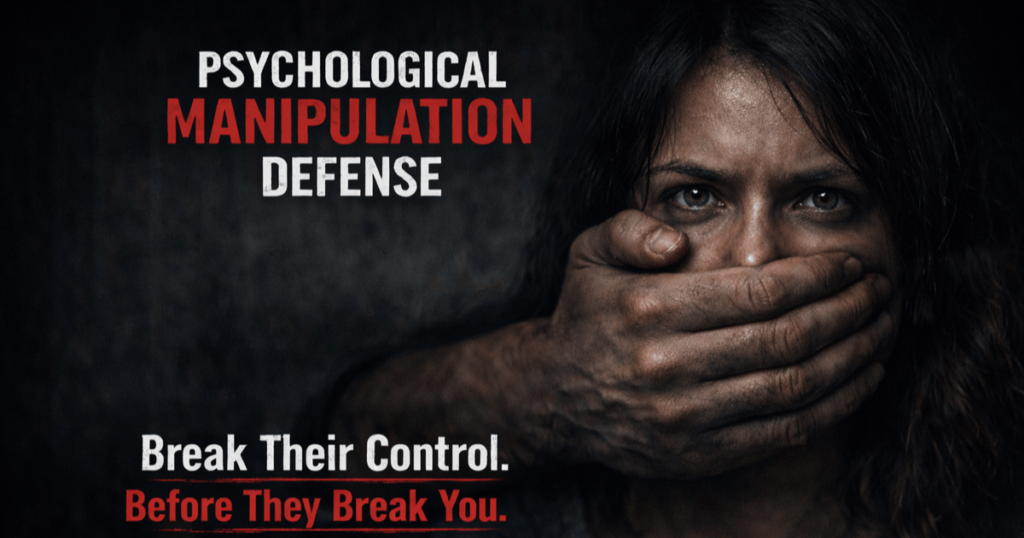
This guide covers 19 techniques to help you defend yourself against manipulation.
Not the “set boundaries, say ‘no’, and everything will be fine” version.
The real one.
You’ll learn what techniques exist, how to apply them, the psychological mechanisms behind them, and what reactions to expect from manipulators.
Context Note: The strategies discussed here are part of an independent psychological analysis of power dynamics. They are intended for self-protection and situational awareness. If you are facing harassment, legal threats, or physical danger, please consult with a qualified professional.
The Core Principle of Manipulation
In most cases, manipulation relies on emotions: guilt, fear, shame, attachment, hope, and anger. For a clear definition of manipulation, see:
The Psychology of Manipulation: Mechanisms, Tactics, and Defense
Source (related): Psychology Today (July 2, 2019)
The simplest way to interrupt manipulation is to stop providing emotional reactions to provocations. There is a universal equation that explains the core of manipulation:
Provocation + Your emotional reaction = Their control
This formula works in most situations, but not always as people expect. The logical conclusion would be to simply remove your reaction from the equation.
It would be great if it were that simple.
In reality, manipulation mechanisms are far more complex and deeply rooted, and life itself is rarely that straightforward.
Manipulation Defense Techniques
This list presents practical, commonly used defense techniques, explained briefly and clearly, along with how they work in real situations.
You’ll also learn what counter-moves manipulators often use to maintain or regain control.
Some of these strategies can be applied immediately, depending on your situation.
Core Behavioral Strategies
Simple, practical behavior changes that help you deal with manipulation.
Healthy Boundary Setting (Personal Boundaries, Emotional Boundaries, Boundary Enforcement)
This is considered one of the most important defense steps. Healthy boundaries act like invisible lines that define what behavior is acceptable to you and what is not.

How to use it
The core idea is to state clearly, not necessarily openly, what you will not tolerate and the consequences if a boundary is crossed. For example: leaving the situation, ending contact, or stopping cooperation.
The consequences must be realistic, and you must be willing to follow through.
How it works
You clearly define your boundaries and take responsibility for your own behavior. At the same time, it’s important to understand that by setting boundaries, you also reveal the areas where a manipulator may try to apply pressure. You are responsible only for your reactions, not for how the other person responds to your boundaries.
Internal knowing that you can hold your boundaries gives you power.
What reactions to expect from a manipulator
It’s important to note that manipulative people often continue to cross boundaries, hoping that you will eventually give in. To them, boundary-setting can feel like a personal attack. Common defensive reactions include emotional pressure, aggression, silent treatment, tears, guilt-tripping, triangulation, and other attempts to regain control. This behavior is defensive in nature, driven by the fear of losing control.
This technique does not change the other person. It changes your self-respect, your self-worth, and how you see yourself.
Risk level:
🟢Low — This approach is generally safe to use. While it may trigger defensive reactions, it rarely escalates into open conflict or direct retaliation.
🟡Medium — If you don’t hold your boundaries once a manipulator starts crossing them.
Assertiveness (Self-Worth)
Assertiveness is the ability to express your needs and position clearly and directly, while still respecting the rights of others. Against manipulators, this technique works as a psychological shield; it prevents them from taking a dominant position through emotional leverage.
Source (related): University of California, Davis – Assertiveness (Student Health & Counseling Services)
How to use it
Learn to recognize your rights in the moment when a manipulator tries to impose guilt, obligations, or responsibility on you. Maintain professionalism, structure, and calm. Do not react emotionally to provocations. Know who you are, and understand that you have the right to defend yourself.
How it works
Assertive behavior strengthens self-worth because you actively protect yourself and stand your ground. Self-worth is exactly what manipulation systematically erodes, which is why assertiveness works as a direct counter to the core manipulation mechanism.
What reactions to expect from a manipulator
Manipulators often attempt to switch tactics: pretending to withdraw, approaching from another angle, spreading rumors, discrediting you, inducing shame or guilt, or using passive-aggression.
If these strategies fail, a temporary disappearance may follow. Over time, assertive behavior tends to repel manipulators; they seek vulnerable people, not those who can hold their position.
Risk level:
🟢Low — Rarely escalates, but may trigger withdrawal or avoidance.
Gray Rock Method (Grey Rocking)
What is it?
A deliberate strategy of becoming emotionally unresponsive and intentionally “boring” so the manipulator loses interest in you as a source of emotional supply.
How to use it
The principle is simple: if contact is unavoidable, respond minimally. Keep responses short, neutral, emotionless, and without explanations.
How it works
The main weakness of the gray rock method is that it often requires suppressing your personality in order to survive a toxic environment. It can be effective when contact is rare or when the manipulator has no real power over you.

However, in long-term relationships or situations involving a power imbalance, this approach can become extremely exhausting and psychologically draining or even dangerous.
Source (related): Cleveland Clinic – Dr. Amy Markley, Grey Rock Method (Jan. 23, 2024). “Managing and minimizing your reactions may help slow down or disrupt an emotional rise in the short term. But it might not be the best long-term strategy.”
What reactions to expect from a manipulator
Simple non-reaction does not always stop manipulation. In some cases, it may be interpreted as weakness and provoke increased pressure: more provocations, hostility, workplace harassment, misinformation, or deliberate obstruction. Some manipulators simply switch to different methods to extract a reaction.
This method (like the related Medium Chill technique) tends to work best in environments with clearer rules, etiquette, or formal structure. In everyday life, when a manipulator has time, access, and proximity, Gray Rock can sometimes make their job easier rather than stop the behavior.
Risk Levels:
🟢Low — when contact with the manipulator is rare and brief. In such cases, this tactic can be relatively effective and safe.
🟡Medium — when Gray Rock is used in environments where you spend a lot of time (for example, work or family settings). Over time, emotional fatigue may develop.
🔴High — when the relationship is ongoing, or there is a clear power imbalance. In these cases, the tactic may trigger resistance, escalation, or attempts to regain control.
No Contact Strategy
What is it?
An extreme, but often the most effective measure, is the complete termination of all communication with a toxic person.
How to use it
If you decide to go No Contact, it must be done fully, not halfway:
- block all communication channels (phone, email, social media)
- if you do not intend to take legal action, consider removing reminders (photos, chats, or “backup channels”)
- and most importantly, stop checking what they are doing (after manipulation, this is a very common residual form of emotional dependency)
Partial contact can resemble a push–pull dynamic and may intensify emotional attachment rather than weaken it.
How it works
No Contact works simply: you cut off the source of influence.

The nervous system finally gets a chance to calm down, and the mind disengages from constant pressure, guilt, emotional fog, and psychological hooks. Depending on the situation, this can be the only way to truly recover.
What reactions to expect from a manipulator
When contact is cut, their “supply source” is often cut as well. As a result, attempts to regain control are very common: hoovering, smear campaigns, provocations, pressure through other people, or harassment in social spaces. In some cases, behavior may escalate or become more aggressive, which depends on the individual and the context.
How long does recovery take?
Most often months, sometimes years. Full psychological “deprogramming” and identity rebuilding depend on the level of attachment and whether a trauma bond was formed.
Risk level:
Usually 🟢Low, but can be 🟡Medium depending on the situation. The method itself is safe, but reactions to it can sometimes escalate, especially if the person has stalking tendencies or holds power over you.
Communication Techniques
If you are confident that you are dealing with manipulators, but communication with them is unavoidable, these techniques can help. They are primarily designed for and most effective in professional environments, but can also be applied in other situations depending on context and relationship dynamics.
These techniques help shift interaction from emotional reactivity to rational, controlled action.
JADE Avoidance (Justify, Argue, Defend, Explain)
What is it?
The JADE principle emphasizes clear communication rules that encourage you not to justify, argue, defend, or explain your decisions.
Source (related): BestInterest – JADE technique definition (Jul. 22, 2024)
How it works
You do not provide the manipulator with additional information that can be used against you. The fewer words you give, the fewer control levers they have.
Everything you say can and often will be used against you; manipulators operate exactly this way.
One of the primary ways manipulators maintain control is through arguments and meaningless debates, where the aim is not resolution but emotional influence. The purpose is to destabilize you and steer the situation in their favor. For example: “You’re selfish. I do so much for you, and you don’t want to.”
What reactions to expect from a manipulator
Anger is common. A manipulator may become irritated that you are behaving “not like everyone else” (a real‑life example). Labeling often follows: “selfish,” “bad,” “cold,” “why don’t you talk to me anymore?” They may also attempt to target your known emotional weak spots.
Risk level:
🟢Low — Generally safe technique; it denies manipulators’ leverage rather than challenging them.
BIFF Responses (Brief, Informative, Friendly, Firm)
What is it?
A communication technique most commonly used in digital environments – messages, emails, and written communication, though not limited to them. It is especially effective in professional and corporate settings.
Source (related): Columbia University – Ombuds Office: How to Write a BIFF Response
How to use it
Communicate in a professional and polite manner, without emotions and without sharing personal information. Responses should be brief, informative, friendly, and firm.

How it works
- Brief — the manipulator receives no extra information to latch onto.
- Professional — the situation is explained clearly, showing that you are not affected by communication disruption or passive aggression; it becomes harder to discredit you.
- Friendly — signals that your internal state was not impacted; there is no emotional hook to exploit.
- Informative — provides precise, fact-based information without interpretation, personal detail, or negative emotions.
What reactions to expect from a manipulator
If a manipulator is used to getting emotional reactions from you, an initial BIFF response may irritate them because their control is lost. Over time, if this technique is applied consistently, the manipulator may realize their efforts are ineffective and eventually disengage.
Risk level:
🟢🟢Low (green zone) — One of the safest techniques: it is non-provocative, documented, and emotionally neutral, leaving manipulators little room to escalate.
BEAR Technique (Behavior, Effect, Action, Result)
What is it?
A structured boundary-defense method where behavior is clearly identified (Behavior), its impact is explained (Effect), a desired change is stated (Action), and consequences are outlined (Result).
How to use it
It is critically important to use this technique calmly and professionally. Unlike aggressive communication, BEAR separates the person from the problem, which reduces the likelihood that the other party will immediately enter a defensive stance.
How it works
This structure allows you to remain assertive, defending your rights without attacking the other person’s dignity and without being pulled into emotional conflict.
What reactions to expect from a manipulator
Manipulators often thrive on diminishing others, so when faced with direct and structured confrontation, they may react with anger or bitterness. They may attempt to involve emotions, induce guilt, change the subject, or otherwise evade responsibility. If the manipulator is a narcissist, in some cases, BEAR tends to affect them like sunlight affects a vampire.
Risk level:
🟡Medium — effective, but may trigger resistance or escalation, especially in ongoing relationships or situations involving power imbalance.
🔴High — BEAR may be unsafe when applied to narcissists in a position of authority or institutional power. This technique can trigger a narcissistic injury.
DESC Script (Describe, Express, Specify, Consequences)
What is it?
DESC is a communication method designed to assertively express your needs, set boundaries, and address conflict situations caused by another person’s behavior.
Source (related): Yale University – Using DESC to Make Your Difficult Conversations More Effective (2016)
How to use it
- Describe — objectively and specifically describe the other person’s behavior or the situation. Focus on facts, not emotions.
- Express — express your feelings and thoughts using “I” statements; this may help reduce defensive reactions from the other person.
- Specify — clearly and concretely state what behavior change you expect.
- Consequences — outline the consequences if the behavior does not change. It is important to choose realistic, controllable consequences and avoid exaggerated threats.
How it works
This model removes unnecessary emotional noise and structures the message so it remains clear, constructive, and solution-oriented.
VERY IMPORTANT: The technique must be used without emotion. Otherwise, a manipulator can gain an additional control lever through your reaction.

What reactions to expect from a manipulator
Although DESC is a healthy and effective communication technique in normal environments, manipulators most often respond defensively. This may include (DARVO): avoidance, ignoring communication, attempting to evade responsibility, or “testing” whether the consequences part is real. There may be attempts to guilt-trip, change the subject, or use gaslighting to maintain control.
Over time, if the method is applied consistently, a manipulator may abandon their efforts and look for an easier target.
Risk level:
🟢Low — In normal environments.
🟡Medium — effective, but may trigger resistance or escalation, especially in ongoing or imbalanced relationships.
🔴 High — if the DESC technique involves emotional expression.
🔴🔴 Very High — when dealing with highly experienced manipulators, particularly those with covert narcissistic traits.
Important: When this technique is used with an emotionally manipulative person, they may identify and exploit it as a vulnerability, a “hook.”
Example (often seen in dating advice contexts):
“I feel uncomfortable when you act this way. I’m not angry. I just want you to understand how it affects me.”
What happened here?
By expressing this in that context, you revealed a vulnerability that the manipulator can use as leverage for control. Depending on the manipulator’s level of skill and intent, there is a high likelihood that this vulnerability (“a hook”) may later be used against you.
A good rule of thumb
In healthy environments, people do not deliberately search for your vulnerabilities.
Where this pattern can lead is analyzed in depth in our case study: Coercive Control at Work and in Relationships.
High-Risk Tactics: Recognize, Not Apply
(Dark Psychology Context)
This section describes methods that are sometimes falsely presented in public discourse as ways to “outplay” a manipulator.
In social spaces, these tactics are often packaged under labels such as social engineering, confidence training, dating games, or attention control.
Source (related): ScienceDirect (Interdisciplinary research): “An interdisciplinary view of social engineering” (2021)
In reality, using such tactics usually means entering the same manipulation dynamic rather than escaping it. These methods may sometimes appear effective in the short term, but they often deepen toxic dynamics and can increase psychological harm to the person using them.
They are presented here for recognition and awareness, not as recommended self-protection strategies. The use of these tactics can carry serious risks, especially in situations involving power imbalances, retaliation, or potential violence.
Mirroring Defense
What is it?
A strategic communication method where you stop reacting emotionally to a manipulator’s behavior and begin systematically mirroring their tone, behavior, and interaction patterns.
How is it applied? (for recognition purposes only)
By reflecting the manipulator’s behavior without emotional involvement: responding to questions with questions, informational blocking in response to blocking, and emotional coldness in response to withdrawal.
How does it work?
A manipulator may become confused when they encounter someone who feels “just like them.”

This can create cognitive dissonance. However, it can also stimulate their competitive drive and appetite for control.
Does it work?
Most likely, no. By engaging in this type of “game,” you increase your own emotional exhaustion. Long-term operation in an “eye for an eye” mode pulls you into uncertainty and psychological chaos, an environment where manipulators always have the advantage.
Risks and consequences
The likelihood that this will resolve the situation is low. More often, it either fuels the manipulator’s excitement (the “game” becomes more interesting) or provokes aggression. Over time, this constant psychological tennis match drains the person attempting to defend themselves, as it requires continuous vigilance and prolonged exposure to a toxic environment.
Instead of gaining freedom, you risk sinking deeper into manipulation dynamics where the manipulator has far more experience.
Risk level:
🔴 High — High risk because it keeps you inside the manipulative game. Mirroring sustains engagement, increases cognitive load, and favors the more experienced manipulator.
CBR Method: Strategic Emotional Detachment
(Cold, Bottom Line, Rational)
What is it?
This method is designed for interactions with high-status manipulators or authority figures (for example, a toxic manager) when leaving the environment is not currently possible.
For safer ways to handle a toxic leader, see our article: How to Deal with a Toxic Boss Without Confrontation.
How is it applied? (for recognition purposes only)
COLD (Emotional Detachment)
Detach yourself emotionally from the manipulator’s influence. Their strongest weapons are usually your guilt and fear.
Example internal frames:
“I am using this person to receive my salary.”
“They are a tool for reaching my goals.”
“Their function is to pay me for my work.”
BOTTOM LINE (Final Objective)
Focus only on the outcome: money, resources, conditions, or leverage. Do not engage in emotional battles that do not move you closer to your primary objective.
RATIONAL (Pragmatic Logic)
Operate strictly through logic and facts. Stop appealing to a manipulator’s morality or values – such appeals are pointless, as they do not genuinely recognize them. Evaluate the person only by their functional usefulness.
How does it work?
The key shift is becoming responsive rather than reactive. CBR allows strategic functioning even inside highly toxic environments.
Possible reactions
May vary depending on timing and how well the toxic authority figure knows you. If you begin using CBT after a long period of interaction, they are likely to recognize it as a behavioral strategy and attempt to push you back into the previous, controllable pattern. In some cases, strong retaliatory measures can be expected. Over time, if sustained, they may realize their previous influence no longer works.
Risk level
🟡Medium — because prolonged emotional suppression can create internal stress, emotional numbing, or delayed psychological backlash if this strategy is used too long without an exit plan.
🔴High — when there is a strong power imbalance, dependency, trauma bonding, or a manipulator prone to retaliation. In such cases, sustained emotional detachment may trigger escalation, punishment, or targeted attacks.
The CBR method is like a diving suit in toxic water: it allows you to stay submerged (in interaction) without letting the water (toxicity) touch your skin.
Strategic Naivety
(formerly: Playing the Fool)
IMPORTANT: This technique is extremely dangerous.
What is it?
A conscious decision to not react to detected manipulation, creating the false impression that the trap went unnoticed. This allows the manipulator to relax and gradually reveal their true intentions or methods.
How to apply it (for recognition purposes only)
Instead of defending yourself against provocations, gaslighting, or attempts at discrediting, you deliberately adopt the role of a neutral observer. You absorb information without emotional resistance, as if you do not recognize the hidden subtext.
The most critical element is systematic documentation of all incoming information and the opponent’s behavior.
How it works
Rather than confronting directly, you become “a fog.” The manipulator loses orientation and begins acting carelessly, in some cases, providing enough material to expose their tactics and intentions.
Possible reactions
Escalation is likely. Believing they have achieved dominance, the manipulator may switch to more aggressive tactics. This is where the greatest danger lies: aggression can become uncontrolled. Without feedback, the opponent may experience emotional instability or attempt to fully discredit you so that any information you have collected becomes worthless.
Risk level:
🔴🔴Very High — requires exceptional self-control and strong identity stability. Prolonged presence in the “victim” role without open defense can damage self-worth and psychological health. Source (related): Mayo Clinic: Stress Management (Aug. 01, 2023)

This parallels the Fool archetype: a figure viewed as naive and non-threatening, and therefore allowed closer than others, often gaining access to sensitive information.
Ambiguity Armor
(Strategic Use of Controlled Uncertainty)
IMPORTANT: This technique is designed to protect your inner space and future plans from people who use information as a weapon. It is not recommended in healthy environments.
A critical rule: ambiguity is not lying. Do not lie. Dishonesty erodes trust and damages professional credibility. Manipulators are highly sensitive to inconsistency and deception and will quickly turn it into a vulnerability.
What is it?
A deliberate refusal to provide clear, detailed answers about your future plans or emotional state makes you less predictable. This is protection through controlled uncertainty.
How to apply it? (for recognition purposes only)
- Communication: Avoid definitive answers and excessive explanations. Use neutral, non-committal phrases (e.g., “I’m still considering my options,” “That will depend on several factors”).
- Body language: Maintain a calm, stable posture that does not reveal inner anxiety or excitement.
How does it work?
A manipulator operates like a hunter, searching for psychological “hooks” to map your personality and predict your moves. Ambiguity creates a psychological fog in which the opponent can no longer find reliable points of attachment, making manipulation attempts imprecise and ineffective.
Likely manipulator reactions
At first, you may experience increased pressure as the manipulator senses a loss of control. However, if you remain consistent, the opponent often loses interest over time, as the energy cost of “shooting into nothing” becomes too high.
This is similar to a hunter sensing movement in dense brush but being unable to define clear contours. Eventually, the weapon is lowered, wasting ammunition on an indistinct shadow is pointless.
Risk level:
🔴High — prolonged use can increase tension, provoke escalation, or be misinterpreted as dishonesty in environments where clarity and trust are required.
Experience-Based Strategies: The Internal Manipulation Radar
These strategies function as an internal early-warning system. They do not require changes in behavior or communication style. Instead, they rely on recognizing what a manipulator is trying to achieve and what kind of game is being played.
While highly effective, they are difficult to apply without real-life experience. For those unfamiliar with manipulative dynamics, they often remain theoretical. With experience, however, pattern recognition develops, and these strategies become highly reliable.
Source (related): American Psychologist – Daniel Kahneman & Gary Klein (Sep. 2009). “Conditions for Intuitive Expertise: A Failure to Disagree.”
Core principle
You do not need to fight or explain. Simply noticing the outcome the manipulator is aiming for is often enough to break their influence.
The experience factor
This “internal radar” forms over time through repeated exposure to manipulation. It is a learned response shaped by real interactions, not theory alone.
Value
The main advantage is time – time to pause, avoid impulsive reactions, and choose the safest response. This shifts you from automatic reaction to conscious management of the situation.
Psychological Game Identification and Analysis
What is it?
A high-level ability to recognize recurring, destructive interaction patterns. This includes a structured understanding of dynamics such as love bombing, guilt tripping, power struggles, gaslighting, stonewalling, passive aggression, and narcissistic behavior patterns.
Core principle
This is the transformation of theoretical knowledge into a practical tool, the ability to see manipulation in real time, accurately name it, and understand the mechanism behind it.
How to use it
Once manipulation is identified, it is crucial to remain in the observer position. Strategic questions can be used to test the opponent’s intentions (for example, asking them to clarify an ambiguous statement). This helps build a complete picture of the situation while preventing emotional involvement.
Psychological effect
When you know what the “hooks” look like and can anticipate the manipulator’s next move, their behavior loses its power.

It becomes predictable and technically simple. This allows you to maintain internal calm and make rational decisions about further communication or disengagement.
Likely manipulator reaction
The opponent may attempt defensive reactions such as accusations or blame-shifting. However, once informational and emotional resistance is sensed, manipulators most often withdraw and look for a more easily influenced target.
Success factor
While theoretical knowledge is essential, the effectiveness of this technique depends directly on personal experience. Most often, only individuals who have personally encountered manipulation and lived through its consequences develop the intuition and emotional resilience required to apply this knowledge in critical situations.
Source (related): Psychological Science (PubMed)(2007)
Risk level:
🟢🟢Minimal / Safe (Green Zone) — This is the safest and most effective form of self-protection, as it requires no active confrontation or offensive action. All defense takes place through awareness and the maintenance of internal boundaries.
Strengthening Internal Reality
What is it?
The ability to unconditionally trust your own perceptions, emotions, and intuition, even when the environment actively questions or distorts them. This is a core form of passive defense against manipulation designed to distort facts or reality.
How to use it
- Do not accept imposed criticism as truth.
- Hold a firm understanding of your self-worth and personal values.
- Pay attention to bodily signals: the body is often the first to sense the “fog” created by subtle, cumulative manipulative hooks.
- When your thoughts begin to tangle, use written notes or fact-tracking systems to anchor yourself back to reality.
How it works
Strong values function as an anchor, preventing manipulators from knocking you off balance. Body reactions often signal danger long before the mind stops rationalizing the opponent’s behavior. This is especially relevant when manipulation targets identity through tactics such as:
- gaslighting
- smear campaigns
- triangulation
- systematic devaluation (“death by a thousand cuts”)
- and related identity-eroding strategies
Likely manipulator reaction
If one approach fails, the manipulator will usually attempt to locate another weak point, depending on how well they know you. Over time, sustained internal stability may remove their leverage, and the opponent disengages.
Success criterion
As with other techniques in this section, experience is essential. During early encounters with “professional-level” gaslighting, maintaining this internal shield can be difficult. With time, however, the skill becomes automatic.
Strengthening internal reality is like pouring the foundation of your home during a storm.
Risk level:
🟢🟢Very Low (Green Zone) — This is a maximally safe method, as it requires no confrontation or external action against the manipulator. All defense takes place within the internal world.
Strategic Withdrawal and Delay
What is it?
A conscious refusal to react immediately when pressure is felt, combined with physical and emotional withdrawal from the situation.
This method is especially useful when you experience unexplained exhaustion (a common effect of manipulation) or an intuitive sense that “something is off,” even if you cannot yet clearly identify the manipulation.
Source (related): Benefits of Psychological Detachment From Work (2020)
How to use it
Simply step away from the situation. This does not require drastic measures such as blocking, complete silence, or demonstrative coldness. It is enough to temporarily leave the toxic space or pause communication, giving yourself room to breathe.
How it works
Manipulative effects often become clear only after a longer pause, once the emotional “fog” has lifted, which can take anywhere from several days to several months or more.

If, after stepping back, your inner calm and positivity return, or you begin to feel even worse after recognizing the manipulation effect, this is a strong indicator that the environment was toxic. The pause allows you to think rationally and, if necessary, re-enter contact later with firmer internal boundaries.
Likely manipulator reaction
Reactions vary. They may range from attempts to mirror your behavior (stonewalling) to active pursuit through calls, messages, or even unexpected visits. The manipulator may feel a loss of control and a need to regain it.
Depending on these reactions, you can decide whether returning to contact is worth it.
Success criterion
This method is unlikely to change the manipulator’s behavior, but it dramatically increases your inner calm and self-worth, as you regain control over your time and energy.
Risk level:
🟢Low — one of the safest techniques. It rarely provokes direct retaliation because it is not aggressive toward the opponent; it is simply the protection of your own space.
Internal and External Support
When a person lives in a toxic environment for a long time, their world begins to shrink. Thoughts loop endlessly around painful or confusing events, self-worth erodes, and confidence declines. It often starts to feel as if everything could still be fixed: explaining yourself, adjusting your behavior, or trying harder might finally change the situation. In reality, the mind has already spent too long on a battlefield.
That is why this section is not about fighting. It is about points of support, ways to restore stability, self-worth, and trust in yourself.
Support in dealing with manipulation operates on two levels: internal resources, which you build within yourself, and external support, which helps you stay grounded, connected to reality, and not isolated.
The core idea behind these approaches is simple: focus on what actually works for you, not on what is supposed to work. Not what sounds good or fits motivational slogans, but what genuinely restores stability and reduces internal noise.
Small Wins Method
What is it?
A psychological resilience–building strategy based on gradually restoring self-trust and self-respect by starting with small, safe steps.
How to use it
Identify small wins that are personally meaningful to you. These can include:
- Physical activity
- A step toward a personal goal
- Healthy eating
- Maintaining order
- Or improving sleep
They do not need to be big; what matters is that they are meaningful to you.
You can take small steps, for example, if you want to improve your body, start with 10 push-ups or sit-ups in the morning. Track your wins, write them down, mark them, or record them in any way that helps you see progress.
How it works
Even achieving a very small goal triggers the release of dopamine, a neurotransmitter linked to motivation and reward. This reinforces positive behavior and increases the likelihood of taking further action. Research shows that recognizing small successes activates the brain’s reward system and strengthens a sense of satisfaction, which increases motivation and resilience over time.
Source (related): The role of brain reward pathways in stress resilience and health (2018, pp. 1-11)
The idea is simple: when enough small wins accumulate, your emotional state and self-worth improve.

As a result, even stronger life stressors or manipulative attacks have less power to destabilize you.
Likely reactions from manipulators
Manipulators may attempt to pull you back into old patterns. It is rarely beneficial for them that you become stronger and more capable of defending yourself. This can show up as comments, blame, or criticism. They may mock your efforts, especially if those efforts exist within their immediate environment. However, this technique is primarily internal and personal; it is about your progress, not direct interaction with the manipulator.
Risk level:
🟢🟢Very Low (Green Zone) — effective and does not require direct engagement.
Self-Care
What is it?
Care for both body and mind: nutrition, food quality, sleep, physical activity, and mental engagement. This reflects a well-known principle in productivity psychology: important but non-urgent practices are often postponed, especially when living under constant stress.
How to use it
After prolonged manipulation, sleep, eating habits, leisure quality, and concentration often deteriorate. Alcohol consumption or reliance on fast food may increase; this is a normal response to sustained pressure.
Self-care starts with simple actions: consciously allocating time for yourself and tending to your basic needs. Your environment and appearance matter; even something as small as making your bed in the morning can serve as a stabilizing signal.
How it works
Self-care reduces chronic stress levels and helps the brain exit a constant threat state, gradually restoring balance and lowering cortisol (a stress hormone) levels. As a result, emotional regulation improves, decision-making becomes clearer, and overall cognitive functioning stabilizes.
Source (related): Mayo Clinic – Chronic stress puts your health at risk (n.d.)
Likely reactions from manipulators
When changes become visible, manipulators may begin to criticize you; they often do not benefit from your growing order or strength.
It is also worth recognizing that removing manipulators from your life is itself a form of self-care and can be considered an act of environmental hygiene.
Therapy and Professional Support
Helps process trauma and rebuild self-worth
What is it?
Consultations with certified professionals who have the education and skills to help you understand your situation, emotions, and behavioral patterns. Therapy provides a structured space to examine past experiences and gradually move toward healthier self-worth and emotional balance.
How to use it
A psychologist or therapist typically guides the process, using established methods to create a safe environment grounded in mutual respect and trust.
A good therapist can have a significant impact on the healing process. With their support, you can gain deep insight into yourself, explore your behavior and emotions, and understand patterns and situations you may not have recognized before.
It is important to be honest: not all specialists are equally competent. Some may fail to help, or in rare cases even engage in harmful dynamics, minimizing your experience, using subtle manipulation, or gaslighting. Choosing a therapist consciously and carefully matters.
Source (related): Ethical and clinical considerations in gaslighting support (2025)
How it works
Therapy helps revisit lived experiences and explore internal reactions with clarity and safety. Over time, a person gains a deeper understanding of both vulnerabilities and strengths, as well as their own role within relational dynamics. A stable, supportive therapeutic relationship allows for gradual rebuilding of emotional regulation, self-trust, and resilience.
Likely manipulator reaction
There is none. Therapy is not an interaction with the manipulator; it is a protected space, entirely focused on you. The focus is your recovery, not the other person’s behavior or response.
Risk level:
🟢Low–🟡Medium — for most people, therapy is beneficial and safe. Outcomes depend on therapist competence, relational fit, and the suitability of therapeutic methods. Poor matching or unprofessional practice can reduce effectiveness or, in rare cases, cause harm, making informed selection essential.
Exit Strategy Planning
What is it?
A clear internal understanding of when and how you will disengage if a situation crosses a certain threshold. This is not the same as full No Contact; in most cases, it is an internal plan rather than an immediately executed action.
How to use it
Depending on the context (personal relationships, work, or other environments), create a contingency plan. Think through what you will do if the worst-case scenario occurs and make necessary preparations.
This plan functions like a light in the dark when pressure increases or anxiety starts to rise.

How it works
Planning an exit strategy reduces feelings of helplessness by allowing the brain to see available options instead of a dead end. This calms the nervous system, lowers anxiety, and restores a sense of control and safety.
Likely manipulator reaction
None. This is an internal process and does not involve direct interaction with the manipulator.
Final Thoughts
It is important to understand that manipulation only works as long as you participate in it. The core of all these methods is emotional disengagement and the conscious refusal to play by rules set by someone else.
Some of these techniques may appear simple or even ordinary, but there is a rule worth remembering: simplicity works.
It is also important to know that situations often get worse before they get better. When you stop providing manipulators with their “emotional food” reactions, attention, and emotional engagement, they may escalate their behavior in an attempt to regain control. This is a normal, though uncomfortable, part of the process.
For this reason, in the long term, the most effective strategy is often the removal of toxic individuals from your environment physically, emotionally, or structurally, depending on the situation.
Dark Psychology Lab – Defense Guidance
This article is part of our defense guides.
Dark Psychology Lab focuses on clarity, self-protection, and regaining control in situations involving psychological manipulation, power imbalance, and covert abuse.
Rather than offering motivational advice, we document defensive frameworks based on recurring real-world patterns observed in narcissistic, manipulative, and hostile environments.
If you are dealing with ongoing psychological pressure and cannot disengage immediately, the following resources expand on practical defense mechanisms:
- Manipulations
How psychological manipulation works, how it escalates, and how to interrupt the control loop.
Practical Defense Guide: This Article - Narcissism
Structural patterns of narcissistic behavior, supply extraction, and power-based interaction.
Practical Defense Guide: How to Deal With a Narcissist and What to Do When You Can’t Leave - Workplace Mobbing and Toxic Culture
How coordinated pressure, passive aggression, and reputation attacks operate inside organizations.
Practical Defense Guide: Workplace Mobbing Defense Playbook: 17 Steps Guide
These materials are designed as defensive tools, not long-term solutions.
Where possible, disengagement remains the safest outcome.
Where it is not yet possible, clarity reduces damage.
Safety Protocol: Immediate Emergency Resources
If you are in immediate physical danger, experiencing a crisis, or fear for your safety, do not wait. Use the resources below to find professional support and create a safe exit plan.
Immediate Danger: Call your local emergency services (e.g., 911 in the US, 999 in the UK, or 112 in the EU).
United States (US)
- The National Domestic Violence Hotline: Call 1-800-799-SAFE (7233), text “START” to 88788, or visit https://www.thehotline.org.
- Crisis Text Line: Text “HOME” to 741741.
United Kingdom (UK)
- National Domestic Abuse Helpline: Call 0808 2000 247 (Freephone, 24/7) or visit Nationalda help line refuge
- Men’s Advice Line: Call 0808 801 0327 or visit https://mensadviceline.org.uk.
- Respect Phoneline: Call 0808 802 4040 (for anyone affected by abuse, including men and LGBTQ+ individuals) or visit Respect Phoneline.
European Union (EU)
- Victims of Crime Helpline: Call 116 006 (availability varies by country; if it does not connect, search for your country’s official victim support line).
- Victim Support Europe: Pan-European network providing neutral victim support resources for all genders: https://victim-support.eu/
Global / Other Regions
- RAINN: Support for survivors of sexual violence (all genders): https://www.rainn.org.
- Chayn: Trauma-informed resources and tools for survivors of abuse of all genders: https://www.chayn.co.
Disclaimer
This material is based on personal experience, independent analysis, and publicly available psychological frameworks. It is provided for informational and educational purposes only and does not constitute psychological, medical, or legal advice.
Every situation involving manipulation, abuse, or power imbalance is unique. The strategies described here may not be appropriate or safe in all contexts, especially where there is a risk of physical harm, retaliation, legal consequences, or significant power imbalance. Readers are encouraged to use their own judgment and, when necessary, consult qualified professionals before applying any of the concepts discussed.
The author assumes no responsibility for actions taken based on this material. The responsibility for decisions and outcomes remains solely with the reader.
More at our Disclaimer Page.
Dark Psychology Lab
Original content based on lived experience and independent psychological analysis.
If reading feels exhausting right now, audiobooks can be an easier way to absorb information.
Listen on Audible