

A practical guide to understanding and recovering from workplace mobbing, a form of prolonged group psychological pressure in toxic and manipulative work environments.
What this guide covers:
- Why mobbing breaks even strong people (systems + neuroscience).
- The Hero’s Journey: reframing suffering as transformation (Jung/Campbell).
- 5 common symptoms and what actually helps (practical psychology).
- Legal considerations and strategic defense.
You will learn what most commonly happens after mobbing, and which actions actually help reduce the damage.
Psychological Effects After Workplace Mobbing
After prolonged exposure to a hostile environment, over time, self-esteem slowly begins to rebuild.
Yes, recovery does start to happen, and you can be calm about that.
Workplace mobbing is a prolonged form of psychological devaluation. For many people, recovery takes time.
From a psychological perspective, this is often an unresolved existential threat signal that the nervous system is still trying to “close.” The body may remain stuck in a constant state of fight-flight-or-freeze.
In other words, it is the feeling of being pushed to the bottom of the social hierarchy, when the biological system begins to operate as if danger lurks around every corner.
Source (related): Social dominance, hierarchy, and chronic stress — Robert M. Sapolsky (Science) (Published 2005).
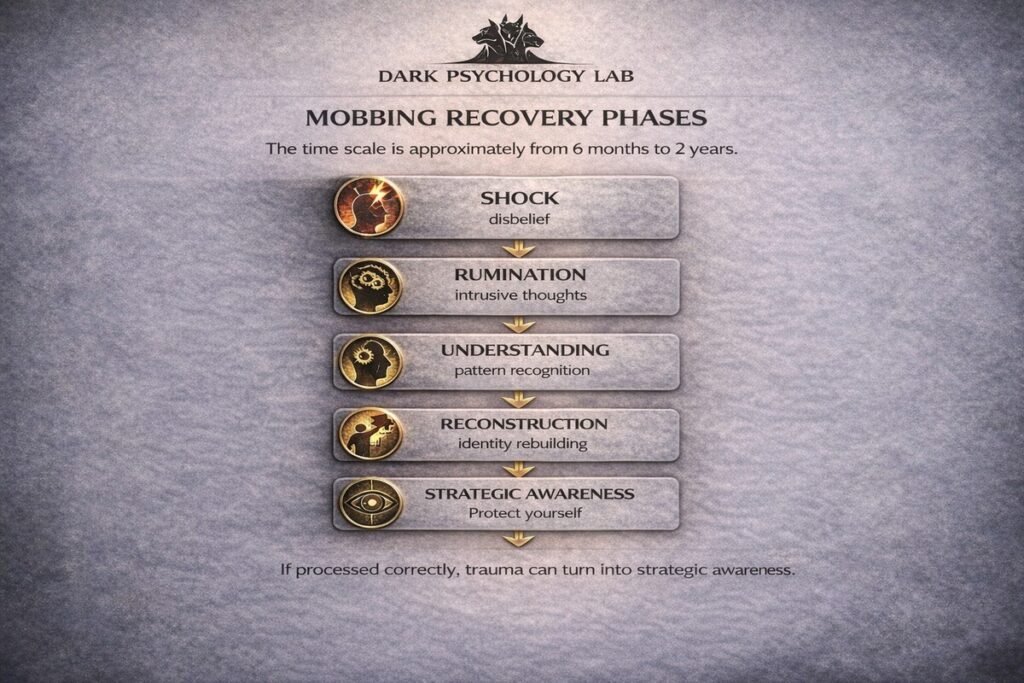
The World After Mobbing
That bottom, no matter how it looks, is a brutal place.
Your mind keeps replaying past events, almost like flashbacks. The same scenes repeat again and again, refusing to go quiet late at night before sleep, and again in the morning when you wake up. Your mood shifts constantly, but it tends to stay on the darker side. It can feel as if the light has gone out of your life.
Even after more than a year, the internal dialogue may still return. Sometimes it comes back with a wave of anger, perhaps even a lingering desire for revenge. This is perfectly normal.
People around you may sense the vulnerability left by a toxic environment. Sometimes, without even realizing it, they can push against it again. Concentration becomes difficult. Confidence may feel shattered, and even practical things like work or money can begin to slip through your fingers.
This is a real low point.
“The world has changed. It looks the same, but it is different.”
If you are recovering after mobbing, you probably recognize that feeling inside.
Breathing exercises or journaling alone are often not enough to recover. That doesn’t mean they don’t work, but for many people, they aren’t sufficient on their own.
However, this is not the end of the story. It is possible to get out of this place.
Hero’s Journey as a Cognitive Reframing Framework
Cognitive reframing is a psychological technique that helps reinterpret painful experiences from a different perspective (Rachael Coakley, Tessa Wihak et al., 2017). Instead of seeing the event only as damage, the goal is to examine whether some aspects of the experience can later be transformed into strength, knowledge, or strategic awareness.
In this article, the Hero’s Journey is used as a cognitive reframing framework.
Origins of the Hero’s Journey Concept
Joseph Campbell, inspired by Carl Jung’s ideas about individuation, examined in greater depth a very old narrative pattern found throughout human history. He called it the Hero’s Journey (The Hero with a Thousand Faces, 1949).
Source (related): Carl G. Jung — The Archetypes and the Collective Unconscious (1959).
From the earliest stories of our ancestors, myths and legends, to modern films, the same archetypal human story keeps repeating. It usually looks something like this:
A person leaves the familiar world, faces trials and an inner crisis, undergoes transformation, and eventually returns with new understanding or strength.
Mobbing Analogy

In a workplace mobbing situation, this story often unfolds in a similar way:
You get a new job at a company with a good reputation. People speak well of it.
Things go well for you. You move up, solve problems, gain recognition, maybe even receive a promotion.
It’s a good place, it is comfortable. You do not want to let it go.
But after some time, small mistakes begin to appear. They can be many different things, but they are often connected to human relationships.
The supportive smiles you once saw begin to carry a faint trace of resentment.
From the darker corners of the office, the “monsters” start to appear, people who once looked like ordinary colleagues.
They begin to turn against you. Their numbers grow. Their power increases.
Eventually, you are forced to leave in order to protect your sanity.
The monster seems to have won. But this is not the end.
What remains is a deep wound.
And this is where another story begins.
Your journey into the underworld.
How This Model Applies to Recovery After Mobbing
By “underworld,” we mean the lingering symptoms left after prolonged psychological pressure.
In this section, the journey through the underworld is used as a form of cognitive reframing. We will examine whether some aspects of trauma may eventually reveal unexpected strengths, and how the pain you feel today might later become useful knowledge.
If the mobbing experience was severe enough, it can become one of the most effective techniques to overcome the existential crisis that often follows.
Who This Article Is For
In the article about group dynamics, we already explained why workplace mobbing hurts so deeply.
Article: Workplace Mobbing: The Psychology of Group Escalation
From the outside, the situation can look like just another disagreement at work. HR departments often frame it that way: “it is just a one conflict, conflicts happen,” or “sometimes colleagues simply don’t get along.”
When repeated over time, this framing can start to function similarly to corporate gaslighting, gradually reframing a systemic problem as a simple interpersonal disagreement.
Internally, however, something very different may be happening: a collapse of identity after prolonged psychological group pressure. The severity depends on how intense the situation was and how long a person remained inside a toxic environment.
One interesting pattern appears repeatedly: people often blame themselves not so much for the hostile behavior directed at them, but for their own reactions to how they tried to handle the situation, and how it failed.
This is frequently connected to what is called reactive abuse. Manipulative or toxic personalities subtly provoke a person repeatedly, and when that person finally reacts, the reaction becomes the evidence used against them. An emotional outburst is then reframed as “proof” that the target is the problem, especially when events were not documented, and the full context cannot be easily shown.
Source: When Abusers Provoke and Record — Lisa Aronson Fontes, PhD (DomesticShelters.org) (Published 5 Oct 2022).
Why Some People Become the Target
Often, it is because of openness, envy from others driven by deep-seated insecurity, lingering resentment, emotional investment, or attachment.
Toxic personalities rarely attack directly if they feel someone can defend themselves. Instead, they often begin by “testing the water” with small provocations, subtle pressure, and gradual attempts to weaken the person and shape them into an easier target.
It is genuine malice, but hidden behind a corporate facade.
Why Mobbing Can Break Even Strong People
After mobbing, many people begin to think the same things: I should have defended myself better. I should have seen where this was going. How could I believe these people?
Sometimes a deep sense of inadequacy begins to grow inside. But this interpretation is often wrong. In reality, the psychological damage usually comes from two combined blows.
1. Prolonged power abuse at work.
Workplace mobbing often involves character attacks: isolation, humiliation, manipulation, and the gradual rewriting of a person’s reputation. The individual’s voice becomes suppressed, and the narrative about them begins to shift. This is systematic malevolence.
2. System failures.
HR departments, management structures, and internal “processes” are often designed not to deliver justice, but to close the complaint and stabilize the organization.
This creates a situation in which a person slowly breaks down as they fight a large corporate mechanism that is extremely difficult to overcome and designed to exhaust resistance.
In many cases, a technique known as complainant fatigue appears (Overcoming Complainant Fatigue, 2024).
This resembles an institutional form of DARVO: when a person tries to resolve the problem, they encounter delays, bureaucratic loops, shifting narratives, and procedural obstacles (Namie, 2024). Over time, the responsibility can be subtly redirected toward the person who reported the issue.
The process becomes a long chain of procedures that gradually drains energy, sometimes pushing even very competent professionals out of the system.
DARVO article: What Is DARVO Manipulation? How Blame Gets Reversed
Recovery Is an Uneven Process
After leaving a toxic workplace, the real pain and the understanding of what actually happened to you often arrive later. This is sometimes called a “manipulation after-effect.”
Recovery rarely moves in a straight line. It tends to come in waves: One week, you may feel as if things are finally getting better. The next week, anger or tears may return. This can last a long time, often around a year, sometimes longer.
This does not mean you have gone back to zero. It simply reflects how healing after intense psychological abuse can sometimes resemble PTSD-like recovery patterns.
Source (related): Posttraumatic Stress Disorder — National Institute of Mental Health (Updated 2023).
Structure can help. If you manage to hold on to some structure even when your mind feels chaotic, it can become the first stable step toward recovery.
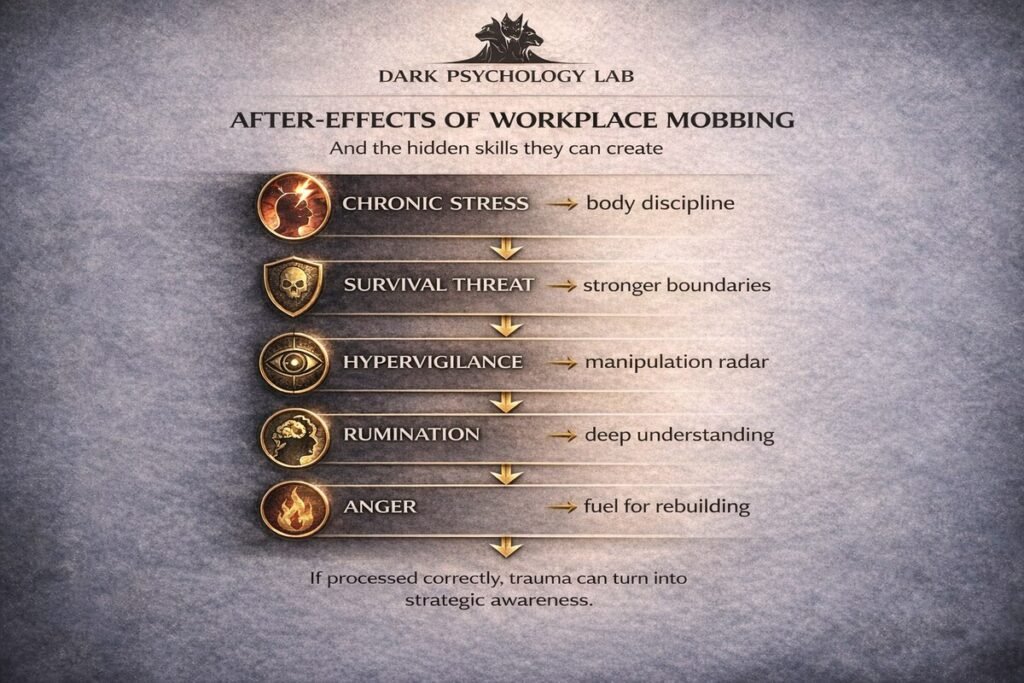
Common After-Effects of Workplace Mobbing
Many people experience a similar set of psychological and physiological reactions after workplace mobbing.
The most common include:
- Chronic stress response
- A sense of existential threat
- Hypervigilance
- Rumination
- Anger
The following sections explore each of these in more detail, outline practical steps that may help reduce their impact, and explain the benefits the trauma effect provides.
Source (related): Post-Traumatic Growth framework (Tedeschi & Calhoun, 1996).
1. Chronic Stress Response
Sleep disturbances, physical tension, chills, heart palpitations, digestive problems, headaches, loss of appetite, and sometimes a stronger pull toward unhealthy habits.
After prolonged workplace mobbing, the body can remain stuck in a fight-flight-or-freeze state long after the situation itself has ended. For some people, this lasts months. In certain cases, it can take a year or even longer.
For a while, your body may simply function differently than it used to. It is your operating system. If you neglect it, it will begin to pull down every other part of your life. That is why recovery often begins with stabilizing the body first.
Practical steps
1. Sleep
To stabilize the nervous system, try to return to a consistent daily rhythm. Go to sleep at roughly the same time each night and wake up at the same time each morning. A stable routine helps the nervous system gradually calm down.
2. Nutrition
Try to eat at least three times per day, or as often as your body needs. Focus on nutrient-dense, good-quality food. Your body will thank you for it.
In some cases, supplements may also help support recovery from chronic stress. Common ones include:
- Magnesium (often taken in a slightly higher dose before sleep)
- B-complex vitamins (in moderation, too much can sometimes worsen sleep)
- Vitamin D (especially during winter when sunlight is limited)
- Omega-3 fatty acids (support overall physiological health)
- Ashwagandha (lowers stress hormones, has a positive effect on neurotransmitters, and the nervous system)
Source: Stress, Nutrition, and the Role of Micronutrients in Stress Management — M. S. Maher et al. (Nutrients, MDPI) (Published 2020).
3. Physical activity
Regular movement helps regulate the nervous system. In many ways, it acts like a form of meditation. If focusing on breathing exercises feels difficult, physical activity can force the brain to shift its state.
Examples include:
- Gym training
- Running or other cardio
- Long walks
If you were not physically active before, even simple walking is already a strong starting point, especially in nature.
These simple actions help stabilize the nervous system, circulation, and reduce the physiological symptoms of stress.
Sometimes the simplest things work the best.
Are There Any Benefits to a Chronic Stress Response?
If you manage to implement even one or two of these steps or perhaps all of them, there is a good chance you will learn to take better care of yourself and maintain a healthier routine.
Over time, this means learning to regulate your body more effectively, even under stressful conditions.

In the long run, that skill alone can significantly improve your quality of life.
2. The Sense of Survival Threat
The feeling of existential threat after mobbing. The collapse of self-esteem can begin to feel like the collapse of identity itself. It stops being “someone treated me badly” and becomes “I became nothing.” Fear may appear: “What if other people find out?”
Sometimes a person continues living in the same city, or even near the former workplace. But even if that is not the case, the modern world is highly transparent. Social networks and platforms like LinkedIn can create the impression that everything is visible and public.
Because of this, the sense of threat can feel very real. And in many cases, it is not completely imaginary.
However, there is one important truth: for most people, what happened to you is usually far less important than it feels internally unless they had a strong emotional connection to the situation.
Practical steps
1. Evaluate the situation realistically
Toxic organizations often care deeply about protecting their external reputation. If the conflict occurred within a corporate environment, the likelihood that toxic individuals will continue to actively discredit you outside the company is usually quite low.
Why?
Because outside the organization, it is no longer their territory. They have far less power than they did within the company’s internal politics, and they may be more vulnerable in those settings.
2. Social media anxiety
Sometimes it may feel like someone is watching your profile. You might notice things like “Private mode viewers” or anonymous profile views.
If this creates tension, the simplest solution can be distance:
- Block toxic individuals.
- Remove connections related to that environment.
- Temporarily set your profile to private.
- Avoid sharing personal updates for a while.
This can create space for calmer recovery.
3. Living in the same environment
If remaining in the same city or social environment feels extremely difficult, one option is a form of hard no-contact.
Some people choose to change professions, cities, or even countries. This is not necessary for everyone, but in certain situations, it can significantly help recovery.
The most important factor is that you feel safer.
4. Caution in a new workplace
If you notice stronger self-protection or doubt in a new job, that is normal.
In the beginning, it may help to keep a slightly more professional distance:
- Fewer personal details
- More professionalism
- Clearer boundaries
Communication techniques designed to deal with manipulators can also be technically helpful during the early stages of recovery, even when interacting with ordinary people.
Article: Psychological Manipulation Defense: Safe Strategies and Dangerous Tactics Explained
This kind of “hard” distancing often helps in the early phase. Over time, the situation usually becomes less emotionally important.
At your own pace, you can gradually open up again and be yourself.
Are There Any Benefits to the Survival-Threat Phase?
At first, this idea may sound absurd: “They tried to publicly and professionally destroy me, humiliate me, and now you’re suggesting I should look for positives in that?”
That reaction is completely understandable.
However, sometimes searching for meaning in difficult experiences can shift a person from a reactive state into agency, from simply reacting to events toward actively shaping what comes next. Psychological research shows that this shift can help in recovery (Minibas-Poussard, 2025).
Over time, you may learn to:
- Recover faster after difficult situations.
- Change environments or relationships when they become toxic, without second-guessing.
In the future, it will become much harder for external situations to knock you completely out of balance.
Sometimes, perspective slowly changes. There is an old idea:
“There are no mistakes — only lessons.”
3. Heightened Sensitivity
What is hypervigilance?
Hypervigilance is a state of increased alertness in which the nervous system constantly scans the environment for possible threats. A person may begin to react very sensitively to other people’s tone of voice, facial expressions, or subtle signals, even when there is no real danger present.
Source: Hypervigilance — APA Dictionary of Psychology (Updated on 04/19/2018).
In this state, it can feel as if you are constantly “scanning” the environment: watching people’s reactions, their tone of voice, and their body language even unconsciously.
Because this is closely connected to the fight-flight-or-freeze response, other people may sometimes notice it. Body language, tone of voice, or sudden reactions can reveal that the nervous system is still operating in threat mode.
What can help
1. Stepping back
When you sense a potential threat, it can be helpful to simply step away. While your system is still recovering, this is often one of the most effective strategies. Reduce contact with people or environments that trigger stress.
2. Breathing
Slow, controlled breathing can help the nervous system return to the present moment. It is a simple but powerful way to reduce physiological tension.
3. Writing things down
Keeping notes can help you analyze your reactions. You might ask yourself questions such as:
- “Why am I reacting this way?”
- “What systems are active here?”
- “What could I do differently next time?”
Over time, this process often leads to a better understanding and greater control over your responses.
Are There Any Benefits to Hypervigilance?
In some ways, it can feel as if you have developed a kind of manipulation radar.
This is a skill that many people would never develop if they had always lived in calm environments and had never encountered manipulative dynamics.
In the future, this heightened sensitivity may help you:
- Make better decisions.
- Recognize toxic individuals earlier.
- Detect dishonesty more easily.
- Avoid harmful relationships.
- Choose partnerships or collaborations more carefully.
Your “situational awareness” expands. You begin to notice subtle signals and small behavioral patterns that might have passed unnoticed before.
4. Rumination: The Endless Negative Inner Dialogue
Rumination is a state in which thoughts begin to circle endlessly. The mind replays painful events again and again through internal dialogues and repeated mental scenes. At the same time, people often experience reduced concentration and difficulties with executive functions, which can make it hard to read, write, or stay focused.
Source (related): Thinking too much: rumination and psychopathology — Ehring & Watkins (Nature Reviews Psychology/review via PMC) (Published 2021).
Emotional swings or brief panic episodes may also appear. Feelings of shame (“I was humiliated”) or guilt (“Maybe it was my fault”) are common.
This state can be extremely exhausting. In fact, rumination is one of the main reasons why the psychological effects of mobbing often take so long to fade. The mind keeps pulling you back into the past by replaying the same events.
Because of this, it is often one of the areas that requires the most conscious work during recovery.
Practical steps
1. Analysis and understanding
Learning about the situation and studying the mechanisms behind it may initially bring the mind back to the past more often. However, over time, being able to name the processes and understand the dynamics often removes a large part of their negative impact on the nervous system.
2. Talking about it
One way to release internal tension is to talk about what happened.
However, repeatedly telling the same story to close friends or family members is not always the best solution. Even supportive people may eventually become emotionally overwhelmed, and you may unintentionally transfer your emotional burden to them.
It is often more helpful to choose spaces that exist specifically for this kind of conversation.
For example:
- Psychologists or therapists can help structure both the events and the emotions.
- Support hotlines: often staffed by people who understand similar experiences.
- Forums or communities: sharing your story may help both you and others.
3. Activity
Small tasks and activities can help redirect attention. When the mind is occupied, it has less space to repeatedly return to the same painful thoughts.
4. Creative expression
Creative activities such as drawing, writing, video creation, or photography, or whatever suits you, can provide a healthy outlet for internal tension.
When people engage deeply in creative activity, processes related to the vagus nerve and emotional regulation often become more active. From a psychological perspective, creative expression is frequently considered one of the more effective ways to regulate emotional stress.
Source: Heart Rate Variability and Cardiac Vagal Tone in Psychophysiological Research — Laborde, Mosley, & Thayer (Frontiers in Psychology) (Published 9 Feb 2017).
5. Group support
Many people avoid talking about these experiences because they feel ashamed. But you are not alone. Statistically, around 17.9% of employed people worldwide report experiencing psychological violence or harassment at work at some point in their lives (Foundation & Gallup, 5 December 2022).
Finding a supportive group or community can significantly help the recovery process.
Are There Any Benefits to Rumination?
Sometimes this difficult process can lead to unexpected discoveries.

People may find new interests, meet new individuals, or even discover a sense of purpose or mission that genuinely matters to them.
Over time, perspective often changes. One may begin to see the situation differently: what are a few hostile individuals?
On the scale of the world, almost nothing.
5. Anger, Hatred, and the Desire for Revenge
After workplace mobbing, anger can become very intense. It may appear as revenge fantasies, constant analysis of the situation, or a strong desire to prove that what happened to you was unjust.
Anger itself is not abnormal. The important question is where you direct it.
If anger is expressed through revenge, public confrontation, or attempts to harm others in illegal ways, it may ultimately damage your own life. Because of this, the key is to channel that energy in a constructive direction.
After mobbing, anger often comes in waves. And it carries a large amount of energy.
In practice, two different narratives often appear:
- The revenge narrative: “I will show everyone who they really are.”
- The recovery narrative: “My goal is to rebuild myself and become better.”
Are There Any Benefits to Anger?
Anger can become fuel for rebuilding your life: exercise, creative work, learning, discipline, and structure. But if anger becomes the only driving force, it can keep you psychologically tied to those people for much longer than necessary.
The Recovery Narrative: Healthy Aggression
There may come a moment when you feel strong anger and a desire to fight back. If you decide to fight, do so legally and strategically.
One thing to understand: you may need to learn their language.
- Companies speak in corporate language.
- Lawyers speak in legal language.
This is a different level.
If you choose to confront the system, understand that it may cost a lot:
- Time (6 months? 5 years?)
- Emotional energy (Hire a lawyer? Document? File a complaint?)
- Financial resources ($5,000? $30,000?)
In such a situation, you are essentially challenging an entire structure. Because of that, it is important to prepare at least minimally:
- A social support network
- Legal backing
- Communication skills
- Financial stability
- Emotional discipline
In practice, the energy that comes from anger is far more useful when directed toward your own growth and personal goals.
Why this matters
Manipulative individuals often distort facts. In a legal environment, it becomes harder to manipulate emotions in the same way as in a workplace environment.
However, they may still attempt to:
- Keep facts unclear
- Delay processes
- Search for your weak points
If you enter such a situation unprepared, you may accidentally cause more damage to yourself. Unless you are absolutely certain that nothing about you can be used against you.
It is also worth remembering something important: attacks like workplace mobbing usually begin when the other side believes that defending yourself will be difficult.
FAQ
1. Why do I feel “broken” after mobbing, even though I already left?
Because the body often remains in a threat-response mode (fight/flight/freeze). Leaving the workplace removes the source of the stress, but the nervous system still needs time to return to a state of safety.
2. How long does recovery after mobbing take?
For many people, it takes months, and after long-term mobbing, it can take a year or more. In rare cases, it may take even longer. Recovery often happens in waves: better weeks may be followed by more difficult ones. This does not mean you have gone back to the beginning.
3. Why do thoughts and internal dialogues still keep coming back?
This is often a “conflict that has not been closed” in the mind and an attempt to regain a sense of control. Some people find it helpful to set a limited “rumination window” (for example, 15 minutes per day), write their thoughts down, and redirect attention toward physical regulation and present-moment activities.
4. Why did my self-esteem collapse so much?
Mobbing frequently operates through social shame, reputation damage, and isolation. When a group begins to behave as if you are the problem, the brain interprets this as a threat to status and belonging.
5. Is it worth documenting everything?
If you plan to pursue an official complaint or legal path, documentation can be very important. However, it should remain “cold”: dates, facts, witnesses, screenshots, and emails. If documenting every detail increases anxiety or paranoia, it may help to set limits and collect only what is truly necessary.
6. What should I do if rumors follow me to a new workplace?
Avoid emotional confrontations and do not try to defend yourself broadly in every direction. Keep communication professional, demonstrate stable behavior, avoid sharing vulnerable personal details, and rebuild your reputation through consistent work and calm professionalism.
Conclusion: Life After Mobbing
Mobbing tries to reduce you to a “problem.” Recovery is the process by which you return to your real self.
Not to prove something to them. But to live again, sleep again, work again, and breathe without their shadow over your life.
Sometimes the greatest victory is not defeating the system but simply leaving it and reclaiming your life.
Recommended Reading for Self-Recovery
How to Stop Worrying and Start Living — Dale Carnegie
A classic self-help book with practical advice that remains relevant today. It focuses on dealing with worry, stress, and everyday mental pressure.
🎧 Audiobook: Listen on Audible
12 Rules for Life: An Antidote to Chaos — Jordan B. Peterson
A book about responsibility, life structure, and developing a stable attitude toward chaos. It also explains several biological and psychological mechanisms in an accessible way.
🎧 Audiobook: Listen on Audible
The Archetypes and the Collective Unconscious — Carl G. Jung
One of Jung’s most influential works. It explores archetypes, the shadow, and the deeper processes of psychological transformation.
🎧 Audiobook: Listen on Audible
The Red Book — Carl G. Jung
A more symbolic and complex work by Jung, intended for deeper reflection and a different perspective on inner change and personal transformation.
🎧 Audiobook: Listen on Audible
The Hero with a Thousand Faces — Joseph Campbell
A book that analyzes the universal structure of the Hero’s Journey, a pattern that appears in myths, legends, and modern storytelling.
🎧 Audiobook: Listen on Audible
Sometimes good books help people see their own story from a wider perspective and understand that difficult phases of life are not the end. They are often the beginning of a new path.
Dark Psychology Lab Psychological Defense Guides
Collective psychological pressure can be addressed using structured defense strategies. The following resources outline practical approaches:
Manipulations
Practical Defense Guide: Psychological Manipulation Defense: Safe Strategies and Dangerous Tactics Explained
Narcissism
Practical Defense Guide: How to Deal With a Narcissist and What to Do When You Can’t Leave
Workplace Mobbing and Toxic Workplace Culture
Practical Defense Guide: Workplace Mobbing Defense Playbook: 17-Step Guide
Disclaimer
This article is intended for educational and informational purposes only. It reflects general psychological concepts and personal interpretations of workplace mobbing and recovery.
It is not a substitute for professional psychological, medical, or legal advice. Every situation is unique, and readers should make their own decisions based on their personal circumstances.
If you are experiencing severe psychological distress, ongoing harassment, or safety concerns, consider seeking support from qualified professionals such as licensed therapists, legal advisors, or relevant support services.
The responsibility for personal decisions and actions always remains with the reader.
For additional details, please review our full disclaimer page.
Dark Psychology Lab
Original content based on lived experience and independent psychological analysis.