

Recognition and Self-Defense Guide
This guide focuses on workplace situations where a person exhibiting narcissistic traits enters the devaluation phase and disengagement is not possible.
The term “narcissist” in this article refers to observable behavioral patterns, not a formal psychological diagnosis.
The sections below outline practical defense strategies drawn from workplace research and direct observation of covert and malignant narcissistic behavior. If there is a significant power imbalance, assess risks realistically before applying any strategy.
Narcissists in the Workplace
Their Value to the Organization
It is important to acknowledge that individuals with narcissistic traits are often useful to companies. They are frequently well established within organizational structures and can function effectively in toxic environments, sometimes ones they helped create.
A moderate level of narcissism can help a leader rise within a hierarchy and manage decisively. In such settings, aggressive behavior may gradually be reframed as “high standards” or “strong leadership.”
Source (related): Narcissistic Leaders: The Incredible Pros, the Inevitable Cons – Harvard Business Review (January 2004)
Their traits that may benefit the organization:
- Decisive and often harsh decision-making: reduced empathic concern may make it easier for such leaders to terminate employees or implement cost-cutting measures without visible emotional hesitation.
- High standards and ambitious goals: their competitive drive and intolerance for stagnation can drive company growth and performance.
- Charisma and persuasive communication: they can attract new clients effectively and shape a strong public image for themselves and the organization.
- Emotional stability in chaotic situations: narcissists usually display lower neuroticism, which may increase stress tolerance, allowing them to remain composed during critical moments.
The Damage They Cause
While a moderate level of narcissism may benefit performance, excessive narcissism can become destructive. As these traits intensify, they may corrode organizational culture, accelerate employee turnover, and in severe cases jeopardize the organization’s long-term viability.
Such personalities often initiate or tolerate:
- Psychological abuse and systematic targeting of individuals.
- An internal structure in which workplace mobbing functions as an informal dismissal system.
Who Is Most Affected?
- Direct subordinates: They may become a “narcissistic resource” or a target onto whom the narcissist projects failures, insecurity, and emotional instability.
- High-potential employees: Narcissists often experience intense envy toward competent or well-liked colleagues. In order to preserve dominance, they may isolate, discredit, or push these employees out of the organization. This frequently results in large-scale talent loss, sometimes described informally as a corporate “blood bath,” sudden and ruthless systematic purge of employees, a narcissistic discard phase at work.
Why This Article Is Necessary: Recurring Workplace Patterns
If you are reading this, you have likely noticed recurring toxicity in your workplace. Similar situations unfold across different organizations and industries.
What looks like a “difficult personality” is often persistent narcissistic behavior. In some organizations, it becomes part of the toxic workplace culture and is quietly reinforced.
Sources (related):
Leader Narcissism and Outcomes in Organizations: A Review at Multiple Levels of Analysis and Implications for Future Research – Frontiers in Psychology (2017)
Nothing personal, it’s the organization! Links between organizational culture and workplace bullying – Frontiers in Psychology (2024)
Principle One: Winning Means Remaining Yourself

Most people make the same mistake. When engaging with a narcissist, they assume the interaction will lead to mutual understanding and constructive dialogue.
However, collective experience shows:
- They do not see you as an equal unless you occupy a higher position in the hierarchy.
- Their goal is control, status, and recognition, not truth or shared results.
The purpose of the following techniques is to reduce the damage zone and help protect your nervous system.
Useful Techniques during Devaluation Phase with a Narcissist in the Workplace
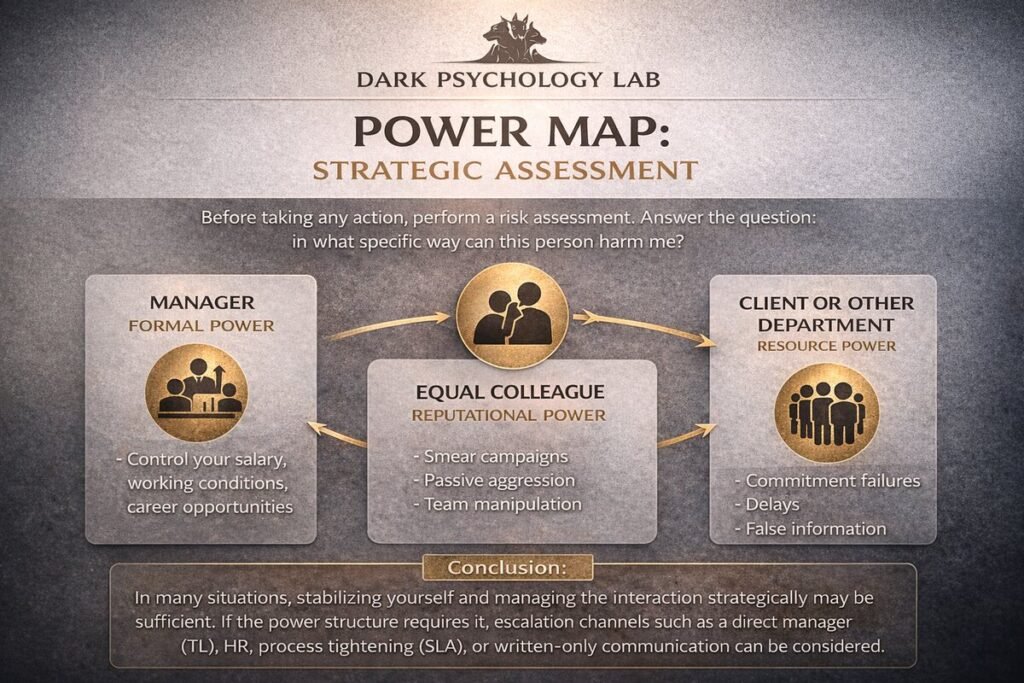
1. Power Map: Strategic Assessment (DPL)
Before taking any action, perform a risk assessment. Answer the question: in what specific way can this person harm me?
- If it is a manager (formal power), they control your salary, working conditions, and career opportunities.
- If it is an equal colleague (reputational power), they can cause harm through smear campaigns, passive aggression, or manipulation of the team’s opinion.
- If it is a client or another department (resource power), the harm may appear through failure to fulfill commitments, intentional delays, or false information about your work.
Conclusion: In many situations, stabilizing yourself and managing the interaction strategically may be sufficient. If the power structure requires it, escalation channels such as a direct manager (TL), HR, process tightening (SLA), or written-only communication can be considered.
2. Recognition of the Narcissistic Model (Cycle)
Narcissistic relationships almost always follow the same repeating model, more about it in our article: Narcissistic Supply. Knowing which stage you are can be your greatest advantage.
- Idealization phase (Love bombing): At the beginning, the narcissist shows charm, pulls you in, praises your competence, and mirrors your needs.
- Devaluation phase: Aggression increases (often passive-aggression), mood instability grows, emotional distance appears, communication starts to break down, and the more damaging manipulations begin. You may start to feel constantly guilty.
- Discard phase: Open contempt, disregard, and aggressive discrediting. You become unnecessary or dangerous to their image.
- Return phase (Hoovering): A refusal to fully let go of the target. This may look like “mobbing with a smile”: “It is a shame you are leaving, you were a good employee,” or a phone call after six months or later, offering cooperation again.
Why does this work? When you understand that the narcissist’s “charm” or “anger” is only part of the cycle, and not a reflection of your value, you may stop reacting emotionally.
3. Boundaries as Process, Without Drama
A boundary works only when it is procedural, not emotional. The less they know, the fewer levers they have against you.
- Focus all attention on the task scope, quality criteria, and deadlines.
- Protect your privacy: do not share personal problems, past trauma, relationship history, or your vulnerabilities.
- Applying Techniques Against Manipulation – communication techniques: BIFF, JADE, BEAR. We covered in depth strategies that can be useful when facing manipulators in the workplace and beyond in our defense guide: Psychological Manipulation Defense: Safe Strategies and Dangerous Tactics Explained
Why does this work? Narcissists are skilled at shifting attention from work results to your personality or emotions. When you turn boundaries into work processes, you remove their ability to dig into your feelings and force the interaction back to dry facts, where there is less room for manipulation.
4. Triangulation Defense and Audience Management
Goal: prevent the manipulator from distorting information by using other people.
- When third parties are pulled into the conflict, respond calmly, factually, and, if possible, publicly in a shared email thread or meeting.
- The goal is not to prove to the narcissist that they are wrong, but to document the accurate narrative for the audience managers and colleagues.
- Template: “So that everyone is clear and we see the same picture: here are the facts, here are the deadlines, and here are the assigned responsibilities.”
Why does this work? Narcissists thrive on the “broken telephone principle”. When information is presented transparently and publicly, they lose space to create false interpretations behind your back.
5. Neutralizing the “Silent Treatment”
Goal: do not allow the narcissist to emotionally torment you through ignoring. If they ignore you, try to suppress your emotions or dissatisfaction, continue making decisions and completing tasks without them as professionally as possible.
- Do not send dozens of messages and do not ask, “What happened? Why are you silent?” This will only feed their ego and give them a sense of power.
- Move to a strictly formal communication channel and set a boundary: If there is no X, then there will be Y.
- Template: “In order to move forward, I need your confirmation. If I do not receive it by 12:00, I will proceed according to plan Y.”
In rare cases, this can be used as a basis for gaslighting or escalation of a smear campaign if done incorrectly or with emotions involved.
Why does this work? You continue making decisions without waiting for their approval. This shows that the narcissist’s silence has no impact on your work or emotional state. When the “punishment” no longer works, the manipulator loses a primary tool.
6. Micro Allies. Witness Mode (Prevention)
Goal: maintain a healthy connection with the community and prevent the narcissist from isolating you and creating “he said / she said” situations.
- Identify 1 to 2 colleagues who value facts, communicate in a healthy way, and with whom you are able to work constructively. This helps ensure that you are not left alone against the narcissist and their “flying monkeys.”
- Address critical issues only in the presence of a third person, such as a team leader, project manager, or colleague.
- For “difficult” conversations, choose more public spaces or send official calendar invitations that include other participants.
Why does this work? It becomes much harder for the narcissist to shape a negative image about you when other team members have direct, positive, and professional experience working with you. Allies function as your social “armor.”
7. Escalation to HR or Management: Behavior, Not Labels
Before escalating the situation to HR, we strongly recommend reviewing our article: Workplace Mobbing Defense Playbook: 17-Step Guide.
It is important to understand that narcissists are often financially useful to the company, and HR most likely will not solve relationship problems, which means leadership may tolerate their toxicity.
Warning: A narcissist who feels exposed often begins a revenge response (narcissistic injury). They may attack you more aggressively, attempt to discredit you, and use intensified psychological pressure. Manipulators are skilled at distorting facts; confrontation through HR may often not end in your favor.
If you still decide to approach HR or management:
- No diagnoses: Do not use labels such as “narcissist,” “toxic,” or “manipulator.” These sound subjective and unprofessional.
- Speak in terms of benefits and costs: usually, HR and CEOs care about the company’s profit and image, not your emotions. Emphasize risks to the project, team productivity, or potential financial loss.
- Formula: Their behavior → Impact on the company profit → Action recommended.
Example: “Employee X systematically delays providing information (behavior), as a result, the team is delayed on stage Y (impact), therefore, I request clearer accountability procedures (action).”
Why does this work, and why is it risky?
While leadership can address process failures, you must understand that escalation may intensify the interpersonal conflict.
8. Strategic Pattern Mapping (DPL Protection Focus)
Beyond recognizing the emotional cycle, it is essential to identify the recurring strategies behind it.
Narcissistic behavior often follows predictable patterns. The more clearly you understand these tactics, the less personally you are likely to interpret them.
A deeper breakdown is available in our article How to Deal With a Narcissist and What to Do When You Can’t Leave.
Not sure if you’re being manipulated? Take a test. Press a button below, sign up for Dark Psychology Lab, and we will send it to your email.
Harmful Tactics (For Recognition Only)
Sometimes you can find advice on how to manipulate, improve the relationship, or use a narcissist to your advantage, especially in the workplace when leaving quickly is not a simple option. In this section, these tactics are analyzed only so that you understand the mechanism. We do not recommend using these strategies.
Supporting Research:
Influence Strategies/Tactics in the Workplace – Oxford-style lecture notes / compiled academic sources, PDF (2021).
Exposure to Workplace Bullying: The Role of Coping Strategies in Dealing with Work Stressors – International Journal of Environmental Research and Public Health (PMC) (2017)
How do I get my way? A meta-analytic review of research on influence tactics – The Leadership Quarterly (2017)
1. Becoming a “Useful Resource”
Sometimes it is suggested to allow a narcissistic manager or colleague to believe that your idea came from them, or simply to give them the credit.
- Mechanism: this feeds their pathological need for control and recognition.
- Short-term effect: direct friction may decrease. You may enter a “favor zone” or become part of the inner circle.
- Long-term costs: you lose professional visibility, authority, and the strength of your position within the organization.
Risk level:
🟨Medium — If you do this intuitively, without understanding.
🟥High — If this becomes a conscious and consistent strategy.
⬛Very High — Significant damage to self-esteem when you eventually realize that you were used solely as a source of ego validation for another person.

2. Controlled Compliment
This is a moderate use of validation in order to improve the communication or relationship. In some cases, the self-esteem of a narcissist critically depends on reactions from the environment.
- Mechanism: the narcissistic person regulates their internal state through external validation (EGO boost).
- Short-term effect: fewer open conflicts. Superficial charm and favor from the narcissist may appear.
- Hidden risk: constant validation reinforces a strict hierarchy. You stop being an equal partner and become an “audience” for their performance.
🟨Medium — If compliments are sincere and match reality.
🟥High — If this becomes a conscious strategy to gain approval, strengthening your dependence on their emotional stability.
⬛Very High — In the devaluation phase, this may accelerate the reduction of your value in the narcissist’s eyes and dangerously worsen their behavior.
3. Unconditional Agreement
Conscious avoidance of disagreement in an attempt to please or to prevent escalation at any cost.
- Mechanism: For a narcissistic person, any disagreement is perceived as a threat to their authority, which triggers a strong defensive reaction. The agreement temporarily “extinguishes” this fire.
- Short-term effect: A surface-level stability and an illusion of calm are created.
- Long-term impact: Continuous self-suppression, growing internal tension, and eventual transfer of power to the other side. The relationship becomes completely distorted.
Risk level:
🟨Medium — If this is simply your personality trait, and you do not yet understand the narcissistic dynamic.
🟥High — If this is applied in long-term professional relationships.
⬛Very High — If you respond to increasingly worsening behavior with more concessions, this is interpreted as an expansion of your tolerance limits, and inappropriate behavior becomes the “new normal.”
4. Competence Without Competition
Demonstrating your value while continuously emphasizing the narcissist.
- Mechanism: Narcissistic personalities need a valuable “audience,” but may react pathologically to competition. By highlighting your usefulness while denying ambition, you can temporarily calm their insecurity.
- Short-term effect: Conditional tolerance and stability. You can be seen as “useful.”
- Long-term risk: You begin to consciously reduce yourself and suppress your potential, which can directly damage your self-esteem and professional growth.
Risk level:
🟥High — With increased familiarity, particularly after emotional closeness develops, the narcissistic supply mechanism may become activated.
⬛Very High — Over time, it can lead to a devaluation phase.
Behavior Not Recommended When Working with a Narcissist
Working with a narcissist is a constant balance between benefit and power. It is important to understand that they often show limited empathy. What appears as their “sincerity” is often acted or simply your own projection, an attempt to see goodness where it does not exist.
The biggest mistakes when working with a narcissist
- Waiting for them to change: Expecting empathy or genuine behavioral change is futile.
- Narcissists often show limited capacity for sustained self-reflection.
- If the devaluation cycle has started, it rarely stops.
- In many cases, waiting only increases psychological harm.
- Direct confrontation, such as “You are a narcissist”: This is one of the most dangerous mistakes. It can drastically worsen the situation and may be followed by disproportionate rage and attempts to destroy you professionally.
- Trying to negotiate logically and rationally: This is the most common mistake. In high-conflict situations with a narcissist, logic alone does not work.
- Open confrontation without evidence or in an emotional state: Without solid facts, you can receive a DARVO response and become labeled as a “problem employee.”
- Moralizing and offering empathy: Expecting fairness from someone who consistently prioritizes self-interest over mutual standards may lead to disappointment.

Checklist: Are you in the Devaluation Phase at Work?
A narcissistic person at work usually uses an entire “package” of manipulation. Their behavior often repeats the same patterns:
- Gaslighting (distortion of reality, see: What is Gaslighting?): Paranoia about mistakes, “strange” errors appear, and you can begin double or triple-checking everything.
- Loss of clarity: you no longer clearly see when the person is lying and when they are telling the truth.
- Provocations: you experience harassment, inappropriate flirting, or direct insults.
- Silent treatment / Stonewalling: Deliberate ignoring or blocking of information as punishment. Communication becomes increasingly difficult. This form of passive aggression is also a strong early indicator of the covert or vulnerable type narcissist.
- DARVO (our article: Deny, Attack, and Reverse Victim and Offender): When you present a fact or constructive criticism, they deny it, then attack you, and finally reverse the roles by presenting themselves as the victim and you as the offender.
- Smear campaign: Quiet and systematic damage to your reputation through gossip behind your back.
- Triangulation: Involving third parties such as colleagues or managers in order to strengthen their position and further damage your reputation.
- Flying monkeys: Intermediaries or supporters persuaded by the narcissist and used as tools to pressure or monitor you.
- Use of information or trauma: Your openness or personal boundaries are turned into leverage and later used as punishment or control.
If you recognize at least 3 to 4 of these signs in your environment, it is likely that you are dealing with a person who has narcissistic traits and malicious intent.
Escalation Warning: It is Normal
Removing reactions, the emotional “fuel,” often causes a short-term escalation of aggression known as an extinction burst. The narcissist feels that control is being lost, so they can try to regain it by pressing your “buttons” more intensely.
What does this mean in practice? During the first 1 to 3 weeks, it may seem that your strategy is not working. In reality, this is often a sign that it is working very well. You removed their leverage of control, so they desperately search for new entry points.
Core Idea
When dealing with a narcissist, the best prevention and remedy is distance. The best strategy is not to allow them into your personal space, your thoughts, or your emotional world.
Conclusion: What Is Real “Success”?
Real success is not controlling or changing the narcissist.

It is the ability to build a career in an environment where your work is evaluated objectively, where growth opportunities exist, and where your nervous system is not under constant pressure.
In many cases, the problem lies not only in one individual but in a broader organizational model. If you want to understand how toxic workplace culture becomes “normal” and why some companies quietly tolerate it, read:
Workplace Mobbing: Signs, Tactics, and the System Behind It
Disclaimer and Responsible Use Notice
This article is a behavioral analysis guide focused on recognition and self-defense in workplace environments involving narcissistic traits. It is not a diagnostic tool and does not determine whether any individual has Narcissistic Personality Disorder or any other clinical condition.
The information provided is educational and informational in nature. It is not therapy, legal advice, medical advice, or a substitute for professional consultation.
Workplace conflicts can arise from many factors, including stress, structural problems, leadership gaps, and communication failures. Not every difficult person or high-conflict situation is the result of narcissistic pathology.
If you are experiencing threats, harassment, retaliation, or severe psychological distress, prioritize your safety and seek professional legal or medical support.
The strategies described in this guide are defensive in nature. They are designed to reduce damage and increase clarity. Outcomes may vary depending on power imbalance, organizational structure, and individual circumstances.
Dark Psychology Lab does not encourage retaliation, harassment, or manipulative counter-tactics. Recognition is for protection, not escalation.
Use this material responsibly and assess risk realistically.
For more details, please see our full Disclaimer page.
Dark Psychology Lab
Original content based on lived experience and independent psychological analysis.
If reading feels exhausting right now, audiobooks can be an easier way to absorb information.
Listen on Audible