

Gaslighting is a form of psychological manipulation designed to make you doubt your own perception. It is a deliberate attempt to create confusion, which provides leverage for the manipulator’s control.
Because of its covert nature, its effects often feel like constant anxiety and brain fog caused by attempts to piece together details of events that were fragmented from the very beginning. Over time, the mind can become trapped in what may be described as a “kingdom of broken mirrors,” where every reflection is distorted.
Britannica describes gaslighting as an insidious form of deception and psychological manipulation that gradually undermines a person’s confidence in distinguishing truth from falsehood, often making the target more dependent on the gaslighter.
Sources: Gaslighting – Encyclopaedia Britannica (Feb. 21, 2026)
DPL does not condone manipulation or teach people how to manipulate. In this article, this insidious manipulation is broken down and analyzed only to make it easier to recognize and defend against it.
The Psychological Mechanism Behind Gaslighting
In the beginning, gaslighting is often very subtle, and people usually do not try to verify the situation. It can look like nothing more than small lies or harmless misunderstandings.
If you have never encountered gaslighting before, this stage may be difficult to recognize at first, but here, you may begin to notice patterns in the manipulator’s behavior and make more cautious assumptions about what kind of personality you might be dealing with.
However, when a person is dealing with a real manipulator operating with hidden intentions, what starts as occasional misinformation may slowly evolve into systematic psychological manipulation. If you are not familiar with how manipulation works, this article explains the mechanism in detail:
The Psychology of Manipulation: Mechanisms, Tactics, and Defense
Over time, small lies turn into a consistent pattern in which facts are distorted, events are reinterpreted, and conversations are subtly rewritten.
Why Is Gaslighting Called Reality Distortion
The term reality distortion may initially sound strange. People who encounter gaslighting usually notice things that look more like ordinary deception: lies, misleading information, and small contradictions that seem intentionally introduced. It may simply look like toxic behavior.
At first glance, nothing appears to literally “distort reality,” but the confusion arises because the human mind is used to logical sequences.
In everyday reasoning, the brain expects a simple structure: a straight line from point A to point B.
Gaslighting interferes with this process.
A manipulator may omit key information, introduce misleading details, or attempt to convince you that the path itself is unclear. The sequence becomes fragmented. Facts no longer connect in a predictable way. This creates cognitive dissonance (Leon Festinger — A Theory of Cognitive Dissonance, 1957).
Cognitive Dissonance as a Core Mechanism of Gaslighting
Cognitive dissonance occurs when two contradictory pieces of information exist at the same time. The brain tends to register unresolved contradiction as a form of psychological tension that pushes toward resolution.
In response, the brain’s threat-detection system can activate. The amygdala, which is responsible for detecting potential threats, becomes engaged. Stress hormones such as cortisol and adrenaline may begin to rise.
Source (related): Understanding Emotions: Origins and Roles of the Amygdala — Biomedicines / MDPI (2021).
This mechanism is one of the keys to understanding gaslighting.
Much of the destructive effect often described as “reality distortion” works through repeated cognitive dissonance. The manipulation itself is psychological, but the consequences are biological.
Source: Epistemic Dimensions of Gaslighting: Peer-Disagreement, Self-Trust, and Epistemic Injustice — Philosophical Inquiry / Taylor & Francis (2019).
When this state repeats over time, cortisol levels may remain chronically elevated. Prolonged stress of this kind can have physical consequences: memory may weaken, sleep may become disturbed, immune function may decline, and decision-making may become more difficult.
Source (related): Immunology of Stress: A Review Article — Alotiby, Cureus / NIH PMC (2024).
This helps explain the often-reported feeling of “personality erosion” during prolonged gaslighting. What begins as small lies and contradictions can, over time, lead to significant psychological and physiological strain.
Cognitive Confusion and Self-Doubt
Gaslighting does not need to alter external reality directly.
When a person is repeatedly exposed to deliberate misunderstandings, denials, and shifting explanations, the mind keeps searching for a logical explanation, assuming there must be a reasonable cause, even though the situation was designed to create psychological disorientation in the first place.
The result is confusion, growing self-doubt, and constant mental effort to “figure out what really happened.” Often leading to a cycle of overthinking.
The target may begin to question:
- their own memory
- their interpretation of events
- their emotional reactions
- even their basic judgment
How Gaslighting May Create Emotional Dependence
Over time, the manipulation begins to affect the emotional state. Dependence is slowly created through psychological confusion.
Because a person is constantly exposed to misleading information, the body remains in a prolonged state of stress, which can be removed by the one who created it. If the manipulator sometimes clarifies the facts and sometimes withholds them, a pattern of intermittent reinforcement may develop.
When gaslighting combines with intermittent reinforcement, trauma bonding can develop. This creates a paradoxical attachment where the target becomes emotionally dependent on the manipulator despite ongoing harm. For a detailed analysis of this mechanism, see:
Why You Can’t Stop Thinking About Them: How Intermittent Reinforcement Creates Obsession
Emotional Destabilization
The target may start relying more on the manipulator, trying to verify facts with them, and hoping to receive the truth. This gives the manipulator even more leverage and allows them to distort the situation far more effectively.
At this stage, the mind may already be so exhausted that it becomes difficult to distinguish between what is true and what is false.
When more emotions are involved, a common reaction is that the person begins to resist the manipulator and tries to play the gaslighting game back at them, without fully understanding what they are doing and believing they are refusing to submit to the manipulator’s control. In reality, they are stepping directly into the manipulator’s territory and becoming even more lost in the confusion created by this technique.
Gaslighting can distort reality so severely that people begin defending themselves when there is no threat, and surrendering when they are actually under attack. Lies begin to feel believable, while reality itself becomes doubtful. In some cases, the target may start trusting the manipulator, the very person who is creating the distortion, while losing trust in the people around them.
Isolation Factor
An important condition for this technique to work is isolation.
Some people stay silent and try to process the situation on their own. That is exactly what the manipulator needs.
If the manipulator can limit the target’s access to outside perspectives, while keeping the manipulation subtle enough that discussing it with others may be perceived as delusional, by controlling information, influencing the surrounding environment, or creating social pressure, the distorted narrative becomes much harder to challenge. Without external reference points, the target is left alone inside the manipulator’s version of reality.
In this way, gaslighting does not simply deceive a person. It slowly reshapes the environment in which that person tries to understand the truth.
Gaslighting mechanism formula (DPL):
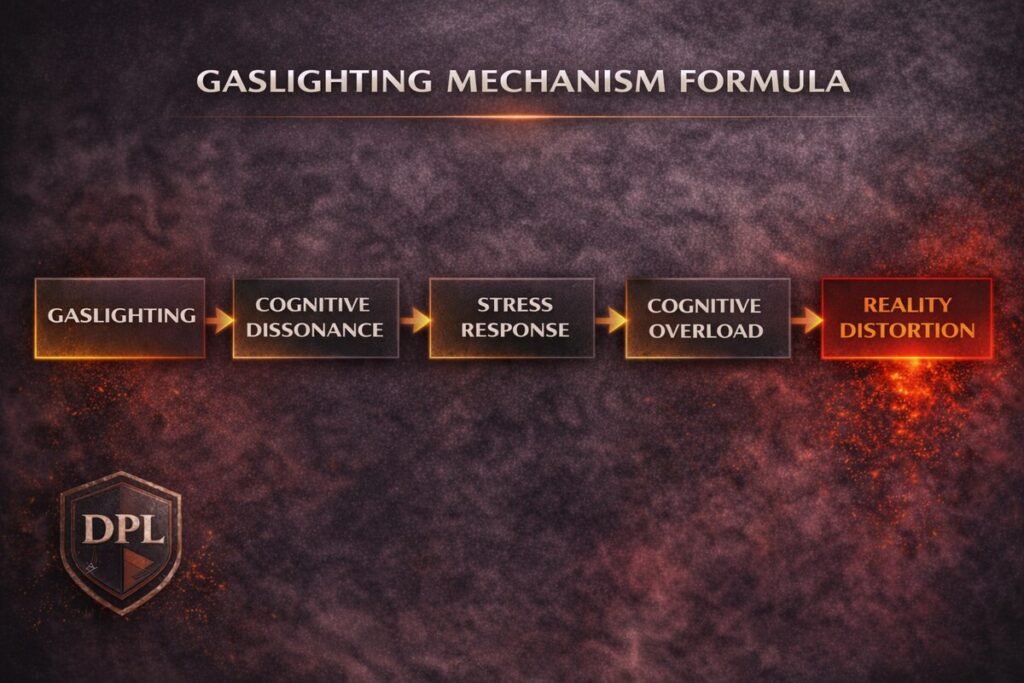
Gaslighting → Cognitive Dissonance → Stress Response → Cognitive Overload → Reality Distortion
Neighbor Joe: A Simple Example of Gaslighting Escalation
Most of us have met someone like Joe, a “funny guy” who lies just to get a laugh. He mixes things up on purpose, misleads people, or leaves out important information. Maybe Joe does not mean serious harm, and this is simply his strange sense of humor. Or maybe he is trying to put you down so he can feel better about himself.

Level 1: Subtle Lies and Dismissiveness
Suppose Joe simply does not care how you feel. On the contrary, he enjoys your confusion. He never corrects his lies and never apologizes. Instead, his words drift further and further away from the facts.
You start checking information with other people. Soon, they begin looking at you as if you misunderstood something simple, because the story you repeat is based on Joe’s distorted version of events.
Joe does this subtly. When you try to clarify things, he never admits the truth. Instead, he dodges the conversation and insists that you simply misinterpreted the situation.
At the same time, other toxic personality traits in Joe may begin to gradually reveal themselves.
Level 2: Power and the Creation of “Fog”
Let’s say Joe gains real power over you. Your quality of life may depend on him, your job, money, social status, or even your family situation. He may even become part of your close social environment.
More inconsistencies begin to appear. Things start disappearing at home. Information becomes constantly unclear.
Joe stays silent. He acts as if he does not understand what you are talking about and shows no intention of explaining anything. Instead, he distorts things even further while denying any involvement.
Over time, you may begin to feel lost in the “fog” Joe has created. Something feels wrong, but you cannot fully explain it because there is nothing that directly proves he is lying.
Level 3: Collective Manipulation and Loss of Reality
Now imagine not one Joe, but five people like him supporting each other.
They all repeat the same distorted version of an event that was not even clear from the beginning, gradually creating a subtle but hostile environment through gaslighting — a situation the brain tries desperately to resolve.
But instead of resolving it, the mind sinks deeper into rumination.
Group dynamics significantly reinforce the isolation process and can amplify psychological pressure by activating deep biological survival responses. This makes gaslighting far more destructive in group settings. More about this in our article:
The Psychology of Group Pressure Escalation in Workplace Mobbing
At this point, Joe has completely confused you.
When Gaslighting Reaches Its Peak
Your mind enters a constant state of anxiety, replaying the events again and again, trying to piece together the puzzle pieces from different puzzles, to arrange the facts into a logical sequence, even though those facts were designed from the start to mislead you.
Over time, your confidence in your own judgment begins to collapse.
This state can be described as cognitive overload (APA, Cognitive overload) — a condition in which brain fog, a social-threat response, and a manipulation effect “FOG” (Fear, Obligation, Guilt) can occur simultaneously as a result of gaslighting. In this state, the brain may struggle to process information clearly, and decision-making becomes significantly impaired.
At this stage, additional pressure is no longer necessary. Despite its subtle, often invisible nature, gaslighting can work surprisingly fast and have highly destructive effects.
Group gaslighting escalation formula (DPL):
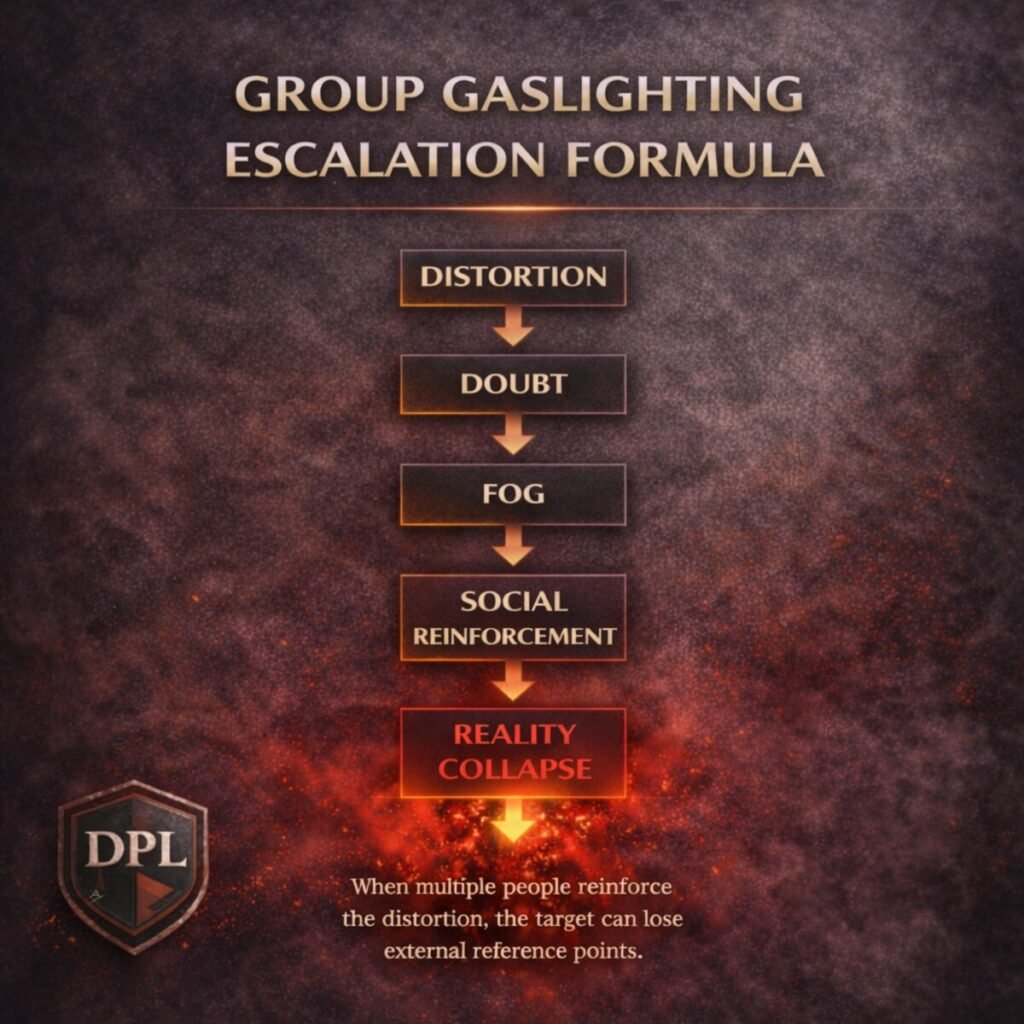
Distortion → Doubt → Fog → Social reinforcement → Reality collapse
What Motivates Someone to Use Gaslighting
What drives a person to behave this way?
- Anger and revenge.
- An unhealthy desire for power.
- The feeling of control?
Gaslighting can function as a form of psychological humiliation. For some manipulators, in certain personality patterns, usually toxic ones, it may provide a sense of satisfaction or dominance. The more you accept their toxic behavior, the stronger they feel, and the more it erodes your self-confidence and self-esteem.
Source (related): Normative Isolation – The Dynamics of Power and Authority in Gaslighting (2025, pp. 146-162)
The technique itself is deeply inhumane. When it continues for a long time, the manipulation slowly eats away at the target’s personality from the inside, destroying their sense of reality and self-understanding.
Conditions That Allow Gaslighting to Work
If a stranger attempted to use gaslighting, the effect would usually be limited. Most people would simply ignore them or stop taking them seriously.
For gaslighting to become truly effective, the manipulator must have some form of leverage — a factor that keeps the target’s attention focused on them. Without such influence, the technique loses much of its power.
Knowing someone well is usually not enough. Several conditions can amplify the effect of this manipulation.
Emotional Attachment
Gaslighting is more likely to succeed when there is an existing emotional connection between the manipulator and the target.
Emotional attachments such as obsession or trauma bonding can concentrate a person’s attention almost entirely on the other person. This creates a significant power imbalance in the relationship and further amplifies the effectiveness of psychological manipulation.
Power Imbalance
Gaslighting becomes far more powerful when the manipulator holds some form of authority or influence in your life.
This can include:
- Hierarchical power: for example, a boss at work or a parent in a family.
- Group support: when several people reinforce the manipulator’s narrative.
- Family or close social ties: relationships that are difficult to walk away from.
For this reason, this reality-distortion technique can be particularly destructive when used by someone in a position of authority, such as a higher-ranking individual in the workplace. One such personality type is examined in detail in our article:
How to Deal with a Toxic Boss Without Confrontation: A Psychological Strategy
Personal Vulnerability and Need for Approval
Gaslighting is also more effective when the target is emotionally vulnerable.
For example, when a person:
- Struggles with low self-esteem or excessive self-criticism.
- Has a strong need for approval and fears rejection.
- Tends to give others the benefit of the doubt, even when warning signs appear.
Many toxic individuals instinctively target these vulnerabilities to assess whether a person is suitable for further control escalation. Techniques such as gaslighting are particularly characteristic of individuals with covert narcissistic traits. One such personality type is examined in more detail in our article:
The Narcissistic Woman: Recognizing Subtle Patterns of Covert Control
When Gaslighting is Most Destructive
Gaslighting causes the greatest damage when it becomes a systematic and prolonged process. The longer a person remains in such an environment, the more distorted the power dynamic becomes, the more confused the target becomes, the more control the manipulator gains.
At its most destructive form, the message underneath may be interpreted like this:
“I decide what is real here, not you.”
Key takeaway: Gaslighting is most effective when several factors combine: a power imbalance, isolation, growing self-doubt, emotional dependency, and prolonged exposure to the manipulation.
Gaslighting leverage chain:
Power imbalance → isolation → self-doubt → emotional dependency → sunk-cost trap
How Gaslighting Feels
A useful comparison here is a deer caught in a car’s headlights. Blinded, it freezes and stares at the light instead of moving. You may sense that something is wrong, try to figure it out, stay precise, calm, and rational, and still end up in a fight/flight/freeze state (Cannon, 1915; Porges, 2011).
Common emotional states that gaslighting creates:
- The nervous system begins to react: Anxiety appears, and the tone of voice may change.
- Small details start to become a source of worry: Self-doubt increases, and actions are repeatedly checked and rechecked. The situation gradually occupies more mental space.
- Mood swings begin to appear: One day, everything seems manageable. The next day, it feels overwhelming. The body senses that something is wrong, while the mind becomes increasingly exhausted.
At this stage, defending yourself becomes extremely difficult because this kind of psychological pressure can only be countered with a clear, grounded, and rational mind, the very thing gaslighting slowly erodes.
Not sure whether you are being manipulated? We have prepared a self-check checklist. Click the button, register with Dark Psychology Lab, and we will send it to your email.
Why is Gaslighting Difficult to Prove
Each incident is small, deniable, and wrapped in everyday interactions. To remain unnoticed, manipulators may use something similar to a “truth–lie–truth” sandwich technique. Example:
“Yes, the meeting happened.” (truth)
“But you misunderstood what people meant. Nobody is against you.” (lie/ distortion/ confusion)
“It was just a normal discussion. Maybe you’re overreacting?” (normalization + blame shift)

Over time, distorted communication breaks down self-trust. The process is quiet, gradual, and difficult to prove or to explain clearly. For this reason, it functions particularly well in politically correct environments and retains its power despite the constraints of social etiquette.
Psychological and Health Effects of Gaslighting
At first, the effects may appear as hesitation and self-doubt. Over time, they can develop into impulsive or emotionally reactive responses, sometimes described as “reactive abuse.”
As the confusion continues, mental chaos sets in. You may notice changes in yourself, such as increased tension, irritability, or impulsive reactions.
The body often accumulates stress, even when the mind does not fully understand why.
If you stay in a manipulative environment long enough, some people begin to develop trauma-like symptoms similar to PTSD: night flashbacks, disturbed sleep, feeling on edge, chills, and old bad habits returning.
Source (related): Cleveland Clinic (Last reviewed 10/06/2023): “Nightmares… Flashbacks… Being easily startled.”
FAQ: Common Questions About Gaslighting
1. What’s the difference between gaslighting and lying?
Lying is about one false statement. Gaslighting is about repeating lies until you start doubting your judgment and double-checking everything, not just the situation.
2. Is gaslighting always intentional?
Not always. Some people lie reflexively or avoid responsibility, or do so to humiliate. Some do not even realize they are using gaslighting in its simplest form. It may be unintentional.
3. Why does gaslighting feel so confusing, even when nothing “big” happens?
Because gaslighting doesn’t rely on obvious events. It works through small contradictions, shifting meanings, and repeated doubt, slowly overwhelming your ability to make sense of what’s happening.
4. Can gaslighting happen in groups?
Yes, and this is when its effect increases and becomes especially damaging.
5. Why do I notice it only later?
Gaslighting is a very subtle form of psychological manipulation. In some cases, it may have a “manipulation-aftereffect”. Clarity often returns only after you distance yourself and reflect on the gaslighter’s behavior.
6. Should I confront a gaslighter?
If confrontation is unavoidable, keep it calm, factual, and minimal. Often, distance and disengagement are the best actions with manipulators. Emotional confrontation usually gives a gaslighter more leverage to twist facts and provoke reactions.
Check Boxes: Am I Being Gaslit?
- You may constantly feel a need to apologize, even when you’re not sure why.
- They deny conversations, facts you clearly remember.
- You feel confused or exhausted after talking to them.
- Communication is difficult with them.
- Your confidence has dropped since knowing them.
- You find yourself double-checking everything that involves them.
- They claim “everyone” agrees with their version.
- You’ve started recording conversations for proof.
- Your body reacts (tension, dread) before seeing or contacting them.
3+ checked = a strong pattern worth examining further
6+ checked = a serious situation, consider creating distance
How to Protect Yourself From Gaslighting

The core formula is simple: provocation + your emotional reaction = their control.
The most effective first step is to reduce emotional engagement, which is the leverage that manipulators use to control.
When you react emotionally, you reveal what can be used against you. Your emotional response becomes a hook: “This is what affects you.”
The inverse is also true: their provocation + your non-emotional reaction = no leverage (or less, considering how gaslighting works).
People who engage in gaslighting actively usually seek emotional responses. The calmer and more professional your behavior, the less control they gain.
If the situation has reached this level, the most effective option is often to remove yourself from the toxic, manipulative environment. Manipulators rarely change.
Many people recommend documenting incidents, and this can be useful in the early stages or in professional settings. Documentation brings clarity into chaos and creates a factual record.
However, prolonged exposure to a gaslighting environment destabilizes emotional regulation and thought processes. As confusion accumulates, even well‑kept records may lose their effectiveness. Depending on the intensity and stage of the gaslighting, documentation alone may no longer protect you.
Practical ways to protect yourself
- Keep responses short and factual. Avoid over‑explaining, giving more information to manipulators, as they often will use extra information against you.
- Regulate reactions before responding. A delayed, neutral response denies the emotional leverage gaslighting relies on.
- If it is safe, set a clear boundary and end the interaction. Simple statements are enough.
- Involve a third party or neutral witness to reduce one‑on‑one manipulation.
- Use documentation early, but do not rely on it as a long‑term solution in chronic gaslighting.
- If gaslighting is persistent, the cleanest defense is distance. This is a severe manipulation tactic and should not be tolerated
Some people are capable of smiling while keeping you at the edge of breaking – distressed, but still functioning. At this point, it may be better to leave a toxic environment.
Source (related): Cleveland Clinic (July 14, 2025): “The longer gaslighting goes on, the more the victim’s relationship with trust… unravels.”
Defense Guides – Practical Self-Protection
Dark Psychology Lab focuses on clarity and self-protection in situations involving manipulation, power imbalance, and covert psychological pressure.
The following defense guides expand on practical mechanisms to reduce psychological damage and regain control:
Psychological Manipulation
Psychological Manipulation Defense: Safe Strategies and Dangerous Tactics Explained
Narcissistic Dynamics
How to Deal With a Narcissist and What to Do When You Can’t Leave
Workplace Mobbing & Toxic Culture
Workplace Mobbing Defense Playbook: 17-Step Guide
Final Thoughts
In lighter forms of gaslighting, it can look almost harmless. Most of the time, these situations leave nothing more than brief confusion, a small psychological bump, unpleasant but not dangerous.
The real damage starts when gaslighting is used intentionally and repeatedly.
When someone uses it to control, maintain power, or mislead you over time, it becomes a tactic of control. After you’ve dealt with a real manipulator, someone who uses gaslighting deliberately to keep you disoriented, the mechanics of this manipulation can start to make sense.
Disclaimer
This article is for informational and educational purposes only. It does not provide medical, psychological, or legal advice, and it is not a substitute for professional diagnosis or treatment.
The term gaslighting is used here to describe repeated patterns of psychological manipulation, not isolated disagreements, misunderstandings, or everyday conflicts. Not every instance of lying, denial, or poor communication constitutes gaslighting.
This article does not diagnose individuals or assign labels. Only qualified mental health professionals can assess or diagnose psychological conditions. The examples and mechanisms described are intended to help readers recognize harmful patterns and understand their effects, not to accuse or pathologize others.
If you are experiencing persistent confusion, anxiety, emotional distress, or feel psychologically unsafe, seeking support from a licensed mental health professional or appropriate support services is strongly recommended.
For full context and limitations, please see our Disclaimer Page.
Dark Psychology Lab
Original content based on lived experience and independent psychological analysis.
If reading feels exhausting right now, audiobooks can be an easier way to absorb information. Explore more about this topic:
Listen on Audible