

A trauma bond is one of the most powerful forms of attachment a person may experience. It operates through biological attachment systems that are deeply embedded in human social behavior (Long et al., 2020). The paradox is that people become attached to someone who drains and hurts them, to an abuser who causes emotional and, in some cases, physical pain.
The connection experienced through it can feel like finding a soulmate. It can feel real, like something that needs to be saved, something that, if only it could be fixed, would become “unique and irreplaceable.” Yet encountering this kind of bond for the first time often also exposes you to the darker side of toxic human behavior.
Even after the abuser shows their true face, you can still find yourself reading old messages at three in the morning and feeling a wave of pity or self-criticism: “I could have acted differently.”
Yet this reasoning is completely illogical. A trauma bond forms primarily with people who cause harm. Instead of protecting you, the biological system, once convinced that a bond has formed, allows itself to be harmed simply to preserve that bond.
A Framework for Understanding Trauma Bonding
A trauma bond is a psychological model describing a specific attachment dynamic in abusive relationships, based on a power imbalance and a cyclical pattern of harm and relief (Dutton & Painter, 1993). It is not an official medical or psychiatric diagnosis. But taken as a whole, a trauma bond is a fascinating biological cocktail experienced through emotion. Here, we will analyze it to understand how it works, which internal processes it influences, why it can feel like a “love unlike any other” you will never forget, and how this experience can be turned to your advantage through clarity and understanding.
This material is intended for educational purposes. It does not replace professional help from a psychologist or psychotherapist.
TL;DR: Bonding, Reinforcement, Biology, Recovery
- A trauma bond works through many of the same processes involved in natural attachment, but the intermittent reinforcement principle progressively strengthens the bond, making it unusually powerful and much harder to leave.
- This attachment operates through neurobiological circuitry that can keep a person bonded to the abuser even at a biological level.
- The emotional manipulator becomes unusually significant. The irony is that this significance can remain even after the relationship has ended.
- A trauma bond acts almost like poison to the nervous system, but once a person has gone through it and processed the experience, a kind of antidote can begin to form.
How a Trauma Bond Forms: Mechanism Analysis
People often experience romantic fascination with their partner at the beginning of a relationship. Romantic attraction brings heightened emotions and changes in neural activity, and as familiarity grows, these processes help a normal relational bond to form (Blumenthal & Young, 2023). This is natural.
A simplified sequence of the initial processes involved in bond formation looks roughly like this:
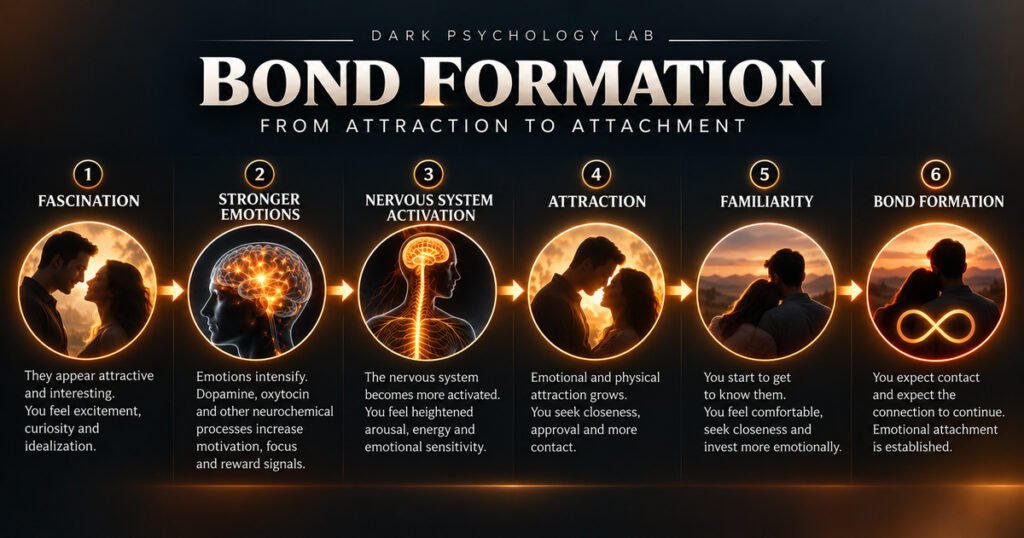
Fascination → stronger emotions → nervous system activation → attraction → familiarity → bond formation
Based on this model, the transition from familiarity (“I’m starting to get to know them, and I seek closeness.”) to bond formation (“I expect contact and expect the connection to continue”) is a key step in developing emotional attachment.
A trauma bond begins to form during that transition, which often happens when dealing with an emotional abuser who exploits the attachment signals. They allow enough closeness, but not enough to close the loop, which may keep the nervous system cycling within the familiarity → bond formation stages.
Instead of building a healthy, mutual relationship or withdrawing when the relationship doesn’t work for them. An emotional manipulator, for whatever reason, begins to use forms of abuse. The sensitive bond-forming brain receives unclear signals: the manipulator is dissatisfied but does not fully withdraw. On top of that, they use whatever form of power they have to punish, create emotional pain and distress, then return to better or at least tolerable behavior before repeating the cycle. Even a hint of rejection can feel like pain to an attached nervous system.
As a consequence, the person’s biological processes can become locked in the familiarity → bond formation phase, where they become more sensitive and empathetic. The primitive brain structures may begin to interpret the abuser’s actions differently. Instead of withdrawing, the nervous system seeks to restore the connection and, put bluntly, can keep the person in a situation where they continue to be harmed. It sounds brutal, but unless you have experienced something like this yourself, it can be extremely difficult to recognize what is happening or resist it.
Basically, this is how a trauma bond works. It pulls a person into a vortex of strong emotions. They are already suffering because of the relationship, yet at the same time do not want to leave it, because that same connection remains emotionally significant and deeply compelling.
The trauma bond mechanism, once active, looks like this:
Abuse → distress → reconciliation → relief → stronger bond → repeat.
Download the Manipulation Recognition Guide
Not sure if you are being manipulated? Take a test. Press a button below. Sign up for Dark Psychology Lab, and we will send it to your email.
Intermittent Reinforcement: Why Attraction Can Increase as the Relationship Worsens
For a person not to withdraw when the abuser begins causing pain, strong attraction needs to be in place.
Inconsistent behavior from someone we are already attracted to, such as push-pull or hot-cold behavior, can increase attraction by creating mild stress and uncertainty. Narcissistic or toxic people may use this pattern naturally, perhaps because similar behaviors have worked for them repeatedly and gradually became part of how they relate to others. But the same principle also appears in dating material and relationship advice that recommends manipulative tactics built around uncertainty to increase attraction. People may use these techniques without fully understanding where they lead or how manipulative they actually are.
More broadly, manipulative techniques that alternate closeness and reward with rejection operate through intermittent reinforcement. In relationships, it can be a powerful mechanism for increasing attraction because inconsistent reinforcement can produce persistent attempts to regain the reward.
This principle was demonstrated in Skinner’s operant-conditioning experiments. Animals trained under intermittent reinforcement schedules continued responding even when reinforcement became infrequent or stopped altogether. In one striking example, after prolonged exposure to a 900:1 ratio reinforcement schedule, a pigeon emitted 73,000 responses during the first 4.5 hours after food reinforcement was removed (Skinner, 1957).
Using intermittent reinforcement, whether unconsciously or as learned behavior, the person we are attracted to may get into our head through uncertainty, creating mild stress in the nervous system. Attention becomes increasingly fixed on them while we wait for closeness and validation that arrive inconsistently.
We examined this mechanism in more detail in our article:
How Intermittent Reinforcement Creates Obsession
As a result, attraction can become so strong that, when dealing with an emotional abuser, it may persist or even increase as the relationship begins to deteriorate. This is one of the core behavioral mechanisms that can keep people trapped in trauma-bonded relationships.
When Intermittent Reinforcement Escalates Into Abuse
Once strong attraction is already in place, and the relationship is moving through the → familiarity → bond formation stages, an emotional abuser’s behavior tends to deteriorate. The same push-pull pattern that previously created uncertainty and increased attraction can now escalate into harsher neglect, devaluation, punishment, or other forms of abuse.
Because the person is already emotionally attached, withdrawing when the harm begins becomes much more difficult. On top of that, the manipulator’s periods of rage and the distress they create can be followed by improved treatment, reconciliation, or even the simple stopping of the abuse, which releases tension and further reinforces the intermittent reinforcement cycle.
Repeated shifts between harm and temporary calm can maintain attachment even as the relationship deteriorates. Over time, the person may become increasingly dependent on the same individual who creates the distress and then becomes the source of its reduction.
The Reinforcement Principle in the Trauma Bond Mechanism
If we look at the trauma bond sequence:
Abuse → distress → reconciliation → relief → stronger bond → repeat
and intermittent reinforcement:
Discomfort (🔴) → Tension (🟡) → Temporary relief (🟢)
Technically, both use a similar reinforcement principle. The difference is that the cycles move from intermittent reinforcement games such as push-pull, hot-cold, and attention-withholding behavior into more severe abuse-relief patterns:
- Humiliation → Validation
- Contempt → Affection
- Drastically worsened behavior → Normal communication
- Severe abuse cycles → Basically, simply stopping the abuse can be enough to trigger relief
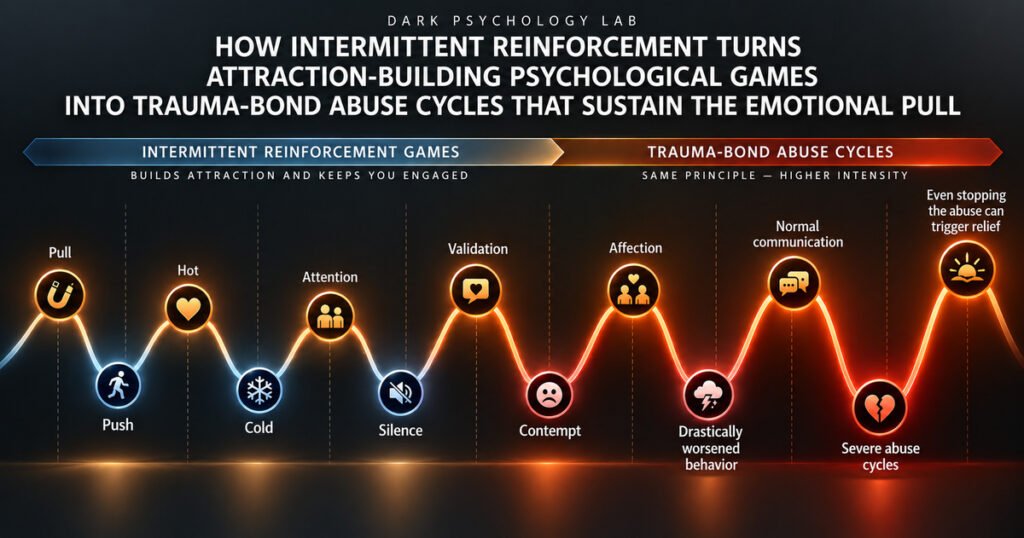
During a trauma bond, much stronger emotions come into play, producing greater nervous-system activation and intensifying related physiological responses (Kreibig, 2010). In this way, trauma bonds act on already engaged biological processes, while intermittent reinforcement keeps the attraction mechanism active. This is part of what makes these relationships so difficult to leave. On top of that, manipulative processes at this level operate through neurobiological circuitry involved in behavioral regulation.
Trauma Bond, the Nervous System, and Oxytocin
A trauma bond forms by engaging existing systems of self-protection, stress regulation, attachment, and reward. These systems developed through evolution and, under normal conditions, help us defend ourselves, seek safety, build closeness, and maintain important social bonds (Boyce & Ellis, 2005).
After prolonged exposure to this kind of dynamic, the bond-formation phase is supported less by a healthy mutual relationship and more by dysregulated neurobiological processes in a person whose attention becomes increasingly fixed on the abuser.
Abuse Cycles: Cortisol and Adrenaline
Stress-response systems
Cortisol
Cortisol is one of the body’s main stress hormones. When the brain detects a real or potential threat, cortisol helps mobilize and redistribute energy so the body can adapt and respond to the stressor. During a short-term threat, this hormone is protective and adaptive (Kaur et al., 2023).
The problem begins when the threat does not end. When a trauma bond and the related emotional abuse continue, the biological stress response does not get enough time to return to its normal state.
As a result, emotional regulation may deteriorate, fatigue can set in, and various physical symptoms of stress tend to appear. This can feel like intense internal anxiety, often accompanied by insomnia, rumination, poorer concentration, and mood changes.
Adrenaline
Meanwhile, adrenaline plays a major role in the fight-or-flight response. During a threat, it mobilizes the body by increasing heart rate, increasing blood and oxygen supply to the muscles, releasing more energy, and increasing alertness (Endocrine Society, 2022). It prepares a person to act quickly and solve the problem here and now, so as emotional exploitation intensifies, behavior can become increasingly reactive.
Consequences of Prolonged Activation of the Stress-Response System
During a trauma bond, prolonged stress creates a kind of biological circus: the system is preparing to defend itself while the person is trying to save the relationship with the very person they should be defending themselves from. Due to intense anxiety, the person can question their own actions, yet still keep trying to solve the problem with the abuser causing the pain and often respond impulsively and reactively. This helps explain why people in such a state often make decisions or mistakes they later regret.
As this state persists, a person can experience tension, trembling, or constant irritability (Cleveland Clinic, 2024). At the same time, the nervous system becomes increasingly sensitive to real or possible threats, including threats that are sometimes only imagined. The body also begins paying a biological cost, continuously directing resources toward processes meant only for short-term emergencies, and over time this begins to exhaust the person.
Relief Phase: Dopamine and Oxytocin
Attachment and reward processes are closely linked with dopaminergic systems involved in reinforcement and partner preference (Young & Wang, 2004).
Dopamine
Anticipation and Reward System
Dopamine is a neurotransmitter involved in motivation, reward learning, action selection, and movement control. Dopamine signals are especially important for how the brain evaluates reward anticipation, unexpected outcomes, and prediction error, helping the nervous system learn from experience and adjust future behavior (Kahnt & Schoenbaum, 2025).
In the context of a trauma bond, dopamine signaling can become especially active when the manipulator elicits positive reactions. In effect, it trains the nervous system without understanding the broader context of the reward, reinforcing the urge to seek reward from a manipulator whose attention and approval are delivered through uncertainty.
An example of the sequence:
“They replied” → relief → the brain registers: their attention reduces my tension → their signals become even more important → waiting repeats → effort increases → “They replied” → repeat
What is most interesting is that we usually do not consciously understand this. You need to know precisely how these systems work and what toxic behavior looks like before you can begin to recognize their activation in yourself.
Oxytocin
Bonding System
Oxytocin is a neuropeptide and hormone important for social bonding, processing social signals, closeness and caregiving behavior, and reproductive functions such as childbirth and breastfeeding. It also participates in social reward and stress regulation (Rigney et al., 2022).
During traumatic attachment, especially during intense emotional highs and reconciliation phases driven by intermittent reinforcement, oxytocin-related processes may become increasingly involved. The romantic delusion maintained by a trauma bond also strongly involves social cue processing, approach, social reward, social salience, bonding-related behavior, and hopes tied to the release of this hormone (Menon & Neumann, 2023). As a result, an exhausted nervous system can continue forming and maintaining a bond with the abuser at a biological level.
This helps explain why the nervous system reacts strongly to the abuser’s behavior and continues seeking closeness with the same person, even when that person becomes a source of pain.
Nervous System and Emotional Destabilization
As explained above, the body experiences a very intense emotional cocktail. It no longer knows whether to defend itself or build a bond, protect itself or move closer. Of course, this also depends partly on personality. For some people, this kind of cocktail may trigger a strong urge to resist or even feelings of disgust, while others become more deeply attached to the abuser.
The interaction of polar opposites creates something resembling internal cognitive dissonance that is difficult for conscious awareness to interpret:
There should be a bond → it genuinely feels very strong → I want it, I need it → yet the source of the bond causes intense pain
Two polar-opposite drives are operating here. Emotional responding and conscious cognitive evaluation rely on partly different neural systems that constantly interact (Salzman & Fusi, 2010). They exist within the same person and are intertwined:
Rational mind < Emotional bond
In the context of a trauma bond, when attachment is strong, emotions tend to take over. A dysregulated nervous system stimulates emotional pathways and responds through empathy. At the same time, stress, intense emotions, and instincts can partially impair logical thinking (Arnsten, 2015).
A person attached to the abuser may stop listening to their rational mind.
This is why defending yourself from an emotional manipulator can become very difficult during a traumatic attachment.
The Emotional Manipulator’s Significance Boost
In a certain sense, a trauma bond works like a significance boost. During this kind of attachment, a person can become disproportionately significant in the mind. They become special even at a biological level. They demean and humiliate, yet even after that, the target still wants to work things out. Usually, they want the version of that person they first knew to come back.
The manipulator’s actions become increasingly significant. They withdraw or behave ambiguously, and the nervous system reacts: uncertainty = threat. Something that would otherwise be a minor issue, or simply the instability and unreliability of a toxic person, becomes significant.
There are cases where the abuser acts openly vicious. They start humiliating the person publicly, setting them up, pushing them around, using physical violence, and escalating the situation in other ways until it reaches a point where the rational brain finally wins, and the person leaves.
Yet even then, sadness and longing can remain.
They are stronger during the first weeks. After that, they can persist for a long time, mixing with anger and hatred and sometimes being accompanied by impulsive actions, until they eventually disappear completely.
The irony is that this “unforgettable love” really does become unforgettable. In a sense, the manipulator remains significant even after the relationship with them has ended.

Recovery Phase: Trauma Bond as Poison
A trauma bond feels like poison.
It is powerful.
It takes over the nervous system, thoughts, sleep, and every aspect of life.
It stays for a long time. The body needs a long time to detox from it.
But this poison also has something useful.
If you had not been vulnerable, you would not have seen how toxic people operate.
You would not have seen how your nervous system reacts.
In the future, it would be much harder to distinguish a healthy bond from toxic attraction.
Although the poison is strong, once it passes through the nervous system, it generates an antidote.
Obsession rarely happens the same way twice.
A deeply processed trauma bond can make the attachment mechanism much harder to confuse with love again.
The second time, you may recognize the pattern, and you’re very likely to identify it as pain.
So one idea for defending against a trauma bond is:
“Accept your poison until it becomes useful to you.”
This also means accepting the increased sensitivity that remains after this experience. It is part of the poison, and it stays for a long time.
Despite the fragile state that often accompanies experiences like this, a person can subjectively feel fragile for a long time while, in reality, already being much stronger than they were before.
Dark Psychology Lab Defense Guides
Dark Psychology Lab focuses on understanding covert control and defending against it. These guides explore defensive techniques in greater detail across different areas.
Psychological Manipulation
Psychological Manipulation Defense: Safe Strategies and Dangerous Tactics Explained
Narcissistic Dynamics
How to Deal With a Narcissist and What to Do When You Can’t Leave
Workplace Mobbing & Toxic Workplace Culture
Workplace Mobbing Defense Playbook: 17-Step Guide
Conclusion: An Antidote for the Future
These kinds of attachments mainly develop through a combination of toxic behavior from another person and a sensitive nervous system that tolerates too much. A trauma bond forms when these elements come together.
Yet a fully processed experience can also leave behind an antidote.
A person gains more than theoretical knowledge about a toxic bond. They gain a real example from experience of what it feels like, what it looks like, and how emotional manipulators operate.
The poison becomes information and an antidote for the future.
Disclaimer
Dark Psychology Lab provides educational content, psychological analysis, and practical guidance related to manipulation, toxic relationships, and psychological abuse. We are not licensed mental health professionals and do not diagnose mental health conditions or provide psychotherapy, psychiatric treatment, medical advice, or legal advice.
Our content is not a substitute for individualized professional mental health care. If you are experiencing severe psychological distress, ongoing abuse, or believe your safety may be at risk, seek help from a qualified professional, local support service, or emergency services.
For more information, read our full Disclaimer.
Dark Psychology Lab
Original content based on lived experience and independent psychological analysis.